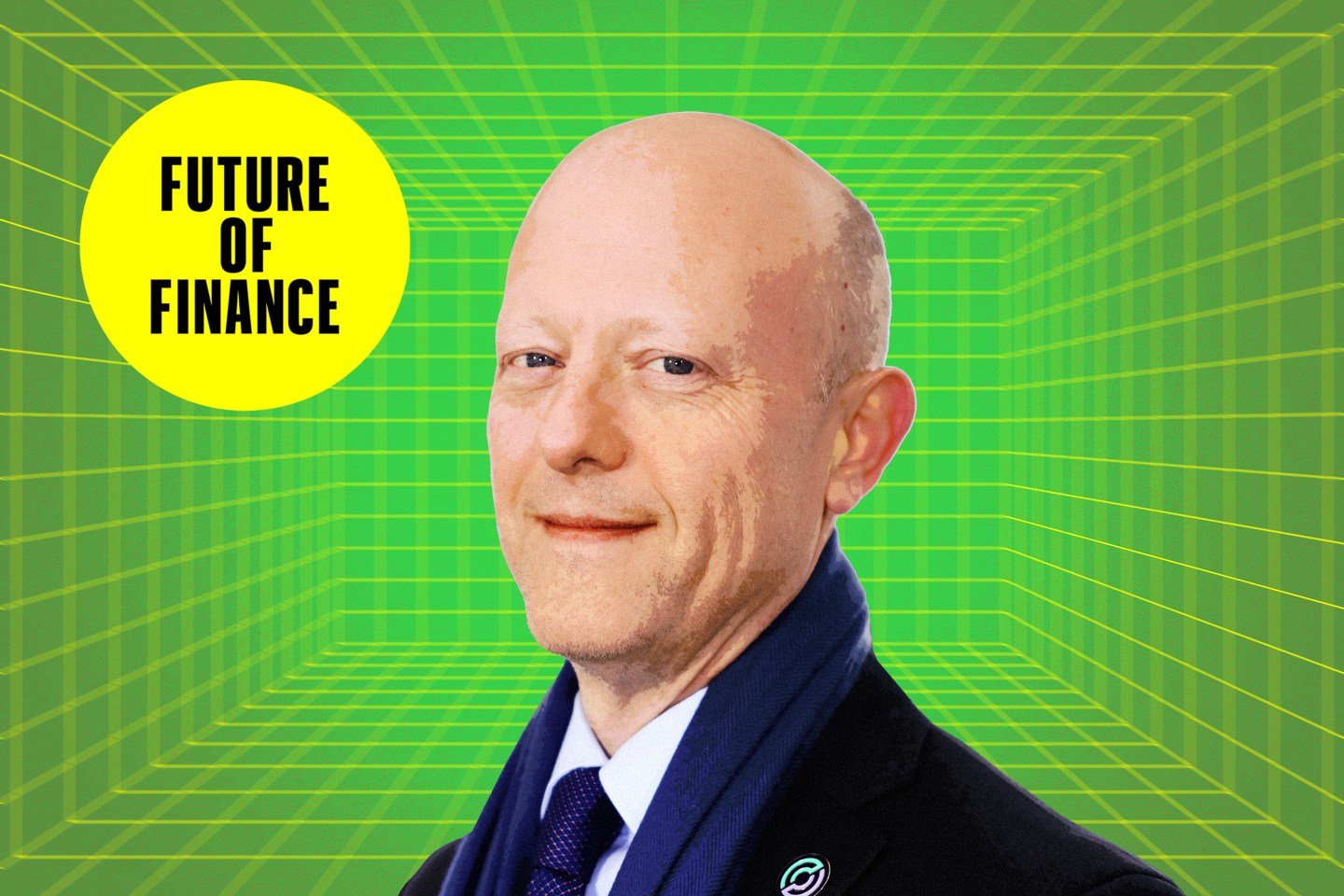
Welcome to Future of Finance, where Fortune asks prominent people at major companies about their jobs, how their firm fits into the crypto ecosystem, and what it all means for how we use money.
Boston-based Circle, best known for the USDC stablecoin it launched in 2018 with Coinbase, was founded in 2013 by Sean Neville and Jeremy Allaire, with the latter since serving as CEO.
Nearly a decade later, and with some $27 billion of USDC in circulation, Allaire spoke to Fortune about the history of Circle, regulations here and abroad, and the parallels between FTX and the dotcom crash.
(This interview has been edited for length and clarity. Shortly after the interview, the company announced layoffs, telling Fortune in a statement that they amounted to “a marginal reduction in headcount” and that Circle would be “continuing to hire in key areas of focus on a global basis.”)
It’s been 10 years now, right? Has that just flown by for you?
I don’t know, crypto’s like dog years; a year’s like seven years. [Laughs] But, no, it doesn’t feel like 70 years. I mean, in some respects, it’s gone by quickly, but it’s also been just an extraordinary evolution over that time, from where we started with a big vision and an extremely nascent technology and industry. And now, it’s really, truly finding its way into the mainstream of the financial system—it’s being integrated into so many things.
And yet, as I say to a lot of people, I still feel like we’re still in the very early stages of this. When I look back at the example of the internet, a lot of things take 20 years to really get to maturity. The first 10 years seem like there’s a lot of maturity, but then the really dramatic growth happens in that second 10 years.
Looking back, what are one or two goals you absolutely smashed, and what are one or two surprises you just didn’t anticipate?
When we started, my cofounder and I, we talked a lot about this idea that there needs to be an HTTP for money, a kind of a protocol where you can represent fiat money. And that that protocol would allow for interoperability and for kind of a global commodities settlement layer, and that would be built on blockchains. And we really believed that needed to exist. But the surprise was we thought a lot of different industry stakeholders would come together to manifest that and build that. We had initially wanted to be building what I would call broadly the application layer of the implementation of digital currency. The surprise—after we’re around four years, it was very clear to us—was that no one was coming together to build that, the protocol for money on the internet. And we saw, now that it was technically possible: We can do it. And so we gave up on building the application layer and said, “Let’s just build the kind of platform and protocol layer—and build USDC.”
When we started, we very much believed that for this to achieve long-term scale and mainstream adoption, we needed clear regulations and clear policies around digital currencies. I used to say in the early days, eventually we’re going to have these, it’s going to be a G7 topic with coordinated responses of the biggest governments in the world. I used to get booed out of the room for saying things like that because the early ethos was so anarchist. But I’m very pleased to see where we are today, actually, because this is now front and center a policy topic.
That leads into my next question: People sound optimistic about U.S. legislation, almost universally saying, “It’ll be stablecoins.” Would you agree with that? And if we get that, will legislators be more comfortable building out a larger framework?
So, I am also in the optimistic camp. Globally, I talk about something like the Financial Stability Board, the convening of all the top financial regulators from the G20, to have clear, coordinated, globally normalized crypto regulations for both the markets side of this activity and the stablecoin side of it.
A lot of people don’t realize, but it was the United States, through the Financial Stability Board, that drove a set of policy recommendations for how to regulate stablecoins several years ago. And now that’s happening—in the U.K., in the EU, in Japan, in Hong Kong, and Singapore. In all of these jurisdictions, national laws are coming into effect.
U.S. government leadership—and I include in that the White House, the Treasury Department, the Federal Reserve—they all are focused on, “Let’s get stablecoin regulation in place.” And there’s bipartisan support for that in Congress.
And then markets?
Markets regulation is a fast follow—I don’t think it’s like years and years. I think it’s a fast follow because the rest of the world is doing this, and it’s not helpful if you’ve got a whole bunch of major jurisdictions and you’ve got inconsistencies across those. There’s a lot of pressure to get something done. You hear that in statements from leaders in the White House, you hear it in statements from Janet Yellen. And clearly, people in Congress see that as well.
But the market side is a lot more complicated. And because of the structure of the U.S. regulatory system, with the alphabet soup of regulators, it’s just a little bit harder to work through. But I think it will—that has to get done. I feel like something could get done even in an election year.
Is it a bit of a double-edged sword being able to point to what’s happening in Europe or the U.K. or Hong Kong as proof of progress, because there’s also a fear of the U.S. falling behind?
I think it’s a little bit of both. There is that kind of market competition. I just came from two weeks in Asia, and I had a chance to meet with multiple governments and the regulators, and it was fascinating to see, in Japan and Hong Kong in particular, like a whole government, not just the financial regulators, the whole of government where Web3 is being viewed as a national priority. They want to attract capital, companies, startups, builders; they want to encourage the biggest companies in the biggest industries to implement Web3 technology.
You’re not hearing that from the U.S. government. You are seeing a difference, and I think that is affecting where capital will go and therefore where talent will go and where companies will form. I think that’s real.
The U.S. may be late to the party in terms of getting these policies done, but it is the biggest economy and has the biggest technology industry and the biggest financial system in the world. And when the U.S. does lay down its rules, it’s going to be a highly competitive market.
Recently, we’ve seen a TradFi rush into crypto, with Blackrock, Fidelity, and a few others trying for a spot Bitcoin ETF. What do you make of this?
It’s interesting, and I think we have a very interesting vantage point. We’ve established meaningful partnerships with the likes of Blackrock and Bank of New York Mellon, and with major industry companies like Visa and MasterCard and Square, and many others like Robinhood—a lot of traditional firms in the payments world. Despite the turbulence of last year with the various bankruptcies, frauds, all these awful things—the period of time I like to call the blast radius from the FTX debacle. But we’re well past that, and at the same time, the technological progress just keeps cranking along.
It’s a little bit like after the dotcom crash. There was a period where if you said “e-commerce” or “consumer internet,” people were like, “Don’t even talk to me, I don’t believe in that anymore.” They just didn’t, and VCs would not invest. But then the tech stacks kept evolving. The next generation of browser technology, the next generation of digital media technology, broadband infrastructure, Wi-Fi infrastructure, mobile devices, all these things just kept going and lit up a whole new era—Web2. And then people are like, “Oh, actually, this is real. And it’s scaling. And it works.”
So what’s next for Circle?
Over the next year or two, in particular, we’re really focused on three things. One is doing our part to make sure that the technology and the infrastructure that make stablecoins usable on a massive scale is possible—improving wallet experiences, eliminating the complexity of knowing what blockchain you’re using, gas fees, the sort of stuff that to an average person is total nonsense. I don’t need to know anything about TCP/IP or SMTP to use email, right?
A second thing is making sure that stablecoins like USDC are as widely available as the demand for digital dollars in the world presents. So we think about the partnerships that we need to build with banks and non-banks that provide access to the financial systems in all of the most important markets in the world.
And then the third thing—it’s not in our control—is ensuring that there’s good, solid legal certainty for stablecoins so, in two years time, every household, every business, every corporation, and every financial institution knows what a stablecoin is, knows how to hold it, use it, what and how to account for it on their balance sheet—that it’s treated as digital cash in all the major markets in the world.
What do you see for the future of finance?
When I think about the next five to 10 years, it’s actually the programmable money era—it’s the breakthrough inventions that come with software, entrepreneurship, the fusion of blockchains, smart contracts, A.I., really transformative things that will reshape the very essence of what a corporation is, how trade and commerce happen.
I get asked, “What do you think that’s going to be?” and that’s like asking in 2007, when the iPhone came out, “Tell me about all the different inventions that are going to happen with mobile software on a smartphone.” It took having an open platform where more software creators could innovate easily, and that scalability to unleash the creativity of entrepreneurs everywhere. And then there was an app for that.
It’s similar to when you lit up broadband for everyone, and you enabled Wi-Fi-connected devices—what became possible, right? Television was reinvented; gaming was reinvented. This is a similar kind of thing in the guts of the way commerce and finance will work. And that, to me, is profound.