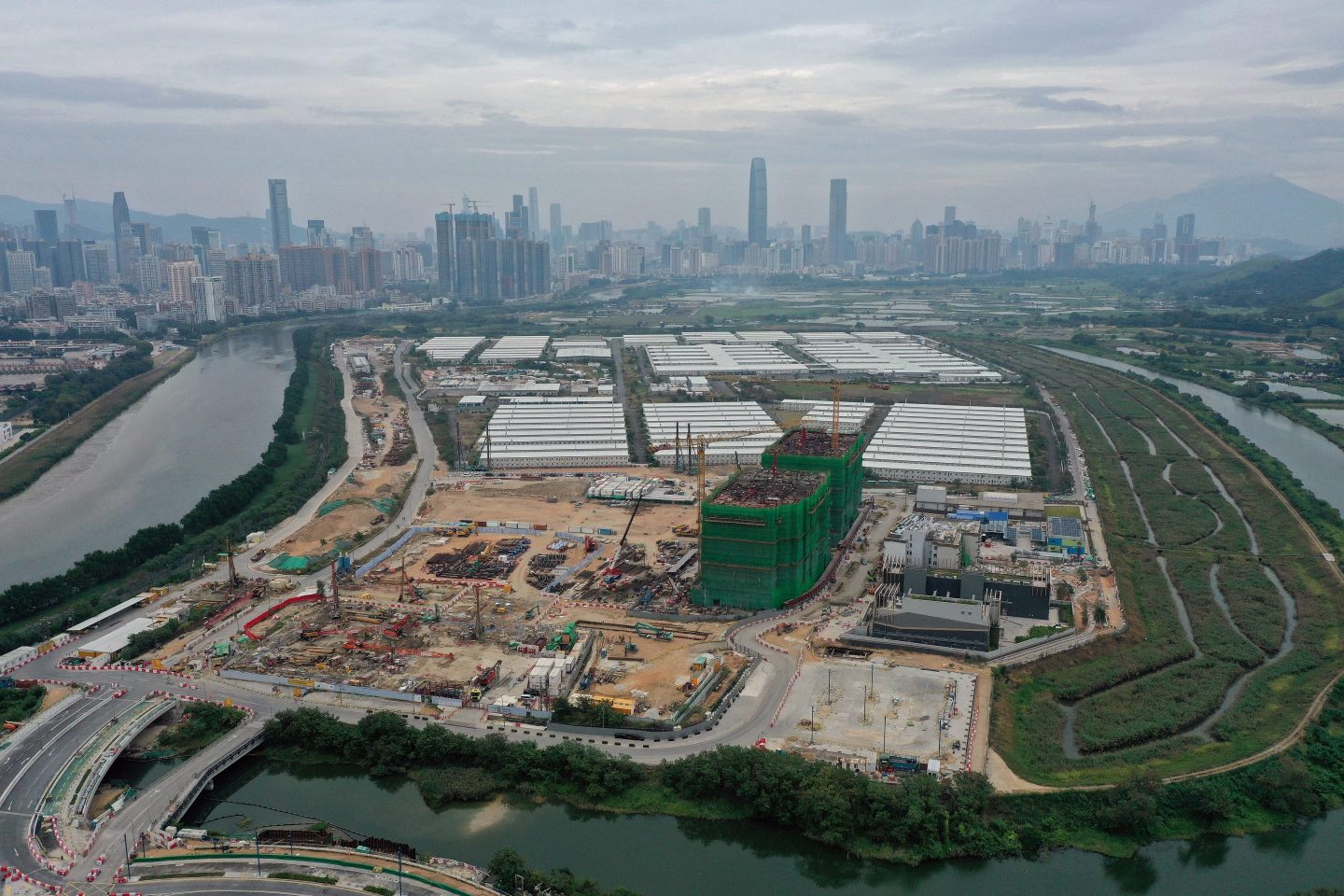
In a village on Hong Kong’s outskirts, Wong Chin Ming inspects zucchini, watermelons, cherry tomatoes and kale growing in his greenhouses. For 19 years he’s been raising crops here on the site of what was once a factory. Soon his farm will be wiped off the map to make way for a massive development, which China hopes will be Hong Kong’s answer to Silicon Valley. The government is setting aside 300 square kilometers (116 square miles) for the project, an area more than twice the size of San Francisco.
It’s called “Northern Metropolis,” yet, for now, it’s anything but. Hong Kong’s hinterland is a hodgepodge of sleepy hamlets, apartment blocks and stray dogs. Rusty fences surround warehouses, abandoned cars lie in bushes, and scores of cabins built to quarantine patients during the Covid-19 pandemic sit empty. Northern Metropolis won’t grow organically over decades like California’s storied tech hub near Stanford University or the glittering skyscrapers of Hong Kong, where companies and citizens had enjoyed greater autonomy from Chinese Communist Party rule before the government cracked down in 2020.
Real estate developers are privately expressing reservations about investing in Northern Metropolis out of fear of making huge financial commitments amid a steep decline in Hong Kong’s property values. Conservationists question the environmental impact, and some local residents don’t want to leave their home. But with dissent in Hong Kong now severely restricted, citizens from all walks of life are resigned to change. The government says Northern Metropolis is set to displace 4,500 households so far. “If they have to develop this place, we can’t stop it from happening,” Wong says of his farm. “We will just take it as it comes.”
Hong Kong’s former leader, Carrie Lam, first proposed Northern Metropolis in 2021 as a way to increase the supply of land for development. Beijing had expressed frustration that homes in the city were the world’s least affordable. The Hong Kong government spent the next few years planning for the area, which makes up one-third of the city.
Northern Metropolis will be built on land along the Shenzhen River, which separates Hong Kong from the Chinese mainland and contains seven border crossings. Its blueprint divides the development into four zones: technology, logistics, border trade and ecotourism. There will be new subway stations, including a cross-border rail line to Shenzhen, China’s third-largest city by gross domestic product. Official plans call for buildings with cutting-edge tech companies and research facilities as tenants and a more than doubling of the area’s population. “As an investment crucial to the social and economic development of Hong Kong, the Northern Metropolis has topped the Government’s agenda,” the Hong Kong administration says in a statement.
The project has taken on urgency because the city’s traditional economic pillars, finance and real estate, are faltering as tension grows between China and the West, whose often conflicting interests Hong Kong has long been adept at balancing. Given the world’s growing geopolitical conflicts, “we need to diversify in terms of our economic engines,” says Kathy Lee, the Hong Kong-based head of research at Colliers International Group Inc., a real estate investment company.
Northern Metropolis could align the city even more with the mainland and the economic goals of Chinese President Xi Jinping. The development will help the city further integrate into the Greater Bay Area, a region encompassing 11 southern Chinese cities, Lee says. It could also be used as a platform to export high-end Chinese technologies, by registering them in the city, according to Carlos Lo, a professor in the school of governance and policy science at the Chinese University of Hong Kong. Many countries consider the city as less of a threat than mainland China. “Hong Kong has to find a new model to revive the economy,” he says. “The government can’t go back to how things were run in the good old days.”
Hong Kong authorities expect the city’s rich families to invest in Northern Metropolis. In the city, the government owns land, and companies buy the right to develop it for a set time, usually 50 years. No one knows how much Northern Metropolis will cost. The government has put the figure in the tens of billions of dollars, but other estimates have been far higher.
At a meeting in Shenzhen late last year, Xia Baolong, the top Chinese official overseeing Hong Kong, urged a group of tycoons and executives to take “concrete action” to support the city’s growth and participate in projects, including Northern Metropolis. Steve Tsang, director of a China research center at SOAS University of London, describes Beijing’s attitude: “If the business elites of Hong Kong do not make contributions to the economy as Beijing deems appropriate, there is no reason why they need to be well treated.”
The costly initiative “comes at an inappropriate timing when everyone needs cash,” says Hannah Jeong, head of valuation and advisory services in Hong Kong for real estate company CBRE Group Inc. Home values in the city are hovering at the lowest in nine years, and office rents have declined 40% since their peak in 2019.
There’s another reason developers might find investing in Northern Metropolis unattractive. The government, facing deficits, is testing the idea of shifting more costs to private companies in three invitations to make bids. They’ll be responsible for electricity, water pipes and other infrastructure, which the government formerly provided.
Property companies have raised concerns with the government about this change, according to people familiar with the discussions. Building infrastructure could add years to projects, making it hard for developers to assess land prices and risks, according to Patrick Wong, a senior analyst with Bloomberg Intelligence. “It’s a big problem,” says Wong, who expects developers to be cautious in submitting bids.
If local developers balk at such large investments when businesses are weak, Chinese state-owned companies, which have more access to cash, will have a significant presence in Northern Metropolis, CBRE’s Jeong says. The government says it’s considering developers’ feedback and could ease their burden by offering more pay-as-you-build and other attractive arrangements.
“We believe that the packages to be tendered would be of good commercial interest to the market,” it says in its statement. About two dozen companies, including Hong Kong and mainland Chinese developers, contractors, conglomerates and an e-commerce logistics company, have expressed interest in making offers under the process the government is testing. Bidding starts in the second half of this year.
Brian Wong of Liber Research Community, a think tank in Hong Kong, questions the environmental cost of Northern Metropolis. The area “has a lot of distinct natural and human landscapes, and it would be a waste if those landscapes are destroyed for a development that doesn’t come to full fruition,” he says. The government says, when possible, it’s trying to preserve active farmland and is turning fallow fields into wetland habitats; it’s also encouraging sustainable urban farming, including on rooftops.
Villages in the Ta Kwu Ling district will be among the first to disappear and give way to Northern Metropolis. The government wants to make the area attractive for universities. In 2028 construction is scheduled to begin on thousands of new apartments for teachers and students. In Sing Ping, a rural village in the district that’s only a 20-minute walk from the mainland Chinese border, residents are worried. Emerald Lee has lived all her life in a house her parents built in the 1960s. About 50 families occupy one- or two-story homes, near fields where they grow their own food.
Even though the government will compensate residents, Lee says she expects it won’t be enough. People living in houses such as hers can get compensation of HK$12,816 ($1,633) per square meter, one-tenth of the area’s average asking price. If their incomes are low enough, they’re eligible to move into subsidized government housing. Lee would rather the government relocate the village to land nearby. “We have lived here for six, seven decades,” she says. “Why do they have to force us out and replace us with a bunch of very different things?”