• Home
  • Latest
  • Fortune 500
  • Finance
  • Tech
  • Leadership
  • Lifestyle
  • Rankings
  • Multimedia
LeadershipAsia
Asia

BYD’s Southeast Asian partner explains what helped the Chinese EV brand break out overseas: Putting the steering wheel on the right side

By
Lionel Lim
Lionel Lim
Asia Reporter
Down Arrow Button Icon
By
Lionel Lim
Lionel Lim
Asia Reporter
Down Arrow Button Icon
September 20, 2024, 5:00 PM ET
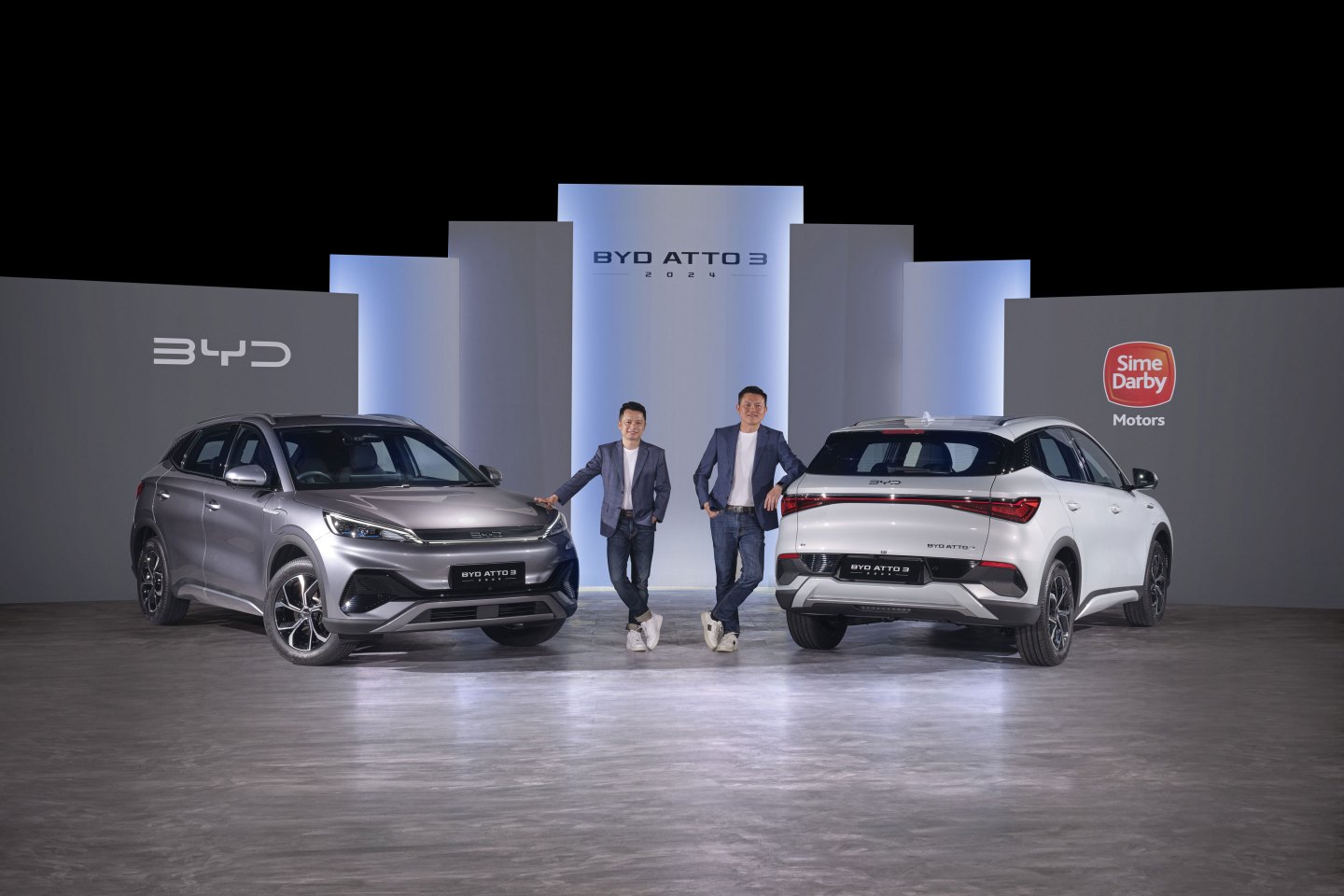
Jeffrey Gan (right), Sime Darby Motors' Southeast Asia managing director with Eagle Zhao, managing director of BYD Malaysia at the launch of the enhanced Atto 3 in Ara Damansara, Selangor, Malaysia on May 3, 2024.
Jeffrey Gan (right), Sime Darby Motors' Southeast Asia managing director with Eagle Zhao, managing director of BYD Malaysia at the launch of the enhanced Atto 3 in Ara Damansara, Selangor, Malaysia on May 3, 2024.Courtesy of Sime Darby Motors

BYD is making inroads into Southeast Asia. The Chinese company was Singapore’s second best-selling car brand, behind Toyota, in the first half of the year. In neighboring Malaysia, BYD is the most popular EV brand and among the top 10 most popular car brands overall. 

Recommended Video

But according to the Chinese brand’s distributor in the region, BYD’s success is due to its quick adaptation to new markets, with one change in particular making the difference.

“They were one of the first Chinese brands that could [offer] right-hand drive for electric vehicles,” says Jeffrey Gan, Sime Darby Motors’ Managing Director for Southeast Asia. Sime Darby Motors, the automotive division of the Malaysian conglomerate, has served as BYD’s distributor in Singapore since 2019.  

Chinese cars drive on the right side of the road, and thus have their steering wheels on the left side of the car, making them “left-hand drive” models. Yet several overseas markets—Japan, Australia, Malaysia, Singapore, and the Chinese city of Hong Kong—are the reverse: Cars drive on the left, and so have their steering wheels on the right, hence becoming “right-hand drive” models.

While right-hand drive markets are smaller than left-hand drive markets, they are likely the first targets for a Chinese EV brand trying to go global. 

It took a while for Sime Darby’s relationship with BYD to bear fruit. “When we started in 2019 [in Singapore] there were not sufficient offerings in terms of their products,” Gan says. Just one passenger vehicle model was available: the BYD e6, a compact multipurpose vehicle. 

That changed two years ago, when BYD decided to “get aggressive outside of China”, Gan said. BYD orders grew once the Chinese EV brand launched the Atto 3, the Seal, and the Dolphin in international markets. 

What is Sime Darby?

Sime Darby, No. 25 on the Fortune Southeast Asia 500, is one of Malaysia’s largest conglomerates. Sime Darby’s motors business has a footprint across ten markets in Asia Pacific, including China. The company represents several luxury continental auto brands in China and is also one of the world’s largest BMW dealers.

Sime Darby assembled its first car in 1982, making BMW and Land Rover models in Selangor. It’s mostly worked on internal combustion engines vehicles since then, but has started to get into EVs in recent years. 

Besides being BYD’s Singapore distributor, Sime Darby was also appointed as BYD’s Malaysia distributor when the Chinese automaker wanted to expand into that market.

As an appointed distributor, Gan explains Sime Darby has a responsibility to bring in the cars, help grow the brand, and appoint dealerships. 

One way Sime Darby tried to grow BYD’s brand in Malaysia was to host a big launch event in December 2022. BYD then was “not that big” compared to the company we know today, Gan explains, but Sime Darby went ahead with a grand launch without any pre orders lined up. He says the launch resulted in 800 vehicles being sold in three days.

In addition to its partnership with BYD, Sime Darby is working with other Chinese car brands. It’s working with Chery to make cars in Malaysia, and has agreed to distribute cars from startup Xpeng in Hong Kong—another “right-hand drive” market.

Sime Darby’s motors division generated 31.6 billion Malaysian ringgit ($7.4 billion) in its most recent fiscal year, which ended June 30, a 16% increase from the year before. Nearly half of its revenue comes from mainland China, Hong Kong and Taiwan. The company also said new operations such as BYD in Malaysia contributed to the improved revenue.

Chinese EVs spreading in Southeast Asia

BYD is not the only Chinese EV manufacturer to try to break into Southeast Asia. Geely, Chery, Great Wall Motors and Xpeng are also entering the market.

Analysts describe Southeast Asia as the “most important” overseas market for Chinese carmakers as Western markets like the U.S. and Europe impose tariffs on imported Chinese cars. 

Gan expects EVs to be a growth market for Sime Darby, as consumer confidence in the new technology grows. Malaysia is already reporting close to a projected 100% year-on-year growth in total EV sales, he explains. 

“We closed 2023 with 10,000 EVs sold. By July 2024, we are already at 12,000 units sold, meaning at the half-year mark we’ve already outsold 2023,” Gan says. Sime Darby holds a 40% market share of the number of EVs sold in Malaysia this year.

Join us at the Fortune Workplace Innovation Summit May 19–20, 2026, in Atlanta. The next era of workplace innovation is here—and the old playbook is being rewritten. At this exclusive, high-energy event, the world’s most innovative leaders will convene to explore how AI, humanity, and strategy converge to redefine, again, the future of work. Register now.
About the Author
By Lionel LimAsia Reporter
LinkedIn icon

Lionel Lim is a Singapore-based reporter covering the Asia-Pacific region.

See full bioRight Arrow Button Icon

Latest in Leadership

Nicholas Thompson
C-SuiteBook Excerpt
I took over one of the most prestigious media firms while training for an ultramarathon. Here’s what I learned becoming CEO of The Atlantic
By Nicholas ThompsonDecember 13, 2025
19 hours ago
Lauren Antonoff
SuccessCareers
Once a college dropout, this CEO went back to school at 52—but she still says the Gen Zers who will succeed are those who ‘forge their own path’
By Preston ForeDecember 13, 2025
20 hours ago
Asiathe future of work
The CEO of one of Asia’s largest co-working space providers says his business has more in common with hotels
By Angelica AngDecember 12, 2025
1 day ago
Donald Trump
HealthHealth Insurance
‘Tragedy in the making’: Top healthcare exec on why insurance will spike to subsidize a tax cut to millionaires and billionaires
By Nick LichtenbergDecember 12, 2025
1 day ago
three men in suits, one gesturing
AIBrainstorm AI
The fastest athletes in the world can botch a baton pass if trust isn’t there—and the same is true of AI, Blackbaud exec says
By Amanda GerutDecember 12, 2025
1 day ago
Brainstorm AI panel
AIBrainstorm AI
Creative workers won’t be replaced by AI—but their roles will change to become ‘directors’ managing AI agents, executives say
By Beatrice NolanDecember 12, 2025
1 day ago

Most Popular

placeholder alt text
Success
Apple cofounder Ronald Wayne sold his 10% stake for $800 in 1976—today it’d be worth up to $400 billion
By Preston ForeDecember 12, 2025
2 days ago
placeholder alt text
Economy
Tariffs are taxes and they were used to finance the federal government until the 1913 income tax. A top economist breaks it down
By Kent JonesDecember 12, 2025
2 days ago
placeholder alt text
Success
40% of Stanford undergrads receive disability accommodations—but it’s become a college-wide phenomenon as Gen Z try to succeed in the current climate
By Preston ForeDecember 12, 2025
2 days ago
placeholder alt text
Economy
The Fed just ‘Trump-proofed’ itself with a unanimous move to preempt a potential leadership shake-up
By Jason MaDecember 12, 2025
1 day ago
placeholder alt text
Success
Apple CEO Tim Cook out-earns the average American’s salary in just 7 hours—to put that into context, he could buy a new $439,000 home in just 2 days
By Emma BurleighDecember 12, 2025
2 days ago
placeholder alt text
Economy
For the first time since Trump’s tariff rollout, import tax revenue has fallen, threatening his lofty plans to slash the $38 trillion national debt
By Sasha RogelbergDecember 12, 2025
1 day ago
Rankings
  • 100 Best Companies
  • Fortune 500
  • Global 500
  • Fortune 500 Europe
  • Most Powerful Women
  • Future 50
  • World’s Most Admired Companies
  • See All Rankings
Sections
  • Finance
  • Leadership
  • Success
  • Tech
  • Asia
  • Europe
  • Environment
  • Fortune Crypto
  • Health
  • Retail
  • Lifestyle
  • Politics
  • Newsletters
  • Magazine
  • Features
  • Commentary
  • Mpw
  • CEO Initiative
  • Conferences
  • Personal Finance
  • Education
Customer Support
  • Frequently Asked Questions
  • Customer Service Portal
  • Privacy Policy
  • Terms Of Use
  • Single Issues For Purchase
  • International Print
Commercial Services
  • Advertising
  • Fortune Brand Studio
  • Fortune Analytics
  • Fortune Conferences
  • Business Development
About Us
  • About Us
  • Editorial Calendar
  • Press Center
  • Work At Fortune
  • Diversity And Inclusion
  • Terms And Conditions
  • Site Map

© 2025 Fortune Media IP Limited. All Rights Reserved. Use of this site constitutes acceptance of our Terms of Use and Privacy Policy | CA Notice at Collection and Privacy Notice | Do Not Sell/Share My Personal Information
FORTUNE is a trademark of Fortune Media IP Limited, registered in the U.S. and other countries. FORTUNE may receive compensation for some links to products and services on this website. Offers may be subject to change without notice.