• Home
  • Latest
  • Fortune 500
  • Finance
  • Tech
  • Leadership
  • Lifestyle
  • Rankings
  • Multimedia
Leadershipgeopolitics
Asia

Countries like Malaysia and Thailand are flocking to join BRICS as a potential ‘counterweight against U.S. economic hegemony’

By
Lionel Lim
Lionel Lim
Asia Reporter
Down Arrow Button Icon
By
Lionel Lim
Lionel Lim
Asia Reporter
Down Arrow Button Icon
August 21, 2024, 5:00 PM ET
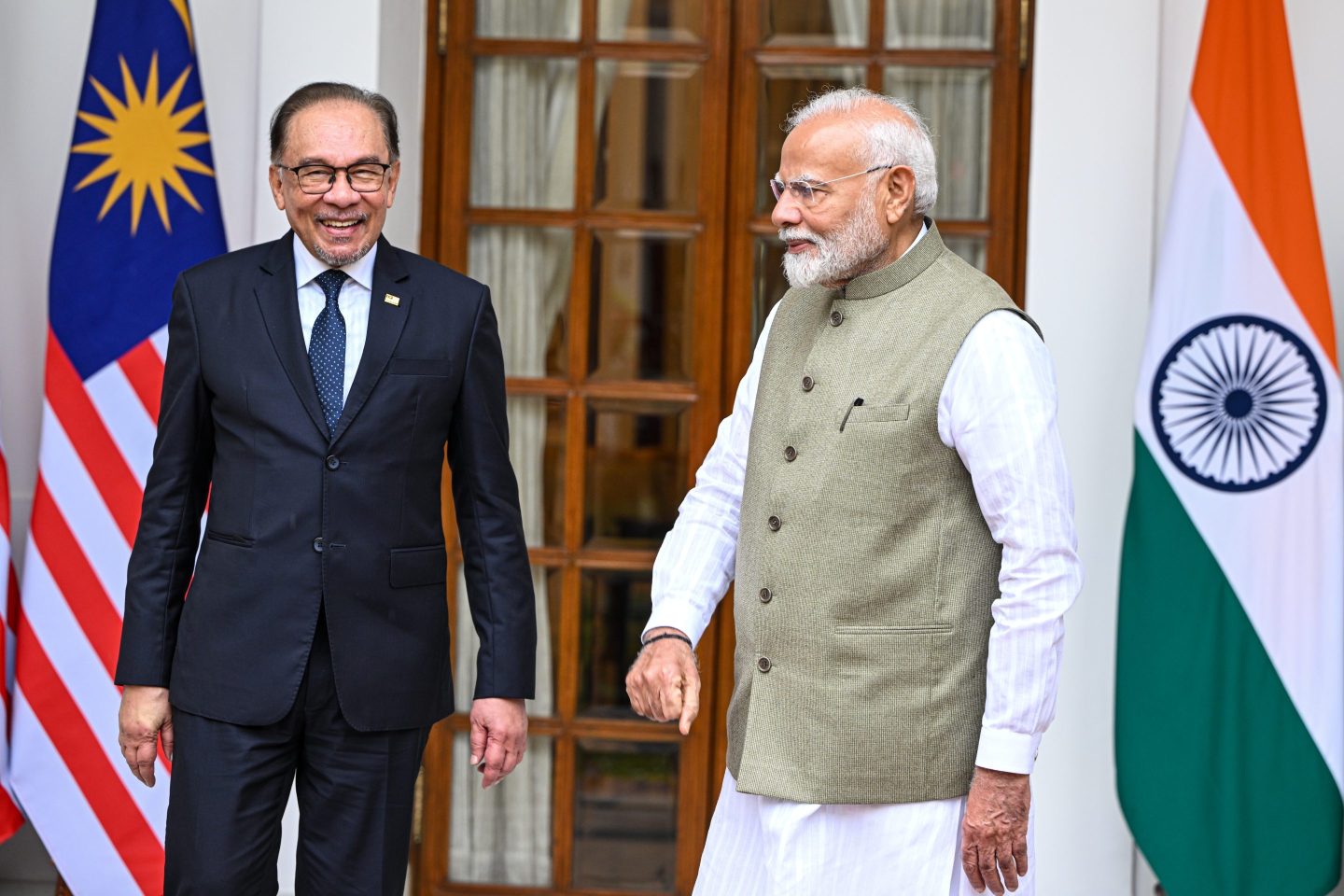
Malaysian Prime Minister Anwar Ibrahim meets with Indian Prime Minister Narendra Modi on Aug. 20, 2024, in New Delhi. India is a founding member of BRICS, and Malaysia has been seeking to join the bloc.
Malaysian Prime Minister Anwar Ibrahim meets with Indian Prime Minister Narendra Modi on Aug. 20, 2024, in New Delhi. India is a founding member of BRICS, and Malaysia has been seeking to join the bloc.Prakash Singh—Bloomberg/Getty Images

BRICS—originally made up of just Brazil, Russia, India, China, and South Africa—is going to need a new name. 

Recommended Video

After not adding any new members for 13 years, the non-Western international group welcomed Egypt, Ethiopia, Iran, Saudi Arabia, and the United Arab Emirates last August. The floodgates have since been opened: In February, South African Foreign Minister Naledi Pandor claimed that over 30 nations now want to join the international group.

Malaysian Prime Minister Anwar Ibrahim has been vocal about wanting to join the bloc, lobbying Russian, Chinese, and just this week, Indian officials about Malaysia’s application. Thailand also submitted a formal application to join the bloc last June, and officials hope that the Southeast Asian country will be able to join the BRICS summit in Russia this October.

BRICS, which traces its name to a Goldman Sachs report in 2001, has long struggled to find an economic or geopolitical purpose, as its member countries have little in common besides being large and non-Western.

But in recent years, the bloc is increasingly trying to position itself as the voice of the so-called Global South, a term used to describe postcolonial developing economies. It’s an argument that’s picked up steam since Russia’s invasion of Ukraine in 2022, which brought geopolitics back to the fore and highlighted the power of the U.S. in the global economic system.

“For some countries, BRICS can be a counterweight against U.S. economic hegemony,” Rahman Yaacob, a research fellow in the Southeast Asia program at the Lowy Institute, says.

Joining the bloc could also be a way to hedge politically, as the intensifying rivalry between Washington and Beijing risks splitting the world into two opposing groups. 

“If the world is going to break into blocs, being in beats being out,” Deborah Elms, head of trade policy at the Hinrich Foundation, says.

Why do Malaysia and Thailand want to join BRICS?

China is already the largest trading partner for Malaysia and other Southeast Asian countries and is also the largest source of developmental aid for a few countries in the region, notes Rahman.

For Malaysia’s Anwar, joining BRICS could be a way to secure trade deals or investments for the Southeast Asian country.

“The intention to join BRICS could prompt Western countries to enhance their investments in Malaysia, or even encourage [Malaysia] to consider applying for membership in Western-aligned alliances, such as the OECD,” Wen Chong Cheah, an Asia-Pacific analyst at the Economist Intelligence Unit, explains. 

Malaysia’s semiconductor industry could also benefit from closer ties to China and India, as the two giant consumer markets could buy more Malaysia-made electronics, Cheah explains. BRICS membership could also lead to increased tourism from member countries, particularly China and India. 

Thailand may also be interested in BRICS as a way to jump-start its flagging economy. Growth has slowed recently as the country’s tourism industry still struggles to recover from the COVID pandemic.

What is BRICS?

Jim O’Neill, former chief economist at Goldman Sachs, in 2001 argued that Brazil, Russia, India, and China would be the key drivers of global economic growth, coining the term “BRIC.” 
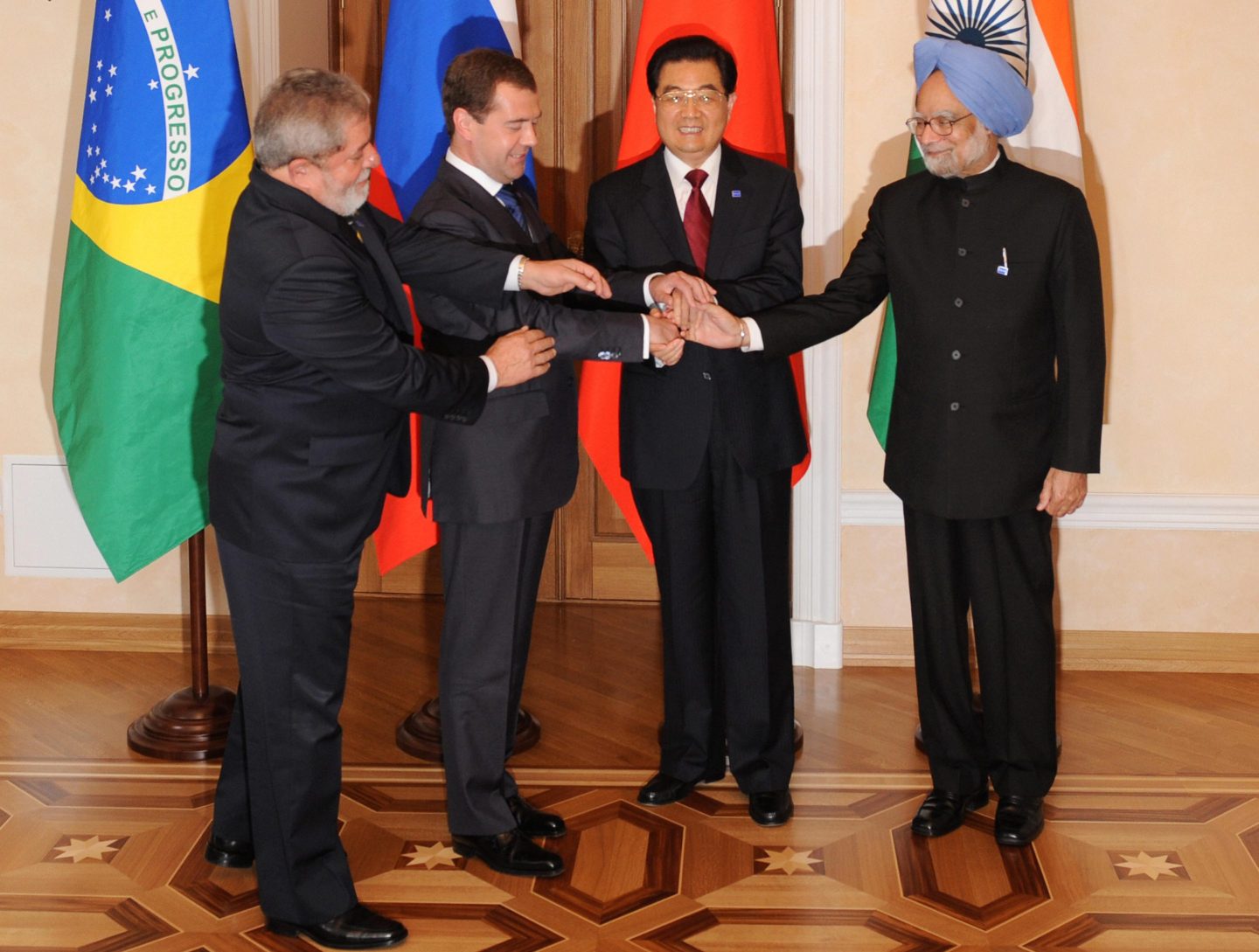
Leaders from Brazil, Russia, China, and India met for the first BRIC summit in Yekaterinburg, Russia, on June 16, 2009.
Dmitry Kostyukov—AFP/Getty Images

The four governments adopted the name when they formally started the organization with a 2009 summit in the Russian city of Yekaterinburg. The group added an “S” to its name when South Africa joined in 2010, becoming “BRICS.”

In 2014, the group founded its own development bank, the New Development Bank. Since starting operations in 2015, the bank has cumulatively approved over $32 billion in loans to member countries; China hopes the bank can disburse a further $5 billion in loans this year. 

Malaysia and Thailand would be hefty additions to the BRICS group. Both have economies that are twice the size of Ethiopia’s, and roughly the same size as those of Iran and Egypt. Malaysia’s GDP per capita is just slightly lower than China’s.

Before its expansion last year, the five countries in the original BRICS already accounted for about 40% of the world’s population and about a quarter of global GDP, according to World Bank data. 

And with the UAE and Saudi Arabia, BRICS now encompasses almost half the world’s oil supply. 

Can BRICS work?

In May, a Thai government spokesperson suggested joining BRICS would help create a “new world order.”

Yet BRICS still has very few achievements to its name. For example, the bloc does not have any formal trade or investment agreements. 

China and India, by far the two largest BRICS economies, are not on friendly terms, especially since a deadly border clash in 2020. India is also a member of the Quad, a grouping that also includes Japan, the U.S., and Australia; U.S. officials point to India as a possible counterweight to China’s political and economic rise.

BRICS includes U.S. rivals like Russia and Iran (as well as China), which means possible joiners like Malaysia and Thailand will need to “carefully balance their engagement” with BRICS, Cheah notes.

Nor is it clear that countries under U.S. sanctions, like Russia, can be reliable and important trading partners, Rahman suggests.

One new BRICS addition already knows how tricky the balancing act between the U.S. and China can be. The UAE, which has a close military partnership with the U.S., saw its AI startup G42 face pressure from Washington to cut its technology ties to Chinese companies. The startup eventually gave in to the pressure and cut its ties with Huawei. 

But countries like Malaysia and Thailand may think the economic upside of joining BRICS is worth the risk—particularly as the organization, as Elms notes, does not have strict requirements to join. 
Join us at the Fortune Workplace Innovation Summit May 19–20, 2026, in Atlanta. The next era of workplace innovation is here—and the old playbook is being rewritten. At this exclusive, high-energy event, the world’s most innovative leaders will convene to explore how AI, humanity, and strategy converge to redefine, again, the future of work. Register now.
About the Author
By Lionel LimAsia Reporter
LinkedIn icon

Lionel Lim is a Singapore-based reporter covering the Asia-Pacific region.

See full bioRight Arrow Button Icon

Latest in Leadership

Finance
Lorem ipsum dolor sit amet, consectetur adipiscing elit, sed do eiusmod tempor incididunt ut labore et dolore magna aliqua. Ut enim ad minim veniam
By Fortune Editors
October 20, 2025
Finance
Lorem ipsum dolor sit amet, consectetur adipiscing elit, sed do eiusmod tempor incididunt ut labore et dolore magna aliqua. Ut enim ad minim veniam
By Fortune Editors
October 20, 2025
Finance
Lorem ipsum dolor sit amet, consectetur adipiscing elit, sed do eiusmod tempor incididunt ut labore et dolore magna aliqua. Ut enim ad minim veniam
By Fortune Editors
October 20, 2025
Finance
Lorem ipsum dolor sit amet, consectetur adipiscing elit, sed do eiusmod tempor incididunt ut labore et dolore magna aliqua. Ut enim ad minim veniam
By Fortune Editors
October 20, 2025
Finance
Lorem ipsum dolor sit amet, consectetur adipiscing elit, sed do eiusmod tempor incididunt ut labore et dolore magna aliqua. Ut enim ad minim veniam
By Fortune Editors
October 20, 2025
Finance
Lorem ipsum dolor sit amet, consectetur adipiscing elit, sed do eiusmod tempor incididunt ut labore et dolore magna aliqua. Ut enim ad minim veniam
By Fortune Editors
October 20, 2025

Most Popular

Finance
Lorem ipsum dolor sit amet, consectetur adipiscing elit, sed do eiusmod tempor incididunt ut labore et dolore magna aliqua. Ut enim ad minim veniam
By Fortune Editors
October 20, 2025
Finance
Lorem ipsum dolor sit amet, consectetur adipiscing elit, sed do eiusmod tempor incididunt ut labore et dolore magna aliqua. Ut enim ad minim veniam
By Fortune Editors
October 20, 2025
Finance
Lorem ipsum dolor sit amet, consectetur adipiscing elit, sed do eiusmod tempor incididunt ut labore et dolore magna aliqua. Ut enim ad minim veniam
By Fortune Editors
October 20, 2025
Finance
Lorem ipsum dolor sit amet, consectetur adipiscing elit, sed do eiusmod tempor incididunt ut labore et dolore magna aliqua. Ut enim ad minim veniam
By Fortune Editors
October 20, 2025
Finance
Lorem ipsum dolor sit amet, consectetur adipiscing elit, sed do eiusmod tempor incididunt ut labore et dolore magna aliqua. Ut enim ad minim veniam
By Fortune Editors
October 20, 2025
Finance
Lorem ipsum dolor sit amet, consectetur adipiscing elit, sed do eiusmod tempor incididunt ut labore et dolore magna aliqua. Ut enim ad minim veniam
By Fortune Editors
October 20, 2025
Rankings
  • 100 Best Companies
  • Fortune 500
  • Global 500
  • Fortune 500 Europe
  • Most Powerful Women
  • Future 50
  • World’s Most Admired Companies
  • See All Rankings
Sections
  • Finance
  • Leadership
  • Success
  • Tech
  • Asia
  • Europe
  • Environment
  • Fortune Crypto
  • Health
  • Retail
  • Lifestyle
  • Politics
  • Newsletters
  • Magazine
  • Features
  • Commentary
  • Mpw
  • CEO Initiative
  • Conferences
  • Personal Finance
  • Education
Customer Support
  • Frequently Asked Questions
  • Customer Service Portal
  • Privacy Policy
  • Terms Of Use
  • Single Issues For Purchase
  • International Print
Commercial Services
  • Advertising
  • Fortune Brand Studio
  • Fortune Analytics
  • Fortune Conferences
  • Business Development
About Us
  • About Us
  • Editorial Calendar
  • Press Center
  • Work At Fortune
  • Diversity And Inclusion
  • Terms And Conditions
  • Site Map
  • Facebook icon
  • Twitter icon
  • LinkedIn icon
  • Instagram icon
  • Pinterest icon

Most Popular

placeholder alt text
Economy
America borrowed $43.5 billion a week in the first four months of the fiscal year, with debt interest on track to be over $1 trillion for 2026
By Eleanor PringleFebruary 10, 2026
15 hours ago
placeholder alt text
C-Suite
Meet Jody Allen, the billionaire owner of the Seattle Seahawks, who plans to sell the team and donate the proceeds to charity
By Jake AngeloFebruary 9, 2026
1 day ago
placeholder alt text
AI
As billionaires bail, Mark Zuckerberg doubles down on California with $50 million donation
By Sydney LakeFebruary 9, 2026
1 day ago
placeholder alt text
Economy
China might be beginning to back away from U.S. debt as investors get nervous about overexposure to American assets
By Eleanor PringleFebruary 9, 2026
2 days ago
placeholder alt text
Economy
It turns out that Joe Biden really did crush Americans' dreams for the future. Just look at how the vibe changed 5 years ago
By Jake AngeloFebruary 10, 2026
6 hours ago
placeholder alt text
Success
Super Bowl champion Sam Darnold says his plumber dad played with him every day after work, no matter how tough his day was—and that taught him resilience
By Emma BurleighFebruary 9, 2026
1 day ago

© 2026 Fortune Media IP Limited. All Rights Reserved. Use of this site constitutes acceptance of our Terms of Use and Privacy Policy | CA Notice at Collection and Privacy Notice | Do Not Sell/Share My Personal Information
FORTUNE is a trademark of Fortune Media IP Limited, registered in the U.S. and other countries. FORTUNE may receive compensation for some links to products and services on this website. Offers may be subject to change without notice.


Latest in Leadership

EconomyJob seekers
The job market is so tough white-collar workers are ‘reverse recruiting,’ shelling out thousands to get headhunters to find them their next role
By Molly Liebergall and Morning BrewFebruary 10, 2026
5 hours ago
shopper
BankingFood and drink
Meat snacks have emerged as the clear winner in America’s seismic GLP-1 consumption shift, while popcorn is down
By Nick LichtenbergFebruary 10, 2026
6 hours ago
C-SuiteNext to Lead
Why GM’s supply-chain chief sees suppressed dissent as a business risk
By Ruth UmohFebruary 10, 2026
6 hours ago
lutnick
PoliticsWhite House
Lutnick admits travel to Epstein island, downplays relationship
By Catherine Lucey, Matt Shirley and BloombergFebruary 10, 2026
6 hours ago
Salesforce founder and CEO Marc Benioff on stage, scowling.
AIEye on AI
AI agents from Anthropic and OpenAI aren’t killing SaaS—but incumbent software players can’t sleep easy
By Jeremy KahnFebruary 10, 2026
8 hours ago
A woman sits in front of her laptop, holding her hand to her head
AIthe future of work
In the workforce, AI is having the opposite effect it was supposed to, UC Berkeley researchers warn
By Marco Quiroz-GutierrezFebruary 10, 2026
8 hours ago