Headlines surrounding precious metals have likely been splayed across your browser feed for nearly a year now. With little exception, these commodities have been on a steady incline since early 2025—with a few dramatic spikes and drops sprinkled in for drama. And the difference in price from a full 10 years ago is even more stark.
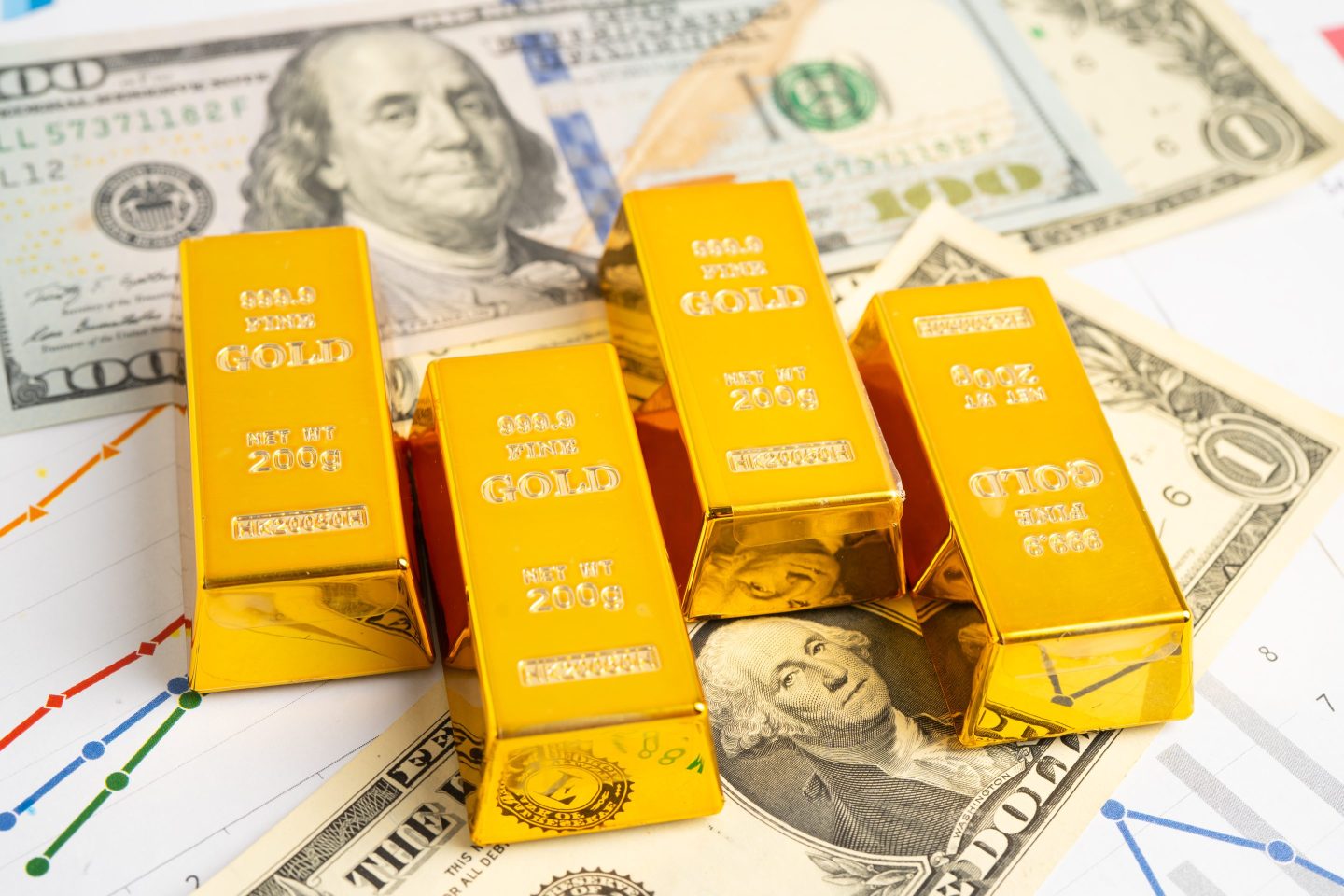
Even after millennia, gold remains the king of precious metals. And no wonder; it’s absolutely stunning, it’s easy to shape, and it doesn’t corrode. It’s a sensible investment that has long shown a tendency to increase in value over the long-term. Let’s take a look at how the price of gold has changed over the past decade so you can evaluate it for yourself as a potential component of your portfolio.
What $5,000 worth of gold purchased in 2016 would be worth in 2026
If you purchased $5,000 worth of gold in the beginning of 2016, you would now have more than $20,000 worth of the precious metal.
Depending on when exactly you purchased gold, you’d have paid around $1,061 per ounce in the first month of 2016. Gold has since catapulted by about 403%. In other words, $5,000 in gold purchased in 2016 would today be worth more than $25,000.
How much gold $5,000 bought in 2016
In 2016, $5,000 would likely have bought you just under 5 ounces of gold. In 2026, it will buy you less than a single ounce. At the time of writing, you’ll pay around $5,340 for the privilege of owning an ounce of gold.
Why gold can help protect your purchasing power over time
Gold has a track record as a store of wealth that spans longer than any other currency on the planet. Empires and their currencies rise and fall, but gold remains constant.
Gold isn’t subject to inflation in the same way that paper money is. That’s because its supply is more finite; governments and central banks can’t create more of it at the push of a button. This limited supply helps it to maintain its value. So when prices for goods and services rise, gold’s price has often (but not always) risen, too.
All this makes gold a common way to diversify your investment portfolio away from stocks, whose success is more directly related to business success—often benefitting from a strong economy.
Gold is not fail-proof
It’s important to understand that gold isn’t necessarily “stabler” than the U.S. dollar. Both are stable in different ways. For example, when the U.S. dollar’s buying power decreases, gold’s value tends to be resilient. But when the U.S. dollar is strong, gold may lag.
For example, during the 2008 economic meltdown, gold prices plummeted as a result of the stock market crash. A mad dash to liquidate gold caused the price to drop—though it managed to regain and reach an all-time just a few years later.
In other words, the dollar tends to lose its strength as prices go up year after year—while gold prices may fluctuate in the short term. But zoom out and you’ll find that gold has generally done a far better job at letting you buy more or less the same amount of stuff throughout the years. If preserving purchasing power is what you’re after, gold is well worth consideration.
Augusta Precious Metals
| A+ BBB rating, AAA BCA rating – unmatched trust and credibility |
| Over 1,000 verified 5-star reviews from real customers |
| Highest buyback guarantee – You’re in control. Switch easily if we fall short |

at Augusta Precious Metals
How to calculate your own gold return
Unless you purchased your gold at the beginning of 2016, it’s unlikely that your return is precisely 403%. To find your unique earnings, use this simple formula: (current price of gold – purchase price of gold) / purchase price of gold x 100 = percentage of value gained or lost.
For example, let’s say you bought gold at $3,500 per ounce. The current gold price is $5,340. In this scenario, the formula would be: ($5,340 – $3,500) / $3,500 x 100 = 52.57% increase.
Is gold a good 10-year investment?
Of course, there’s no way to know whether gold is a good 10-year investment. You’re unlikely to lose the farm on it, but it could make uninspiring gains which you could have better invested elsewhere.
That said, if gold makes similar percentage gains in the next decade that it’s made during the previous, it’s a no-brainer investment. Another 403% increase, and $5,000 spent on gold could potentially again net you $25,000 or more.
Note that some experts suggesting capping precious metals at 15% of your portfolio. So even if you are feeling bullish on gold, it likely shouldn’t be your only investment.
Is $5,000 enough to invest in gold?
Yes, $5,000 is enough to invest in gold. Thanks to “fractional gold,” you aren’t required to buy a full troy ounce for entry. You can instead buy coins that contain a half, a tenth, or even less based on your investment plan.
You can also forego directly owning gold and instead invest in gold ETFs for however much you’d like. With this method, you’re buying shares of a fund that holds (or tracks the price of) gold. This way you don’t have to store and resell the metals yourself.
The takeaway
$5,000 of gold purchased in 2016 would now be worth over $25,000. Gold prices have increased by more than 400% in the last decade or so.
It’s worth noting that the majority of this increase has come in the past year with many questions surrounding the U.S. economy, global trade, and other factors. There’s no guarantee it’ll maintain its vertical trajectory.
Frequently asked questions
What was the price of gold per ounce in 2016?
The price of gold per ounce in 2016 varied between $1,060.74 and $1,375.30 in 2016.
What are the tax implications of selling gold after 10 years?
The IRS considers gold and many gold ETFs (excluding, say, gold mining stock ETFs) to be collectibles instead of a standard stock. When you sell your investment after 10 years, you’ll be subject to a long-term capital gains tax, capped at 28%.
What happens to gold prices during a recession?
There’s no firm rule to this scenario. While gold tends to perform much better than stocks during a recession, it can also lose value in a hurry. Again, the 2008 financial crisis saw gold prices freefall during mass liquidation (though even then, gold regained its footing and came back stronger than ever in a few years).
What are the risks of investing in gold long term?
There are still risks to investing in gold long-term. Gold value can shift precipitously year-to-year. But viewed over a long period of time, it typically trends up. (though nothing’s a guarantee). All to say, don’t let a startling shift in gold to heavily affect your gold strategy.
Is it better to buy physical gold or a gold ETF?
In terms of gold vs. a gold ETF, one isn’t necessarily better than the other. It mostly comes down to personal preference. Investing directly in gold allows you to take delivery of physical metals—but it can come with higher premiums, storage costs, and there may be more rigamarole with selling it. Meanwhile, you can generally trade a gold ETF like a regular stock.