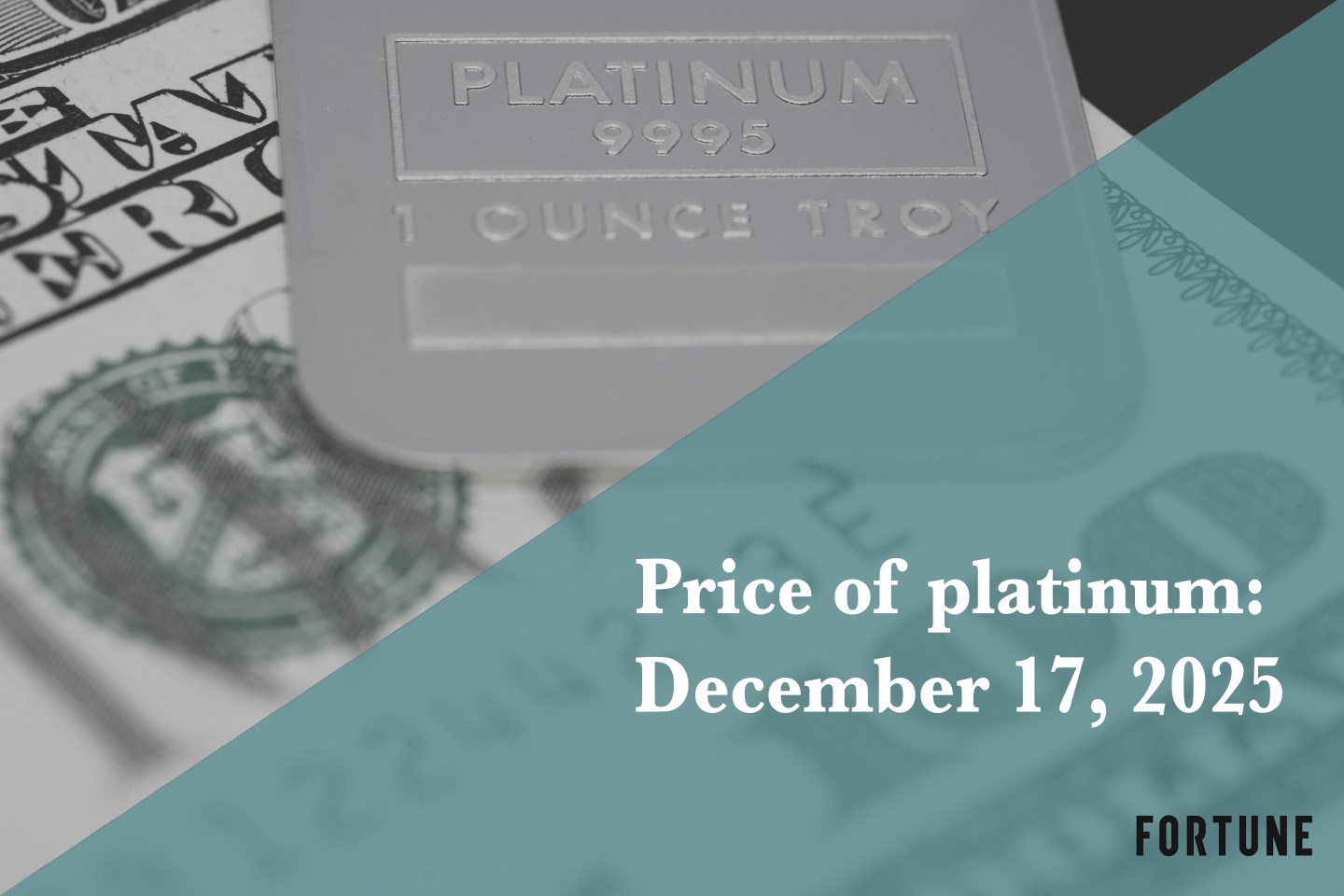
At 8:30 a.m. Eastern Time on December 17, 2025, platinum exchanged hands for $1,922.20 per ounce. That reflects a $111.89 increase from yesterday at the same time and more than a $983 gain over the past year.
Check Out Our Daily Rates Reports
- Discover the highest high-yield savings rates, up to 5% for March 27, 2026.
- Discover the highest CD rates, up to 4.20% for March 27, 2026.
- Discover the top CD rates from major banks on March 27, 2026.
- Discover the current mortgage rates for March 27, 2026.
- Discover current refi mortgage rates report for March 27, 2026.
- Discover current ARM mortgage rates report for March 27, 2026.
- Discover the current price of gold for March 27, 2026.
- Discover the current price of silver for March 27, 2026.
Historical platinum performance
Among precious metals, platinum has established itself as a relatively stable investment option. Many investors use platinum as insurance against the persistent loss of purchasing power that comes as inflation erodes the value of paper currency. As inflation climbs, platinum values typically rise alongside it, helping investors maintain the actual worth of their assets.
Over the past 12 months, platinum has seen the kind of extraordinary value increase that we last observed nearly 20 years ago—during the 2008 financial crisis. Since the start of 2025, platinum has appreciated by more than 77%. The big acceleration began during June, with consistent gains throughout subsequent months.
This abrupt increase in value has several converging factors driving it. In the wake of gold’s meteoric rise, some investors have chosen platinum as a more economical precious metal alternative. Also, many buyers have acquired platinum specifically as an inflation hedge. And reduced production from South Africa’s dominant platinum mining operations—the world’s primary supplier—has constrained supply even as demand continues to balloon.
What does “spot platinum” mean?
“Spot platinum” refers to the hypothetical price at which platinum could theoretically be bought or sold right away, excluding transaction-related costs such as dealer premiums, insurance, delivery fees, and comparable charges. Think of spot price as the baseline figure that sellers reference when quoting platinum prices. As the spot price increases, it signals heightened demand for platinum.
What is “price spread” in platinum trading?
“Price spread” refers to the difference between the asking price (what sellers want) and the bidding price (what buyers are willing to pay) for platinum.
The bid price will invariably be less than the ask price. However, observing the gap between the two reveals important information about the state of the market. When spread narrows, a high number of active buyers and sellers shows vibrant activity—while a wider spread indicates lower trading with limited participants.
How to invest in platinum
Those seeking platinum exposure have multiple options. Whether purchasing bars, coins, jewelry, mining equity, or fund shares, each platinum investment type presents unique risks and rewards. Below are the most popular platinum investments:
- Platinum bullion and coins: Platinum bars, rounds, and coins of 99.95% purity can be purchased as investment-quality bullion.
- Platinum jewelry: When platinum is transformed into jewelry, the cost almost always is greater than the raw bullion value.
- Platinum mining stocks: As an alternative to owning physical platinum, investors can purchase equity in platinum mining firms whose rise and fall tracks closely with platinum.
- Platinum ETFs: You’ll get portfolio exposure to platinum without being required to purchase and safeguard the physical metal.
Is it a good time to invest in platinum?
Platinum hasn’t always demonstrated strong investment potential. For many years, its market price has shown only modest fluctuations—signifying that it operates primarily as a hedge, with relatively lackluster gains.
What distinguishes platinum in 2025 is performance similar to the spectacular run-up it experienced in 2008. During that period, platinum briefly surpassed $2,100 per ounce before crashing below $800 per ounce. The global financial emergency of 2008 resulted in aggressive liquidation and a plummeting demand from industries that rely heavily on platinum.
Precious metals like platinum make sense as portfolio components if inflation protection is your goal. But still, history indicates that platinum prices are susceptible to changes in industry needs. All to say, its wide-ranging manufacturing applications drive its value.
Current precious metals prices as of 8:30 a.m. ET on December 17, 2025
In precious metals investing, gold remains the leading standard. Due to its commanding market share, it offers the best predictability. That said, silver has skyrocketed in value throughout 2025 while remaining an affordable entry point for the emerging investor. Each of these metals (and platinum, too) appeals to those saving for retirement. Visit pages showcasing the best gold IRAs as well as the best silver IRAs to learn more.
The takeaway
Turbulent market conditions and persistent economic unpredictability have made commodities like platinum increasingly attractive. Given platinum’s extraordinary 77% gain over the past year, you may find the timing favorable to include platinum in your holdings.
Platinum represents a practical entry point into precious metals investing thanks to its lower price point relative to gold. Whether you choose physical platinum bars and coins, jewelry pieces, mutual funds, or other platinum instruments, they all serve to shelter your investment from inflation. Remember that platinum prices have greater sensitivity than some alternative precious metals because of its substantial demand from major industrial sectors.
Frequently asked questions
What’s driving platinum prices in 2025?
Scarcity—particularly stemming from manufacturing constraints at South African platinum mines—combined with surging investor interest and increased consumer purchases, is a key factor propelling platinum prices higher.
What percentage of my portfolio should I allocate to platinum?
The standard recommendation among investment advisors is to cap precious metals (including platinum) at no more than 15% of a diversified portfolio.
Can platinum be held in an IRA?
Specific platinum products do qualify for an IRA account. Eligible platinum must maintain a purity level of 99.95% and come from a recognized minting authority. Your platinum assets must reside in a custodial account recognized by the IRS.
Is platinum more volatile than gold?
Platinum demonstrates greater volatility in comparison to gold due to its widespread application in industry including automotive manufacturing and green technology. Market movements in these industries can trigger significant platinum price swings. By contrast, gold valuation is predominantly shaped by investment interest.