
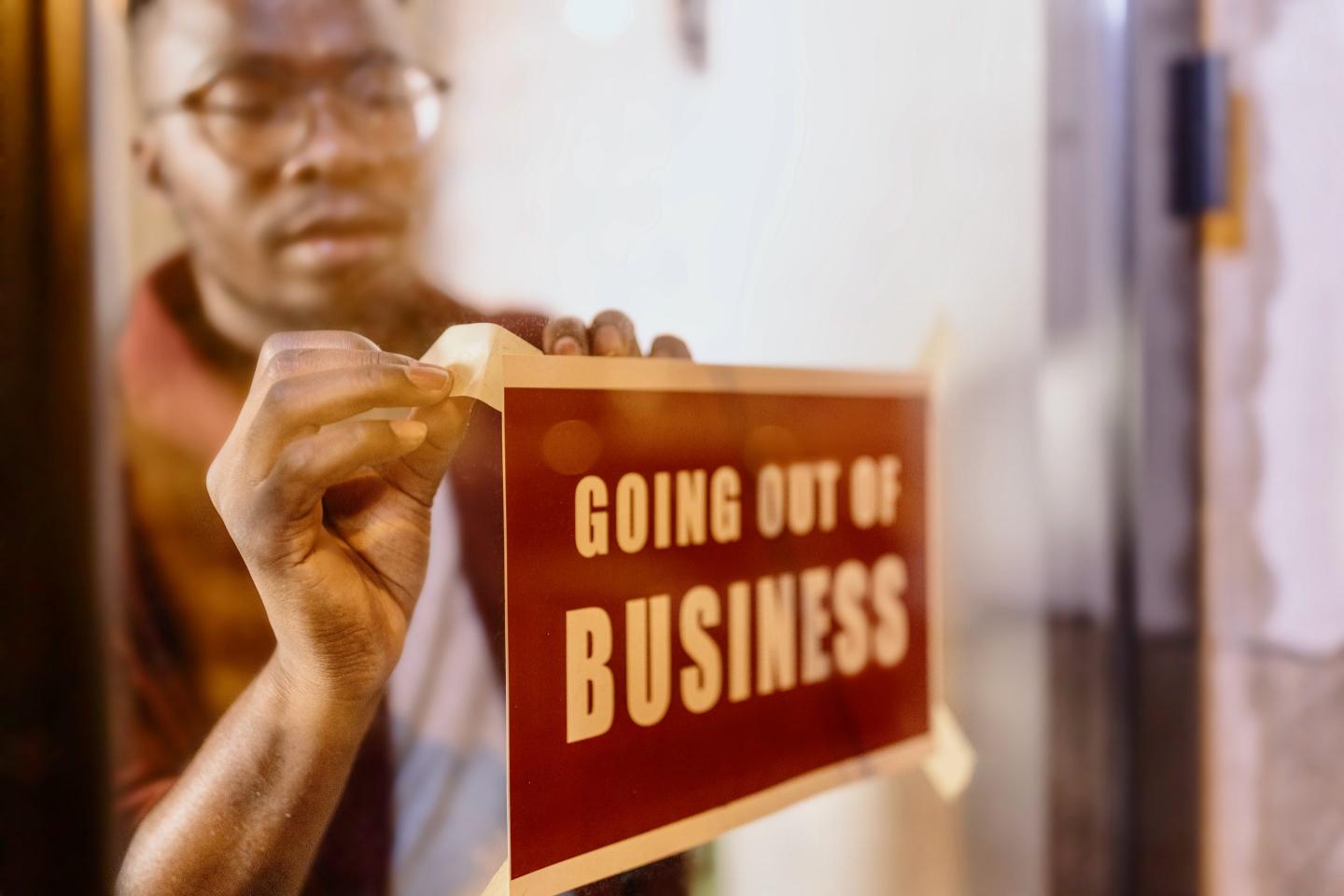
You put in your life savings, work for years, make a few sales and tell yourself this will all be worth it in the end—and maybe inevitably, you hang up a “going out of business” sign outside the front window or send a teary-eyed email to your customer list.
You’re not alone: more American companies are failing than at any time in more than 15 years. Large U.S. companies filed for bankruptcy 372 times in the first half of 2026, the most for that stretch since 2010 and the fourth straight yearly increase, according to S&P Global Market Intelligence. And small businesses are faring worse. Filings under Subchapter V, the bankruptcy chapter for small businesses, rose 46% in the first nine months of the year, according to the American Bankruptcy Institute.
That raises the question of how long does a business last? In 2015, researchers at the Santa Fe Institute offered an answer for publicly traded companies: about a decade.
The team studied more than 25,000 publicly traded North American companies from 1950 to 2009, drawn from S&P’s Compustat database. They found that the typical public company has a half-life of about 10 years, whatever its sector. A company’s risk of dying in any given year had nothing to do with how long it had been in business.
“It doesn’t matter if you’re selling bananas, airplanes, or whatever,” Marcus Hamilton, the study’s corresponding author, said when the paper came out.
“Death” in the study usually wasn’t bankruptcy. The typical company lasted about a decade before it was bought out, merged or liquidated.
Not every study agrees that age makes no difference. Looking at all U.S. firms, not only public ones, economists Hugo Hopenhayn, Julian Neira and Rish Singhania found that older firms are larger and exit at lower rates, in a paper published in Econometrica in 2022. Because U.S. population growth has slowed, fewer new firms are being founded, which shifts the economy toward older companies. The share of new firms among all firms has nearly halved since the 1970s, they found.
A decade after the Santa Fe study, the companies at the top of the market are being replaced faster. In 1958, the average company on the S&P 500 stayed on the index for 61 years, according to a chart from Apollo chief economist Torsten Slok based on Innosight research. Consulting firm Innosight found that tenure fell from 33 years in 1964 to 24 years in 2016. Slok put the average at about 15 years this March.
The original lineup shows the same trend. When the index turned 50 in 2007, S&P published a list of the 86 companies still on it from the start. By 2019, only about 60 remained.
Slok points to several causes. Creative destruction moves faster, shortening the time a company stays large and competitive enough for the index. Mergers and private equity buyouts also pull more large firms off public markets.
Fewer companies are public in the first place. The number of U.S.-listed public companies has fallen by half since 1996, according to Apollo. Startups now stay private for an average of 16 years, a third longer than a decade ago.
Many of those private companies don’t make it. After Fortune reported record startup closures in 2023, equity management firm Carta counted 966 startup shutdowns in 2024, up from 769 the year before. Series A companies made up 14% of shutdowns in 2025, up from about 6% a year earlier, according to SimpleClosure, a firm that helps startups wind down. The Series A companies that failed were seven years old on average.
For small businesses, the odds look similar. Of business establishments opened in 2013, 34.7% were still operating in 2023, according to the Bureau of Labor Statistics. Unlike in the Santa Fe study, industry made a difference. Agriculture, forestry, fishing and hunting had the highest 10-year survival rate at 50.5%. Mining, quarrying, and oil and gas extraction had the lowest at 24.5%. Americans keep starting businesses anyway. Business applications reached a record 5.67 million in 2025, according to Census Bureau data.
Some companies do last for centuries. Japan has 45,284 companies more than 100 years old, including 11 older than 1,000 years, according to credit research firm Teikoku Databank. The oldest, Kongo Gumi, dates back 1,444 years. Even Japan’s oldest firms are failing faster, though. From January to August 2026, 112 Japanese companies more than 100 years old went bankrupt, up 24% from a year earlier and the most since 2007, Teikoku found. A shrinking domestic market and a lack of successors were among the main causes.
In 2015, the researchers didn’t explain why companies die at a steady rate, but they pointed to biology. Geoffrey West, one of the study’s coauthors, developed that idea in his 2017 book Scale: The Universal Laws of Growth, Innovation, Sustainability, and the Pace of Life in Organisms, Cities, Economies, and Companies. In West’s account, companies grow quickly when young, slow as they mature, and eventually die through bankruptcy, mergers or acquisitions. Cities work differently. They grow more diverse as they get bigger, while companies grow more uniform and risk-averse, which leaves them less able to survive a shock.