
Once upon a time, a hugely valuable company sat at the cutting edge of an industry the whole economy depended on, and it had close ties to the White House. Then came signs of financial irregularities on a scandalous scale.
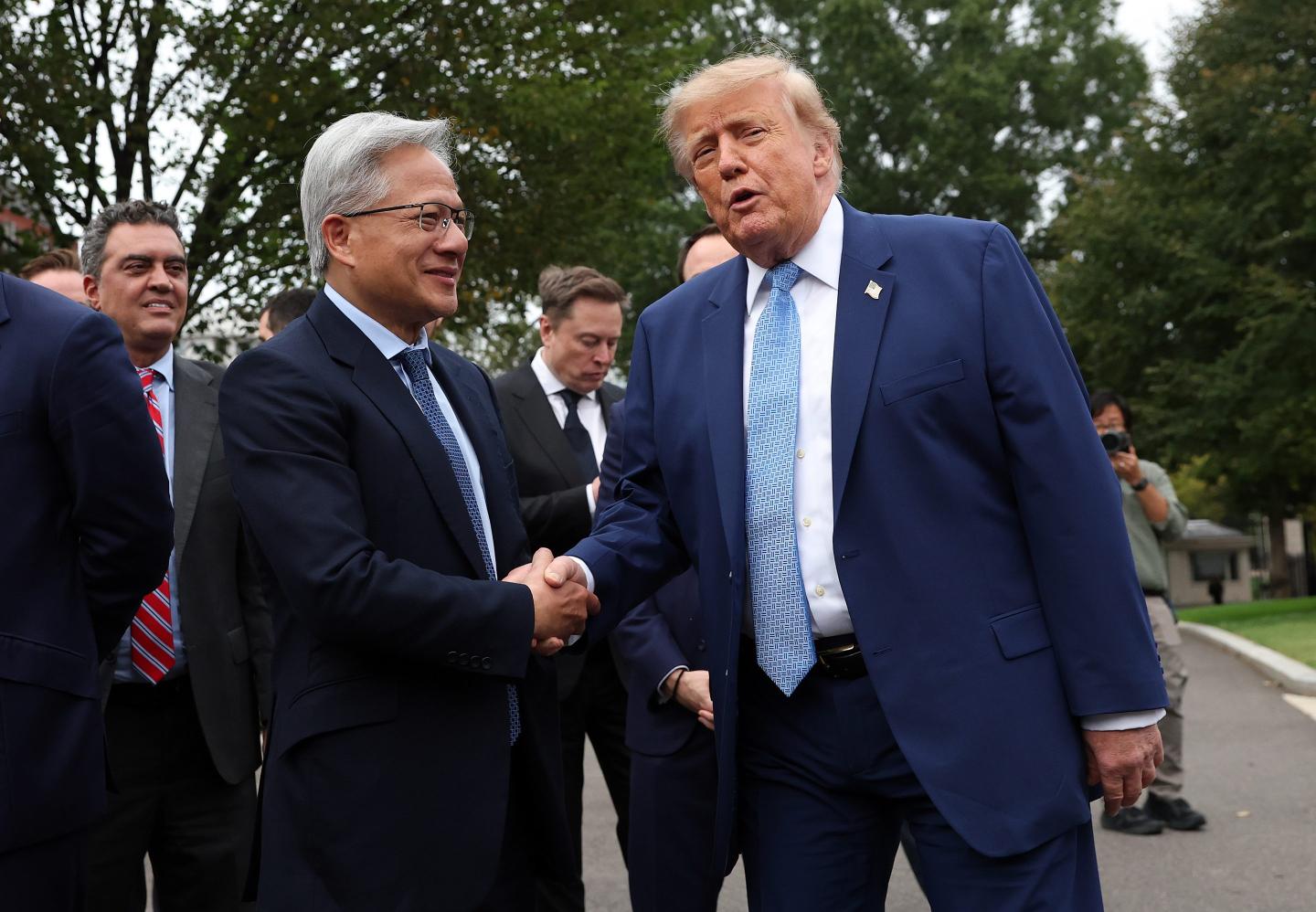
That was Enron in 2001, and President George W. Bush stood back and let justice take its course. On Monday, President Donald Trump did the reverse with Nvidia: the chipmaker reinstated Jensen Huang as CEO 11 days after he resigned over reports of extramarital affairs, including one with Alice Huang, a Chinese national U.S. officials suspect of spying and who is no relation.
“I convinced them,” Trump told CNBC in a phone interview. Huang has denied compromising national security, and no one has charged him with a crime.
Nvidia and Enron are not like-for-like scandals, although some commentators see the connection; the details so far are scandalous but are not Enron-style accounting fraud. Still, with some financial commentators fearing an AI bubble could pop and trigger the next financial crisis, Kenneth “Kenny Boy” Lay’s case is instructive. It shows how far Washington has moved from treating big companies as targets to treating them as partners.
Bush and “Kenny Boy”
Lay was a fixture of Houston’s energy establishment, and his ties to the Bush family went back to the first President Bush. Bush adviser Karl Rove later called any idea that Lay was a “close intimate” of Bush “ludicrous,” but they were close enough that Bush gave him the “Kenny Boy” nickname.
The money was never in doubt. Across Bush’s political career, Enron, its employees and their families gave him more than $550,000, more than any other single source, and Lay was his biggest financial backer.
As Texas governor, Bush signed a 1999 electricity deregulation law that opened new markets to Enron. During the 2000 campaign, he traveled to Houston for the Astros’ first game at Enron Field, where Lay threw out the first pitch.
Wall Street loved the company, too. Fortune named Enron America’s most innovative company six years running, even as Fortune’s Bethany McLean became the first major business journalist to ask, in March 2001, how exactly Enron made its money.
When Enron was collapsing in October 2001, Lay phoned Treasury Secretary Paul O’Neill and Commerce Secretary Donald Evans. Both said they did nothing to help. Nearly five years later, with Bush still in the White House, a jury convicted Lay and former CEO Jeffrey Skilling of fraud.
Skilling’s 24-year sentence was among the longest ever handed to a corporate executive; a judge cut it to 14 years in 2013. Former CFO Andrew Fastow got six years and was released after about five. Lay died before he could be sentenced, and his convictions were vacated.
The two companies already share a footnote. At the end of November 2001, days before Enron filed for bankruptcy, Standard & Poor’s dropped it from the S&P 500 and replaced it with a Santa Clara graphics-chip maker called Nvidia.
How Huang courted Trump
Huang’s closeness to Trump is newer, and he built it deliberately. CNBC reports that Huang spent two years cultivating an “unparalleled relationship” with Trump while Nvidia lobbied for looser limits on selling advanced chips to China.
Nvidia gave $1 million to Trump’s inaugural fund and $25 million to his White House ballroom, and it initially sought to keep the ballroom gift anonymous. In April 2025, Huang attended a $1-million-a-head dinner at Mar-a-Lago, after which the administration briefly held off on restricting Nvidia’s H20 chips before imposing the limits days later.
By July, the administration had reversed course and begun approving sales to China, and in December Trump said Nvidia could sell its more powerful H200 chips to approved Chinese customers. Democrats, including Sen. Chris Van Hollen of Maryland, have tied the donations to those decisions, but there is no known hard evidence of any specific quid pro quo — something that could change under the incoming, heavily Democratic Congress.
A $952 billion day for the “central bank of AI”
Nvidia shares closed up about 31.5% on Monday, their best day since 2003, adding $952 billion in market value, and the S&P 500 rose 4.73%. The rebound reversed much of the slide that followed Huang’s exit, although the stock gave back single-digit percentages on Tuesday and Wednesday.
The stakes are hard to overstate. Nvidia ranks No. 16 on the 2026 Fortune 500 and was the first company on the list to top $4 trillion in market value.
Trump held between $13 million and $58 million in Nvidia stock at the end of 2025, according to his Office of Government Ethics filings, and CBS News estimated his stake gained between $1.3 million and $14.8 million on Monday. The White House told CBS that independent managers run his portfolio.
Nvidia matters well beyond the president’s portfolio. The company, and Huang personally, have been called “the central bank of AI,” a label The Economist applied after tallying more than $70 billion in Nvidia investments in startups over three years and $300 billion in financial support to customers.
Owen Lamont, a portfolio manager at Acadian Asset Management who writes the Owenomics newsletter, says that label carries a curse. In his telling, once an entity is called “the central bank of” its field, it becomes “a prime candidate for a cosmic smackdown.”
Long-Term Capital Management, called “the central bank of volatility” before its 1998 collapse, was the first victim he knows of. FTX, called “the central bank of crypto” six months before Sam Bankman-Fried’s arrest, was the second.
The Economist has also compared Nvidia’s financing to the vendor lending Cisco and Lucent did in the dot-com boom. Cisco is the other fallen high-flier Nvidia is most often measured against, usually by outlier voices; it is the favorite comparison of “Big Short” trader Michael Burry, who has become a Substack star during the AI boom.
From prosecutor to partner
The Enron prosecutions marked the end of an era. In “The Chickenshit Club,” ProPublica’s Jesse Eisinger holds up a Justice Department that set up a dedicated task force, charged nearly all of Enron’s top executives and did so against a friend of the president. He argues that the department has since lost the will and ability to prosecute top executives.
The title comes from James Comey, who led the FBI’s 2016 investigation of Hillary Clinton’s emails and is now fighting a third attempt by Trump’s Justice Department to prosecute him. As U.S. attorney in Manhattan, Comey told prosecutors who had never lost a trial that they belonged to the “Chickenshit Club,” meaning they were too cautious to take on hard cases.
After the financial crisis, a University of Chicago Law Review article noted that Kareem Serageldin, a Credit Suisse banker sentenced to 30 months, was the only banker jailed in the U.S. for a role in the crash. In 2013, Attorney General Eric Holder told the Senate that the size of some banks had “an inhibiting impact” on prosecutions; he later said banks were not too big to jail.
In Eisinger’s telling, that retreat left prosecutors unwilling to pursue big-company executives. Trump has now gone further, treating companies less as targets than as partners.
He has used the pardon power liberally in both terms. He pardoned Nikola founder Trevor Milton, who had been sentenced to four years for securities and wire fraud, and Binance founder Changpeng Zhao in October 2025. A not-yet-published study reported by Law360 found that 49 of Trump’s 89 pardons unrelated to Jan. 6 or the fake-elector scheme went to white-collar defendants.
His administration has also taken a 10% stake in Intel, a golden share in U.S. Steel and a 15% cut of Nvidia and AMD chip sales to China. Foreign Policy describes it as state capitalism of a kind few predecessors embraced.
Nvidia now sits in that company. A person familiar with the matter told CNBC that Trump and Vice President JD Vance were briefed and saw no evidence Huang did anything illegal. Attorney General Todd Blanche publicly called Nvidia “a good corporate citizen” but declined to say whether investigators had examined Huang.
Other probes continue. The Securities and Exchange Commission is conducting a civil investigation of Nvidia, The Wall Street Journal has reported, and California Attorney General Rob Bonta has subpoenaed the company.
Whether this becomes a political scandal is unsettled. AI skeptic Gary Marcus asked in his Substack newsletter this week whether “Jensengate” could take down the president, writing that “you can bet your last dollar the incoming Congress is going to take an interest.”
When Enron collapsed, Lay called two members of Bush’s Cabinet, and both said they did nothing to help. When Nvidia’s chief executive was ousted, Trump openly said he brokered the deal to bring him back.
“I didn’t use the word ‘prosecuted,’” Trump told CNBC. “I said that we believe he’s fine. He’s absolutely fine. I gave them enough assurance.”
The next test comes Dec. 3, when Huang is scheduled to appear at a public Senate Banking Committee hearing. The Enron precedent suggests why lawmakers may keep pressing: it took years and a dedicated task force for Bush’s Justice Department to finish.