
The iPhone 18, released in September, was the first of Apple’s flagship models to use its in-house C2 cellular modem. It marked the end of a 15-year arrangement with U.S. chipmaker Qualcomm, whose chips had been used in every iPhone since the iPhone 4, excluding some of Apple’s budget ‘e’ series, to connect the devices to a mobile network.
“You take us out and your iPhone becomes an iPod, basically,” Don McGuire, Qualcomm’s chief marketing officer, says, explaining how its chips work.
While he adds that the company knew that the end of Apple’s reliance on Qualcomm’s chips was coming, chief executive Cristiano Amon reported that revenue from Apple products would decline faster than expected, because of supply constraints.
In the year to September, Qualcomm’s total revenue fell 3% to $43.1 billion. Chip sales were down 26%, in the final three months to September.
McGuire argues the loss of Apple leaves Qualcomm less exposed to a single customer. “It’s actually very freeing when you can rebalance your customer ecosystem,” he says. In his view, Qualcomm’s success does not hinge on whether its chips end up in one phone maker’s handsets. “Are we in the iPhone? Are we not in the iPhone? I don’t care.”
The company now expects that loss of its chip sales to come from outside of the smartphone category and has recently been expanding into the laptop, car, smart-home device, wearables, and data center markets. Revenue outside of Qualcomm’s mobile chip business is anticipated to grow by more than 60% in 2027.
Data centers remain a lucrative market for chipmakers but it is currently dominated by Nvidia. Nvidia’s data center business accounted for 92% of its revenues in its latest quarterly results.
In June, Qualcomm unveiled a new line of data center chips, and it is targeting $5 billion in data center revenue in 2027.
Qualcomm’s marketing challenge
As CMO, McGuire has to persuade carmakers, computer manufacturers, and cloud companies to buy chips from a business best known for making phone modems. “We’ve diversified so much and expanded our portfolio of where we play in markets that historically we may not have been used to,” he says. “It’s given us a really great opportunity, but it’s also obviously presented some challenges.”
To manage that, he split Qualcomm into three brands, each covering a different chip depending on the buyer. Snapdragon is the firm’s consumer brand, covering the processors inside phones, laptops, and cars. Dragonwing is Qualcomm’s industrial and robotics brand, and Dragonfly, launched in June, covers Qualcomm’s data center products, including server processors and AI chips.
Qualcomm sells to device makers, rather than consumers. However, there is still an advantage to marketing to the broader public. The more people look for a Snapdragon laptop, the more chips Dell, Samsung, and others order, McGuire explains.
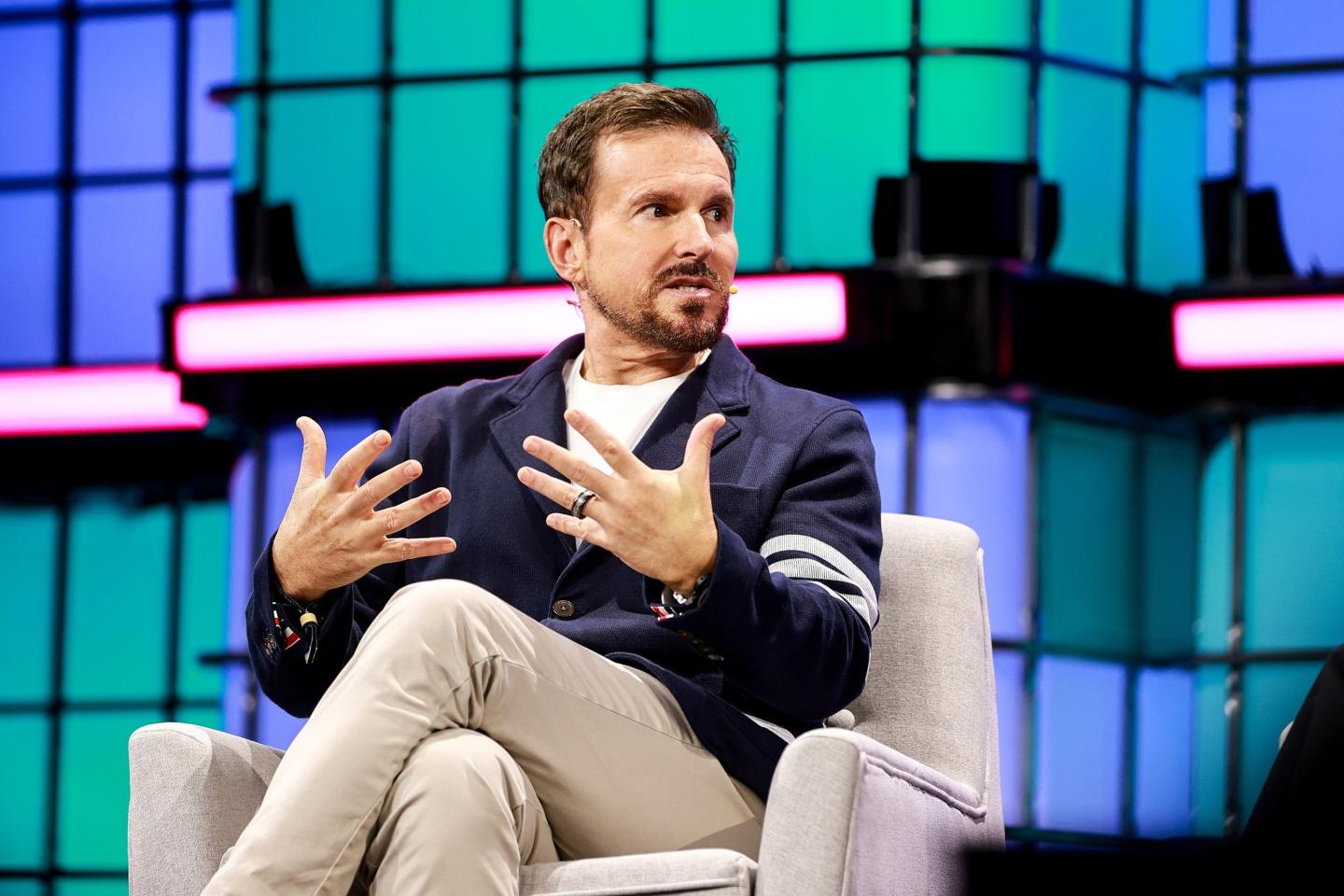
“Are we in the iPhone? Are we not in the iPhone? I don’t care.”
don mcguire, cmo, qualcomm
This is why the brand has focused on building partnerships with sports teams, including a sponsorship deal with Manchester United, which McGuire says delivers exposure equal to 42 Super Bowl ads a season, and its partnership with the Mercedes Formula 1 team. McGuire says the aim is to make technology “visible and emotionally resonant.”
This year’s Christmas, which sees a father build a time machine using Qualcomm’s chips so his impatient son can travel forward through time to Christmas morning, takes a similar approach.
“People don’t care about specs, speeds or feeds,” McGuire says. “They care about what technology can do for them and they care about their passions.”
Data center customers are a different audience, however. The people signing off on Qualcomm’s server chips are cloud companies and finance chiefs, for whom cost matters most. Here, Qualcomm competes with Nvidia on price and power use, a growing concern as data centers’ electricity demands rise. “Nobody does performance per watt better than we do,” McGuire says. Qualcomm has already signed Meta and Microsoft.
Rebuilding the marketing team
Running separate brands across so many markets has also stretched McGuire’s team, which he says has not grown as fast as the company’s ambitions.
McGuire wants his team to spend 75% of its time on planned work and 25% on what he calls “dive and catch,” meaning urgent, last-minute requests. By last year, those figures had flipped, and most of the team’s time was spent firefighting. “I knew this wasn’t going to be sustainable,” he adds.
McGuire believes AI will be crucial in enabling his small marketing team to keep pace with the growing list of demands. In January, McGuire tore up the department’s structure and rebuilt it around AI. “CMOs have a new role now, and that’s chief architect,” he says.
“Roles we thought were going to be important three to five years ago are less important today,” McGuire adds, such as production design and copywriting that is now handled by AI agents. Meanwhile, data, strategy, and creative direction have become more important.
According to McGuire, fewer than 5% of the marketing department was affected. Most of those people moved into new roles, and a smaller number whose skills no longer matched what the team needed left. He calls it “more of a redeployment.”
McGuire says the new structure is already paying off, helping to lower the company’s reliance on agencies and reduce cycle times by two-thirds.
Despite all the changes, McGuire expects further upheaval in the near future. “It’s probably only going to last us 24 months. Technology is changing so fast, I’m not so naive as to think we’ve got another five years,” he adds.
His previous structure, designed in 2021, was meant to last five years but only lasted three and a half years. “The department has gone from a single AI writing tool to several AI systems in three years and McGuire sees no sign of that slowing. “Every day there’s a new tool,” he says. “Every day they’re becoming more agentic.”
McGuire says he has pushed back on demands for AI-driven cost cuts. “I don’t believe we’re at a stage right now where anyone could demand a reduction in cost because of AI,” he says. “It’s too early for that. We’re experimenting and learning.”
Many CMOs face similar pressures. A third of marketing leaders surveyed by executive-search firm Spencer Stuart said they expected to cut headcount within two years, through AI or by eliminating redundancies.
For Qualcomm, the challenge will be whether it can make the jump from phones to data centers, and whether its marketing can keep up. “If we believe we can disrupt, if we believe we have a better solution, we’re going to take a chance,” McGuire says.