
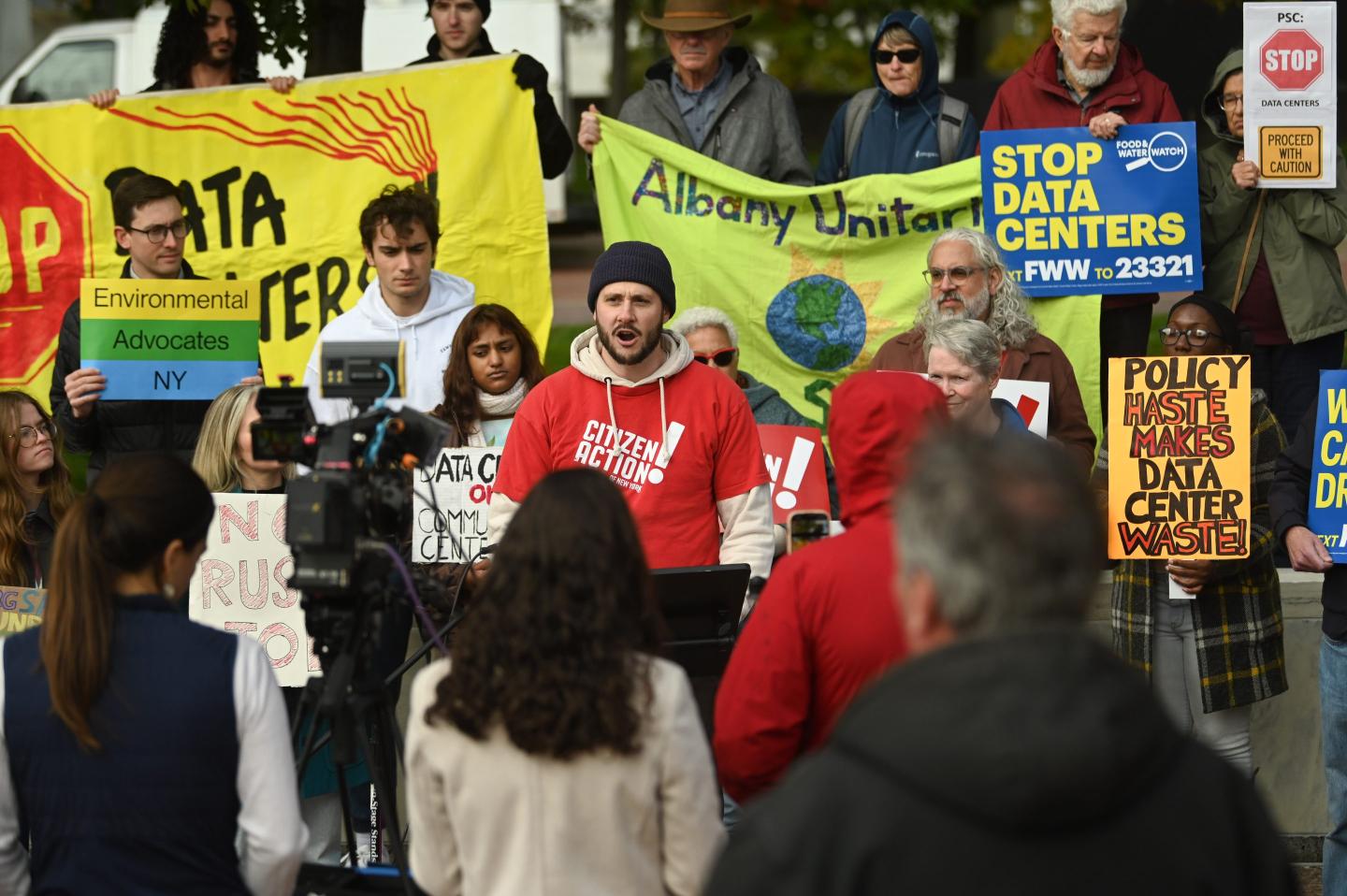
After ChatGPT launched in late 2022, tech companies raced to open data centers at unprecedented rates, pouring billions of dollars into AI hubs in states like Texas and Ohio. Amazon, Microsoft, Oracle, and others did so even as polling showed the centers were highly unpopular among a large swath of the U.S. population.
On Tuesday, the issue came to a decisive tipping point. U.S. voters delivered an overwhelming victory for Democratic candidates throughout the country that will upend the halls of power in Washington and data center hotbeds like Texas. While tech companies have established years-long plans to keep opening the centers, and are regularly plugging more online, they will be met with new state and national political leaders whose mandate is to slow down the unpopular facilities. They also now face a wave of voter rejection on numerous projects across the U.S.
Voters sided against data center development in all but one of 38 local ballot contests with complete counts tracked by Redbud Consulting, a Washington, D.C., polling and data science firm, according to preliminary results.
That includes Piqua, a 20,000-person city in west central Ohio, where Meta is planning to spend $1 billion to construct a data center with a capacity of up to 1.4 gigawatts. Residents voted to recall the mayor and two city commissioners who supported the project.
In Ohio, voters in at least 14 municipalities approved data center bans or other restrictions, showing that the opposition extended well beyond a handful of high-profile projects.
And in Texas, Democrat Gina Hinojosa defeated longtime Republican Gov. Greg Abbott after campaigning on a moratorium on data center development until lawmakers establish additional protections for residents. Texas has more than 400 data center facilities and many more under construction, according to the American Edge Project and Technology Councils of North America.
“Most definitely, there will be challenges — two or three steps forward, one step back,” Baron Fung, senior research director at market research firm Dell’Oro Group, told Fortune, speaking about what Big Tech companies now face. “There could be delays … trying to address any kind of guidelines that weren’t really reinforced before regarding data centers.”
Fung said overall progress will continue, but companies may shift projects as they deal with pushback, and they will be asked to assume more of the financial and energy burden going forward rather than relying as much on municipalities.
Elon Musk, whose SpaceX expects $35 billion to $40 billion in capital expenditures in the quarter ending in December, wrote on X Tuesday night that “Data centers in space looking pretty appealing right now.” Musk spent more than $200 million supporting Republican Senate candidate Ken Paxton, who lost.
The unpopularity of data centers in the U.S. has been a central theme of the AI revolution. Most Americans oppose data centers and are more fearful about AI than hopeful, according to recent Pew Research Center polls. During the second quarter of this year, at least 45 data center projects worth roughly $68 billion were disrupted by local opposition, according to Data Center Watch, a research project run by the company 10a Labs.
The hyperscalers opening the centers have themselves warned about disruptions to their plans. In September, Oracle executives noted during an earnings call that the company doesn’t assume every project will arrive on time, that it has backup options, and that it brings large campuses online in phases. The company has developments across the U.S. and internationally, so “all of our eggs are not in a single basket,” Co-CEO Clay Magouyrk said.
Oracle, in particular, has stood out for its risk-taking during the AI buildout, having more than $125 billion in debt and other notes payable and fundraising aggressively. Earlier this year, the company said it would need to raise between $45 billion and $50 billion in 2026 alone to fund its infrastructure expansion.
Before Tuesday’s election results, Microsoft, Amazon, and other major companies had mounted charm offensives in communities throughout the country in the hopes of winning over weary residents. The strategy has centered on money, utility-bill protections, local jobs, and transparency.
In October, Amazon announced “Built Together,” pledging more than $1 billion over five years to U.S. communities hosting its data centers. Amazon also pledged to publish its annual energy and water use, install lower-emission backup generators at new sites, and pay enough for power to avoid increasing other customers’ electricity bills.
In January, Microsoft promised to cover the power infrastructure costs associated with its facilities and stop seeking local property-tax breaks. Amazon, Microsoft, and Google also dropped requirements that local officials sign nondisclosure agreements regarding data center projects.
That may not be enough in states like Texas. Incoming Gov. Hinojosa has called for repealing data center tax breaks and requiring developers to protect household utility bills and local water supplies, while giving residents more say over new projects.
“The impact may ultimately be less about restrictions than extracting more from data center operators for the social license to operate through taxes, power rates, environmental considerations, and community support,” analysts at investment banking firm Macquarie Group Limited wrote in a note Wednesday.
AI cloud providers could face higher rents for power-equipped data center buildings needed to fulfill customer contracts, potentially passing those costs on to customers, the analysts wrote. Demand from large cloud companies and AI labs could further tighten the supply of available sites. Big Tech companies may also fall back on upgrading or retrofitting existing data centers, Dell’Oro’s Fung said.
Many analysts and tech industry experts agree on one thing: Even with restrictions, AI centers are here to stay, especially as hyperscalers say they need more computing capacity online, not less. Amazon, Microsoft, Google parent Alphabet, and Meta are projected to spend between $720 billion and $740 billion in combined capital expenditures for calendar 2026.
In a call with analysts on Oct. 28, Microsoft CEO Satya Nadella said accelerating demand led the company to add 24 new data centers across five continents during the past quarter. A day later, Amazon CEO Andy Jassy said he expects revenue growth in the company’s cloud business to be 40% or more in 2027 and 2028, largely from AI.
“We’re installing an AI accelerator about every 14 seconds, and almost as fast as we install capacity, customers are gobbling it up,” he said.