
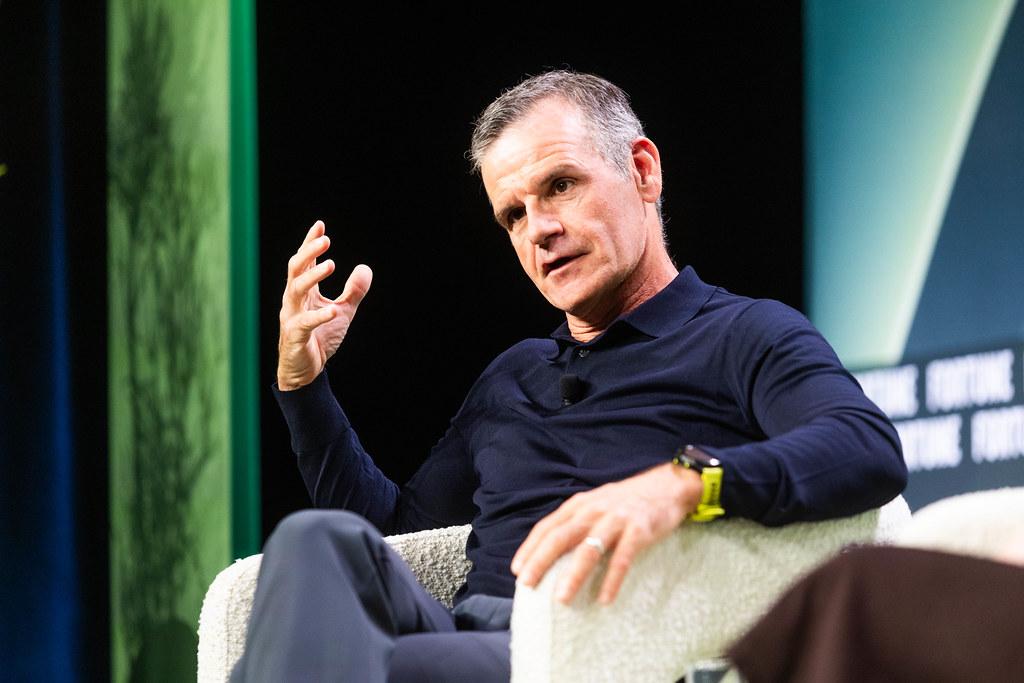
Freshworks has passed $1 billion in annual recurring revenue, CEO Dennis Woodside told Fortune. The software company, which started about 15 years ago in Chennai, India, as a help-desk tool for small businesses, ended its third quarter on Sept. 30 with about $992 million in annual recurring revenue. It crossed $1 billion in October after closing its acquisitions of Torii and Robusta, the company said. Freshworks doesn’t disclose how much of its ARR came from acquisitions.
“$1 billion in ARR is a really important milestone for any software business,” Woodside said in an interview ahead of the results. “It’s a good indication of scale.”
Woodside took over as CEO in May 2024 from founder Girish Mathrubootham. “I think we’ve added about $250 million in ARR in that time period,” he said. ARR measures contracted subscription revenue over the next 12 months, so it runs ahead of reported sales. Earlier today, Freshworks reported $18.3 million in GAAP net income for the third quarter, its second straight profitable quarter, along with adjusted free cash flow of $73.9 million, a record. “We’ll be GAAP profitable this quarter and going forward,” Woodside said. The company has described sustained GAAP profitability as a goal.
Getting there meant deciding what Freshworks would stop doing. “We wound up stopping a bunch of smaller projects,” Woodside said, to “really focus on the business that had the biggest potential, has the biggest market, where we have the most distinctive competitive advantage.”
“You have to be willing to make those hard choices of what’s not going to be important in two years, in five years,” Woodside argued. “And then invest in those areas that are going to be important,” he said. “I think that can be hard to do.”
Some of this is standard management theory, skating to where the puck is moving and seeing around the corner, but it has a counterintuitive element that thought leaders in the space argue isn’t appreciated by enough companies.
The best book about AI adoption is over 30 years old
In an interview at McKinsey’s global headquarters at 3 World Trade Center, two senior partners echoed Woodside’s advice. “AI is everywhere except in the EBIT line,” Alex Panas, who leads McKinsey’s industry practices globally, joked, describing what’s around boardrooms and echoing the famous Robert Solow paradox about the computer age appearing everywhere except in the productivity statistics.
Michael Park, a senior partner in Singapore who co-leads the firm’s technology, media and telecom practice, chimed in. “The number of companies that have really rethought how they’re doing work today, and then changing it to be whatever it should be or could be with AI, is very small.” He shared the example of product development. In the old way, an idea moved down a line: marketing built a business case and PowerPoints, then HR weighed in, then operations. In the new way, a cross-functional team works separately with an AI agent and after a few weeks, Park said, the agent tells them, “There’s like 20 things you guys agree on. But there’s five things that you disagree on.” Then the team meets about those five things.
This is unsettling to people used to the old way of working, because the agent is suddenly the store of knowledge for the enterprise, not the management layer for each silo. Panas noted that org charts have barely changed since McKinsey’s Gilbert Clee wrote the 1959 paper behind the matrix organization in the 1950s. “That’s the last time somebody’s actually thought about organizational structure,” he said. Panas said he thinks the best book about AI was written in 1993: Reengineering the Corporation, the Hammer and Champy management bestseller. Its argument is that technology only pays off once you change the people and the processes around it.
Woodside said the reason people don’t do this is because it’s essentially really unpleasant. Shutting down products meant telling people their work was over. “When you wind down a product, to some degree, you’re saying to somebody that your baby’s ugly,” he said. “And a real person is a product manager of that. You have to say, ‘No, I’m sorry, we’re not going to do that.’”
What Freshworks stopped
When Woodside took over, he was already a Silicon Valley veteran. He had run Motorola Mobility and was chief operating officer at Dropbox when it went public. The first thing the board asked him to do, he said, was “really revisit this strategy” because AI was coming. The company had started as Freshdesk, and its founder had built it around customer support, “and there’s a lot of passion around that,” Woodside said, but still, it was an inflection point.
He decided IT software for bigger companies, “the EX business,” was the future for Freshworks and they had to shift resources into that business, “literally in the first couple of months of being the CEO.”
About a month into his tenure, on June 6, 2024, Freshworks closed its purchase of Device42, an IT asset-management company. It has since bought FireHydrant, Torii and Robusta. EX made up 59% of ARR, or $588 million, as of Sept. 30, up from 35% at the 2021 IPO, and grew 22% from a year earlier, according to the company. The customer-service business it was founded on, CX, accounted for $404 million.
Then he started cutting. “We had a lot of entrepreneurial, you know, $5 million ideas,” he said. “We need $100 million ideas, right, if we’re going to get to a billion [dollars in ARR].” Woodside cited the examples of Freshping, Freshteams, and Freshsurvey as things he deemphasized, focusing on Freshservice, which was already generating several hundred million dollars in ARR when he took over as CEO.
It also meant getting smaller, Woodside said, noting Freshworks now has roughly 3,800 full-time employees, down from a peak of about 5,400 in 2022, roughly a 30% reduction. (That includes an 11% cut announced in May.) “That was hard for the company,” Woodside said. “It was also hard because we wound up reducing the staffing pretty significantly over time.”
He has been on the other end of that call. At Motorola, Woodside engineered the 2014 sale to Lenovo. “We sold it — which meant I sold it — which meant I sold myself out of a job,” he told Fortune’s Diane Brady at the COO Summit in June.
Wharton professor Ethan Mollick, who popularized the phrase “jagged frontier” as he emerged as a thought leader on the topic of AI adoption, puts this as a question. “That’s one of the big questions I ask,” he told Fortune, echoing comments he made on a recent appearance on Peter Kafka’s Channels podcast. “Have you stopped doing anything? With that being attested, almost every company has failed.”
The “micro version” of this is that “there’s just some stuff you stopped doing,” Mollick said, citing hand-written messages of compliance forms. “Then there’s the bigger question about what larger projects in your organization are now obsolete.”
When I put Mollick’s question to Woodside, he responded that “a lot of work that used to be done by kind of early-tenure employees, we are doing with AI.” Designers now build prototypes in Figma that get turned directly into code, and testing that code “is mostly done by AI today as well.” What’s left for people? “The humans get to think at a higher level about: what’s the business problem that I need to go solve.”
He said it wasn’t optional. “If we hadn’t done that very fast, we would simply not be competitive in what we’re putting out there in the market,” he said. “So, for us, it was not a choice.”
Mollick has been vocal in saying he worries most about the bottom of the ladder: the old apprenticeship deal “all broke down because interns are doing work with AI, and middle managers would rather turn to AI than interns,” he told Charter this month. Well, that’s the other worrying outcome, right? Is like, in some ways, the least ambitious way of the well-worn path to using automation is replacing people.”I think that there’s some danger in that,” Mollick told Fortune. He said he worries about too many companies heading down a path of being aggressive at cutting headcount while productivity stays the same; this is not the case with the strategy Woodside laid out, and Mollick was not commenting directly on any particular company.
Woodside emphasized that “early-career talent remains essential to our business,” but it won’t continue to be the kind of “repetitive, mechanical work” that it has been historically. He said early-career workers are being asked to do more “problem-solving and product development.”
Just as most companies are not evaluating what to stop doing, they also haven’t acted on significant headcount reductions. In McKinsey’s State of AI survey, 39% of respondents expected AI to shrink their headcount over the next year, while only 14% said it already had.
Evolve, or get marked down
Investors have rewarded the change so far. Software stocks were hit hard early this year as AI-native startups went after the incumbents’ customers, and Freshworks fell with them. In late March its shares were down about 31% for the year, trading under $8. By late October they were around $15. In a year marked by the so-called “Saaspocalypse” coming for companies a lot like Freshworks, it has returned more than 25% year-to-date.
Woodside told Fortune in general terms that he thinks software’s bottom was in February. Since then, he argued, investors have sorted the sector. “Businesses that are more focused on SMB in particular have been hurt,” he said, referring to small and medium-sized businesses. “Software companies with simpler products, which are perceived to be more easily replicated with AI, they haven’t come back.” Small business is exactly the market Freshworks started in and the strategy the board asked him to revise years ago.
Park argued that the old moats are shrinking because too many executives still think about AI “like enterprise software,” where a system, once installed and customized, “is very difficult to get it out.” Now a company can ask an AI model to help migrate it from one system to another, he noted. He said he thinks companies should move past an idea that AI is “just like automation 2.0,” saying it’s less about costs and efficiencies and more about “doing more things.” That cuts both ways for Freshworks: it’s how an attacker takes share, and it’s how the next attacker could take it back.
From Woodside’s perspective, Freshworks is positioned for that kind of disruption. He said it’s now aiming at what he calls the “agile enterprise”: companies with up to 20,000 employees. “We are absolutely taking share from our larger competitors” in that segment, he told Fortune. Customers paying more than $100,000 a year rose 25% in Freshworks’ third quarter, while those paying more than $5,000 rose 6%.
The pressure comes from both directions. AI-first startups are going after the help desk, the layer Freshworks was built on, while investors fear the model of pricing per seat being hollowed out by AI. Freshworks now prices by usage, by the number of assets managed and by problems resolved. “We’re seeing more and more of our growth coming from the elements that are not seat-based,” Woodside said, although customers still want seats for budgeting. “Our customers want predictability. Seats offer a predictable element.”
Woodside said he doesn’t think the big software players should be counted out in this moment. Startups, he said, find it “always a smart strategy … to throw dirt at the incumbent because you get attention.” But “it doesn’t mean that you can take a business that’s generating, you know, tens of millions of dollars and turn it into tens of billions of dollars. That’s actually really hard.” He gave the incumbents more credit, saying they’re “filled with incredibly ambitious, incredibly smart people. And they’re competitive as hell.”
Panas cited lessons learned from the dot-com era: “We overestimated the short term. We underestimated the long term.”
Woodside used the same logic about his own company. “It’s very easy to overestimate the short-term impact on some of these larger successful organizations, such as us,” he said. “And it’s easy to underestimate how successful the company could continue to be if they get the shift right. In this case, the shift to AI.”
The next number is already on the whiteboard, according to Woodside. “We’re now talking internally about, okay, well, what’s the path to $2 billion and multiple billions?”