

The AI boom has been propping up U.S. growth for more than a year. But Goldman Sachs chief economist Jan Hatzius says that support is about to crest, and Apollo chief economist Torsten Slok says the payoff that was supposed to replace it hasn’t shown up.
“Despite massive investments and widespread hype around artificial intelligence, the technology has delivered zero financial payoff to corporate America outside of tech,” Slok wrote in a note Saturday.
Hatzius wrote in a note to clients Monday that the growth impulse from the AI boom was set to peak in late 2026 or early 2027 “even before concerns around the sustainability of the AI investment boom intensified in recent weeks.”
AI is one of several reasons Hatzius sees risks to growth tilting downward. Gasoline, diesel, jet fuel and European and Asian natural gas prices are back near or above their March and April highs on fears of renewed Middle East escalation. Long-term interest rates are up about 100 basis points on average across developed-market yield curves since early 2026. Hatzius partly blames large deficits and “AI-linked borrowing” for that rise, and estimates it will subtract a cumulative 0.6% from GDP if it lasts.
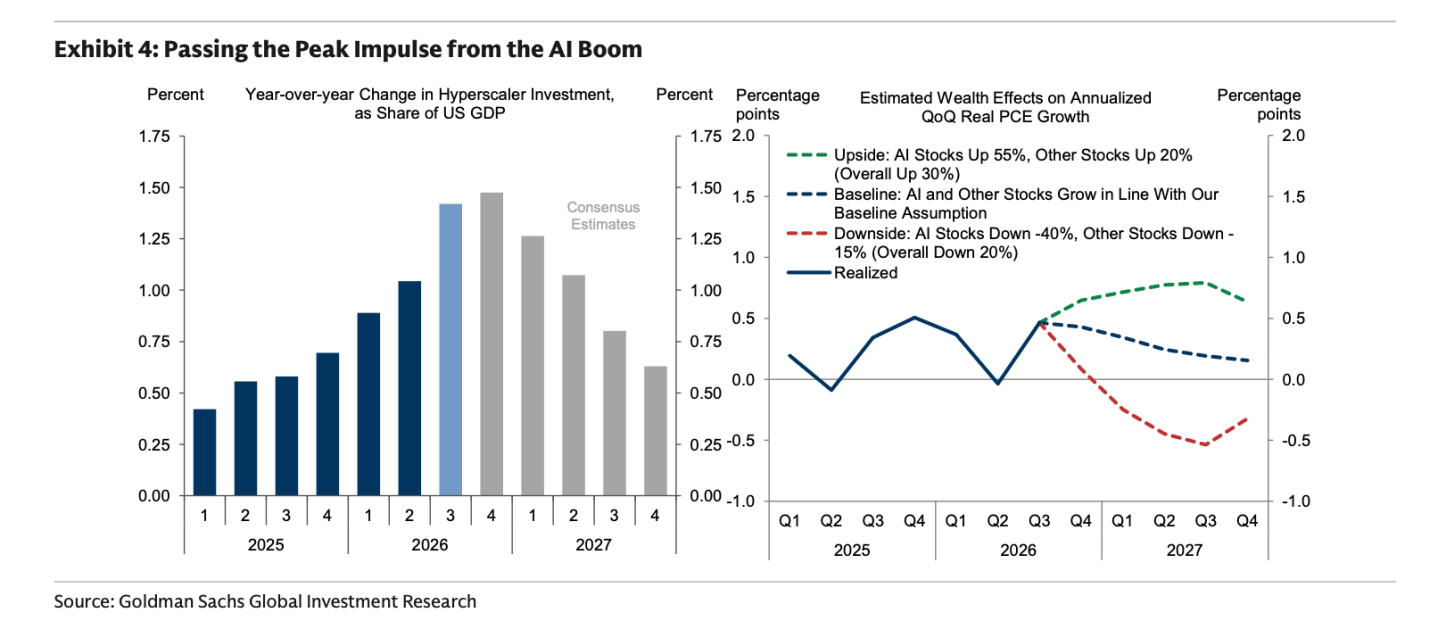
AI investment is still rising rapidly, Hatzius wrote. But he expects the increase as a share of GDP to slow over the next year. That, plus the fading boost from last year’s increase in U.S. depreciation allowances, will weigh on capital spending growth, especially in the U.S. (The One Big Beautiful Bill restored 100% bonus depreciation, which lets companies write off equipment purchases immediately.)
The boom has also juiced consumers through the stock market. Goldman estimates the AI “wealth effect” added 0.4 percentage points to U.S. consumer spending growth over the past year, or 0.25% of GDP. Hatzius expects that to decline over the next year. The slide would be gradual if stocks perform in line with Goldman strategists’ “reasonably upbeat” expectations, and sharper if AI-related stocks keep falling.
The S&P 493
Slok’s note explains why the boost has been so concentrated. Inflation-adjusted revenue per worker and profit margins are rising for the Magnificent 7 and flat for everyone else in the S&P 500, which he calls the S&P 493. Productivity growth shows no AI lift either, he wrote, citing the San Francisco Fed’s utilization-adjusted measure of total factor productivity.
“With no impact on the bottom line, mainstream corporate America is pulling back and starting to view token spending not as a source of growth but as a cost center that weighs on margins,” Slok wrote.
Venture-backed companies, meanwhile, are spending more and more on tokens, he wrote, pointing to Ramp AI Index data and work by Ramp chief economist Ara Kharazian. Mainstream corporate America “does not need the latest model and is unwilling to pay for it.”
“As long as agentic AI and token spending are confined to a small part of the economy, the macroeconomic effects of AI will be very limited,” Slok wrote.
Where they split
The two economists parted ways on what comes next. Goldman’s base case is that AI investment “will ultimately pay off in terms of higher productivity and economywide profits,” Hatzius wrote.
Slok was far less certain. The question, he wrote, is whether mainstream companies can turn “increasingly cheap intelligence” into higher revenue and margins as models get commoditized. “That may be harder than it sounds,” he wrote. “AI may be a great calculator, but in business, intelligence is mostly judgment.”
Hatzius’ optimism comes with a catch. One key channel for that payoff, he wrote, is labor-market disruption, “which has negative near-term macroeconomic effects.”
Labor markets in developed economies still look solid overall, he wrote. But Goldman is seeing clearer signs that AI’s impact is spreading beyond tech. Across U.S. nonmanufacturing industries, the share of firms using AI in regular business functions now has a statistically significant negative correlation with employment growth and a statistically significant positive correlation with unemployment.
Generative AI was used for research assistance and/or transcription of this article. The reporter independently reported and verified the factual claims in this article, and a human editor reviewed it before publication.