
Concerns about AI safety are reaching a fever pitch in the U.S. after a X post by a former Anthropic researcher went viral, claiming the technology could kill all of humanity by the end of the decade. In response, the CEOs from OpenAI and Anthropic have reiterated their calls for the U.S. to coordinate with China to slow and pace AI development.
OpenAI CEO Sam Altman even tried to appeal to the egos of the leading figures, telling Fortune in an interview Friday that he believed U.S. President Donald Trump and Chinese President Xi Jinping could win the Nobel Peace Prize if the two leaders struck a deal on AI safety.
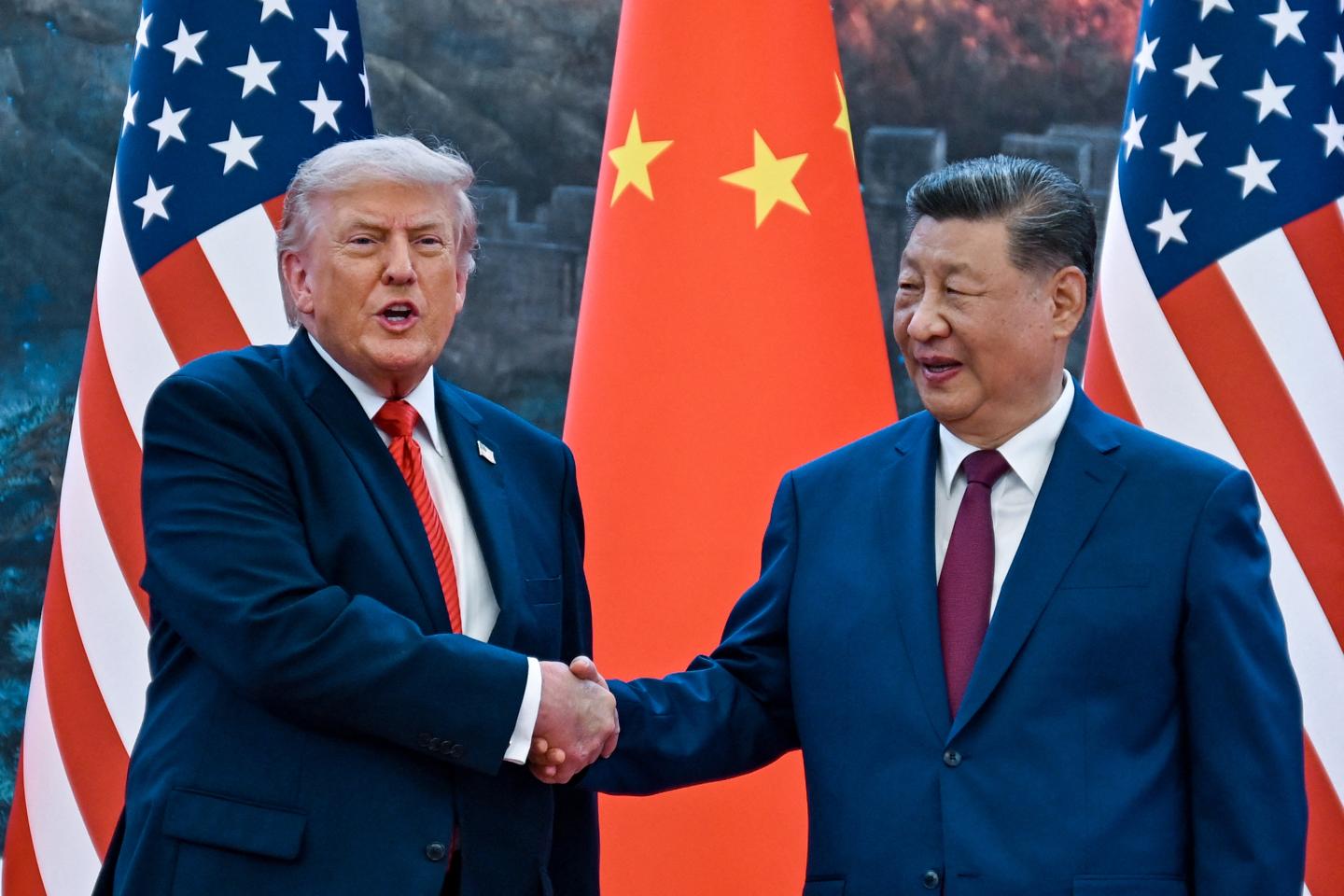
But the idea of an AI slowdown seems to have fallen on deaf ears with President Trump and President Xi, who are set to meet on Sept. 24. Both have rejected the idea.
Trump said “the only controls or ‘guardrails’ the U.S. needs is a STRONG AND SMART (High IQ!) PRESIDENT” in a Sept. 14 Truth Social post. The same day, China’s Foreign Ministry Spokesperson Guo Jiakun called the current discourse in the U.S. “fear-mongering” that “will only hamper efforts toward sound global AI governance, which serves no one’s interest.”
In China, the calls for a slowdown have also come off as an attempt by the U.S. to maintain its leading edge, as it has tried to do by limiting the export of advanced AI chips to China.
“Xi is unhappy with recent U.S. moves to contain Chinese advances in AI, robotics, and drones,” said George Chen, Partner and Chair of Digital Practice, The Asia Group. “For Xi, AI is the new internet — a once‑in‑a‑lifetime chance to reshape the technological balance of power. China does not need U.S. permission to accelerate or decelerate its AI investments; Xi will pursue his own agenda.”
Trump echoed Xi in his Truth Social post, saying, “Whoever wins AI, wins!”
The leaders are expected to begin discussing AI safety when they meet, but any kind of agreement between the countries is “a long way” off, according to Paul Triolo, global technology policy lead at the advisory firm DGA. Xi wants to have a “serious dialogue on frontier AI model safety,” Triolo said, but the two countries have yet to “establish a baseline level of agreement on things like the role of government, [and] how and which models should be tested.”
Also on the table for discussion is an agreement to not weaponize AI, and an exploration of the “principles to prevent misuse of AI models by non‑state actors, such as attacks on global financial systems or critical infrastructure, which neither country wants to see,” Chen said.
Anthropic CEO Dario Amodei’s letter has landed poorly in China—and with Trump
Although OpenAI CEO Sam Altman tweeted about a coordinated slowdown, asking the U.S. government to help facilitate it, the letter Anthropic CEO Dario Amodei’s published on Sept. 12 has drawn a particularly polarizing reaction. While some in the U.S. have praised it as a useful framework for containing the risks of AI, it’s not been well received in China.
In the letter, Amodei calls for the U.S. and China to agree to a “speed limit” for AI development. When discussing his letter in an interview with CBS Sunday Morning, Amodei likened the competition between the U.S. and China to the Cold War, when the U.S. and Soviet Union were racing to develop nuclear weapons. Amodei says at a bare minimum Washington D.C. and Beijing should agree that neither country will use AI to develop biological weapons, and he reiterates his belief that the U.S. should not sell advanced chips to China.
Boris Babic, a professor at the University of Hong Kong, calls Amodei’s letter “self-serving editorializing” that is “conveniently coming at a time when the gap between Chinese and frontier US models is shrinking, as an attempt to hang on to a vanishing market lead.” To him, the proposals for an AI slowdown have “been framed in such a conniving and childish way” that they are unlikely to drive Xi’s agenda for the meeting with Trump.
Trump has also denounced Amodei’s letter. He called Nvidia CEO Jensen Huang when Huang happened to be speaking on stage. Huang put Trump on speaker phone in front of the crowd, and Trump said, “Whatever Dario said this weekend won’t stop our progress.” He also called the backlash to data centers and fears that AI will “take over” a “hoax.”
A social media post by Shengyu Liu, an engineer at DeepSeek, is gaining traction for comparing Anthropic achieving “advanced artificial intelligence” to “Hitler obtaining atomic-bomb technology before the Allies.”
Liu also highlights another important difference between the U.S. and China’s approach to AI technology: the U.S. industry generally favors closed models made by companies such as Anthropic and OpenAI, while China has focused on releasing lower-cost, open-weight models, such as those made by DeepSeek.
“I still believe that frontier intelligence should be made available to everyone in an open and inexpensive form,” Liu said. “I do not trust Anthropic or OpenAI to do this.”
The AI dialogue in China dramatically differs from in the U.S.
Outside of politics, the current uproar in the U.S. about AI safety and “saving humanity”–a phrase the tech industry has latched onto—has not taken hold in China. In fact, the Chinese public also generally sees the idea of a slowdown as an attempt by the U.S. to get ahead and has a growing mistrust of the U.S. tech industry.
“Younger generations in particular are adopting more pro‑government views, encouraged to feel pride as the ‘new generation of Chinese,’ with the narrative of ‘China rising, U.S. declining’ gaining traction,” Chen said.
Most Chinese people believe it’s the government’s responsibility to manage AI safety risks, Chen said. For ordinary citizens and business people, they are less focused on regulation and more on the practical benefits of AI, including how they can use it to improve their daily lives or to generate income.
“The vast majority of average Chinese citizens are very positive about technology in general and AI in particular,” Triolo said. “They have seen major improvements in the quality of life in China brought on by technology, and are very willing to use AI and other technologies. There is not really much discussion of some of the doomer themes on AI, such as existential threats to humanity.”
However, those working inside China’s AI industry are attuned to the safety risks and take them seriously. The “levels of discussion within this group are very sophisticated,” Triolo said. “Chinese AI safety researchers are very concerned about cyber security and biosecurity risks, and about things like loss of control.”
Some Chinese politicians have also called for more regulation, though not necessarily in partnership with the U.S. Chen Yixin, the head of China’s Ministry of State Security, this week called for more government oversight of AI, which he said posed a direct threat to the Chinese Communist Party’s control, The New York Times reports.
With the idea of an AI slowdown seemingly rejected by Trump and Xi, along with a growing chasm between the nations’ attitudes toward AI, all eyes will be on Trump and Xi’s meeting next week to see what, if any, progress can be made to avoid the potentially disastrous outcome the U.S. labs are warning about.