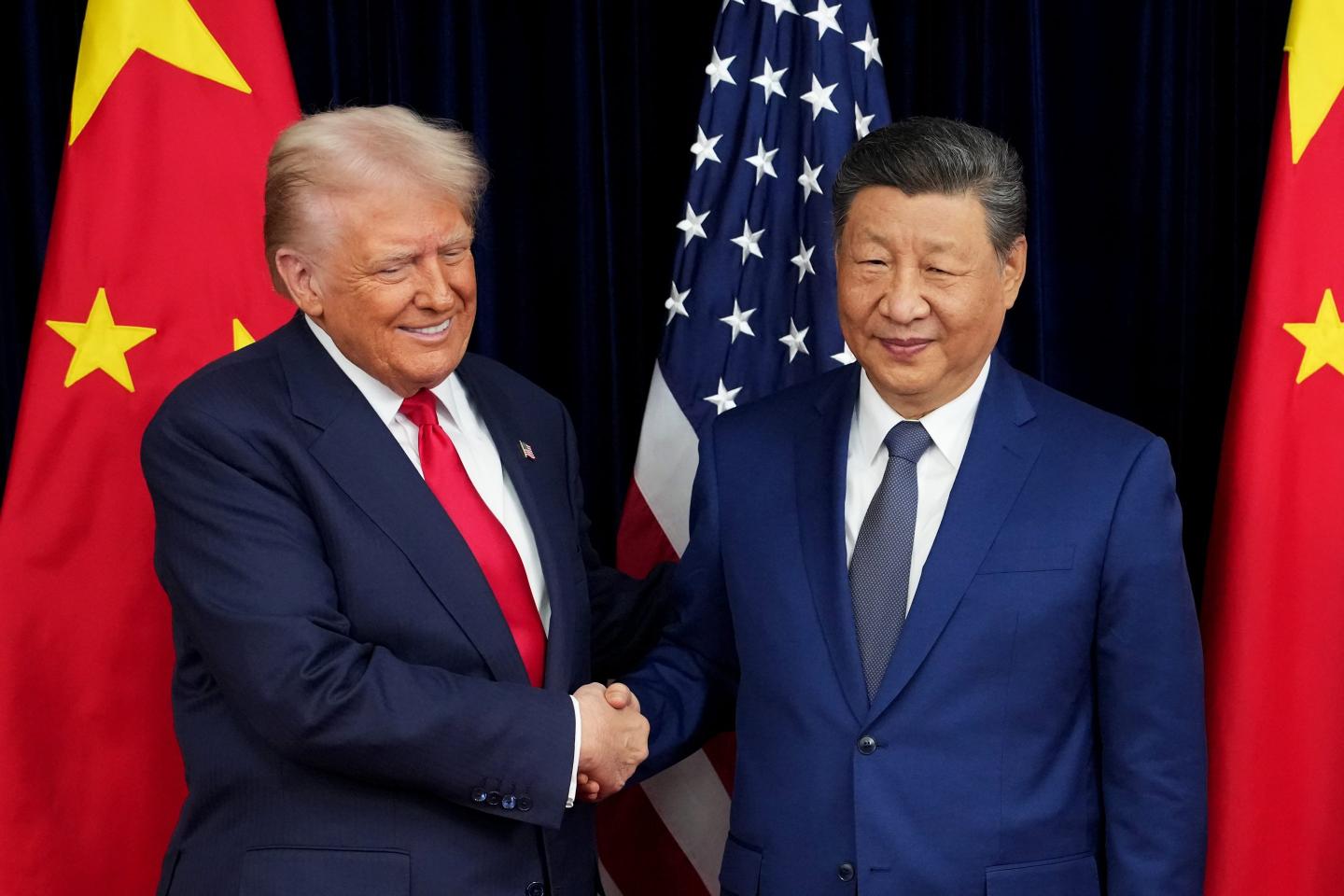
President Donald Trump has been very vocal about how much he thinks he deserves the Nobel Peace Prize. But so far, he has been shut out.
Despite launching a war against Iran early this year, however, concerns about AI’s destructive potential could provide an opening for him to win the award.
In an exclusive interview with Fortune on Friday, OpenAI CEO Sam Altman was asked about the AI industry slowing down in the name of safety and if that extends to the U.S.-China competition.
“I think Presidents Trump and Xi would get the Nobel Peace Prize together if they could agree on something that should be easy to agree to, and it would be wonderful,” he told Fortune Editor-in-Chief Alyson Shontell.
The two leaders ought to concede that neither side should take a certain level of risk in the AI development process, Altman added.
“Even if just the U.S. and China could agree on some shared standards and testing for development of this technology, I think that’d be a wonderful accomplishment that the two of them can deliver,” he explained.
When asked if a ban on recursive self-improvement—meaning an AI that can continuously upgrade itself and add more capabilities—would be enough, Altman replied that it probably would not be sufficient.
Still, he maintained that a notional U.S.-China pact on AI isn’t hard to accomplish and could even be laid out in a one-page document.
The key is having guardrails in place to mitigate the risk of losing control over an AI while also not letting safety measures leave one side at a disadvantage.
“In the extreme case, the U.S. and China are both worrying that if one country gets superintelligence first, that’s a big imbalance of power in that relationship,” Altman explained. “On the other hand, neither of us should be taking loss-of-control risk in the race to beat the other country.”
In his view, the optimal terms for an AI deal signed by the world’s two superpowers could look something like this:
“Here are the rules that we need on development and testing and monitoring alignment standards before anyone proceeds. And then here is the oversight that both countries will have, or some international body will have, to ensure that we are avoiding one country running away in the concentration-of-power element or not following the rules in the first place.”
Such talk about a U.S.-China treaty comes as the stakes in the AI race have reached existential levels, on par with the nuclear arms race during the Cold War.
While earlier concerns about AI mostly focused on jobs that are at risk, students cheating on assignments, and when the hyperscaler investment boom will go bust, anxiety has recently turned to whether humans will survive AI.
On Tuesday, a researcher at Anthropic publicly announced his resignation, and accused both Anthropic and OpenAI (where he also previously worked) of acting irresponsibly in developing ever more capable AI systems.
“They are racing straight to self-improving superintelligence and gambling with our lives,” wrote Jacob Coxon, the researcher, in a post on X. Anthropic’s head of alignment commented on the post, saying Coxon was correct in his assertion that many Anthropic and OpenAI researchers believe that increasingly powerful AI could potentially wipe out humanity.
Evan Hubinger, Anthropic’s “alignment science lead,” wrote in response to Coxon’s resignation post that “we really do earnestly believe AI could kill all humans,” putting the odds of that happening within the next decade at more than 10%.
On Saturday, Anthropic CEO Dario Amodei announced that his company is committing to a new safety measure—giving independent evaluators permanent, employee-level access inside the company—as part of a broader plan he says is needed to slow the pace of AI development.
For his part, Altman also suggested OpenAI and other leading AI companies may be close to announcing a pact to slow AI development and collectively address the rapidly increasing safety risks. While the AI labs “feel the gravity of this moment,” he told Fortune on Friday that the geopolitics between the U.S. and China represent a different dynamic.
Paul Tudor Jones, founder of Just Capital and of Tudor Investment Corp., similarly said the AI threat demands coordinated action by the two countries, flagging recursive self-improvement in particular as a key threshold.
“A new superpower is about to enter the fray, one that is unknowable and unending and potentially dwarfs the U.S. and China individually or collectively,” he wrote in a Wall Street Journal op-ed on Wednesday, adding that Trump and Xi should make AI safety their op priority.
“I urge the U.S. and China to cooperate on a joint briefing by experts from both sides to assess honestly where we are in AI development. That shared understanding may save us all from the third superpower.”