Gen Z has built its brand on anti-capitalist rhetoric. That just shows how misunderstood they are. The transaction data tells a very different story—and it’s not about twenty-somethings’ hypocrisy.
The story that is coming into view is one of a generation with no savings cushion doing exactly what rational actors do when there’s no margin for error: cutting the expensive and uncertain (nights out, concerts, dinners) and doubling down on the cheap and reliable (a coffee, a jewelry piece, a beauty splurge that delivers guaranteed gratification at a predictable price point). The Bank of America Institute calls it the “little treat economy.” The more precise name is budget triage.
A new Bank of America Institute report shows Gen Z’s median savings-to-spending ratio sits just below 0.5—the lowest of any generation—meaning their monthly spending routinely outpaces cumulative savings. That’s a sharper version of a trend BofA flagged in 2025, when Gen Z’s spending-to-savings ratio hit 1.93, nearly double what the generation held in reserve.
“I think the little treat economy, at least in our data, seems to be very much alive and well,” said Taylor Bowley, co-author of the study, in an interview with Fortune. The appeal isn’t just the item, she said—it’s “having the means to purchase it,” a small, reliable hit of agency in an economy that otherwise feels out of your control.
BofA’s own consumer survey puts a number on how deliberate that triage is: 42% of Gen Z live paycheck to paycheck, rising to 73% among those earning under $50,000 a year, according to the bank’s 2026 Better Money Habits report. And when asked directly where their discretionary dollars go, 67% of Gen Z say they spend more on goods than on experiences—only 29% say the reverse. That’s the clearest possible confirmation of the pattern showing up in the transaction data: this isn’t a generation cutting spending broadly, it’s a generation redirecting it, on purpose, away from shared, uncertain experiences and toward small, controllable purchases for themselves.
But the more structurally interesting number isn’t the savings gap—it’s what’s missing from Gen Z’s spending pattern. Across every other generation, higher-income households are pulling away from lower-income ones in spending growth, producing the “K-shaped” divide that defines the current economy. Within Gen Z, that gap has been the smallest of any generation for over a year—and it’s almost nonexistent when you look at it.
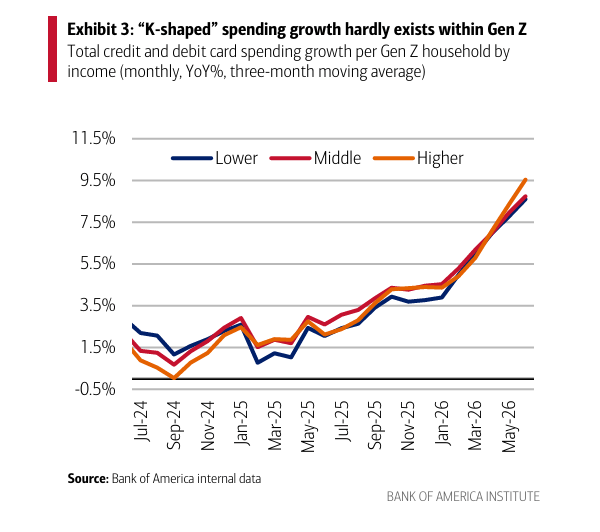
“What really stood out to me was the fact that within the Gen Z cohort, you didn’t really see that K at all,” Bowley said, referring to this school of economics as “alphabet soup,” adding that it may be on its way out. “Across the board, across income groups, spending growth has still looked really resilient.” She tied that resilience partly to life stage—Gen Z isn’t prioritizing savings the way older cohorts do, in part because they haven’t hit the same financial milestones yet—but the flatness across income bands is still the tell.
Lower-, middle-, and higher-income Gen Zers are spending at nearly identical rates. That’s either evidence of genuine generational solidarity, or—more likely—a signal nobody in Gen Z feels far enough ahead to spend any differently than anyone else. The whole generation is compressed into the same band because the whole generation is working with the same thin margin.
What that compression looks like in the receipts
If Gen Z were serious about resisting consumer capitalism, the discretionary numbers wouldn’t look like this. Jewelry spending is up almost 11% year-over-year as of June. Beauty and clothing spending have nearly caught up to overall retail growth. Spending at cosmetic stores has grown roughly 4x faster per transaction than the number of transactions, meaning Gen Z isn’t buying beauty products more often—it’s spending more each time it does.
BofA’s own consumer survey found 92% of Gen Z admits to buying themselves “little treats” regularly, a habit unchanged from a year earlier, and 52% do it every week or more. It isn’t tightly rationed indulgence, either: 58% of self-treaters admit they occasionally, often, or always spend more than they meant to on those small purchases—call it the one place where the triage discipline is allowed to slip.
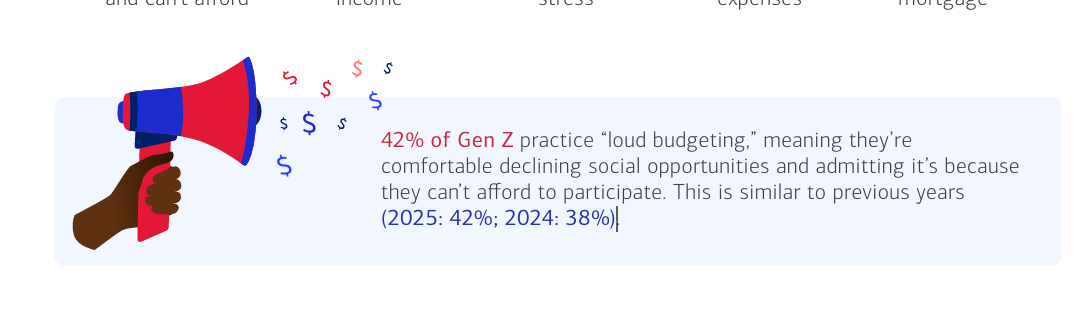
This isn’t scattershot indulgence, when you ask yourself how Gen Z is actually approaching all of these expenditures, but a targeted way of interacting with the economy. Some of that targeting is social, too: 42% of Gen Z practice what BofA calls “loud budgeting”—openly declining plans and telling friends it’s because they can’t afford it, rather than quietly opting out. It’s the same instinct as the little-treat spending, just running in the opposite direction: control what you spend on, and be vocal about what you won’t.
“It feels like everyone’s got a gig,” wrote Bowley and her co-author Lynelle Huskey. Bowley pointed to a related BofA finding that Gen Z is also driving a fast-growing share of new business formation, often via social commerce and resale platforms, a channel earlier generations couldn’t tap at the same age. “Gen X, baby boomers, when they were in their 20s, social commerce wasn’t something that they could necessarily tap into,” she said. Some of that gig and founder activity is filling the exact gap that’s showing up in the savings data—a way of getting “a little extra money in my pocket” when a traditional job is harder to land, especially for recent graduates.
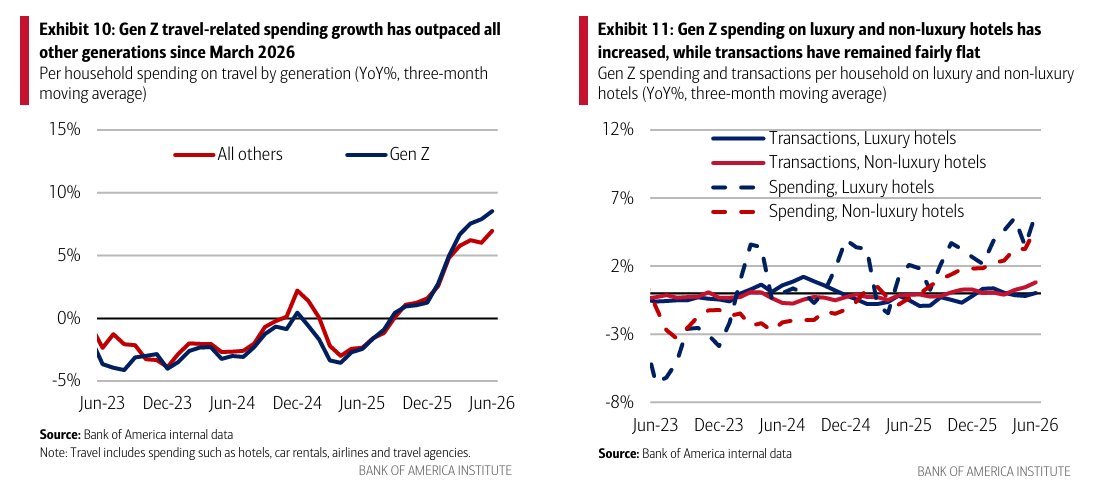
Gen Z’s travel spending also rose 8.5% year-over-year through June 2026, outpacing every other generation’s roughly 7% growth, even as hotel costs rather than more trips drove much of that increase. Twenty-seven percent of Gen Z say they’ve taken on a side gig specifically to afford travel, and more than one-quarter say they’d take extra jobs just to make homeownership possible.
Bowley said she sees that same appetite showing up beyond travel, in what BofA data shows is durable post-pandemic strength in “going to the movies, but also going to concerts, or going to live sporting events”—spending that was initially written off as unsustainable “revenge spending” but has instead persisted. “There does seem to be a desire for people, really across the board, to continue to go to these forms of entertainment,” she said—part of what she calls the broader experience economy. She agreed that the experience economy, the in-person event, seems to be emerging as a defining theme of Gen Z economics.
Importantly, this is not the behavior of a generation opting out of the system. It’s a generation hustling within it, on its own terms, with a clear-eyed read on what’s achievable.
The ideology question, complicated
The polling data does show real skepticism. A June Cato/YouGov survey found 53% of Gen Z holds a favorable view of socialism versus just 45% for capitalism—and Gallup has tracked positive views of capitalism among adults under 30 falling from 68% in 2010 to roughly 45% today, a generational collapse in sentiment. But researchers who study this data consistently flag the same caveat: When young Americans say they support “socialism,” they’re rarely endorsing nationalized industry or central planning. They’re expressing a demand for fairness, stronger social protections, and institutional accountability—a grievance about outcomes, not a program for replacing markets.
Bowley put a sharper point on that gap between rhetoric and receipts. “Gen Z is still spending—there are still positive signs that I think do speak to the fact that it is a more nuanced story sometimes than headline numbers might suggest,” she said. Pressed on whether the generation’s savings shortfall was souring it on the system altogether, she pushed back: Gen Z isn’t “just spending on things that they have to, they’re spending on things that they want to,” even in an environment “characterized by a lot of economic uncertainty.” When I suggested that sounded like a generation making lemonade out of the lemons the economy handed it, she agreed, and read that impulse—toward entrepreneurship in particular, where “you’re taking a risk”—as evidence of “some form of underlying optimism” beneath sentiment numbers that look bleak on the surface.
Survey data from Yelp and Angus Reid Group reinforces that read. Gen Z will wait an hour in a TikTok-viral line for a $9 pastry while calling themselves anti-corporate, because the real grievance is about feeling “ripped off,” not about capitalism as a mechanism. The surging popularity of democratic socialism on the left wing of American politics reflects the same dynamic—an embrace of socialism in theory that is, in practice, a complaint about malfunctioning consumer capitalism.
Further data on Gen Z’s “lonely weekends” completes the picture. A Harris Poll survey of 4,100 adults found 51% of Gen Z reports weekend loneliness—the highest of any generation, 37 points above baby boomers—with nearly three-quarters saying staying home is now their default plan. Harris Poll’s Chief Strategy Officer Libby Rodney told Fortune the cause isn’t psychological; it’s a “spending hangover,” with Gen Z “placing financial regret over FOMO.”
BofA’s own numbers back that up from a different angle: 51% of Gen Z spend $0 a month on romantic dates, and among single Gen Zers, that jumps to 72%. It isn’t that they’ve stopped wanting to date or go out—24% say they’re actively delaying some stage of a relationship because of money—it’s that dating, like dinners and concerts, falls on the wrong side of the triage line: expensive, uncertain, and easy to defer.
Set next to the BofA data, that’s not a contradiction—it’s the same behavior described from two angles. Gen Z isn’t retreating from capitalism or from spending broadly. It’s reallocating discretionary dollars away from expensive, uncertain social spending toward small, guaranteed-payoff purchases that deliver reliable gratification at a controllable price point. The lonely weekends and the jewelry spending are the same budget decision: Skip the dinner that might be a bad time and cost $80 anyway; buy the thing that will definitely feel good and costs $30. And do your Yelp homework so that you can vet the viral line on TikTok, to see if it’s worth not just your time, but also your money. In the age of “conspicuous waiting” or “democratized snobbery,” Gen Z needs to make sure that it triages its budget perfectly—and time is still money, after all. Bowley, who acknowledged that she is a Gen Zer herself, said she has seen the long lines populated by her cohort around New York City and agreed they are worthy of further study.
That’s the little treat economy—and it emerges directly from having a savings-to-spending ratio below 0.5, not from ideology. When money is this tight, you need to make it go as far as you can. The rhetoric may say “I hate this system,” but the data—and the economist who built it—say something closer to what Bowley put in her own words: this is a generation “taking what they have and making the best of it.”