
Most AI strategies fail in the same place. Not in the design phase, not in the technology selection, and not in the rollout plan. They fail the moment a leader stands in front of their team and realizes — sometimes immediately, sometimes months later — that the people nodding in the room have already decided not to follow.
That is the belief gap. And until you close it, no strategy survives contact with your organization.
John Chen understood this the hard way. When he walked into BlackBerry as CEO in November 2013, the company had gone from controlling roughly half the U.S. smartphone market to low single digits in just a few years. He moved quickly on the obvious stuff: write-downs, workforce cuts, a Foxconn manufacturing partnership, and a decision to focus on enterprise customers rather than chase the mass market. Nobody accused him of moving slowly.
But the problem that consumed him had nothing to do with product or technology. People had stopped believing it was safe to tell the truth. Staff were burying bad news for fear of getting blamed. They weren’t challenging decisions. He understood that when people stop speaking honestly, every strategy built on top of that becomes a house of cards. In a 2025 Deep Purpose podcast interview with Ranjay Gulati, Chen explained: “Your people could handle a lot of things if they believe that you treat them fairly.”
He didn’t choose between strategy and belief. He insisted that one was the foundation of the other. Most leaders get that sequencing backward. They build the strategy first and assume belief will follow. It won’t.
The Real Reason Your AI Rollout Is Stalling
Here is what an AI strategy failure actually looks like from the inside. The meeting goes well. You get plenty of nods. Everyone understands the plan. Yet nothing changes. The temptation is to diagnose this as a communication problem — more data, clearer messaging, a better slide deck. That diagnosis is almost always wrong.
After twenty-five years working with leaders at companies like Google, Pfizer, JPMorgan Chase, and Morgan Stanley, and after studying belief in places like North Korea and Rwanda — where what people believe is literally a matter of survival — I’ve arrived at a different conclusion.
The greatest AI strategy in the world will not save you when your people don’t believe in it.
In its State of the Global Workplace 2026 report, Gallup found that nearly one in five U.S. employees said it’s at least somewhat likely AI will eliminate their job in the next five years. You are not asking your team to adopt a productivity tool. You are asking them to trust you with their sense of security, their professional identity, and their sense of what the future holds for them. Compliance, under those conditions, is the floor — not the goal. The most important skill a leader can develop is not communication or motivation, but understanding how conviction actually forms in another person’s mind.
Ted Lasso, the fictional AFC Richmond soccer manager from the Apple TV+ series, described belief in terms that would embarrass most corporate training programs:
“Belief doesn’t just happen because you hang something up on a wall . . . It comes from in here [heart] … And up here [brain]. Down here [gut] … Only problem is we all got so much junk floating through us, a lot of times we end up getting in our own way.”
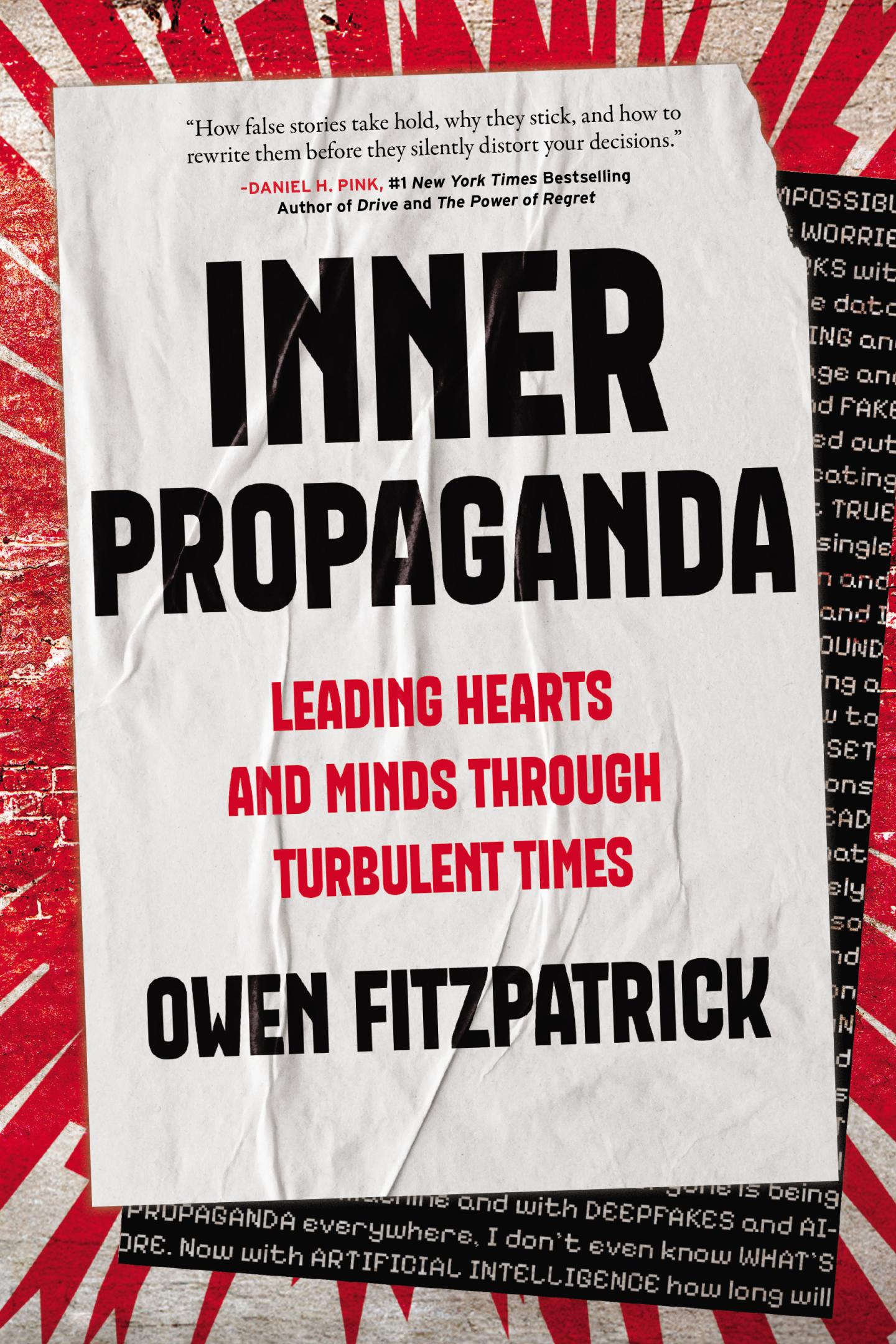
What Ted calls “junk,” I call Inner Propaganda — the accumulated assumptions, shortcuts, and self-protective conclusions your brain has already made before you walk into any meeting. As a leader, your job is to understand how that works in yourself and in the people you’re trying to move.
Feeling Comes Before Logic — Every Time
The instinct is to use data to change minds. But that isn’t how we’re convinced. Motivated Reasoning — a term coined by psychologist Ziva Kunda — describes our tendency to use reason to either find what is true or to justify what we want to be true. Most of the time, people have already decided what they want to believe, and they use their reasoning to build the case for it. Logic arrives after Feeling and Identity have already made dinner, eaten, and done the dishes.
This is why your AI business case isn’t moving your team. It isn’t that the case is weak. It’s that you’re presenting it to people whose emotional conclusion — this is a threat or this is hype — was formed long before you started talking.
A 2025 study by Yang Woon Chung and colleagues, published in the Australian Journal of Psychology, found that employees resist AI adoption because they fear job loss, mistrust AI-driven decisions, and feel excluded from the change. Not one of those barriers is solved by a stronger ROI argument.
Years ago, I was called in by a large financial institution in Dublin that was six months into an organization-wide transformation following the 2008 financial crisis. It wasn’t working. My first question was simple: where is it actually working?
Two departments, they said.
Both had introduced a Friday lunchtime town hall — a weekly hour where people could talk through changes coming down the pipeline before and during the transformation. Here’s what was striking: employees couldn’t actually influence the decisions. The change was fixed. And yet both departments were significantly outperforming the rest of the organization in adaptation.
Why? One manager put it simply: it made people feel the change was up to them. They felt autonomy, even though they had little real opportunity to influence outcomes. When the practice spread across the institution, resistance dropped measurably within two months. Feeling preceded follow-through.
Consider the difference between a leader who tells their team, “AI adoption is a strategic priority for Q3,” and one who opens with: “I spoke to a financial analyst who spent four hours every Monday morning pulling data for a report nobody read. AI now does it in four minutes. She spends those four hours on the work that actually got her into finance in the first place.”
The second leader is not making a better argument. They are creating a different feeling first.
Identity Is Why People Really Resist
If feeling is the gateway, identity is the locked door behind it.
When an AI rollout asks someone to become a different kind of professional, it isn’t asking them to learn a tool. It’s asking them to revise who they are. Most people won’t do that without help.
Years ago, I worked with a woman named Maria who had tried unsuccessfully many times to quit smoking. “I’m just a smoker,” she said.
I asked how many cigarettes she smoked a day. Twenty. About three to four minutes each.
“You spend around eighty minutes a day smoking and twenty-two hours and forty minutes not smoking. If someone had two jobs, which job would you say was theirs — the 80-minute one or the 22-hour one?”
She paused. “The one they do for 22 hours and 40 minutes.”
“So you’re actually a non-smoker who smokes for 80 minutes a day.”
“I never thought about it like that before.”
Years later, she told me she hadn’t touched a cigarette since that conversation. The change in identity label freed her to make the adjustment. She already was the person she wanted to be. She just needed help seeing it.
This is your job with AI adoption. Your team members who don’t see themselves as technical need to understand that being skilled with AI in 2026 doesn’t require technical skills — it requires precision, clarity of intent, and the ability to iterate and refine. Those are skills they already have. The coder who understands what good output looks like is far more valuable than someone who can only write the code itself. Their identity doesn’t need replacing. It needs updating.
Reason Is the Last Step, Not the First
Plato argued that reason was the key to getting out of the cave — to seeing the world as it actually is rather than as shadows on a wall. He was partly right. But reason isn’t just a tool for finding truth. It’s also a tool for proving it.
There are two modes: investigation, which uses logic to figure out what’s actually true; and argumentation, which uses logic to prove a conclusion already reached. Most of the time, when you’re presenting your AI strategy, your team is in argumentation mode — using their reasoning to defend what they already feel and already believe about themselves.
Ensure your message feels right and fits who they believe they are before you make the rational case. In that order. Every time.
John Chen stepped down in 2023, with the BlackBerry board explicitly crediting him with “saving the company and repositioning it as a software company.” He succeeded because he understood that conviction is built from the inside out — feeling first, identity second, reason last.
The next time you stand in front of your team to present your AI strategy, the goal is not a roomful of nods. It should be the excitement, the urgency, and the certainty that people carry out of the room with them. You’ll know the difference not just in what they do next, but in how they do it.
That’s leading at the level of belief rather than information. Because your AI strategy doesn’t have a design problem. It has a belief problem. And that problem starts — and ends — with you.
The opinions expressed in Fortune.com commentary pieces are solely the views of their authors and do not necessarily reflect the opinions and beliefs of Fortune.