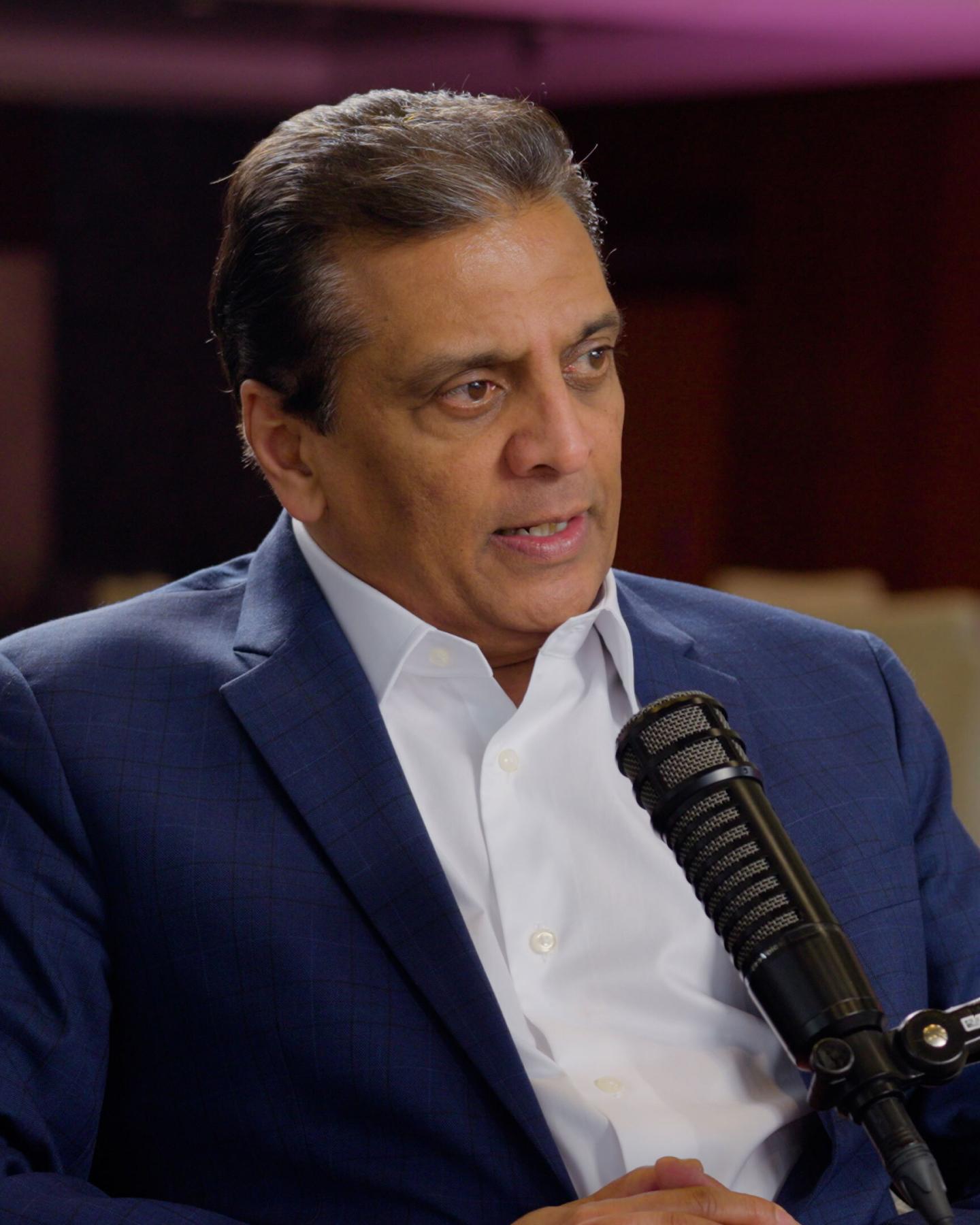

Moving nearly $2 trillion worth of goods every year, FedEx is deeply connected to the flow of global trade. Facing unpredictable tariffs, fleet disruptions, and intense competition, the company is entering a new era of reglobalization, where automated belt systems, edge robotics, and new trade patterns are rewriting the rules of global supply chains.
In a new episode of Fortune 500: Titans and Disruptors of Industry, Fortune’s Editor-in-Chief Alyson Shontell sat down with FedEx CEO Raj Subramaniam to discuss his rise within the company from the lowest level possible up to the CEO seat; how he’s overhauling the logistics company and taking it through three transformations; and how he’s thinking about AI, robotics, and the future of the company.
On reglobalization and trade disruption
- Why Subramaniam says tariffs and geopolitics are reshaping global trade, driving growth in Latin America, Southeast Asia, and India.
On FedEx’s transformation
- How FedEx is uniting its Express and Ground networks, simplifying the organization, and building digital capabilities for e-commerce.
On AI and the value of FedEx data
- How FedEx is using its data and AI to optimize deliveries, improve customs support, predict disruptions, and serve high-value supply chains.
- Why Subramaniam sees FedEx’s logistics intelligence as a potential source of new services and revenue.
On robotics and autonomy
- How FedEx is testing autonomous trucks with Aurora, starting with highway routes.
- How Dexterity and Berkshire Grey are helping automate truck loading and unloading in FedEx hubs.
On preserving the FedEx culture
- Why Subramaniam says FedEx’s “People, Service, Profit” model and its “Purple Promise” remain the company’s foundation.
- How he views taking over from founder Fred Smith as a responsibility to protect the culture that Smith created.
On his path to CEO
- How a roommate’s canceled FedEx interview led Subramaniam to join the company in 1991 as an associate marketing analyst.
- Why he credits continuous learning, mobility across roles and geographies, curiosity, and calculated risk-taking for his rise to the top job.
On CEO advice
- Why Subramaniam says aspiring CEOs need to decide whether they truly want the role, with its sacrifice, travel, and stakeholder pressures.
Read the transcript, which has been lightly edited for length and clarity, below.
Raj, thank you so much for having me here in Memphis at your FedEx Experience Center. It’s a gorgeous, huge facility, and it’s an honor to be with you. You’re a Fortune 500, No. 50 CEO.
Well, Alyson, great to see you in Memphis, and we love to have you in Memphis. I’m glad that you’re right here in our Experience Center, and we look forward to this conversation.
Subramaniam on the shifting global trade landscape
I was saying I’ve had my second helping of barbecue, so I’m good for this interview. So, I know you move about 18 million packages all over the world on average per day. That is a lot of insight that you have into the physical economy and the global economy at scale. And I’m curious, as you look at all of the metrics that you have at your disposal, what are the things that you’re seeing about the global economy that the rest of us might not have from your vantage point?
Yeah, well, that’s an excellent question, Alyson. First of all, these 18 million packages actually represent shipments from about two to three million active shippers, and about 300 million recipients around the world. And we are in the center of this ecosystem. The interesting thing is that it also generates two petabytes of data every single day about the system. So we see the supply chains from the bottom up.
In many ways, we are the referendum on global supply chains. This may not have been that interesting two or three years ago, but it is very interesting today because the supply-chain patterns are changing very rapidly. I’ve been doing this for 35 years, and I’ve been watching these flows. And we had one set of equilibrium over this period of time. And in 2025, we had a lot of changes, and I’ve never seen a change in one year like we’ve seen in 2025.
I’ll let you know what I mean. For example, U.S. imports were down, and U.S. exports were up, and those combinations thereof, we haven’t seen in a long time. Intra-regional traffic is up. We have Latin America inbound up significantly. A lot of countries—Southeast Asia, India—they’re growing very rapidly. So it’s all happening all at the same time.
In essence, the supply-chain patterns are changing, and we are moving from one equilibrium state to another equilibrium state. And we are in the middle of such a transition, and I just coined the term “reglobalization” to kind of capture the point. But it’s a very interesting time as we are watching these changes happen firsthand in real time.
I know the Liberation Day tariffs were about a year, a little more than a year ago, and FedEx experienced that impact firsthand as a business, but so did every other business, and the supply chains have changed accordingly. Geopolitical reordering has happened accordingly, and I’m curious about your vantage point during that moment in April when these tariffs changed globally for everybody.
What was the impact you saw, and how is the geopolitical world order changing based on who’s doing business that maybe wasn’t doing business before?
Well, from our point of view, there were three things that were important. Firstly, as we just talked about, the patterns of physical movement of goods changed. So, in this context, having a scaled physical network was very important. That’s the great advantage for FedEx, is that over the last 53 years, we have built this global network. And I mean network in the truest sense. People use the word very loosely sometimes. It is the ability to pick up a package from any one point in the world and get it to any other point in the world. There are only two or three companies who can do that, and we do it the best.
So we had that scaled physical network. So if a company was thinking of moving their supply chain from A to B before, and they’re now moving from P to Q, well, we are at A, B, P, and Q, and so we already have that established network. That was the first thing.
The second thing is the operational aspect of it, because we are unlike other companies. We’re actually involved in moving the goods across the border. That’s our job. That’s what we’re set up to do, and that became increasingly more complicated. But this is what, before, basic math would have done. Now you need advanced calculus, and we do advanced calculus. This is what we do for a living.
So, ironically, this became an advantage, even though we had to hire a lot of new people, because the number of packages that had to be formally cleared through customs went up six- or sevenfold, and we had to hire about a couple thousand people to make sure that that happened. So, operationally, we had to make some changes, but again, we had an advantage because of the experience and expertise that we have.
And then thirdly is digital intelligence. Just imagine, for every country to every other country, for every commodity, you need clear and scored information. We have it, again through the dint of practice and our experience. And here’s where Gen AI came in handy. If you try to ship this shirt to the U.K. tomorrow, there are probably 50 different classification codes that you may have to choose from. But because of our experience, we can just suggest to you which ones you should use, for example. And we’ve done it for small, medium customers, and we are trying to take that practice up as well.
So those are the three elements of changes that we have seen, and it’s very complex. This is when people who really know what they’re doing can step up to the plate.
People see the FedEx driver show up at their door. But really, how does a package get from point A to point B in the simplest form? You make it seem easy and almost magical. It just appears a couple days after you send it. But what goes on behind the scenes at FedEx?
So obviously that’s what we do. But it just depends upon where it’s starting and where it’s ending up. It could start at another end of the world, and it could be in any ZIP code in America, for example. If that’s the case, then obviously it starts off on the pickup side. We have a FedEx service and a courier and a driver, just like you see here. And it eventually gets to the air ramp in that city, and the flight, let’s say, is from Japan to, let’s say, Michigan. It’ll probably come here to Memphis that night. It’s sorted in our huge hub that we have here, and then gets on a plane to Michigan the next day, to, let’s say, Detroit, and then there’s a whole process that happens from the air ramp to the courier, who gets it to the final deliveries.
So that’s a whole orchestration that has to happen, and you just multiply that by every origin, every destination in the world, and you see the infrastructure that’s required to move that. So it just depends upon where it’s coming. If it is coming from Chicago to Detroit, and overnight, then probably it goes on a truck for a couple of days’ service, or if you really want it by 10:30, then it comes through Memphis and back to Detroit. So depending upon the service requirements and the expectations, from every point to every other point in the world, we have a sophisticated network of possibilities to get that package to the end destination.
It sounds easy, but clearly it’s obviously not, especially with all of the data. You said two terabytes?
Two petabytes.
I don’t even know how many—that sounds like a lot.
Many, many zeros.
How Subramaniam leads FedEx through uncertainty
I was listening to an interview. You said, “I wake up every morning and I say a little prayer,” because unpredictability is plaguing every CEO right now. There’s never been more that’s harder to predict as a leader of any company. But at FedEx, with all the logistics involved, I’m sure I would be saying many, many prayers. So what does a day in your life like for you? How does your day tend to unfold?
Well, first of all, to answer that specific thing, we are a very kinetic organization, and that’s the great thing about FedEx. We are in motion pretty much every second of the day in every corner of the world. But the great thing about that is we have a fantastic team around the world, steeped in FedEx culture.
500,000 people?
500,000 folks, and so that part of it, I know we will take care. It’s just that some of the external environments change and we have to think about how the network will have to adjust to something happening. That’s where we have to keep managing and monitoring. And again, we have a superb team, from an engineering organization perspective and our frontline operations, that really keep it running. And great leadership that makes it happen every single day.
The other question is, what do I do? That’s an interesting question because I realized after I took this job that the most important currency that I have is time. So I actually sat down and thought about it. I said, “What is my role exactly?” And so I determined that, first of all, it’s to guide the strategic direction of the company, obviously.
“The most important currency that I have is time.”
Raj Subramaniam, CEO of FedEx
Second is to create an execution framework. Make sure you have the right set of folks around the table to make this happen, and then be the guardian of the culture of FedEx, and then represent the company well internally and externally, which I’m hopefully doing right now. So that’s how I parcel my time, and more or less, it follows those patterns. But of course, sometimes you’re going to have to jump in on certain emergencies.
Yeah, I think that’s such a good insight—that your time is your most valuable resource that you have. And everybody wants a piece of you when you’re the CEO, and you have to be really diligent about, “Is that meeting one of my priorities? Is it helping me be the external voice or the culture setter or what have you?”
I’m curious—you’ve been in the job now for a few years, and previously you were the COO and the president. How different is it to be in the CEO seat versus one of those? I would have thought, time management. Probably getting to the C-suite you had to figure that out.
That’s exactly right. But the roles have changed. So, as president and COO, and increasingly over time, our founder Fred Smith had handed off more and more responsibilities. So, when the time came, I said, “Okay, it’s one more step up, but I can do this.” But no, the whole thing changed. The world changed. The number of stakeholders that were demanding your attention was completely different and more numerous than I anticipated.
So that’s why I had to rethink and figure out, how do I parcel my time? And actually having to say no a heck of a lot more. And really prioritize, because if you try to do everything, it’s not possible. But this takes it to a whole other level.
And again, the fact that I was president and CEO for three years before that was a huge help. But now this is a whole different level.
Yeah, and Fred was the legendary founder of FedEx. He created it in the ’70s, and unfortunately, he passed away a year ago. But I know he was a great mentor and friend to you as well. What is it like taking the reins from a legendary founder? I mean, it’s daunting, I would imagine, to step into the CEO job of a Fortune 50 company, let alone to be the second CEO in the company’s history.
Yeah, well, I consider it a great privilege to have had that opportunity to take over from our founder. I always say that I can see far because I’m standing on the shoulder of a giant. The preparation for the handover was over a period of time, as Fred was always extremely well-planned and thinking through things ahead of time. And so this transition was also equally well-planned, and so there was no surprise. So when I got appointed as president and CEO, that was when the transition started.
And he kidnapped you on his jet somewhere, right?
No, he asked me to show up—he was traveling to Los Angeles, and he said, “I’ve checked your calendar. You’re doing nothing.” So that’s when I got the word that I was going to take over. So it was quite an interesting trip for sure.
Did he tell you then that you’d be the CEO and this would be the first step as COO?
Well, it was quite well understood at that point that this is a stepping stone. Nothing was guaranteed, of course, but it was a stepping stone into the job. So it was pretty clear to the internal and external world that this was the path that was going to be. The timing was only the question.
So I think that when I stepped into the CEO role, he handled the transition so beautifully, so well, from a communications perspective, from a mentoring perspective. It was very clear—he told me from the very beginning that you are now the final decision maker on anything. We can debate anything you want, but at the end of the day, if this is the direction you’re headed, then you’re the final call.
So it was great. We talked about a lot of things, and one of the things that he and I had a conversation about was I told him that a lot of things might change. We may have new technology, we may have new people, we may buy new companies, but one thing that is not going to change is the FedEx culture, and that’s why I came to work here in the first place. That’s why I come to work every single day. That’s the special thing, and Fred gets credit for a lot of different things, but he doesn’t get nearly enough credit for creating this phenomenal culture that we have at FedEx from the very founding of the company. And so that’s one thing that’s a constant for us.
I was going to ask you about the culture because to execute in the way that you guys need to, you have to be uniform. And I’ve heard you say, no matter what country you’re in, the language of FedEx is the same. And so, what is it about the culture that gets you all to execute? What did he instill, and what are you instilling?
Well, first of all, we are a service business, and so this principle of what we call People, Service, Profit—you take care of your people; they provide outstanding customer service, which turns into profit for the company, which you reinvest back in the people. That’s the unending cycle of PSP.
It’s actually a hard-nosed business proposition because imagine somebody was doing a job just enough not to get fired, versus going above and beyond the call of duty to deliver an outstanding experience, which we call the Purple Promise. That’s the difference between failure and success. And you do it 18 million packages a day. That’s really the hallmark of FedEx.
So I have had the opportunity to live and work and travel to different parts of the world, and I always find myself—the language of the country may be different, but the language of FedEx is the same. It all goes back to the fundamentals of humanity.
“The language of the country may be different, but the language of FedEx is the same.”
Raj Subramaniam, CEO of FedEx
You respect the individual. You make sure people understand what is important to be done and what we expect from them, and you reward and recognize the right behavior. It cuts across humanity, no matter where you are, and that’s the heartbeat of the FedEx culture, and it’s just fabulous. And that’s the foundation from which everything springs.
And did you say Purple Promise? What’s that?
Purple Promise is we make every FedEx experience outstanding, and hopefully if you stop any FedEx person anywhere in the world and ask what the Purple Promise is, they’ll give you that answer.
Amazing! I’m going to try that next time one shows up at my house. Maybe I’ll send my son out to do it.
So your rise at FedEx is really inspiring. There are not many people—although there are a few Fortune 500 CEOs for whom this is the case—who started, as you described, like the lowest person on the totem pole. At FedEx, your first job really that you had, and now you’re the CEO. That’s the kind of mobility that I think people hope for when they join an American corporation, but you’ve actually done it.
Subramaniam on his path from analyst to CEO
Could you just tell me how you got to FedEx in the first place? You and I are fellow Syracuse grads, and I know you’re from India. But why FedEx? How did you get here?
Well, I’m glad that I’m talking to a Syracuse grad.
Go Orange.
My first port of call from moving from India was to Syracuse, and I had not seen temperatures below 80 degrees before I moved here, and then surely got surprised when I got to Syracuse. But it was great fun. It was a great experience.
When I was doing my MBA at University of Texas at Austin, and at that point, 1991, jobs were hard to come by, and my roommate at that time had decided to go back to India. So anyway, when I was walking into the apartment, I heard him on the phone. He’s like, “No, I can’t do that,” and he hung up the phone. I said, “What’s going on?” He said, “That’s FedEx calling, and that it was for an interview, but he has obviously decided to leave the country, so he was like, ‘No, I can’t do it.’”
I immediately picked up the phone and said, “Give me the number,” and I called over and said, “You just talked to my roommate, but he doesn’t want to do the interview, but I am still here. Can I send you my resume?” And they said, “Okay,” and the rest is history.
So that’s how I got started at FedEx, and at the lowest level here in Memphis, which I didn’t know anything about at that time. But it was great. It was a great opportunity. I started off in international marketing, but the international business was a fledgling business, so you get to do a lot of things when that’s small, and it was such a great opportunity. So that’s how we got here.
Interesting. And at what point in the career path did you think, “Whoa, actually maybe the C-suite could be something I could aspire to, and I want to be on that path?”
Well, I think in my particular case, pretty much every job that I’ve gotten, maybe with the exception of one or so, was somebody said, “Yep, I want you to do this. I want you to do this.” I kind of moved around, whether geography or job responsibilities, and was given multiple opportunities, and I just took it.
And it was a great learning experience, whether living in different geographies or doing different jobs. So I was just learning and growing. Continuous learning is my thing, and so it was always exciting to take on something new. It’s only when I got to the job as the president of FedEx Canada, about 2003, when I was in a senior role, I realized, “Oh, this is starting to look pretty interesting now.” That’s probably when I first thought, “Okay, this could lead to something.”
And so, at what point did you realize there was an arrow in the FedEx logo?
Well, we moved from the original Federal Express branding to FedEx. I think it was in the early ’90s when this was the case, and the agency that was doing the work unveiled a new logo, but they pointedly did not mention the arrow. They wanted it to be a discovery, and there was one person in the room who actually saw the arrow instantly, and that was Fred Smith. So he said, “Well, that’s an arrow. Once you see the arrow, you can’t unsee it, right?”
So it’s incredible. It’s a party trick even now because a lot of people I know have never seen the arrow in that FedEx logo, and it reveals itself when you actually look at it. So it’s great.
Yeah, it’s not surprising to hear that the founder, of course, is the person who recognized it. And the only reason I know about it is because I was an advertising major, and it was a logo we studied in class, and I was like, “Whoa, look at that! Now I can never look at a FedEx truck the same again.”
Once you see the arrow, you just simply can’t unsee it. It’s great, but a lot of people I still realize haven’t seen that arrow between the F and the X.
When you’re at a company for as long as you’ve been here at FedEx, I feel like you definitely can drink the Kool-Aid, and you become part of the culture, but when it’s your turn to lead, how do you keep the ideas fresh? And how do you know where to take the company once it’s finally your turn in the seat? And how did you work that out with Fred?
It sounds like he gave you a great leg up by saying, “Look, this is your company now, and I’ll be here to support you, but they’re your decisions.” That’s such a great thing for him to do.
The great thing is that change has always been part of our culture, and if you don’t like change, you’re going to hate extinction, and so that’s never been a problem. We’ve always been this underdog. And driving change was always the game, and so when we are expanding or creating new value for our customers or innovating, there’s always change.
When the time is right for change, we have to make the change, and the team is ready for that. And as long as the mission is clear and timelines are certain, things get done. And so that’s kind of where we are. And we are in an era of transformation at FedEx. It was time to make those kinds of changes. And that’s what we did.
How Subramaniam is reshaping the FedEx network
There are three different transformations happening under the Drive Initiative at FedEx, if I understand.
What we had to do in the shadow of the pandemic was to firstly reduce structural cost, and that was hard to do. But we had to do it. After the pandemic high, we had to bring down structural costs. Once we knew that was a mission, the team just did an amazingly brilliant job. Billions of dollars of structural-cost reduction in the last four years. I just couldn’t be prouder of the team because that’s not easy to do, right? It’s not. It’s not variable costs. It’s structural. That’s not coming back.
So we did that. But that’s not the most exciting part. The exciting part was the transformation. The transformation has three components to it, and the first one was the network transformation. We are bringing both the erstwhile Express network and the Ground networks into one common network in the United States. Easier said than done.
It sounds like, from the outside, yeah, of course they should be the same.
Well, there was a reason why it was different, and I can talk about that. Before, primarily the packages were B2B business, and a lot of stops were business stops, meaning I’m coming to this building and I have two trucks, one delivering 10 packages, another delivering six packages. But everything else is optimized, and it worked just fine.
In fact, we gained market share in the ground parcel business for 52 straight quarters, and we were at 10% market share at the turn of the century. Our gap in market share was 70 points versus our nearest competitor. That’s now single digits. But as e-commerce started to grow, the number of stops at residences started to go up. Now we’re going with one truck with one package, and the other truck with the other package. That doesn’t work.
So it was the business evolution that we had. Then we knew we had to make this change. Originally, the way FedEx was—we created FedEx Express. We bought this company, Caliber Systems, in ’98, which was FedEx Ground, so two separate units. But now we had to bring it together, and the time was right to do that.
So that was the network transformation. We are also using the same time frame to do a transformation internationally, and I won’t go through the details of it. Suffice it to say that what we call tricolor was incredibly timed because without that we couldn’t have done so well during this period of time with a lot of supply-chain patterns changing.
I’ll tell you the evidence. In the last quarter we just finished, we had a 5% increase in volume, but the number of flight hours actually went down, which means more density through our system, so that was working.
So those are the network transformations. We also had an organizational part of the transformation because you’re now collapsing all these different organizations into one FedEx, and that makes us much more efficient, but also, more importantly, much more effective.
And then we have this digital transformation, again pointing to the fact that the intelligence that we have about the global supply chain is a valuable asset, while we are modernizing our technology at the same time.
So all these three elements are underway. I know it’s a lot of work, but I’ve just been delighted at how the team has rallied to the cause. The mission is clear. And we’re just executing right now, and it’s working. And it’s great when a plan comes together.
Definitely. And how long do you think before the total transformation of FedEx is complete?
In essence, this is an ongoing journey. But our network transformation, what we call Network 2.0, will be wrapped by the end of next year. The fall of 2027 is our target. We are right on target. We are 45% of the way done. By the end of this calendar year, we’ll be 65% of the way done, and so that’s our target: to get that done by that period of time.
Having said that, that’s also not the end; it’s actually the beginning because now it gives us a lot more opportunities to optimize across the air and the surface going forward. But this element will be done by ’27.
The organizational—we already put the organization together, or it’s already done. But I think we are in the early innings in terms of what we can create, in terms of effectiveness of this one FedEx. I would say over the next two years we will see the benefits of that coming.
And the digital transformation, I think it’s an ongoing thing, but I think we plan to lay the infrastructure down over the next two to three years. So we are about halfway in this journey, and, like I said, it’s great to see the plan come together.
Subramaniam on AI, robotics, and FedEx’s future
Yeah, and I wanted to talk about the data layer that you’re building for FedEx. It was a journey you started pre-AI craze, and now it seems like a no-brainer with AI and all that it’s capable of doing. When did you realize how powerful the data you were collecting is, and that that could be a product in and of itself, and how is that revenue line growing?
Yeah, well, that realization was in early 2020. Actually, I have a smart, young person in our organization. He wrote me a white paper, and so I didn’t know him very well at that time. He just sent me the paper, so it was in about October of 2019, and I asked him to come and see me and walk me through it.
Basically, the premise was the data we are sitting on is very, very important and valuable. By the way, right now it’s an exhaust and it’s not been really collected in the right places or engineered the right way. So that was a wake-up call. I guess I had the good sense to understand that I was onto something here, so we put about eight people in downtown Memphis in a building, and I just said, “Go build the infrastructure to make this happen.”
And it started there, and I had this incredible set of young folks who kind of joined that effort, and it was really incredible that we started building our data platform, and then we saw the benefits that came right out of it. In fact, we couldn’t have done our network integration without that because that was the one that kind of blurred the boundaries between all these organizations and companies. They were just packages; a package is a package construct.
So then comes AI. I mean, two, two and a half years later. Of course, the fuel for AI is data, and everyone’s talking about AI, about publicly available data, but there’s the proprietary data, the tacit intelligence that every company has—that’s really, really important. And to extract value from that, you need to have your data engineered and organized. You just can’t wave your wand and say, “Oh, so luckily we’re already two and a half years down the road on this journey.”
So we started using this AI, and I think the way I see it, it’s a no-brainer. We’re going to use AI to improve the efficiency of our back-office operation. But that’s not what excites me. What excites me is what we are doing to optimize our networks.
For example, we’re using deep-learning models to really optimize our flows of packages. You asked the question earlier: How does a package get from one place to another? Just multiply that by 18 million every single night.
The other thing that’s even more exciting is we are now providing valuable predictive and visibility solutions for the high-value-goods supply chain, and that’s winning more business on the transportation side.
Now we are nearly $10 billion in business for health care right now. That is substantial growth in the last three, four years, and these technologies and tools that we are building in AI are already helping drive more business to FedEx, so that’s actually terrific for us.
And then thirdly, we’re using technology as a value creator in its own right. So we have now established a partnership with Dun & Bradstreet. We are working with ServiceNow. We are starting to externalize some of our services.
We’re already doing route optimization. We know more about route optimization than probably anybody else, but other companies need it. We have predictive-maintenance capability that we can start to externalize, customs-clearance capabilities. We can externalize.
So those are those kinds of things, and then ultimately, I do want to go up even higher in the value chain, especially on supply-chain orchestration. There’s $1.8 trillion of inefficiency in global supply chains today, and we think we can, because of the intelligence that we have and the expertise that we have, make a dent on that. So that’s the longer-scale-term vision for that.
So this is a journey—we got started in 2020. We’ve made a lot of progress, but we have a long way to go. The best is yet to come.
Yeah, that’s really exciting. It’s $1.8 trillion?
$1.8 trillion of supply-chain inefficiencies, because the goods are in the wrong place. They have obsolescence, they have wastage. I mean, you can multiply, especially the value of the goods we’re talking about. Each of these things is health care, electronics.
It’s not letters. I mean, it’s quite a small percentage, but defense things and health care. Those are big parts of what you do.
So we move $2 trillion of commerce, and so obviously, the value per pound of the things we move is very high.
So the other thing people think about is when is an autonomous truck going to be delivering my goods, or I suppose even an autonomous plane? What do you see for the future of autonomous vehicles within FedEx, and what timeline?
So we have been working with a company called Aurora over the last few years. We actually have 700,000 autonomous miles already driven, with the driver next to it. But we’re testing the technology, and so we’re proving it out.
The important thing is that you have to combine the technology with the assets on the ground that FedEx has got. So, in essence, the first place to try these things is on the highway, right?
You don’t expect an autonomous truck driving on your street, but we have so many points in the country. We can just go point to point there. Then a human driver can take it out for the local delivery. So that’s also an important component of that.
So we’re testing that. I would say we’ve been happy with what we’re seeing, but there’s still some ways to go to finally prove it out and make it fully autonomous without the other driver there.
So at least a few more years.
I would say, yeah, a few more years. I think, yeah.
And I’m sure on the back end with loading trucks and things like that, you’re doing all sorts.
That’s a completely separate effort. If you go to our largest surface hubs that we have, it’s these huge facilities, and it is actually fully automated. And the only place where it is not automated is truck unloading and truck loading. Once it’s in the system, it comes out the other side in a matter of minutes, and there’s no human being touching it.
So when I was up in Silicon Valley about four or five years ago, I started hearing about robotics development, especially in the age of AI, and we started working with some of these companies. And lo and behold, we now have solutions actually working in our facilities to do this truck loading and truck unloading, and it’s actually working.
We’ve got to get through a few more steps here, but I would envision that we will be scaling something like that more broadly into some of our facilities, working hand in hand with our team members to make their jobs easier, and so this is something that hopefully could come in the next couple of years.
That’s amazing. Yeah, people talk about robotics, or I guess in nerd speak, it’s physical AI. Yeah, physical AI. That’s what’s coming. Yeah, and amazing that you guys are already starting to implement that.
This is real physical AI. I mean, if you really think about it, trying to load a truck with packages of different shapes, sizes, weights—it is playing Tetris. That’s an extremely complicated robotics problem to solve, and it’s only because of the advances in AI that it’s been able to solve that.
It works. It’s actually, if you see it in action, quite interesting. It’s got a view of what the next set of packages are coming down the belt, and it kind of maps it out where it needs to go, and it starts to put it in there.
Is it a startup you’re working with? What’s the company?
One is called Dexterity, and they are on the package loading, and then we have a company called Berkshire Grey on the unloading side.
A huge thing also that you just accomplished was spinning out FedEx Freight into its own business, its own publicly traded company, and I think there’s lots of reasons why that makes sense. I’m curious from the leadership perspective of how you execute that, get buy-in from everybody, and make it a reality.
Yeah, I think it was a non-obvious solution to the front end, but when we looked at the logic of why it makes sense, it’s the ability to focus on a segment, provide the right customer experience and the right technology. Just focus only on that LTL segment without having to optimize across parcels worldwide. You just focus on North America, focus on the LTL segment, and there’s a lot of value to be had by doing that.
And once it was clear that this was the direction that needed to go, that’s one of the great, fantastic things about FedEx. It is the alpha of FedEx, I would say, is once the mission is clear and once the timeline is certain, it gets done. And so I’m just extremely thankful for the incredible team that simply got on the mission and executed flawlessly to get here.
And so far, so good. FedEx Freight now is trading as an independent company. They have their first earnings call coming up here. I’m glad that we decided to do it, and also extremely glad that we got through the implementation phase, execution phase, so well.
So you mentioned earlier that both you and Fred have said one of the sayings here at FedEx is, “If you don’t like change, you’re going to really hate extinction.” From your vantage point, what is the biggest threat that you’re trying to fight against here at FedEx?
Well, for me, it’s much more of an opportunity. I’m a believer in making sure we continuously need to differentiate our services versus the customers.
We are a customer-centric organization. Every company has got their core strengths. Some are engineering-oriented. Some are finance-oriented. We are a customer-centric organization.
So we put ourselves in the shoes of a customer. We think what value proposition we can offer that others cannot. So that is our constant challenge: how do we differentiate? And now we have to put in both the physical and the digital, and how they work together. And again, because of the way the world is changing, our expertise becomes even more important in this space.
So we are thinking in the broadest sense: how do we become the heartbeat of the industrial economy and make supply chains smarter for everyone? This is a specific service that we can do in this regard, and so that’s what excites us. I mean, it’s less of a threat, more of an opportunity.
Before the pandemic, the word “supply chain” really was not in anybody’s lexicon. It was maybe in the realm of the procurement manager, maybe the CFO. But ever since the pandemic, supply chains have become a boardroom conversation, and suddenly what we do becomes cool.
And so we evolved our vision to make supply chains smarter for everyone. We are now constantly driving ourselves to make sure: how do we do that for our customers? So that’s what keeps us excited. And how do you differentiate?
And I guess lastly, I would ask you for advice for the future generation of Fortune 500 CEOs. Say there’s someone, a future Raj, sitting in FedEx somewhere who’s maybe 10, 15 years out from the ability to get the top job. What would you say they need to do to prepare, and what advice would you have for them now that you are the CEO of a Fortune 500?
Yeah, I think first of all, the role of the CEO continues to evolve, and so that’s definitely not a fixed target in that sense. So you have to have that appreciation of what exactly it is, or at least what you think it’s going to be. So I think if someone has aspirations to be a CEO of any company, I think it’s important first of all to truly understand what it is going to take, to the extent you can, of course, with the assumption that it is going to change, but at least understand what it means in the truest sense.
It’s not just me talking to you, Alyson. There are a lot of other things that happen, so they have to understand that. Do they really want it? I mean, that’s a big question. Only individuals have to answer for themselves because there’s a lot of stress and sacrifice that goes with it, and they have to really ask themselves that question: “Do you really want it?”
And once you say yes to that, okay, then you have to go about preparing to do those different aspects of the job. And I think, for me, what has helped is a curious mindset. Never be judgmental. There’s a fine line between curiosity and judgment. Have a curious mindset, be able to adapt to what’s coming, have this continuous-learning mindset, and maybe take some calculated risks along the way as we move along here.
So I think it’s really important that you first really have to want it and truly understand what it’s going to take.
Yeah, I think that’s such a good point of really wanting it. And actually, there are a lot of executives now that, when we ask them in rooms at Fortune, “Do you want to be on the CEO path?” they won’t raise their hands. I think there’s such a complex world that people are navigating. It can be intimidating, and I know you’re on the road like three out of five days or something too. There’s a lot involved.
Well, travel is constant. That’s just what it is at this point, especially in our business, with so many different stakeholders and global at that. So that’s a given. I mean, you just need to be comfortable with jet lag. That’s just a given.
But there are so many other aspects of the job these days, and all the stakeholders. So again, like I said, it is exciting. It’s exhilarating. It’s challenging all at the same time. But you’ve got to truly know in your heart that you want it.
Well, Raj, thank you so much for spending the time with me.
Thank you very much, Alyson. I appreciate you being here in Memphis.
Yes, likewise.