
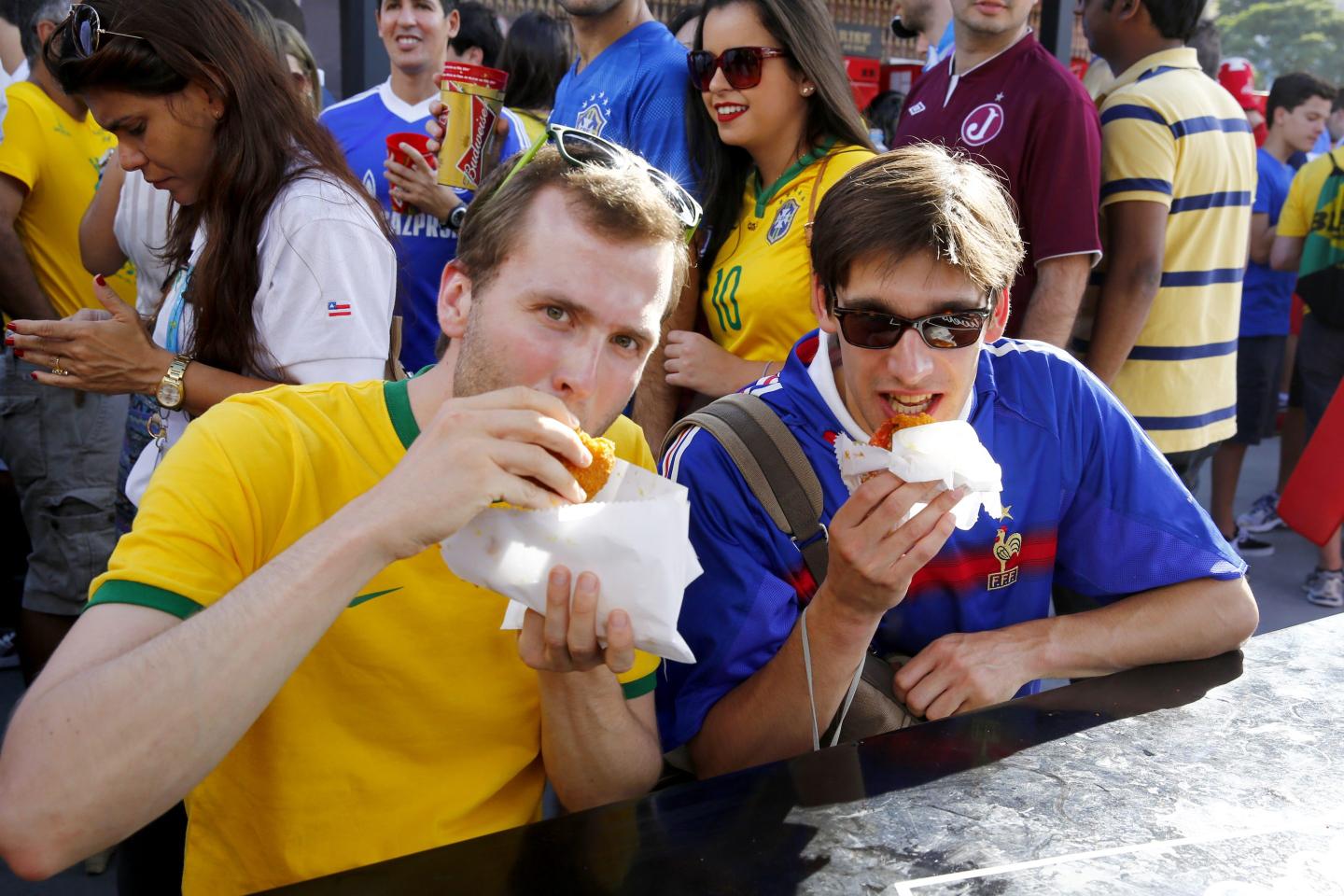
The world came to America for soccer and discovered ranch dressing.
As the FIFA World Cup has drawn hundreds of thousands of international fans to host cities across the U.S., a secondary tournament has broken out online — a cheerful, calorie-dense competition to see how much American food visitors can consume before their flights home. The meme has a name: the “FIFA 15,” a riff on the dreaded “Freshman 15” that college students famously pack on during their first year away from home. Swap a dormitory dining hall for a Raising Cane’s, and the joke is visitors will be packing more than extra luggage weight.
The breakout star is German soccer superfan @FreddyLA7, whose road trip from Georgia to Texas has captivated hundreds of thousands of followers eager to watch him discover America one chain restaurant at a time. Taco Bell was described as “the holy land,” a late-night Waffle House visit earned a glowing review, and Buc-ee’s left him in disbelief—he posted excited dispatches from Walmart, Wendy’s and Chili’s, while marveling at Atlanta’s greenery and struggling to choose a drink from a Coca-Cola Freestyle machine. An observer posted on X: “Man is having the most regular time and loving it.”
A group visiting Texas from Japan raved about the steak and Caesar salad. A Whataburger pilgrim deemed it “the best dining experience of my entire life.” A Norway fan tried the impossibly Bostonian combo of clam chowder with a Dunkin’ drink on the side. Houston attorney Jimmy Ardoin captured the collective mood on Threads: “He walked into a Buc-ee’s and I genuinely think he saw the face of the divine. This man is experiencing America for the first time with the wonder of a newborn and the stamina of a Navy SEAL.”
Ranch dressing has been the breakout condiment. A Swedish X user posted: “Why did no one tell me ranch sauce is like crack? EUROPE WE NEED RANCH ASAP.” After confiscating bottles at checkpoints across the country, the TSA posted on Instagram: “Days since the last airport ranch incident: 0.” Kraft pounced with a limited-edition TSA-approved travel kit. Beyond ranch, international visitors have been going wild for Dunkin, Raising Cane’s, Chipotle, Taco Bell, BBQ, steak, clam chowder, pizza, and deli sandwiches — and are already plotting how to take some of their discoveries home with them.
The joke is funny, but it’s also what governments have long attempted: culinary diplomacy.
Gastronomy as a peacekeeping tool
Food has long functioned as one of the softest and most durable forms of soft power. The terms “culinary diplomacy” and “gastrodiplomacy” have been in use since the early 2000s, popularized by public diplomacy scholars Paul Rockower and Sam Chapple-Sokol, whose basic premise is that “the easiest way to win hearts and minds is through the stomach.” The idea has been used by more than a dozen governments, but none more successfully than Thailand.
In 2002, Thailand launched a government initiative called “Global Thai,” aimed at increasing tourism and food exports to boost the country’s economy. Within a decade, the number of Thai restaurants in the world had nearly doubled, largely thanks to loans the Thai government distributed to people willing to open restaurants abroad. The Export-Import Bank of Thailand offered up to $3 million in loans for Thai nationals looking to open a restaurant abroad. Before the program began, there were roughly 5,500 Thai restaurants worldwide; in the following 10 years, that number jumped to over 10,000.
Despite Thai people making up just 0.1% of the U.S. population, there are an estimated 10,000 Thai restaurants across the country—a ratio that didn’t happen by accident. A study found that for every million people who dine at a Thai restaurant globally, roughly 100,000 will eventually visit Thailand, and since Global Thai launched, the country has seen a 200% increase in tourism, with nearly a third of new tourists citing food as a critical reason for their trip.
Scholars of culinary tourism—a field that examines food as both a destination and a diplomatic instrument—say this kind of exchange follows a predictable pattern. Lucy Long, a folklorist at Bowling Green State University who coined the term “culinary tourism” and wrote the field’s foundational text, has argued that the desire to experience “otherness” through food is one of the most powerful and underestimated drivers of cross-cultural connection.
Krishnendu Ray, a food studies professor at NYU and author of The Ethnic Restaurateur, has spent his career documenting how cuisines travel—and what it means when they land. Both would likely recognize the FIFA 15 not as a novelty, but as a case study: the same impulse that sends Americans hunting for authentic Neapolitan pizza or a conveyor-belt sushi bar in Tokyo is now sending European fans to a Waffle House at 1 a.m. and rating it a perfect 10.
Fortune has tracked how FIFA restructured the World Cup into its biggest payday ever—and how host cities are struggling to capture the windfall. But the food phenomenon is going viral: the free refills, the unlimited ice, the deli owner in a host city who handed a group of British tourists free lunch “because they came all this way.”
The U.S. has never needed to run a Global Thai-style program, and that’s because American food—with its chains, its portions, its sauces in quantities that alarm European customs officials—has exported itself through movies, television, and decades of cultural ubiquity. In a study conducted by Public Diplomacy Magazine, over half of those surveyed said eating a country’s cuisine leaves them with more positive feelings toward that country.