
• Home
  • Latest
  • Fortune 500
  • Finance
  • Tech
  • Leadership
  • Lifestyle
  • Rankings
  • Multimedia

New

Watch Fortune Daily, our new video show that brings you inside the Fortune newsroom and the boardroom

Watch Fortune Daily, our new video show that brings you inside the Fortune newsroom and the boardroom

Watch Fortune Daily, our new video show that brings you inside the Fortune newsroom and the boardroom

Watch Fortune Daily, our new video show that brings you inside the Fortune newsroom and the boardroom

Watch Fortune Daily, our new video show that brings you inside the Fortune newsroom and the boardroom

Watch Fortune Daily, our new video show that brings you inside the Fortune newsroom and the boardroom

Watch Fortune Daily, our new video show that brings you inside the Fortune newsroom and the boardroom

Watch Fortune Daily, our new video show that brings you inside the Fortune newsroom and the boardroom

Watch Fortune Daily, our new video show that brings you inside the Fortune newsroom and the boardroom

Watch Fortune Daily, our new video show that brings you inside the Fortune newsroom and the boardroom

HealthCancer

The U.S. cut cancer deaths by 34% since 1991—but not in 458 rural counties

By
Arthur Cosby
Arthur Cosby
and
The Conversation
The Conversation
Down Arrow Button Icon
By
Arthur Cosby
Arthur Cosby
and
The Conversation
The Conversation
Down Arrow Button Icon
June 23, 2026, 2:07 PM ET
dr
Rural counties are struggling with cancer.Getty Images
Add Fortune on Google for similar content.

Cancer in the United States experienced a dramatic turnaround in 1991. Prior to that year, cancer deaths had been increasing for decades, peaking at 215 deaths per 100,000 people, meaning about 1 in 4 deaths were attributed to cancer. Then it began to consistently decline, decreasing by 34% between 1991 and 2022. This amounted to an estimated 4.5 million fewer cancer deaths during that period.

Recommended Video

When the second-most frequent cause of death in the nation begins to decline, the effects are considerable. Improvements in cancer screening, treatment and prevention have led to increases in longevity and well-being.

In a diverse country, however, not everyone or every place benefits equally from improvements in health and medicine. In coordination with my colleague Viswadeep Lebakula, research from my team of social scientists and I found that where people live can profoundly influence their chances of dying from cancer.

Rural mortality penalty

While national data on cancer deaths can provide a useful report card on how successful a country has been on improving its health, it can also mask large geographic differences.

My team and I examined cancer deaths rates for almost 3,000 U.S. counties between 1981 and 2019. By looking at cancer mortality at the county level, we found a more complex picture of changing cancer death patterns than just examining the country overall.

Specifically, geographic differences between who benefited from the medical and public health improvements that reduced cancer deaths were stark.

Large urban centers along both the Atlantic and Pacific coasts consistently had the highest rates of cancer improvements. The heavily populated corridor from Boston to Washington, D.C., had steep declines in cancer deaths. For example, the four largest boroughs in New York City – Manhattan, Queens, Bronx and Brooklyn – saw cancer death rates decline over 40% between 1991 and 2019. The largest and wealthiest borough, Manhattan, had the highest improvement at 47% fewer deaths.

Similarly, large coastal urban centers, such as Miami, the San Francisco Bay Area, Los Angeles, San Diego and Seattle, saw very large improvements in cancer mortality. In the San Francisco Bay Area, for example, wealthy urban counties had decreases in cancer rates that substantially exceeded the national rate of 34%. Specifically, Marin County saw a 47% decline, San Mateo County a 44% decline and San Francisco County a 40% decline.
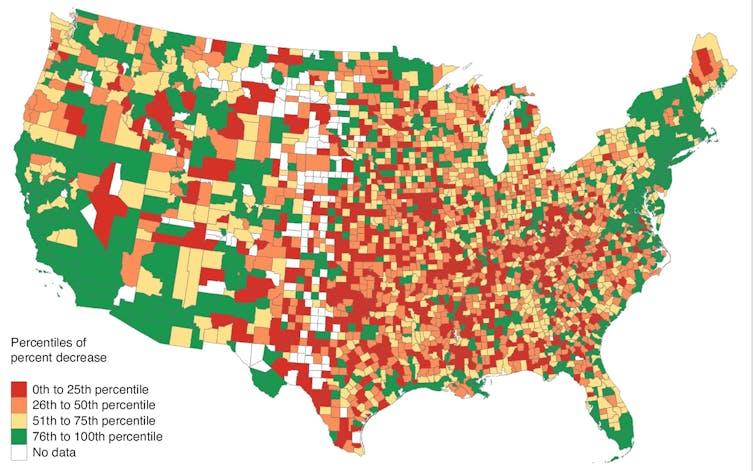
It is a much different story for rural counties in the middle of the country.

Prior to 1991, rural and urban America generally shared similar rates of cancer mortality. When the national rate started to decline, however, rural and small-town America lagged behaind large urban centers. These nonmetropolitan areas had much lower rates of declining cancer deaths: 20% for Mississippi, 23% for Arkansas, 24% for West Virginia and 29% for Montana. Around 458 rural counties even experienced increasing cancer mortality.

Notably, these differences in cancer mortality between rural and urban counties were originally small and only began to increase when overall national cancer rates began to drop. The cancer rate in rural, small-town America was improving overall, but metropolitan America was improving substantially faster.

These disparities suggest that the medical and social changes leading to reduced cancer mortality were concentrated in more metropolitan regions.

Higher income, fewer cancer deaths

We found that county median family income had a strong influence on cancer death rates.

When cancer death rates peaked in 1991, there was initially little difference between counties with the highest and lowest income levels. By 2019, the 10% of the U.S. population living in counties with the highest median incomes had mortality improvements approximately seven times greater than the 10% living in the lowest-income counties.

The overall pattern was very clear: As county income increased, improvements in cancer mortality increased. Counties with the least financial capacity to deal with the burden of cancer saw the least improvement.

The American Cancer Society and the Centers for Disease Control and Prevention have identified multiple factors underlying declining cancer death rates. These include advances in cancer prevention, screening and treatment. But there are considerable county and state differences in the adoption of preventive measures and access to cancer services.
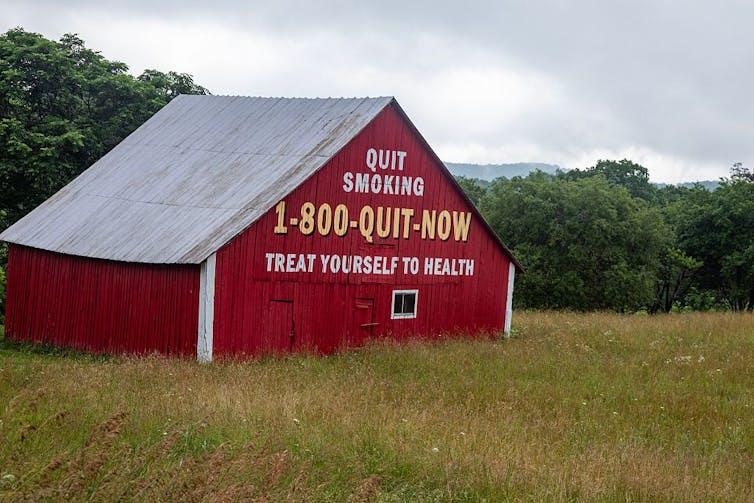
For example, lung cancer is the leading cause of cancer deaths and has seen the strongest decline in death rates. Tobacco control strategies – smoking cessation programs, health warnings, increased taxes on tobacco products, bans on tobacco purchases by minors and smoking in public place – have been especially successful in reducing deaths from lung cancer. Geographic differences in adoption of these tobacco control measures can partially explain why some places have higher cancer death rates compared to others, especially for lung cancer.

For example, New York City aggressively instituted tobacco control measures, and the results show. My team found that New York’s Manhattan borough had 60% fewer lung cancer deaths in 2019 compared to 1991. At the same time, many states and counties – often rural and less affluent – have adopted fewer and weaker tobacco control measures. Rural communities often have higher smoking rates and exposure to tobacco smoke in the home, along with fewer smoke-free laws and less support for tobacco control policies.

Innovation over access

Cancer can devastate families and communities, both emotionally and economically. The U.S. has become more successful in developing innovations to treat cancer than in equitably distributing these innovations across the nation.

While most of the U.S. is experiencing improvements in cancer mortality, these benefits are greatest in urban and wealthy areas. Developing tobacco control policies and screening techniques tailored to rural settings, as well as increasing access to advanced treatments in rural and poor settings, could help improve cancer mortality for more people.

Will the gap between rural and urban America – and the gap between rich and poor America – decline or grow? Answering this question will require a better understanding of the unique needs of everyday people in their communities.

Arthur Cosby, Professor of Sociology, Mississippi State University

This article is republished from The Conversation under a Creative Commons license. Read the original article.

The Conversation

The Conversation

Fortune Daily breaks the traditional barrier between audience and newsroom. The show transforms Fortune’s trusted reporting into actionable, conversational, and entertaining insights for an emerging class of business leaders. Watch here.
About the Authors
By Arthur Cosby
See full bioRight Arrow Button Icon
By The Conversation
See full bioRight Arrow Button Icon
Add Fortune on Google for similar content.

Latest in Health

Finance
Lorem ipsum dolor sit amet, consectetur adipiscing elit, sed do eiusmod tempor incididunt ut labore et dolore magna aliqua. Ut enim ad minim veniam
By Fortune Editors
October 20, 2025
Finance
Lorem ipsum dolor sit amet, consectetur adipiscing elit, sed do eiusmod tempor incididunt ut labore et dolore magna aliqua. Ut enim ad minim veniam
By Fortune Editors
October 20, 2025
Finance
Lorem ipsum dolor sit amet, consectetur adipiscing elit, sed do eiusmod tempor incididunt ut labore et dolore magna aliqua. Ut enim ad minim veniam
By Fortune Editors
October 20, 2025
Finance
Lorem ipsum dolor sit amet, consectetur adipiscing elit, sed do eiusmod tempor incididunt ut labore et dolore magna aliqua. Ut enim ad minim veniam
By Fortune Editors
October 20, 2025
Finance
Lorem ipsum dolor sit amet, consectetur adipiscing elit, sed do eiusmod tempor incididunt ut labore et dolore magna aliqua. Ut enim ad minim veniam
By Fortune Editors
October 20, 2025
Finance
Lorem ipsum dolor sit amet, consectetur adipiscing elit, sed do eiusmod tempor incididunt ut labore et dolore magna aliqua. Ut enim ad minim veniam
By Fortune Editors
October 20, 2025

Most Popular

Finance
Lorem ipsum dolor sit amet, consectetur adipiscing elit, sed do eiusmod tempor incididunt ut labore et dolore magna aliqua. Ut enim ad minim veniam
By Fortune Editors
October 20, 2025
Finance
Lorem ipsum dolor sit amet, consectetur adipiscing elit, sed do eiusmod tempor incididunt ut labore et dolore magna aliqua. Ut enim ad minim veniam
By Fortune Editors
October 20, 2025
Finance
Lorem ipsum dolor sit amet, consectetur adipiscing elit, sed do eiusmod tempor incididunt ut labore et dolore magna aliqua. Ut enim ad minim veniam
By Fortune Editors
October 20, 2025
Finance
Lorem ipsum dolor sit amet, consectetur adipiscing elit, sed do eiusmod tempor incididunt ut labore et dolore magna aliqua. Ut enim ad minim veniam
By Fortune Editors
October 20, 2025
Finance
Lorem ipsum dolor sit amet, consectetur adipiscing elit, sed do eiusmod tempor incididunt ut labore et dolore magna aliqua. Ut enim ad minim veniam
By Fortune Editors
October 20, 2025
Finance
Lorem ipsum dolor sit amet, consectetur adipiscing elit, sed do eiusmod tempor incididunt ut labore et dolore magna aliqua. Ut enim ad minim veniam
By Fortune Editors
October 20, 2025
Fortune Secondary Logo
Rankings
  • 100 Best Companies
  • Fortune 500
  • Global 500
  • Fortune 500 Europe
  • Most Powerful Women
  • World's Most Admired Companies
  • See All Rankings
  • Lists Calendar
Sections
  • Finance
  • Fortune Crypto
  • Features
  • Leadership
  • Health
  • Commentary
  • Success
  • Retail
  • Mpw
  • Tech
  • Lifestyle
  • CEO Initiative
  • Asia
  • Politics
  • Conferences
  • Europe
  • Newsletters
  • Personal Finance
  • Environment
  • Magazine
  • Education
Customer Support
  • Frequently Asked Questions
  • Customer Service Portal
  • Privacy Policy
  • Terms Of Use
  • Single Issues For Purchase
  • International Print
Commercial Services
  • Advertising
  • Fortune Brand Studio
  • Fortune Analytics
  • Fortune Conferences
  • Business Development
  • Group Subscriptions
About Us
  • About Us
  • Press Center
  • Work At Fortune
  • Terms And Conditions
  • Site Map
  • About Us
  • Press Center
  • Work At Fortune
  • Terms And Conditions
  • Site Map
  • Facebook icon
  • Twitter icon
  • LinkedIn icon
  • Instagram icon
  • TikTok icon
  • YouTube icon

Latest in Health

backpack
HealthEducation
Back-to-school shopping raises the new-age question: how heavy should your kids’ backpack be?
By Cheyanne Mumphrey and The Associated PressAugust 4, 2026
2 hours ago
Exclusive: Former OpenAI exec Fidji Simo discusses her battle with POTS and her startup’s plans to cure it with AI and 3,500 vials of blood (so far)
HealthOpenAI
Exclusive: Former OpenAI exec Fidji Simo discusses her battle with POTS and her startup’s plans to cure it with AI and 3,500 vials of blood (so far)
By Emily ForliniAugust 3, 2026
19 hours ago
Best Hair Serums (2026): Tested and Reviewed
HealthDietary Supplements
Best Hair Serums (2026): Tested and Reviewed
By Emily PharesAugust 3, 2026
22 hours ago
AstraZeneca said to have explored Bristol Myers merger
HealthPharmaceutical Industry
AstraZeneca said to have explored Bristol Myers merger
By Dinesh Nair, Michelle F. Davis, Ashleigh Furlong, Kelly Gilblom and BloombergAugust 2, 2026
2 days ago
Photo of Hudson Leogrande
SuccessEntrepreneurs
He was homeless at 16. Now he sits on the board of David Beckham’s wellness company and his business is about to hit $1 billion in revenue
By Emma BurleighAugust 2, 2026
2 days ago
A person walks alone in a public plaza
North Americapublic policy
Bars, bowling alleys, and movie theaters cost too much to run and visit. Americans have run out of places to hang out and we’re paying with our health
By Catherina GioinoAugust 2, 2026
2 days ago

Most Popular

Bars, bowling alleys, and movie theaters cost too much to run and visit. Americans have run out of places to hang out and we're paying with our health
North America
Bars, bowling alleys, and movie theaters cost too much to run and visit. Americans have run out of places to hang out and we're paying with our health
By Catherina GioinoAugust 2, 2026
2 days ago
Sam Altman says a 'cool use case' for ChatGPT is a daily AI podcast about your kids. The replies were brutal
AI
Sam Altman says a 'cool use case' for ChatGPT is a daily AI podcast about your kids. The replies were brutal
By Holly Van Leuven and Morning BrewAugust 3, 2026
1 day ago
How Zohran Mamdani's pied-à-terre tax exposed an epidemic of 'ghost cars' instead
Personal Finance
How Zohran Mamdani's pied-à-terre tax exposed an epidemic of 'ghost cars' instead
By Catherina GioinoAugust 4, 2026
7 hours ago
Electric air taxis are finally ready for takeoff
Magazine
Electric air taxis are finally ready for takeoff
By Alexei OreskovicAugust 3, 2026
1 day ago
Current price of oil as of August 3, 2026
Personal Finance
Current price of oil as of August 3, 2026
By Joseph HostetlerAugust 3, 2026
1 day ago
Wall Street bulls are starting to admit the earnings bubble is real—and the 60/40 portfolio may be the first casualty
Investing
Wall Street bulls are starting to admit the earnings bubble is real—and the 60/40 portfolio may be the first casualty
By Nick LichtenbergAugust 3, 2026
22 hours ago

© 2026 Fortune Media IP Limited. All Rights Reserved. Use of this site constitutes acceptance of our Terms of Use and Privacy Policy | CA Notice at Collection and Privacy Notice | Do Not Sell/Share My Personal Information
FORTUNE is a trademark of Fortune Media IP Limited, registered in the U.S. and other countries. FORTUNE may receive compensation for some links to products and services on this website. Offers may be subject to change without notice.