
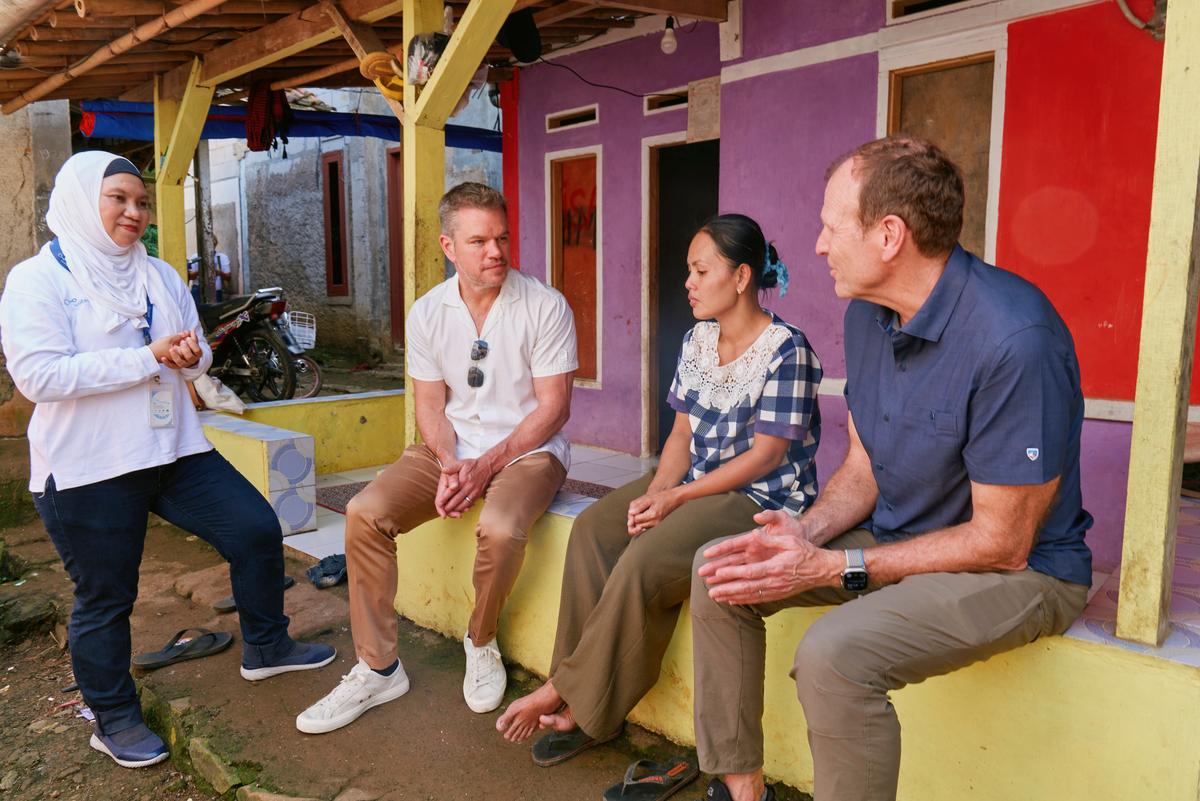
Water.org, the nonprofit co-founded by actor Matt Damon and engineer Gary White, is launching Get Blue, a consumer-facing campaign that bets corporate America’s retail footprint can do more for the global water crisis than traditional charity ever could.
Get Blue’s founding partners—Gap, Starbucks, and Amazon—are themselves significant consumers of the world’s water supply.
Gap Inc. consumed 28 billion liters of water in 2024, reducing or replenishing only 14% of what it used. A single cup of Starbucks coffee carries a virtual water footprint of roughly 140 liters, once you account for the water used to grow, produce, package, and ship the beans. Amazon, whose AWS data centers underpin much of the internet, doesn’t disclose its total water consumption. Google, which reported 6.4 billion gallons across its global data center fleet in 2023, and Microsoft, which disclosed 1.7 billion gallons the same year. Now, all three are helping solve the crisis their operations help deepen.
The initiative goes live Monday with those founding partners, alongside Ecolab, and is designed to embed water philanthropy into the mundane rhythms of consumer life: buying a t-shirt, ordering a matcha, asking Alexa a question. More than 2 billion people—roughly one in four globally—lack access to safe water at home, with many relying on hours of daily walking or unsafe sources.
The campaign’s mechanics hinge on Water.org’s WaterCredit model: proceeds funnel to local financial partners that issue small, affordable loans so families can finance pipes, pumps, or plumbing. Five dollars funds access for one person; $25 for a family. The loans repay at a 98% rate, meaning capital revolves—one family’s repayment seeds the next family’s loan. Water.org says it has reached more than 90 million people and is targeting 200 million by 2030.
Gap is launching a limited-edition capsule collection—denim, tees, and sweats across adult, kids, and toddler lines—with $5 per purchase going to Water.org. The company has saved more than 6 billion liters of water across its supply chain since 2016 and has set a 2030 goal of reducing and replenishing water equivalent to 100% of what it uses in manufacturing and company operations.
Starbucks follows June 16 with two new summer drinks—the Iced Blue Coconut Matcha and the Blue Coconut Refresher, both made with blue spirulina—donating $0.25 per purchase through July 7. Starbucks’ Greener Stores program has already reduced annual water use by more than 30%, saving more than 1.3 billion gallons annually. The company has committed to cutting its total water footprint by 50% by 2030.
Amazon’s Alexa+ users can trigger a $5 donation with a voice command at no cost; streams of participating artists’ REDISCOVER playlists on Amazon Music generate $1 per play; and a dedicated Get Blue storefront funnels a portion of purchases to the cause. AWS reported being 53% of the way toward its goal of becoming water positive by 2030, having improved water use efficiency 40% over three years.
Ecolab is pledging $1 million through its foundation: $500,000 immediately, the rest contingent on helping customers achieve 255 billion gallons of water savings this year. AccuWeather, Ripple, and TikTok round out the coalition, with Ripple deploying its RLUSD stablecoin to move funds faster to Water.org’s microfinance partners in emerging markets.
AI demand driving water consumption
Get Blue does not directly address industrial water consumption. Its founders are focused on the 2 billion people who lack access to safe water entirely. But it is launching into a moment when water scarcity has moved from a humanitarian abstraction to a front-page fight—and when the companies being recruited to help are under growing scrutiny for their own footprints.
U.S. data centers directly consumed 17.4 billion gallons of water in 2023, a figure projected to rise to 38 billion-73 billion gallons by 2028, according to the EPA. Communities from rural Georgia to the Arizona desert have begun pushing back. As Fortune reported in May, data center developers in both states were caught taking public water without authorization.
Americans now say they’d sooner live near a nuclear power plant than a data center, according to Gallup. Fortune has reported the facilities cost the U.S. economy an estimated $25 billion annually in hidden health and environmental damage, and account for roughly 50% of all U.S. electricity demand growth—electricity that itself requires vast amounts of water to generate.
‘The Nomad’
To launch publicly, Damon is leaning into absurdism: a rap video in which he performs under the moniker “The Nomad”—his last name spelled backwards—alongside Grammy-winning producer Hit-Boy and songwriter Teddy Walton. A companion TikTok challenge, #GetBlue, asks users to film themselves changing one thing blue and nominate others, modeled on the Ice Bucket Challenge.
“When brands join us, they invite their communities into this work,” said Gary White, Water.org’s CEO. “That is how progress happens—one person, one action at a time.”
Whether cause marketing at this scale can outlast a summer is the open question. Water.org is betting that embedding Get Blue into the ongoing commercial infrastructure of Amazon and Starbucks builds something more permanent.
For this story, Fortune used generative AI to help with an initial draft. An editor verified the accuracy of the information before publishing.