

Across Dayton, Ohio, city workers are pulling black trash bags over dozens of automatic license plate readers previously installed by the local government, rendering the devices useless.
The move comes after city officials suspended the use of these Flock Safety cameras over concerns the system’s data was being used for immigration enforcement.
Last month, the Dayton Police Department announced the city would no longer use Flock’s data after it found more than 7,000 cases of searches relating to immigration enforcement made by outside entities. Cities officials called the cases “egregious violations of policy” that prohibited data from the devices from being used for immigration enforcement or shared with agencies “whose primary purpose is to enforce immigration laws.” Dayton appropriated an extra $30,000 for an audit of Flock camera data logs.
Joe Parlette, Dayton’s deputy city manager, said at a city commission meeting last month the Dayton Policy Department would work with the city to cover the cameras until they could be removed. The Dayton Daily News first reported on workers putting trash bags over the devices. Representatives for Dayton did not respond to Fortune’s request for comment, but confirmed to the Dayton Daily News that all 72 of the city’s fixed-site ALPR cameras have been covered, and the cameras have not been active following suspension of the program. The purpose of bagging the cameras despite their inoperability was to assuage community concerns about the devices.
Automatic license plate readers (ALPRs), such as Flock, use optical character recognition to identify numbers and letters on a license plate. While the technology was intended to identify vehicles in safety scenarios, such as Amber Alerts or missing plates, it has increasingly been associated with a number of alleged privacy violations, part of a growing nationwide concern about AI technology being used for widespread surveillance. Evanston, Ill., officials confirmed in September 2025 the city bagged its Flock cameras, the Evanston Round Table reported. The decision followed an announcement from Illinois Secretary of State Alexi Giannoulias that Flock allowed U.S. Customs and Border Protection to access cameras in the state as part of a “pilot program” that violated state law.
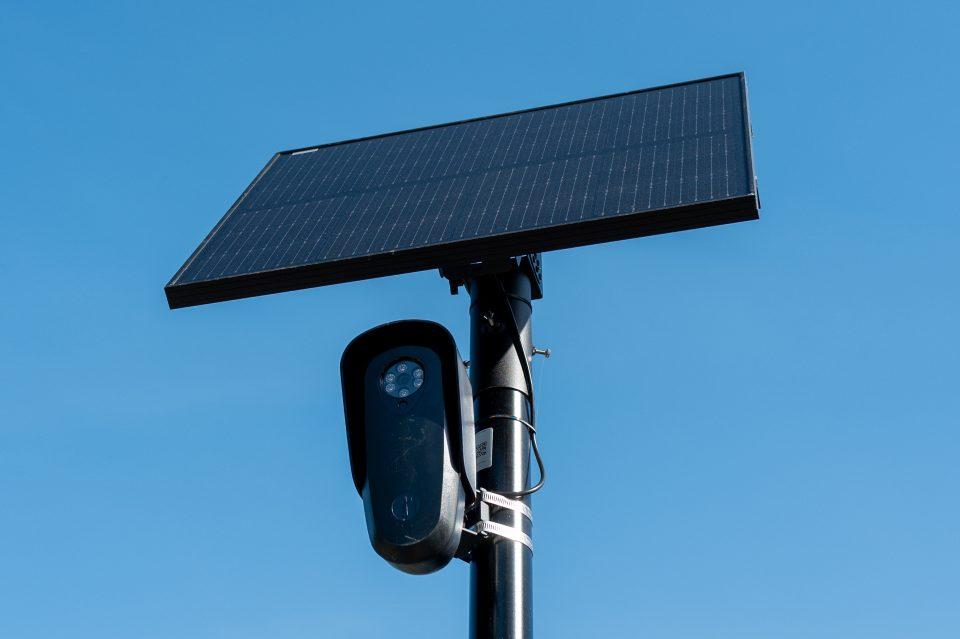
Oxnard, Calif., similarly suspended its Flock technology after an audit found the vendor enabled a “nationwide query” that gave agencies outside of California access to the Oxnard Police Department’s data without the department’s approval or knowledge, despite the security settings being set to “California only” access. Renton, Wash., officials announced last month they would “put a pause on” the use of Flock cameras until the city better understood the privacy concerns surrounding the technology after public outcry over Flock data being used for immigration enforcement.
Flock denies having any contracts with ICE or any other federal immigration agency and said the ability to give data access to certain entities depends on the law and legislation of the city or state where a customer is located.
“At Flock, we believe safety and privacy should go hand in hand, which is why our technology is built around transparency, accountability, and local control,” a Flock spokesperson said in a statement to Fortune. “Our customers own and control their data, which is deleted after 30 days by default. Our platform includes safeguards like audit trails to help ensure accountability at every step. Every day, Flock supports communities across the country in addressing crime and locating missing people.”
Privacy advocates are sounding the alarm
ALPRs have been around for years, but increased scrutiny of the devices come amid a surge in ICE activity across the U.S. as part of the Trump administration’s crackdown on undocumented immigrants. The influx of ICE raids are largely unpopular, with about 60% of Americans saying President Donald Trump went “too far” sending ICE agents to American cities, according to a February AP-NORC poll.
“People may not have realized that for years these systems have been working,” Tom Bowman, the policy counsel for the Center of Democracy and Technology’s Security & Surveillance Project, told Fortune. “It was only once they saw ICE officials or CBP officials in their own communities that they realized that this data was leaking out from their immediate jurisdiction, and that really forced it into attention.”
ICE did not respond to Fortune’s request for comment.
Digital privacy advocates like Bowman warn that despite Flock not having direct business with immigration enforcement entities like ICE, the company has enabled agencies to gain access to a jurisdiction’s data through “side-door handshakes.” This could look like law enforcement making immigration-related searches on school-district-owned cameras, according to Rachel Levinson-Waldman, director of New York University’s Brennan Center’s Liberty and National Security Program. Flock denied any loopholes in contracts that could enable this access.
“It’s generally flowing from the bottom up,” Levinson-Waldman told Fortune. “So either it’s a local jurisdiction that’s allowing access to a camera, or it’s a jurisdiction that’s doing a search at the request of an immigration agency or component.”
For residents, the potentially unfettered access of law enforcement to camera data raises concerns around safety. For local governments, suspending the technology after finding a policy violation is also a waste of resources, Bowman said. Dayton approved $825,750 on spending on 35 new Flock cameras in 2024 and was awarded a $90,000 grant for 27 more devices earlier this year.
“In many cases, these cities are caught in a contractual trap where the cities have signed multimillion dollar contracts with Flock without realizing that they lacked legal or technical mechanisms to force Flock to actually shut down the cameras upon cancellation,” he said. “These legal disputes over contract termination clauses have left cameras active during months of bureaucratic and legal gridlock.”
Levinson-Waldman and Bowman have called for retention limits for how long data is stored in ALPR systems, as well as restrictions on data access and sharing, but legislation limiting ALPR use has been sparse. Last month, the House Committee on Transportation and Infrastructure defeated an amendment to the BUILD America 250 Act that would have prohibited recipients of federal highway funding from using ALPRs for reasons besides tolling.
In some instances, Bowman said, ALPRs can do real good, like for an Amber Alert or finding a missing person. However, the repeated suspensions of the devices suggest the risks currently outweigh the benefits.
“If we’re not going to get sensible guardrails for these systems,” Bowman said, “maybe we shouldn’t be using these systems at all.”