• Home
  • Latest
  • Fortune 500
  • Finance
  • Tech
  • Leadership
  • Lifestyle
  • Rankings
  • Multimedia

Trendingnow

1

Anne Hathaway says she was spammed with ChatGPT-written thank you notes after hiring for a recent role: ‘Nobody on that list gets that job’

2

The affordability crisis is so bad that, for the first time ever, both mom and dad are working full-time in most American families

3

Current price of oil as of June 18, 2026

1

Anne Hathaway says she was spammed with ChatGPT-written thank you notes after hiring for a recent role: ‘Nobody on that list gets that job’

2

The affordability crisis is so bad that, for the first time ever, both mom and dad are working full-time in most American families

3

Current price of oil as of June 18, 2026
CybersecurityLaw

Taylor Swift just exposed a blind spot in AI law — and it’s bigger than copyright

By
Daryl Lim
Daryl Lim
and
The Conversation
The Conversation
Down Arrow Button Icon
By
Daryl Lim
Daryl Lim
and
The Conversation
The Conversation
Down Arrow Button Icon
May 30, 2026, 7:57 AM ET
ts
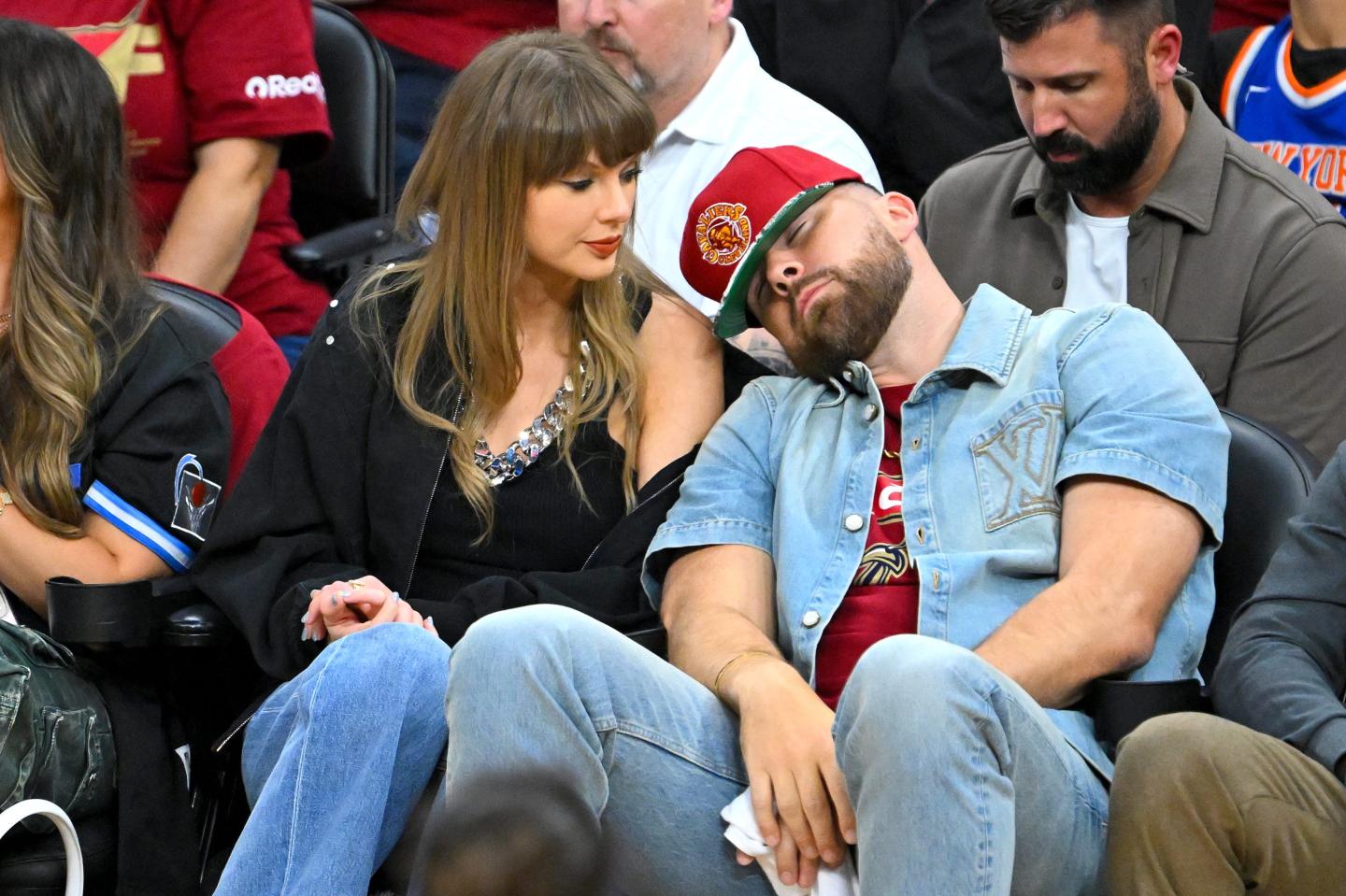
Travis Kelce (R) of the Kansas City Chiefs reacts as Singer Taylor Swift (L) looks on during the fourth quarter in Game Three between the New York Knicks and the Cleveland Cavaliers in the NBA Eastern Conference Finals at Rocket Arena on May 23, 2026 in Cleveland, Ohio. Jason Miller/Getty Images
Add Fortune on Google for similar content.

As one of the most popular celebrities in the world, Taylor Swift has already endured her share of AI-related abuse.

Recommended Video

Fake nudes of the singer have spread widely online. Her voice and likeness have also been used to create fabricated political messages and bogus product endorsements.

In April 2026, Swift pushed back. Her intellectual property and brand management company, TAS Rights Management, filed trademark applications covering short audio clips of her voice and her visual likeness.

As a law professor, I was struck by Swift’s filings because they highlight a new legal frontier in artificial intelligence.

Most AI-related litigation has centered on copyright law, which protects creative works such as songs, books, photographs and recordings from being copied, distributed, adapted or publicly performed without permission.

But TAS Rights Management’s recent move involves trademark law, not copyright. The filings aren’t really about protecting Swift’s lyrics or albums. Instead, they’re about preventing AI-generated voices and images from misleading people into believing she has endorsed a product, political message or cause.

Copyright is about creative works

Most AI-related lawsuits have been tied to whether copyright violations have taken place – specifically, whether AI companies used copyrighted works to train their systems, or whether their chatbots have produced outputs that too closely resemble protected material.

For example, The New York Times sued OpenAI and Microsoft in 2023, alleging that the companies used the outlet’s journalism to train their AI systems, which then went on to generate outputs that have competed with or reproduced New York Times articles. Authors, publishers, photo agencies and music publishers have sued other AI companies for the same reason.

But copyright violations are only one part of the legal issues raised by generative AI.

Copyright doesn’t necessarily protect a person’s identity. It does not give Swift a general right to control anything that sounds like her, looks like her or evokes her in the minds of audiences.

If an AI-generated voice imitates Swift without copying a particular recording, song or lyric, copyright may not address the real issue, which is that people are being led to believe she said, sang or endorsed something she never approved.

Trademarks are about trust

Trademark law starts from a different concern. It protects names, images, sounds and other markers that help consumers identify who or what is behind a product or service.

A trademark can be a word, phrase, symbol, design or combination of these things. Familiar examples include brand names such as Coca-Cola, logos like the Nike swoosh, slogans like Subway’s “Eat Fresh” and even distinctive sounds, such as the MGM lion roar.

A red banner featuring the Coca-Cola logo and the text 'FIFA World Cup 26.'
FIFA uses a ‘TM’ wordmark in its 2026 World Cup logo, meaning soccer’s world governing body is claiming the logo as a trademark. Coca-Cola features a small ‘R’ with a circle around it at the end of its iconic cursive logo to indicate that it has registered the design as a trademark with the United States Patent and Trademark Office. Steve Russell/Toronto Star via Getty Images

A trademark is not a general ownership right over a word, phrase, voice or image. It is a way of helping consumers know who stands behind what they are buying, hearing or seeing.

That difference becomes crucial once AI can mimic a person’s voice or face. Suppose a company uses an AI-generated Swift-like voice to sell perfume or cryptocurrency. The concern is that listeners may think Swift approved of the product or message.

That is a trademark problem. Trademark law asks whether the use misleads consumers about whether a company or person has produced or endorsed something. Swift’s filings appear aimed at that danger. They suggest a concern beyond copied songs: fake endorsements, fake appearances and fake signals of approval.

Swift’s concerns also bleed into what are known as “publicity rights,” which generally protect against unauthorized commercial use of a person’s identity, such as a name, image, likeness or voice.

A classic publicity rights case involves a company using a celebrity’s face in an advertisement without permission to mislead consumers into believing the celebrity endorses the product.

AI’s ability to clone voices and images makes publicity law especially relevant. But in the United States, publicity rights are mostly governed by state law, and the rules vary widely from one state to another. That patchwork helped inspire the bipartisan NO FAKES Act, introduced in 2025, which would create a national standard that would prohibit unauthorized AI-generated replicas of a person’s voice or visual likeness. The bill, still in its early stages, has been referred to the Senate Judiciary Committee for consideration.

The untested part

Swift is not alone: Actor Matthew McConaughey trademarked “alright alright alright,” his memorable line from “Dazed and Confused,” to protect it from being used in AI-generated content.

The courts have already affirmed that sounds can function as trademarks. But it isn’t clear whether trademark law can police AI-generated replicas of a person’s voice or image when the issue is not counterfeiting but a manufactured endorsement.

A person’s voice or likeness is not automatically a trademark. In order to qualify as one, it must be used help consumers identify who is behind a product or service.

One existing limit on trademark protection is especially important. Federal law protects certain uses of a celebrity’s image and likeness in cases involving parody, criticism, commentary and news reporting. Not every imitation is a form of deception.

Courts will have to draw that line on a case-by-case basis. A fake ad that makes consumers think Swift endorsed a product is different from a parody that comments on celebrity culture. A scam using her voice is different from a news story about AI deepfakes.

That said, Swift’s filings reflect a real problem: AI has allowed fake endorsements to look and sound real enough to spread before anyone has time to set the record straight.

Major AI copyright cases will continue to focus on copied works. But when AI is used to manufacture identity, endorsement or trust, copyright alone is no longer enough. Swift’s filings suggest that AI law will increasingly focus not only on protecting the work of musicians, writers, journalists and artists, but also on protecting the signals that tell audiences who is really speaking.

Daryl Lim, Associate Dean for Research and Strategic Partnerships, Penn State

This article is republished from The Conversation under a Creative Commons license. Read the original article.

The Conversation
Subscribe to Fortune Gulf Brief. Every Tuesday, this new newsletter delivers clear-eyed, authoritative intelligence on the deals, decisions, policies, and power shifts shaping one of the world’s most consequential regions, written for the people who need to act on it. Sign up here.
About the Authors
By Daryl Lim
See full bioRight Arrow Button Icon
By The Conversation
See full bioRight Arrow Button Icon
Add Fortune on Google for similar content.

Latest in Cybersecurity

Finance
Lorem ipsum dolor sit amet, consectetur adipiscing elit, sed do eiusmod tempor incididunt ut labore et dolore magna aliqua. Ut enim ad minim veniam
By Fortune Editors
October 20, 2025
Finance
Lorem ipsum dolor sit amet, consectetur adipiscing elit, sed do eiusmod tempor incididunt ut labore et dolore magna aliqua. Ut enim ad minim veniam
By Fortune Editors
October 20, 2025
Finance
Lorem ipsum dolor sit amet, consectetur adipiscing elit, sed do eiusmod tempor incididunt ut labore et dolore magna aliqua. Ut enim ad minim veniam
By Fortune Editors
October 20, 2025
Finance
Lorem ipsum dolor sit amet, consectetur adipiscing elit, sed do eiusmod tempor incididunt ut labore et dolore magna aliqua. Ut enim ad minim veniam
By Fortune Editors
October 20, 2025
Finance
Lorem ipsum dolor sit amet, consectetur adipiscing elit, sed do eiusmod tempor incididunt ut labore et dolore magna aliqua. Ut enim ad minim veniam
By Fortune Editors
October 20, 2025
Finance
Lorem ipsum dolor sit amet, consectetur adipiscing elit, sed do eiusmod tempor incididunt ut labore et dolore magna aliqua. Ut enim ad minim veniam
By Fortune Editors
October 20, 2025

Most Popular

Finance
Lorem ipsum dolor sit amet, consectetur adipiscing elit, sed do eiusmod tempor incididunt ut labore et dolore magna aliqua. Ut enim ad minim veniam
By Fortune Editors
October 20, 2025
Finance
Lorem ipsum dolor sit amet, consectetur adipiscing elit, sed do eiusmod tempor incididunt ut labore et dolore magna aliqua. Ut enim ad minim veniam
By Fortune Editors
October 20, 2025
Finance
Lorem ipsum dolor sit amet, consectetur adipiscing elit, sed do eiusmod tempor incididunt ut labore et dolore magna aliqua. Ut enim ad minim veniam
By Fortune Editors
October 20, 2025
Finance
Lorem ipsum dolor sit amet, consectetur adipiscing elit, sed do eiusmod tempor incididunt ut labore et dolore magna aliqua. Ut enim ad minim veniam
By Fortune Editors
October 20, 2025
Finance
Lorem ipsum dolor sit amet, consectetur adipiscing elit, sed do eiusmod tempor incididunt ut labore et dolore magna aliqua. Ut enim ad minim veniam
By Fortune Editors
October 20, 2025
Finance
Lorem ipsum dolor sit amet, consectetur adipiscing elit, sed do eiusmod tempor incididunt ut labore et dolore magna aliqua. Ut enim ad minim veniam
By Fortune Editors
October 20, 2025
Fortune Secondary Logo
Rankings
  • 100 Best Companies
  • Fortune 500
  • Global 500
  • Fortune 500 Europe
  • Most Powerful Women
  • World's Most Admired Companies
  • See All Rankings
  • Lists Calendar
Sections
  • Finance
  • Fortune Crypto
  • Features
  • Leadership
  • Health
  • Commentary
  • Success
  • Retail
  • Mpw
  • Tech
  • Lifestyle
  • CEO Initiative
  • Asia
  • Politics
  • Conferences
  • Europe
  • Newsletters
  • Personal Finance
  • Environment
  • Magazine
  • Education
Customer Support
  • Frequently Asked Questions
  • Customer Service Portal
  • Privacy Policy
  • Terms Of Use
  • Single Issues For Purchase
  • International Print
Commercial Services
  • Advertising
  • Fortune Brand Studio
  • Fortune Analytics
  • Fortune Conferences
  • Business Development
  • Group Subscriptions
About Us
  • About Us
  • Press Center
  • Work At Fortune
  • Terms And Conditions
  • Site Map
  • About Us
  • Press Center
  • Work At Fortune
  • Terms And Conditions
  • Site Map
  • Facebook icon
  • Twitter icon
  • LinkedIn icon
  • Instagram icon
  • Pinterest icon

Latest in Cybersecurity

The week that changed AI: Inside Trump’s Anthropic crackdown, and how a phone call from Amazon CEO Andy Jassy triggered the chaos
AIAnthropic
The week that changed AI: Inside Trump’s Anthropic crackdown, and how a phone call from Amazon CEO Andy Jassy triggered the chaos
By Sebastian Herrera and Beatrice NolanJune 18, 2026
14 hours ago
Half of U.S. adults under 50 get health information from influencers who mostly aren’t medical professionals, Pew finds
HealthSocial Media
Half of U.S. adults under 50 get health information from influencers who mostly aren’t medical professionals, Pew finds
By Mia OsmonbekovJune 18, 2026
17 hours ago
Gary Lockwood talks to Keir Dullea in a scene from the film '2001: A Space Odyssey', 1968.
AIGoogle DeepMind
Google DeepMind unveils plan to protect itself from its own rogue AI agents
By Jeremy KahnJune 18, 2026
1 day ago
World Cup, America 250 face new risk with spy law lapse
CybersecurityWorld Cup
World Cup, America 250 face new risk with spy law lapse
By Caitlin Reilly, Roxana Tiron and BloombergJune 17, 2026
2 days ago
The global under-16 social media ban Is no longer a fringe policy
EuropeSocial Media
The global under-16 social media ban Is no longer a fringe policy
By The Associated PressJune 17, 2026
2 days ago
Anthropic CEO Dario Amodei speaking into a microphone.
NewslettersEye on AI
Decision on Anthropic’s Fable and Mythos models means the U.S. has a licensing regime for frontier AI—it just doesn’t want to admit it
By Jeremy KahnJune 16, 2026
3 days ago

Most Popular

Anne Hathaway says she was spammed with ChatGPT-written thank you notes after hiring for a recent role: ‘Nobody on that list gets that job’
Success
Anne Hathaway says she was spammed with ChatGPT-written thank you notes after hiring for a recent role: ‘Nobody on that list gets that job’
By Orianna Rosa RoyleJune 18, 2026
1 day ago
The affordability crisis is so bad that, for the first time ever, both mom and dad are working full-time in most American families
Economy
The affordability crisis is so bad that, for the first time ever, both mom and dad are working full-time in most American families
By Jacqueline MunisJune 17, 2026
2 days ago
Current price of oil as of June 18, 2026
Personal Finance
Current price of oil as of June 18, 2026
By Joseph HostetlerJune 18, 2026
1 day ago
Hundreds of Stanford students walked out of their grad ceremony to protest Google CEO’s commencement speech. It wasn’t all about AI
Big Tech
Hundreds of Stanford students walked out of their grad ceremony to protest Google CEO’s commencement speech. It wasn’t all about AI
By Tristan BoveJune 15, 2026
4 days ago
Microsoft boss Steve Ballmer publicly dismissed Chrome as a 'rounding error'—but Google’s CEO says he used the jab as fuel to win the browser-wars
Success
Microsoft boss Steve Ballmer publicly dismissed Chrome as a 'rounding error'—but Google’s CEO says he used the jab as fuel to win the browser-wars
By Preston ForeJune 17, 2026
2 days ago
Current price of gold as of June 18, 2026
Personal Finance
Current price of gold as of June 18, 2026
By Danny BakstJune 18, 2026
1 day ago

© 2026 Fortune Media IP Limited. All Rights Reserved. Use of this site constitutes acceptance of our Terms of Use and Privacy Policy | CA Notice at Collection and Privacy Notice | Do Not Sell/Share My Personal Information
FORTUNE is a trademark of Fortune Media IP Limited, registered in the U.S. and other countries. FORTUNE may receive compensation for some links to products and services on this website. Offers may be subject to change without notice.