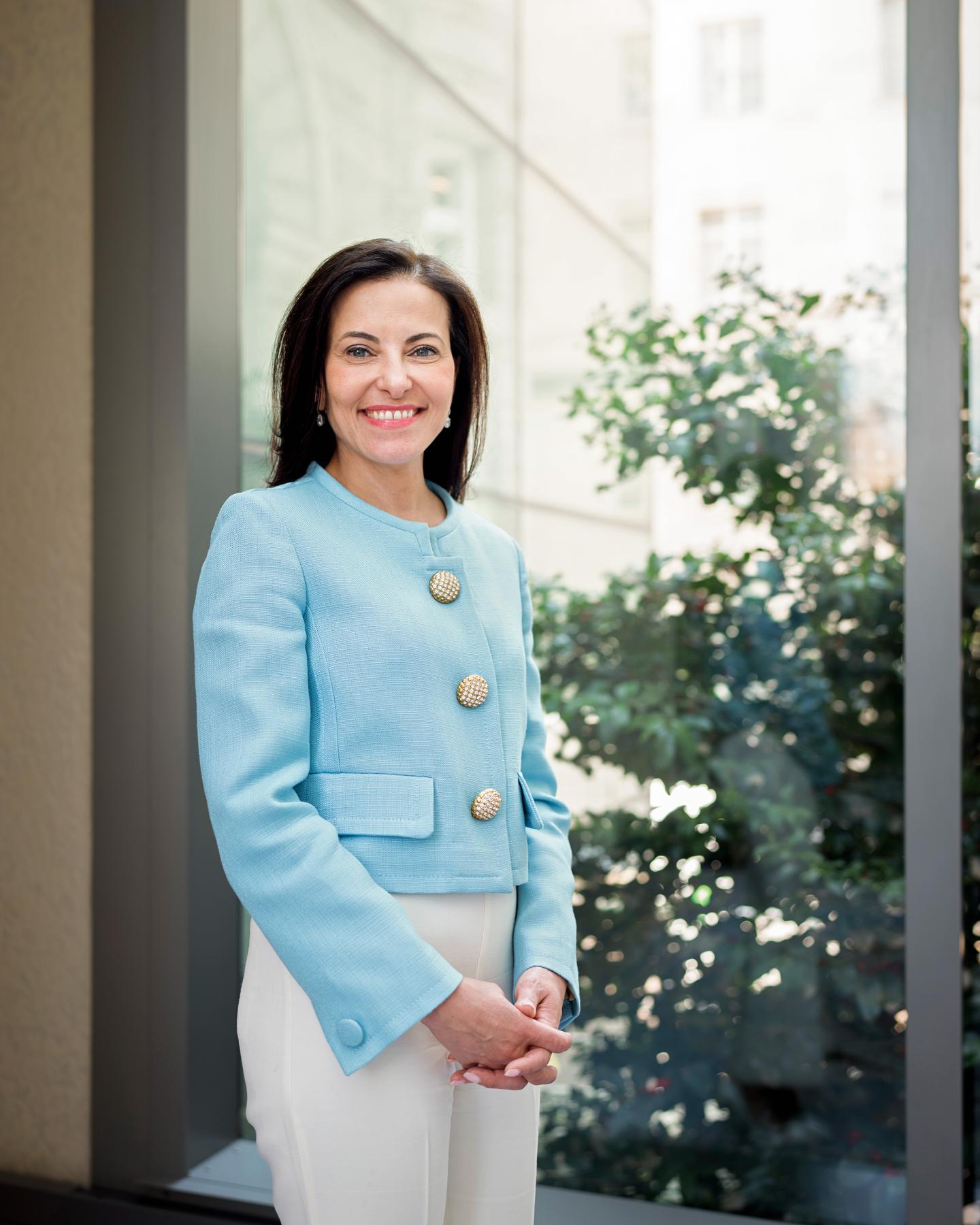

Dina Powell McCormick weaves through the crowd, cheerily hugging people and introducing strangers to one another. She’s cohosting a Washington, D.C., luncheon in April on behalf of Meta, where she’s president and vice chairman. Amid the swirl of festivities preceding the White House Correspondents’ Association Dinner (and before the week was marred by an attempted terror attack), Powell McCormick has returned to her old stomping grounds in politics to showcase Meta’s AI ambitions.
The attendees include journalists, business leaders, and an eclectic group of political figures including Republican political consultant Kellyanne Conway; Trump’s first-term White House press secretary Sean Spicer; and the iconoclastic Democratic senator from Pennsylvania, John Fetterman.
But Powell McCormick, who is ranked No. 58 on this year’s Fortune Most Powerful Women in Business list, is the undisputed star of the show. Perfectly poised and dressed in a sky-blue cropped jacket, cream pants, and stilettos, she interviews the CEO of a small cement company that is leveraging Meta’s suite of AI tools. From the stage, she has a politician-like habit of calling out prominent attendees by name—”There’s Speaker Paul Ryan, who’s investing in some of the most important tech in this space!” she exclaims at one point.
She interviews Sen. Fetterman, the Democrat who has broken from his party on several high-profile issues, whom she describes as a dear friend and “one of the most courageous people I have ever known.” She makes a self-deprecating joke about how when she and her husband, Pennsylvania Republican Sen. David McCormick, went out for dinner recently with Fetterman and his wife, more people wanted to take selfies with Fetterman than with her husband.
Then it’s right back to her—and Meta’s—core message about AI. She closes out the interview by comparing the AI revolution to the Industrial Revolution and World War II. The U.S. will need “250 gigawatts of power” and “500,000 new electricians in the next two years” to build its AI infrastructure, she says. To a round of applause, she implores the audience to “bet on America.”
I happen to be sitting next to a former colleague of Powell McCormick’s who tells me that “Dina has the biggest network of anyone I know.” Indeed, she was a close advisor to Ivanka Trump and Jared Kushner during President Trump’s first term, and she played a pivotal role in his first foreign trip, to the Middle East in May 2017; Powell McCormick was the only woman at the table during a high-profile meeting between the president and Saudi Arabia’s King Salman. She also has deep ties on Wall Street: JPMorgan Chase CEO Jamie Dimon has praised the Goldman Sachs veteran as a banker who had “more or better relationships than many big finance CEOs.”
These connections are one of the reasons that Powell McCormick, who joined Meta full-time in January after a year on its board, is so valuable to the company at a time when it finds itself in need of an advocate in Washington who can get through to the current administration. As if to drive that point home, minutes after her appointment was announced, President Trump congratulated her on Truth Social, calling her a “fantastic, and very talented, person.”
$145 billion
Top end of Meta’s 2026 largely AI capital expenditure guidance
55%
Capex as a percentage of Meta’s estimated 2026 revenue
Source: Meta
Until recently, Meta has been best known as the parent company of Facebook, WhatsApp, Instagram, and Messenger, with its business overwhelmingly driven by digital advertising on its platforms. Meta is widely seen as trailing OpenAI, Google, and Anthropic in the race to build the most advanced frontier AI models, despite having a significant distribution advantage via these platforms.
Recently, however, cofounder and CEO Mark Zuckerberg has articulated aggressive AI ambitions and invested in a massive compute infrastructure and wildly expensive talent pool to fulfill them. This new chapter will involve a staffing overhaul—the company plans to lay off 10% of its workforce, some 8,000 jobs—and a vast capital investment in AI data centers and infrastructure. In its first-quarter 2025 earnings results, Meta raised its full-year 2026 capital expenditure guidance: It’s now $125 billion to $145 billion, up from a previous range of $115 billion to $135 billion. Meta’s stock subsequently fell by 9%.
The strategic shift comes as Meta is fighting legal battles on multiple fronts, from the FTC’s appeal in its Instagram-and-WhatsApp antitrust case to a landmark youth-addiction verdict over social media design.
It’s easy to see why Meta needs Powell McCormick, a woman who has spent decades at the highest echelons of Washington and Wall Street. Born Dina Habib in Egypt, she moved to Texas at the age of 4, after her parents decided that the U.S. would provide better opportunities for their daughter. After attending the University of Texas at Austin, she worked her way up from an internship in the state senate, through various roles working for elected Republicans and the party, to become an assistant secretary of state for educational and cultural affairs under Secretary of State Condoleezza Rice and President George W. Bush. In 2007, she joined Goldman Sachs and spent 16 years there, becoming a partner and holding senior roles across finance and economic development globally; she fostered deep relationships with major institutional investors as well.
Also at Goldman she helped build major programs that sought to empower and create opportunities for marginalized populations, such as 10,000 Small Businesses, 10,000 Women, and One Million Black Women. Those initiatives are still running and have provided education and billions of dollars in capital to hundreds of thousands of entrepreneurs. In 2017, Powell McCormick returned to Washington, where President Trump appointed her deputy national security advisor for strategy, with a focus on Middle East policy.
Powell McCormick left government in 2018, returning to Goldman before joining the merchant bank BDT & MSD Partners.
After lunch, during a brief interview with Fortune where a security guard stands outside the hotel room door, Powell McCormick steers the conversation back to Meta. Her remit there includes co-leading Meta Compute, the division that manages the company’s AI infrastructure build-out; and an initiative aimed at helping small-business owners, including the 200 million already on the platform, adopt AI. “These products are meant to empower people like small-business owners, welders, the fiber technicians, creators, musicians, actors,” she says. “For years, Meta has been at the center of connecting people, and that is a very big difference, I think.”
When she was offered a role at Meta that could help shape AI’s future, Powell McCormick says she discussed it with her family (she and her husband have a blended family with six daughters), telling them that “if I could even play the tiniest role in one of the companies that I think will have such an impact, I felt both a responsibility and an excitement to do so.”
“These products are meant to empower people like small-business owners, welders, the fiber technicians, creators, musicians, actors.”
Powell McCormick says she’s passionate about ensuring that women embrace AI. A recent study by Lean In showed that women are not yet adopting the technology at the rate that men are. “We haven’t communicated enough that the idea [of AI] is to make your life better. So, if we give a mom three hours of her day back, that’s transformative,” she says. “We believe that giving these hours back to women will help them reach their potential.”
I wonder how she squares her work promoting access and inclusivity, particularly for women, with a company that, 10 days before Trump’s second inauguration, disbanded its DEI programs and ended internal representation goals for minorities. “We’ve always been a company that has believed in the economic empowerment of women,” she replies. “We do have a responsibility to ensure that women and small-business owners are not left behind.”
I have several more questions—but we’re out of time. Powell McCormick, who seems to be one of the busiest women on the planet, is up and striding off to her next appointment. I request an opportunity to ask follow-up questions over the next few days, but her team is unable to find a slot.
It’s the week of King Charles’s U.S. tour, and Powell McCormick is at the center of the action. She posts a photo on X in which she stands at the front of a group of prominent tech leaders, including Jeff Bezos, Tim Cook, Lisa Su, and Jensen Huang, who gathered to meet the British king. The same day, she is at the White House Tennis Pavilion alongside first lady Melania Trump and Queen Camilla for an education event where students wear Meta headsets and AI glasses to virtually explore historic landmarks.
At the start of our conversation in the hotel meeting room, Powell McCormick makes a throwaway remark about her hopes that the U.S. will one day have a woman president. I ask if it could be her, and she politely laughs off the suggestion. (Having been born outside the U.S., she would not be eligible anyhow.) Still, having spent a few hours watching her in action, I wouldn’t bet against her.
This article appears in the June/July 2026 issue of Fortune.