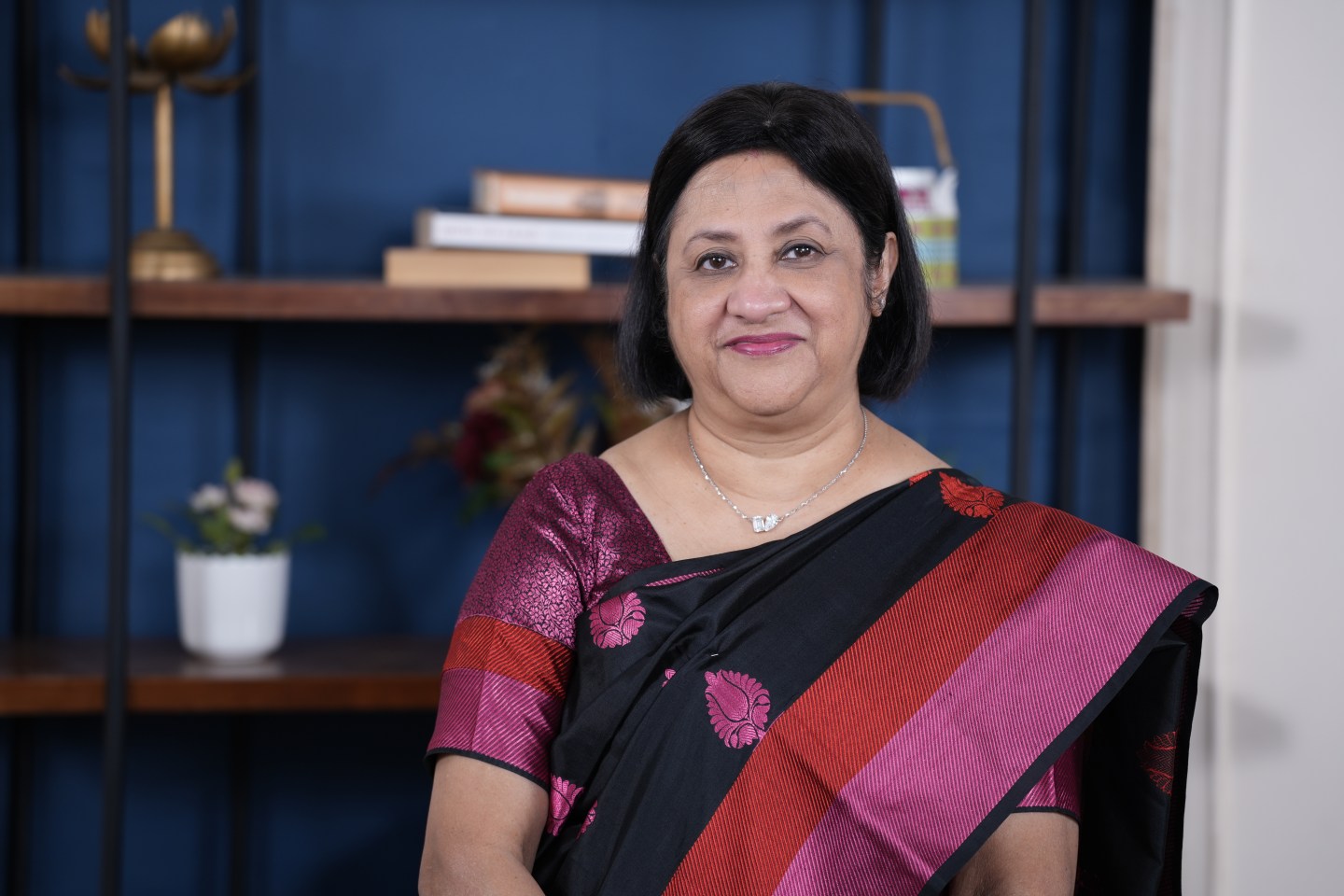
When Arundhati Bhattacharya stepped down as the State Bank of India (SBI)’s chairperson in 2017, she never envisaged her next gig would be with an American tech firm.
“Finance to tech was a move that was never planned,” she tells Fortune. “When this role came about, I sat on it for about five to six months, trying to make up my mind on whether to start in a new area after so many years, and after retiring.”
Bhattacharya had just wrapped up a five-year tenure as the first female head of the SBI, one of India’s largest banks, capping a career that spanned 40 years.
Yet she changed her mind after a trip to San Francisco and a meeting with Salesforce CEO Marc Benioff, who also handed her a copy of his book, Trailblazer. Two stories stood out to her. First was Salesforce’s decision to lobby San Francisco’s city government to increase taxes to tackle the city’s homeless problem; “I have known a large number of companies. I have never known any one of them lobbying to pay more taxes,” she muses.
The second, perhaps more relevant, point was Benioff’s decision to have annual equal pay audits—which seek to eliminate gender wage gaps. “Marc was told not to do that audit because it might mean hefty payouts. He still went ahead and did it,” she recounts. “That made a big impression on me, because I thought a company that does things like that would be one from which I could learn a lot, in terms of the values that it espoused.”
That convinced Bhattacharya to take a chance on a U.S. tech company—even as she admits she sometimes needs a “translation” to understand what tech people are saying—as she builds Salesforce’s business in one of its fastest-growing regions.
A banker turned tech executive
Bhattacharya first joined SBI in 1977 as a probationary officer, climbing up the ranks through human resources, retail banking, foreign exchange and investment banking. She became the bank’s chair in 2013, guiding SBI through a complicated merger of its five associate banks.
After leaving SBI in 2017, she spent several years cycling through part-time advisory and consulting roles before Salesforce made her an offer. Serving as a non-executive didn’t sit well with her. “You can give a lot of advice, or ask a lot of questions, but you don’t really know the impact you’re making.”
Bhattacharya joined Salesforce as its South Asia CEO in 2020; the role was so new that she had to write her own job description. “They didn’t have a regional CEO, as most of Salesforce’s operating units are for sales and distribution,” she says. “I had to think deeply about how I could contribute.”
Under Bhattacharya, Salesforce’s South Asia headcount grew from 2,500 to over 18,000 today; India now consistently ranks as one of Salesforce’s fastest growing markets. Salesforce doesn’t break out country revenue in its regular earnings, but a company filing in November to India’s corporate register reported 133.8 billion rupees ($1.8 billion) in sales for the twelve months ending March 2025.
In 2024, Salesforce expanded Bhattacharya’s profile to include Southeast Asia. She believes the expansion makes sense, given the similarities between the two regions. “Southeast Asia comprises a number of other countries which are very much like India, in the sense that they are younger and are far more populous,” she explains. “Their economies are also just a little ahead or behind where India is today, so it made sense for us to use what we had learnt in India across Southeast Asia.” For example, the diversity of languages and cultures in both India and Southeast Asia requires international firms like Salesforce to localize their products.
Salesforce estimates that AI could be a $1 trillion growth opportunity for the region. Last October, Salesforce opened an office in Manila, Philippines, adding to three existing regional hubs in Thailand, Indonesia and Singapore. Bhattacharya said that her team is looking at expanding to around three other countries in Southeast Asia, but declined to specify which ones. The company’s AI agent platform, Agentforce, also offers voice chatting capabilities for two Southeast Asian languages: Tagalog and Bahasa Indonesia.
Salesforce’s bet on AI
At the Singapore leg of its annual Agentforce World Tour series of conferences, Salesforce touted its new Headless 360, an initiative that allows AI agents to read data and trigger workflows automatically on Salesforce’s customer relationship management platform. Attendees were drawn to Slack’s booth, where a software engineer showcased the capabilities of the new-and-improved Slackbot, which the company relaunched in January as a Claude-powered agent.
Bhattacharya is now a huge proponent of Salesforce’s AI products, though she admits she needed some “reverse mentoring” from more junior engineers at the company. She says she now uses Slackbot to screen for the most important messages and tasks that come in overnight, given that India is around 12 hours ahead of Salesforce headquarters in San Francisco.
“I ask the Slackbot to summarize whatever texts have come in, then ask it to name those I need to do urgently,” Bhattacharya explains. “I also let Slackbot loose on my calendar, so it can tell me which are the meetings that really need to be attended, and which ones I can skip to make better use of my time.”
Still, she admits that she needs to catch up to how today’s engineers talk about tech trends. “Sometimes the language of the current generation, though they speak English, is unintelligible to me,” she jokes. “I literally need a translation of what they’re saying.”
She brushed off concerns about the looming SaaSpocalypse, or the fear that increasingly powerful AI models might run companies like Salesforce out of business. (Salesforce shares are down almost 35% since the start of the year.)
“We are the operating system for agentic enterprises, so how can we be out of step?” she asks. “We’re evolving on all fronts—from products, to the way we go to market, and pricing—to keep pace with AI.”(She’s echoing words her boss, Benioff, uses to call critics “dead wrong.”)
Allies both male and female
Bhattacharya is one of India’s most storied female leaders and is ranked No. 83 in Fortune’s Most Powerful Women Asia ranking.
But she admits her journey to the top wasn’t without difficulty. “For women, the issue is that you have to always try and strive to prove yourself,” she says. “You have to be better than the best in order to be noticed… and keep negotiating throughout your life to ensure that you’re getting the opportunities you should rightfully get.”
She illustrates the point with an anecdote from a hiring committee, shared by one of her contacts. When the committee judges a male candidate who’s on the borderline, they say “he’ll do it”. When it’s a female candidate, the committee instead asks “will she be able to do it?”
“There’s a vote of confidence if it’s a male. There’s always a question if it’s a female,” she says.
Bhattacharya has worked to ensure gender parity in the in the organizations she has led. When she ran the SBI’s human resources department, she introduced a two-year sabbatical policy for women that covered maternity and elder care.
“You need everybody to rally together, and that means not just women, but also male allies,” she concludes. “If men are allies, they can make a big difference.”
And she still feels like she’s learning how to build more inclusive organizations. She remembers taking unconscious-bias training when she joined Salesforce, and was surprised at what she learned.
“I thought I didn’t have unconscious bias because I’m a woman, and I’ve traversed this entire career for 40 years. But when I went in to take the training, I realized that even I have unconscious bias,” she says. “Everybody has it.”