
Good morning. On Fortune’s radar today:
- Google’s internal war against its anti-Pentagon employees.
- Markets: Happy with a record high.
- Iran vows to strike any U.S. vessel in the Strait of Hormuz.
- The fight over one word—“additional”—at the Fed.
- AI hyperscalers are carrying $400 billion in debt.
- Bank of America: “Boom loop” could open “door to doom.”
Quick note: Subscribe to the forthcoming Fortune Gulf Brief. Every Tuesday, this new newsletter will deliver clear-eyed, authoritative intelligence on the deals, decisions, policies, and power shifts shaping one of the world’s most consequential regions, written for the people who need to act on it. Sign up here.
THE MARKETS
Wall Street shrugs at record high stocks—in a good way
- S&P 500 futures were flat this morning. The index was up 0.29% in the last session, setting a new record at 7,230.
- In Europe, the Stoxx 600 was down 0.26% in early trading and the U.K.’s FTSE 100 was down 0.14% before lunch.
- Asia: South Korea’s KOSPI was up 5.12%. India’s Nifty 50 was up 0.31%. China’s CSI 300 was flat.
- Brent crude was $109 this morning.
- Bitcoin was up at $79K.
- Meme stock GameStop pitches $56 billion takeover of eBay - Bloomberg
ONE BIG THING
How Google defeated its internal anti-military activist employees
Google signed a deal with the Pentagon to allow its Gemini AI to be used by the U.S. military for “any lawful purpose,” and when news of the deal leaked, close to 600 employees signed an open letter opposing it. “I spent the last 2 months trying to prevent this,” Alex Turner, a research scientist at Google DeepMind, the unit that builds the company’s Gemini models, said in a post on X. “Shameful.”
But Google’s management is likely to ignore internal resistance, Fortune’s Bea Nolan reports. Following an employee rebellion in 2018, Google cracked down on in-office activism by decommissioning a lot of the internal mailing lists and deleting the internal social network, one source said. “It is harder to organize internally now.”
IRAN
Tehran to U.S. Navy: escort ships at your peril
Iran threatened to attack any U.S. ship in the Strait of Hormuz following President Trump’s promise yesterday that the U.S. Navy would guide ships through the Strait as a “Humanitarian gesture.” The head of Iran's central command said it would attack "any foreign armed force … especially, the aggressive U.S. army,” according to the BBC.
The price of oil spiked up from a low of $106 per barrel of Brent crude this morning to over $110, before settling back to $109.
“Iran’s parliamentary security committee head [Ebrahim] Azizi called [Trump’s] posts delusional,” UBS’s Paul Donovan told clients this morning. “The oil market reaction gives weight to the Iranian view. U.S. gasoline prices are approaching USD 4.5 per U.S. gallon, which is an incentive for the administration to use calming rhetoric to guide markets. This has less impact as the point of physical shortages moves closer.”
- The clock is ticking as oil markets barrel toward nightmare scenarios with the West bracing for ‘tank bottoms’ and Iran racing to delay ‘tank tops’ - Jason Ma
- The Iran war has turned the world’s shipping straits into a chessboard—and the U.S. aims to box out China from the Panama Canal to the Malacca Strait - Jordan Blum
- Enbridge aims to help North America win from the AI boom and the Iran war as the FedEx of energy delivery - Jordan Blum
“ADDITIONAL”
If the Fed stops saying this one word, interest rates will likely rise
One of the controversies in last week’s decision from the U.S. Fed to leave interest rates at the 3.5% level was the number of dissenters—three—on a vote to use a specific phrase in the central bank’s commentary. The phrase is:
- "In considering the extent and timing of additional adjustments to the target range for the federal funds rate, the Committee will carefully assess incoming data, the evolving outlook, and the balance of risks.”
On its face, nothing in those words sounds controversial. The key is the word “additional.” The Fed had been delivering a program of rate cuts, so “additional” implies that the Fed’s next move will be another cut. However, this time around three members of the Fed’s rate-setting committee voted against the phrase, suggesting they are not convinced rates should go any lower.
If inflation continues to rise, perhaps driven by high oil prices, expect that “additional” phrase to disappear from the Fed’s future statements—and buckle up for rate hikes.
GIVE THEM CREDIT
AI hyperscalers are carrying $400 billion in debt
The big tech companies will probably spend up to $725 billion this year, building out AI data centers, according to an estimate by the Financial Times. But much of that spending will come in the form of debt. Already, tech companies have issued $400 billion in investment-grade and high-yield debt since mid-2025, according to an estimate by Goldman Sachs’s Amanda Lynam and her colleagues in a research note seen by Fortune.
“The scale and scope of AI-related issuance in the credit markets is likely to be, in many ways, unprecedented,” Lynam says.
MORE FROM FORTUNE
China has a welcome mat for Trump: it just rewrote the rules on U.S. sanctions - Steve H. Hanke and Jeffrey Weng
A decade after the ‘Godfather of AI’ said radiologists were obsolete, their salaries are up to $571K and demand is growing fast - Marco Quiroz-Gutierrez
Chinese court rules firms can’t lay off workers on AI grounds - Bloomberg
CHART OF THE DAY
Bank of America: “Boom loop” could open “door to doom”
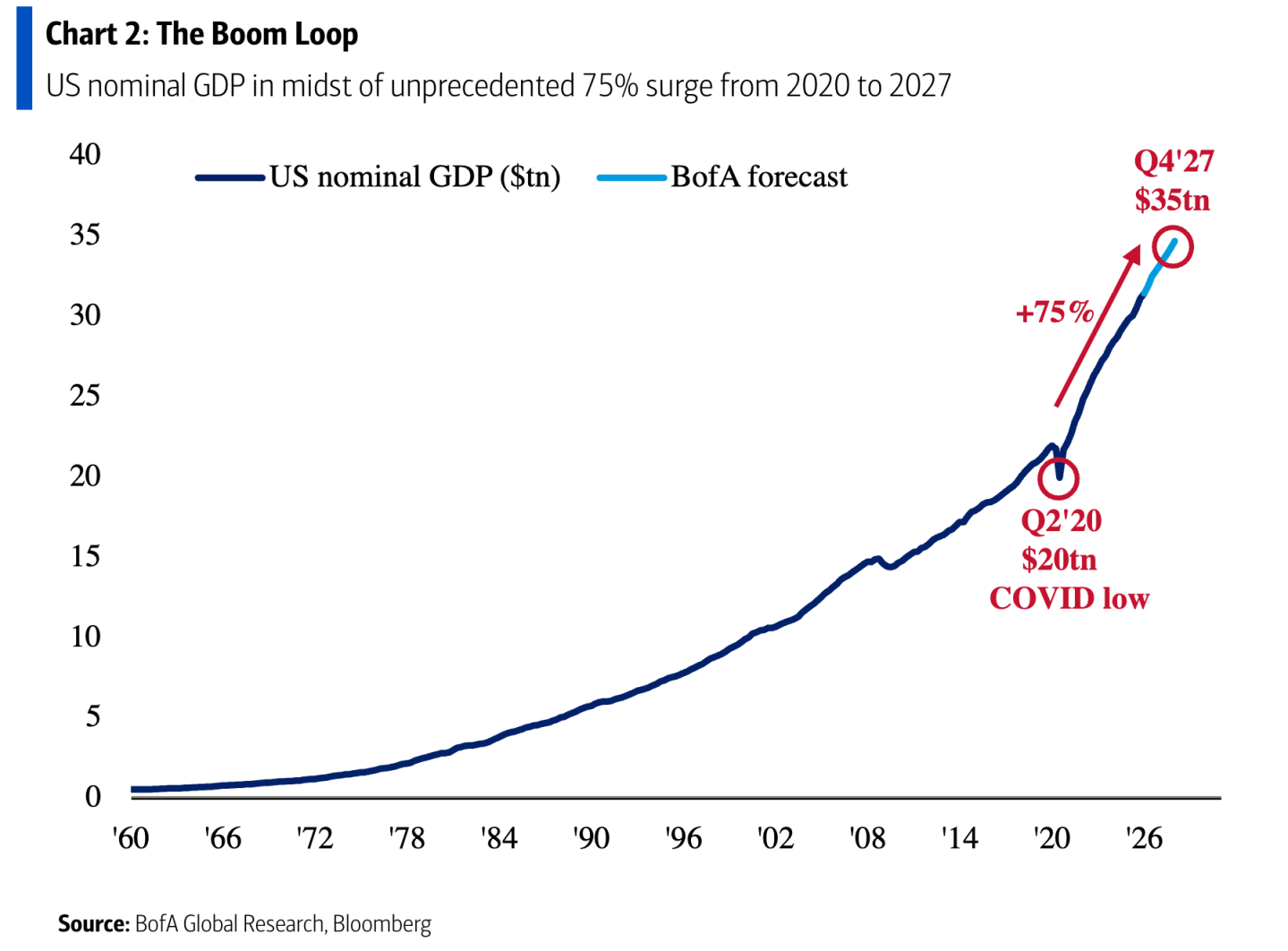
U.S. GDP will have risen 75% in the seven years from 2020 (when it was $20 trillion) to 2027 (when it will be $35 trillion), Michael Hartnett and his colleagues at Bank of America forecast. They call this the “boom loop,” driven by increased government spending (up 60% since 2020) and inflationary trade and industrial policies. The “only thing that breaks the 2020s boom loop is bond [market] collapse,” they told clients in a note seen by Fortune.
The first sign of that collapse will be if the interest yield on 30-year U.S. Treasury bonds goes above 5%—an indicator that debt investors want to be paid more for holding the debt. They are near that right now. But if they move higher, “booms/bubbles always end with sharp jump in yields,” Hartnett says. “Then the door to doom starts to open.”
NUMBER OF THE DAY
2.5 billion
The “installed base” of iPhones, laptops, and other devices made by Apple currently being used by customers. The entire population of Earth is 8.3 billion.
THE FRONT PAGES TODAY
Vladimir Putin hunkers down for fear of assassination - FT
Meme stock GameStop makes $56 billion offer for eBay in bid to rival Amazon - CNBC
Rudy Giuliani in "critical" condition in hospital, spokesperson says - Axios
Why Almost Everyone Loses—Except a Few Sharks—on Prediction Markets - WSJ
Drone Hits Upscale Moscow Tower as City Readies for WWII Parade - Bloomberg
‘The Death Zone’: How Russia Is Luring Africans to Ukraine - NYT
ONE MORE THING
The rich get richer—especially in the Southern U.S.
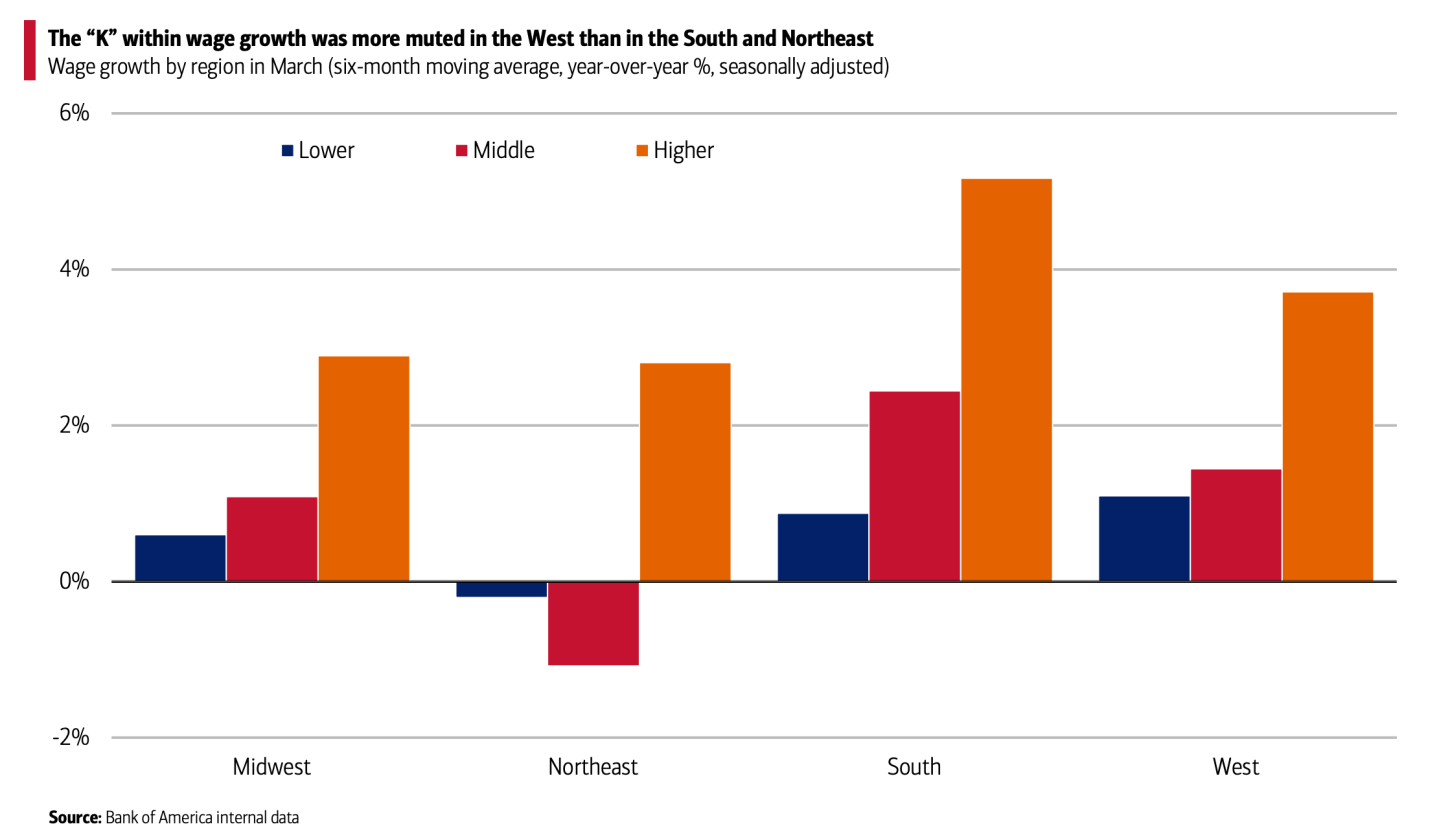
This chart shows wage growth in the U.S. broken out by income bracket and region. Notably, the rich continue to get richer faster than everyone else. But mostly, the poor are getting richer too—just not at the same rate. The best wage growth is in the South, for all income groups. Only in the Northeast does the old cliché ring true: The rich are getting richer up there, and the poor are getting poorer too. Data from Bank of America’s Liz Everett Krisberg and David Michael Tinsley.