• Home
  • Latest
  • Fortune 500
  • Finance
  • Tech
  • Leadership
  • Lifestyle
  • Rankings
  • Multimedia

Trendingnow

1

Iran strikes 85 U.S. military sites in the Gulf, sparking a global selloff in stocks and a spike in the price of oil

2

Ex-PepsiCo CEO Indra Nooyi worked from midnight until 5 a.m. as a receptionist to pay for her Yale degree—and she says ‘respect went up’ because of it

3

Shark Tank's Kevin O'Leary says if he were 25 today, he'd chase these two booming opportunities in the world of AI

1

Iran strikes 85 U.S. military sites in the Gulf, sparking a global selloff in stocks and a spike in the price of oil

2

Ex-PepsiCo CEO Indra Nooyi worked from midnight until 5 a.m. as a receptionist to pay for her Yale degree—and she says ‘respect went up’ because of it

3

Shark Tank's Kevin O'Leary says if he were 25 today, he'd chase these two booming opportunities in the world of AI
Economynational debt

Trump, the $39 trillion national debt, rosy growth assumptions, and the question of ‘a sustainable path’

Nick Lichtenberg
By
Nick Lichtenberg
Nick Lichtenberg
Business Editor
Down Arrow Button Icon
Nick Lichtenberg
By
Nick Lichtenberg
Nick Lichtenberg
Business Editor
Down Arrow Button Icon
April 7, 2026, 1:22 PM ET
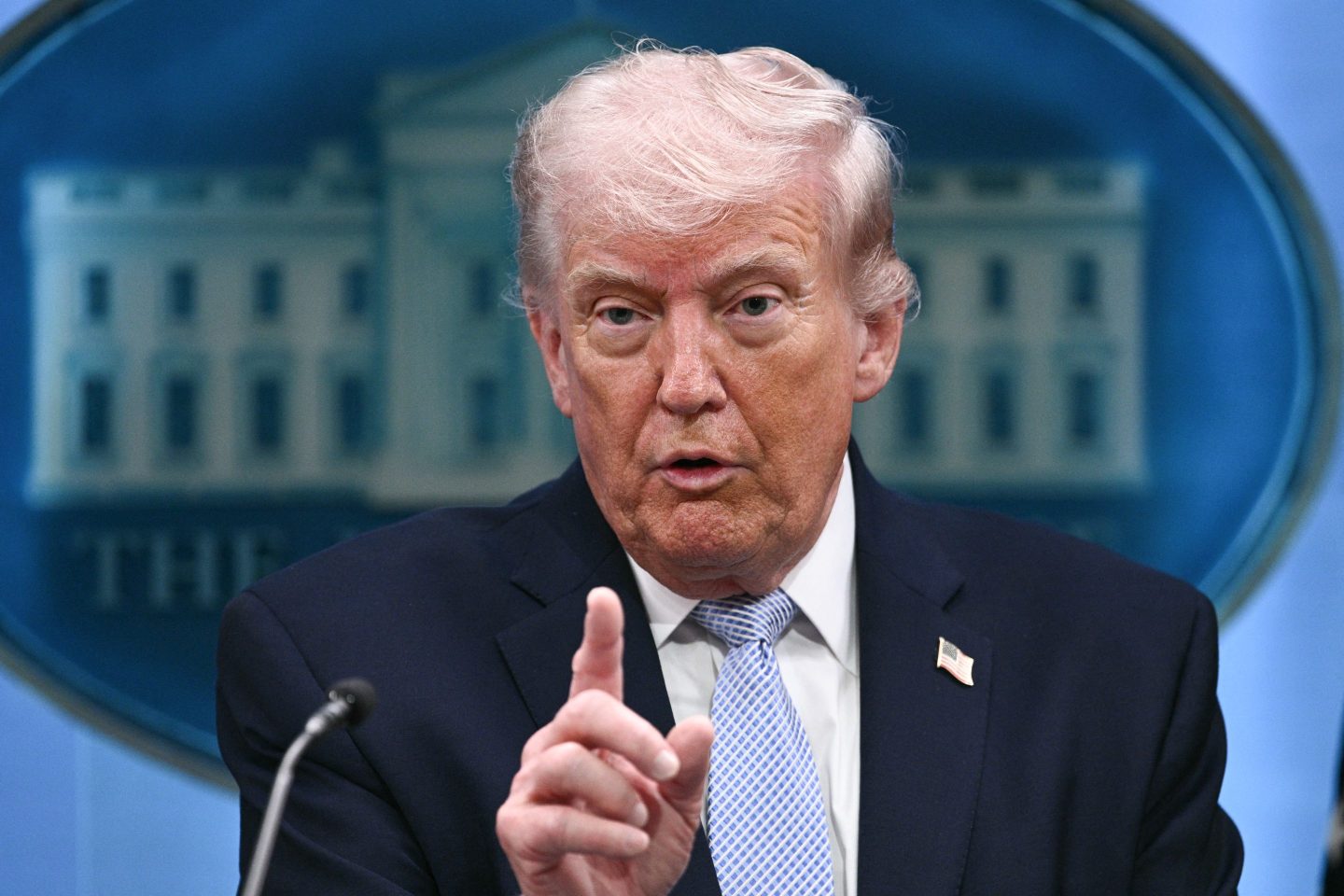
Photo of Donald Trump
President Donald Trump in the James S. Brady Press Briefing Room of the White House on April 6, 2026, in Washington, D.C. Brendan SMIALOWSKI / AFP via Getty Images
Add Fortune on Google for similar content.

President Trump’s fiscal year 2027 budget is built on a single, load-bearing bet: that the U.S. economy can grow at 3% annually for the next decade. The White House says that growth will flood federal coffers with new tax revenue and eventually bend the national debt, now sitting at over $39 trillion, onto a downward path. It is an optimistic vision. It is also, Federal Reserve Chair Jerome Powell suggested last month, the kind of optimism that has repeatedly failed to reckon with what he called an “unsustainable” fiscal trajectory that “will not end well.”

Recommended Video

A leading budget economist explained to Fortune why the sustainability picture isn’t getting better, even if you accept the White House’s growth numbers at face value.

The growth assumption driving everything

Kent Smetters, faculty director of the Penn Wharton Budget Model, ran the numbers on what an extra percentage point of real GDP growth—the gap between OMB’s 3.0% projection and the lower percentage seen by CBO, the Federal Reserve, and PWBM itself—actually delivers to the federal balance sheet. The answer, on first glance, is impressive: roughly $2.5 trillion in additional federal revenue and $1.5 trillion in reduced deficits over 10 years.

But Smetters didn’t stop at the headline figure. “Because interest rates and growth tend to track each other in the shorter run, government payments on debt could also increase by $750 billion,” he told Fortune. In other words, faster growth drives up borrowing costs—and at over $39 trillion in outstanding debt, even a modest rate uptick would compound into the hundreds of billions. The $1.5 trillion deficit gain and the $750 billion interest cost would hit simultaneously, leaving a true net fiscal benefit of roughly $750 billion—less than half the number the administration’s framing implies. Smetters said the administration is essentially pairing the “more aggressive growth rate being assumed by OMB” without the higher interest rates and spending that would naturally follow.

Zooming out historically, Smetters said the idea of cutting costs by a certain percent per year basically comes down to “one president saying that they are hoping that the next president will do it. And the next president comes in and hopes that the next president will do it.” Significant bipartisan reform is the only time you typically see such big changes, he added, absent a windfall that comes from sheer luck, such as the surprise one-time revenue recorded during the Clinton administration, resulting in a budget surplus.

In testimony to Congress in 1998, then-Fed Chair Alan Greenspan remarked on the surprise surplus, attributing it to “the taxes paid on huge realized capital gains and other incomes related to stock market advances, coupled with taxes on markedly higher corporate profits, [which] have joined with restraint on spending to produce a unified budget surplus for the first time in nearly three decades.”

Smetters said a more sustainable fix to get finances on a sustainable path would be something like the 1986 Tax Reform Act. “Today we need the Tax Reform Act times two.”

These calculations come before another offset that Smetters flagged: Social Security initial benefits are tied to wage growth, which rises with GDP, and health care costs track economic output. A faster-growing economy, he noted, is also a more expensive one to govern. This also doesn’t touch on the costs of the ongoing war in Iran, which Smetters previously estimated as costing as much as $210 billion, although he allowed there was more risk to the upside in case of a long conflict.

Watchdogs are skeptical

The Smetters analysis lands against a backdrop that Powell made explicit last month. The Fed chair, in remarks that rippled across financial markets, described the national debt trajectory as unsustainable and warned it would not end well—a typically blunt assessment from the central banker, on the question of the debt. His concern wasn’t abstract: It was precisely the dynamic Smetters is now quantifying. When you carry $39 trillion in debt, the relationship between growth, rates, and interest payments stops being theoretical and starts being arithmetic.

The White House’s own projections show the debt-to-GDP ratio peaking at 103% in 2029 before declining—a trajectory that depends almost entirely on the 3% growth assumption holding for a full decade. The Congressional Budget Office, projecting 1.8% growth, sees no such decline.

The Committee for a Responsible Federal Budget (CRFB) reached a similarly skeptical conclusion. CRFB estimated that if you replace OMB’s growth assumptions with CBO’s more conservative projections—and account for the Supreme Court ruling striking down IEEPA-based tariffs—the national debt would reach 120% of GDP by 2036, compared to the administration’s projected 94%. “Unfortunately, this budget provides little guidance on how policymakers should put the national debt on a sustainable path,” the CRFB concluded.

None of this has diminished the ambition of the budget’s spending side. The centerpiece is a $1.5 trillion defense funding request for FY 2027, combining a $251 billion increase in base defense discretionary spending with $350 billion in new reconciliation resources. To partially offset those costs, the budget proposes cutting nondefense discretionary spending by 10% in FY 2027, followed by a “two-penny plan” reducing those accounts by 2% annually thereafter—a path CRFB estimates would trim $2.5 trillion in nondefense spending over 10 years.

Whether the growth bet pays off or not, the interest rate math embedded in it may be the number Congress pays closest attention to. At $39 trillion in debt, even a quarter-point move in borrowing costs adds tens of billions to the annual tab. A full percentage point of unexpected rate pressure—the kind that could plausibly accompany a genuine growth surge—is a risk that no budget model can fully insure against.


Subscribe to Fortune Gulf Brief. Every Tuesday, this new newsletter delivers clear-eyed, authoritative intelligence on the deals, decisions, policies, and power shifts shaping one of the world’s most consequential regions, written for the people who need to act on it. Sign up here.
About the Author
Nick Lichtenberg
By Nick LichtenbergBusiness Editor
LinkedIn icon

Nick Lichtenberg is business editor and was formerly Fortune's executive editor of global news.

See full bioRight Arrow Button Icon
Add Fortune on Google for similar content.

Latest in Economy

Finance
Lorem ipsum dolor sit amet, consectetur adipiscing elit, sed do eiusmod tempor incididunt ut labore et dolore magna aliqua. Ut enim ad minim veniam
By Fortune Editors
October 20, 2025
Finance
Lorem ipsum dolor sit amet, consectetur adipiscing elit, sed do eiusmod tempor incididunt ut labore et dolore magna aliqua. Ut enim ad minim veniam
By Fortune Editors
October 20, 2025
Finance
Lorem ipsum dolor sit amet, consectetur adipiscing elit, sed do eiusmod tempor incididunt ut labore et dolore magna aliqua. Ut enim ad minim veniam
By Fortune Editors
October 20, 2025
Finance
Lorem ipsum dolor sit amet, consectetur adipiscing elit, sed do eiusmod tempor incididunt ut labore et dolore magna aliqua. Ut enim ad minim veniam
By Fortune Editors
October 20, 2025
Finance
Lorem ipsum dolor sit amet, consectetur adipiscing elit, sed do eiusmod tempor incididunt ut labore et dolore magna aliqua. Ut enim ad minim veniam
By Fortune Editors
October 20, 2025
Finance
Lorem ipsum dolor sit amet, consectetur adipiscing elit, sed do eiusmod tempor incididunt ut labore et dolore magna aliqua. Ut enim ad minim veniam
By Fortune Editors
October 20, 2025

Most Popular

Finance
Lorem ipsum dolor sit amet, consectetur adipiscing elit, sed do eiusmod tempor incididunt ut labore et dolore magna aliqua. Ut enim ad minim veniam
By Fortune Editors
October 20, 2025
Finance
Lorem ipsum dolor sit amet, consectetur adipiscing elit, sed do eiusmod tempor incididunt ut labore et dolore magna aliqua. Ut enim ad minim veniam
By Fortune Editors
October 20, 2025
Finance
Lorem ipsum dolor sit amet, consectetur adipiscing elit, sed do eiusmod tempor incididunt ut labore et dolore magna aliqua. Ut enim ad minim veniam
By Fortune Editors
October 20, 2025
Finance
Lorem ipsum dolor sit amet, consectetur adipiscing elit, sed do eiusmod tempor incididunt ut labore et dolore magna aliqua. Ut enim ad minim veniam
By Fortune Editors
October 20, 2025
Finance
Lorem ipsum dolor sit amet, consectetur adipiscing elit, sed do eiusmod tempor incididunt ut labore et dolore magna aliqua. Ut enim ad minim veniam
By Fortune Editors
October 20, 2025
Finance
Lorem ipsum dolor sit amet, consectetur adipiscing elit, sed do eiusmod tempor incididunt ut labore et dolore magna aliqua. Ut enim ad minim veniam
By Fortune Editors
October 20, 2025
Fortune Secondary Logo
Rankings
  • 100 Best Companies
  • Fortune 500
  • Global 500
  • Fortune 500 Europe
  • Most Powerful Women
  • World's Most Admired Companies
  • See All Rankings
  • Lists Calendar
Sections
  • Finance
  • Fortune Crypto
  • Features
  • Leadership
  • Health
  • Commentary
  • Success
  • Retail
  • Mpw
  • Tech
  • Lifestyle
  • CEO Initiative
  • Asia
  • Politics
  • Conferences
  • Europe
  • Newsletters
  • Personal Finance
  • Environment
  • Magazine
  • Education
Customer Support
  • Frequently Asked Questions
  • Customer Service Portal
  • Privacy Policy
  • Terms Of Use
  • Single Issues For Purchase
  • International Print
Commercial Services
  • Advertising
  • Fortune Brand Studio
  • Fortune Analytics
  • Fortune Conferences
  • Business Development
  • Group Subscriptions
About Us
  • About Us
  • Press Center
  • Work At Fortune
  • Terms And Conditions
  • Site Map
  • About Us
  • Press Center
  • Work At Fortune
  • Terms And Conditions
  • Site Map
  • Facebook icon
  • Twitter icon
  • LinkedIn icon
  • Instagram icon
  • Pinterest icon

Latest in Economy

A woman, standing in a grocery store, looks at a bag of apples.
EconomyTariffs
Trump has created a ‘trickle up’ tariff economy that means U.S. companies aren’t done hiking consumer prices over import taxes
By Sasha RogelbergJuly 9, 2026
3 hours ago
‘Project 2029’ floats free child care—or $1,000 to stay home
Politicschild care costs
‘Project 2029’ floats free child care—or $1,000 to stay home
By Simone Foxman and BloombergJuly 8, 2026
13 hours ago
a man having chair still by the window in the office
EconomyLabor
Labor force participation falls to 61.5%, the lowest in 50 years outside COVID, and economists say it’s not just people giving up
By Catherina GioinoJuly 8, 2026
13 hours ago
Kevin Warsh buried an unusual, unhedged promise in his first Fed minutes—and one economist says it’s the strongest signal in the document
BankingFederal Reserve
Kevin Warsh buried an unusual, unhedged promise in his first Fed minutes—and one economist says it’s the strongest signal in the document
By Catherina GioinoJuly 8, 2026
13 hours ago
How climate change could raise your water bill
EnvironmentConsumer Prices
How climate change could raise your water bill
By Emma Court and BloombergJuly 8, 2026
15 hours ago
IMF expects modest 3% growth as the Iran war is dragging down the economy while AI is boosting it
EconomyIran
IMF expects modest 3% growth as the Iran war is dragging down the economy while AI is boosting it
By The Associated Press and Paul WisemanJuly 8, 2026
19 hours ago

Most Popular

Iran strikes 85 U.S. military sites in the Gulf, sparking a global selloff in stocks and a spike in the price of oil
Newsletters
Iran strikes 85 U.S. military sites in the Gulf, sparking a global selloff in stocks and a spike in the price of oil
By Jim EdwardsJuly 8, 2026
1 day ago
Ex-PepsiCo CEO Indra Nooyi worked from midnight until 5 a.m. as a receptionist to pay for her Yale degree—and she says ‘respect went up’ because of it
Success
Ex-PepsiCo CEO Indra Nooyi worked from midnight until 5 a.m. as a receptionist to pay for her Yale degree—and she says ‘respect went up’ because of it
By Preston ForeJuly 6, 2026
3 days ago
Shark Tank's Kevin O'Leary says if he were 25 today, he'd chase these two booming opportunities in the world of AI
AI
Shark Tank's Kevin O'Leary says if he were 25 today, he'd chase these two booming opportunities in the world of AI
By Marco Quiroz-GutierrezJuly 5, 2026
4 days ago
Current price of oil as of July 8, 2026
Personal Finance
Current price of oil as of July 8, 2026
By Joseph HostetlerJuly 8, 2026
22 hours ago
Billionaires John and Laura Arnold have already donated nearly half their wealth. Now they're funding a hunt for the health risks of sports betting
Success
Billionaires John and Laura Arnold have already donated nearly half their wealth. Now they're funding a hunt for the health risks of sports betting
By Sydney LakeJuly 8, 2026
1 day ago
Mining CEO worth $24 billion nearly drowned and had to break his own leg in a freak hiking accident—he used the recovery time to go back to school
C-Suite
Mining CEO worth $24 billion nearly drowned and had to break his own leg in a freak hiking accident—he used the recovery time to go back to school
By Eleanor PringleJuly 8, 2026
18 hours ago

© 2026 Fortune Media IP Limited. All Rights Reserved. Use of this site constitutes acceptance of our Terms of Use and Privacy Policy | CA Notice at Collection and Privacy Notice | Do Not Sell/Share My Personal Information
FORTUNE is a trademark of Fortune Media IP Limited, registered in the U.S. and other countries. FORTUNE may receive compensation for some links to products and services on this website. Offers may be subject to change without notice.