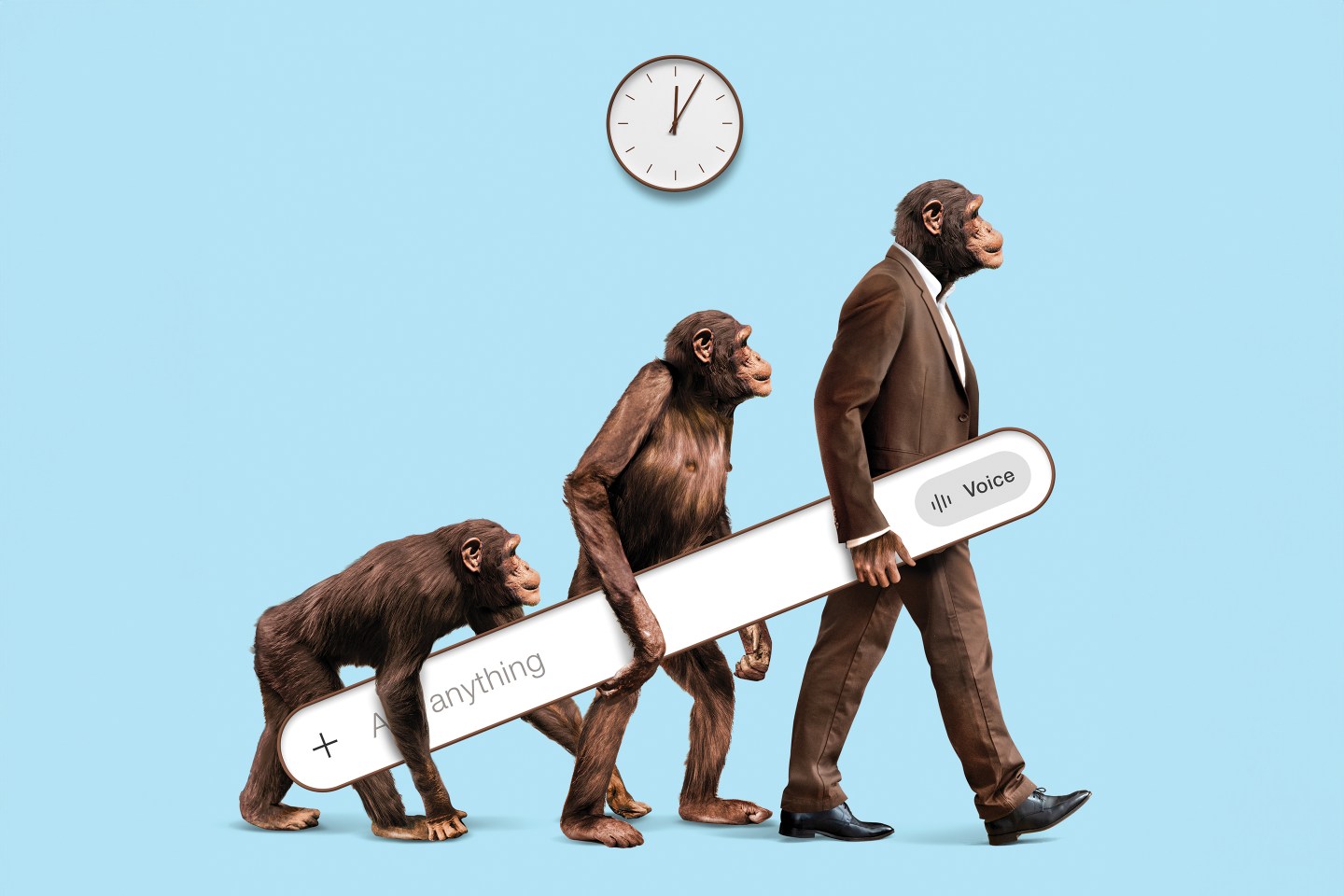
In a blunt companywide memo last year, Micha Kaufman, the CEO of freelance marketplace Fiverr, had some harsh truths to share with his employees.
“AI is coming for your jobs. Heck, it’s coming for my job, too. This is a wake-up call,” he warned. A year on, he has a message for the C-suite trying to ride out the AI tsunami.
“Don’t be a cheerleader. If you’re not practicing, don’t preach,” Kaufman tells Fortune. “You can’t make AI a value on the wall and then not behave by it.” CEOs are currently treating AI as a training problem, he says—buying products, running a seminar, and checking a box—when the real challenge is a cultural one that starts at the top.
Across industries, there’s palpable angst about the impending AI onslaught and how best to prepare workers, managers, and—above all—themselves for the new reality that lies ahead. The technology is moving faster than any organizational playbook can keep up with, and the executives tasked with leading the transition are often figuring it out in real time. What’s more, many are seeing a gap between their companies’ AI ambitions and the results. There are lots of pilots and hype—but only a small number of organizations, usually in tech, are seeing transformative gains.
Eight out of 10 Fortune 500 companies now use some kind of AI agent in their business that they built with “low-code/no-code/or vibe coding” tools. The agents touch everything from sales to customer service.
Source: Microsoft Research
“There are many companies that are struggling with some kind of dissonance between the promise of AI and the reality of what they hoped it would be,” says Kate Smaje, senior partner and AI lead at McKinsey. “There are firms all over the map.”
It’s a disconnect that’s keeping CEOs awake at night. A recent survey by the Harris Poll found that 79% of U.S. CEOs believe they could lose their jobs within two years if they fail to deliver measurable business gains from AI. Part of this is investor pressure over ROI, and part of it is FOMO: Some sectors, like software engineering, have seen massive productivity gains from AI, while others are still grappling with how to implement basic tools.
For business leaders trying to prepare, it’s a daunting moment. But with so much at stake, it’s not one they can ignore.
The danger of sticks
One response to this anxiety has been to shift from an era of experimentation—in which employees are encouraged to try out AI—to one of top-down mandates and formal pilots, where employees are required to trial specific tools and demonstrate measurable results.
Companies including Meta, Amazon, Salesforce, and Microsoft are cracking down to impose AI adoption within their workforce, mandating, monitoring, and evaluating the use of AI tools. At Meta, new performance review systems can reportedly track how many lines of code an engineer wrote with AI assistance, while Amazon managers have dashboards monitoring individual AI-tool usage that factors into promotion decisions, according to media reports.
What’s called for in a CEO who thinks more like a scientist than a general.
But tech companies have a history of driving workforce trends before the rest of the business world. And of course, tech companies have their own skin in the game, since they are the ones making—and selling—the various AI products.
Outside of tech, CEOs are operating with a lot less clarity. As Wharton management professor Peter Cappelli notes, too many executives are still “listening to the people who built the tools” instead of asking whether those same approaches make sense in their own businesses. The builders, he argues, “are not experts in business or in management”—and yet their success stories are being treated as a universal blueprint.
Instead of mandates, some companies are betting on peer-led learning and positive incentives to drive adoption of AI tools.
“I think if you take a stick approach right now, you might actually get people basically achieving the right short-term goal but failing the long-term objective, which is building an organization that is much more nimble and resilient,” says Greg Hart, CEO of online learning platform Coursera. The stakes for companies of successfully adapting to AI are higher than immediate productivity metrics. And because many employees view AI as a threat to their livelihoods, mandates tend to deepen that anxiety rather than dissolve it.
Roughly 55,000 jobs were cut in layoffs that companies attributed directly to AI in 2025, more than three times the total in the preceding two years, according to recruiting firm Challenger, Gray & Christmas. Employee fears were hardly relieved when enterprise software company Atlassian cut 10% of its staff in March, and fintech firm Block slashed 40%. Block CEO Jack Dorsey said that AI tools, paired with “smaller and flatter teams,” are fundamentally changing the nature of work and “what it means to build and run a company.” Some employees also worry that by using AI at work they’re essentially training the automaton that will replace them.
26%
Share of 2,300 companies surveyed that now have a Chief AI Officer, up from 11% in 2022. More than half were appointed from within.
Source: IBM Institute for Business Value
Fiverr’s Kaufman argues that this is exactly why leaders need to disentangle fear around AI from AI skills. Companies often “collapse” the anxiety conversation around job displacement and the upskilling conversation, making both worse in the process, he says. Fears about displacement are “legitimate” and deserve a direct, honest discussion, not “corporate reassurance theater,” Kaufman notes. Only once that’s on the table can leaders talk credibly about how roles will change, which categories of work will shrink or grow, and which new skills people actually need to develop.
Scientist CEOs, not generals
Joseph B. Fuller, a professor of management practice at Harvard Business School, says companies “just have to get comfortable” with spending more now to learn, and resisting the pressure to make premature moves they will later regret. What’s called for is a CEO who thinks more like a scientist than a general—someone comfortable not just overseeing the experiments, but protecting the people running them from being penalized when things don’t go to plan.
A successful CEO’s job is to create the conditions for risk-free experimentation by making sure “the people who are conducting the experiments understand that senior colleagues, up to [and] including the board, realize that what they’re doing is a trial,” Fuller says. Instead of quietly shelving AI pilot projects that fail to deliver results, Fuller recommends celebrating well-run failures and sharing the knowledge.
Coursera’s Hart stresses the importance of using this early phase of the AI era to learn and to adjust.
“If you focus only on efficiency right now—given that AI is still in its very early days for what it’s going to be able to accomplish—you’re losing an opportunity to think about the really transformative effect that AI can have for your company,” he says.
Coursera runs monthly “AI spark sessions” where employees volunteer how they are using AI to make their jobs easier and more effective. These sessions are among the most well-attended companywide, Hart says, with staff openly sharing tools, workflows, and follow-up resources instead of hiding efficiencies they’ve discovered.
“If you take a stick approach you might get people achieving the right short-term goal but failing the longterm objective.”
Greg Hart, CEO, Coursera
That’s especially important for AI projects, where returns on investment are not always immediate. Economists call it the J-curve: Productivity dips before it soars, as companies absorb the costs of learning before reaping the gains.
When a now infamous MIT report last year found a majority of AI pilots weren’t delivering meaningful returns, investors panicked, treating it as an indictment of AI technology. In fact, the report found that the biggest cause of poor outcomes wasn’t the technology itself but a widespread “learning gap,” with large organizations lacking the expertise to embed AI meaningfully into their workflows. Startups, unburdened by entrenched processes and office politics, were found to fare considerably better.
Thinking beyond the tech
It’s helpful to keep in mind that executives have been here before, and there are valuable lessons from the past. The last time a technology promised to remake business—when the internet emerged in the 1990s—most companies bolted it on and hoped for the best.
In those early dotcom days, businesses tended to treat the web like a digital brochure rack—a shinier distribution channel rather than a reason to rethink how they worked. Only when a minority of firms started rebuilding their businesses around the web did the ground really shift under everyone else.
What separated the winners from the laggards wasn’t access to the technology; it was whether leaders were willing to challenge habits, redesign jobs, and tolerate a messy period of experimentation.
In that sense, AI might not be so different.
“If you’re just bringing AI in, we’re already seeing evidence that it won’t deliver what you hope,” says Aneesh Raman, chief economic opportunity officer at LinkedIn. “Even skilling people on ‘how to use AI’ only gets you part of the way there. The real impact comes when workers use AI in service of changing their jobs—redesigning tasks and workflows, not just adding another tool.”
This article appears in the April/May 2026 issue of Fortune with the headline “Adapt or die in the C-Suite.”