In many ways, Cursor CEO Michael Truell is Gen Z’s Patrick Collison.
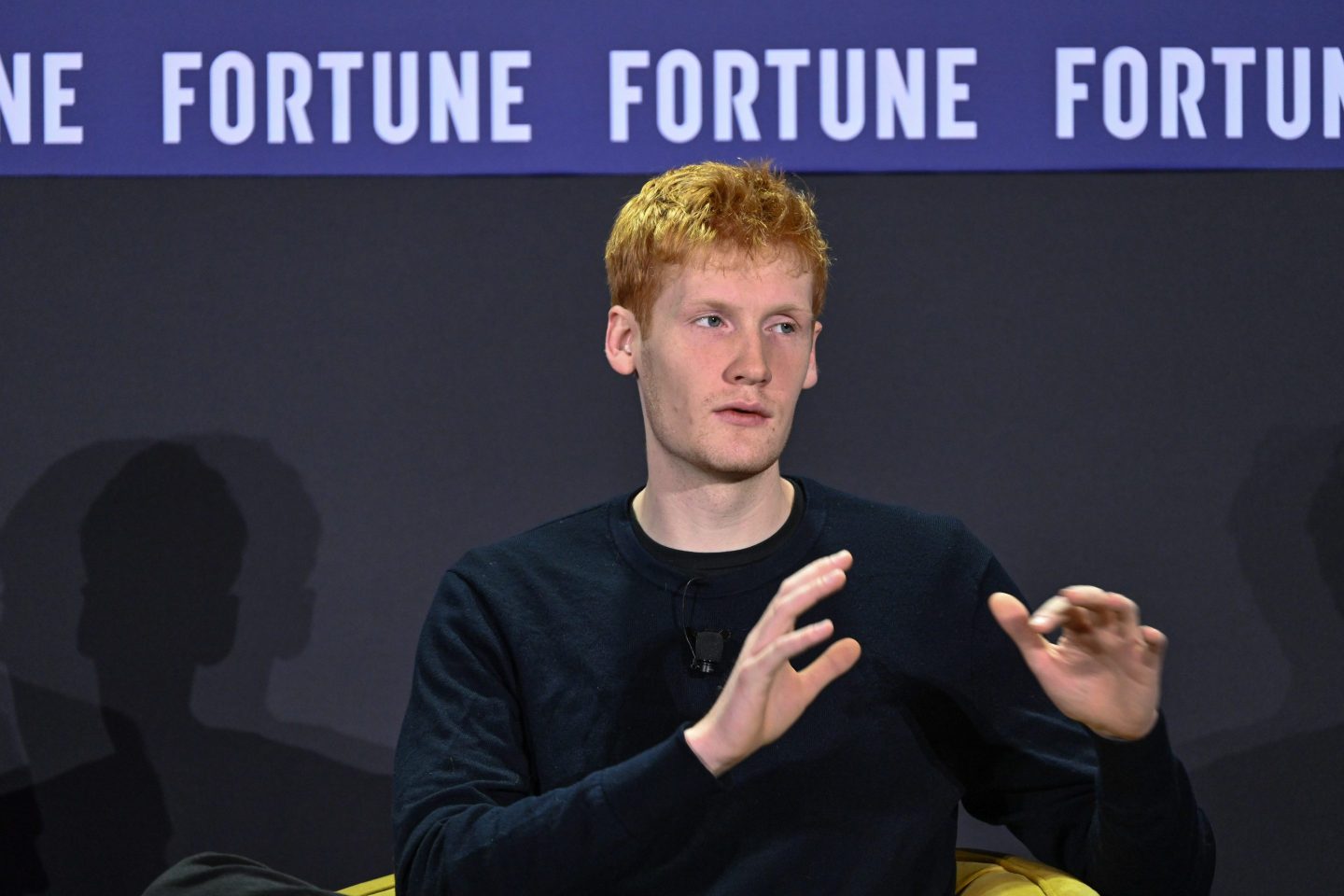
It’s something I’ve heard a few people say and it’s fitting: Truell’s a 25-year-old red-haired coder, known for his technical chops and intellectual bent. When I spoke to Truell, he even had a framed photo of legendary biographer Robert Caro looming over him. I thought about this, as I was writing the feature I just published on Cursor:
Not many 25-year-old CEOs have a photo of Robert Caro over their desks. Michael Truell does. As Truell takes a Zoom call, the image of Caro—legendary biographer of Lyndon Johnson and Robert Moses, known for his exhaustive, decades-long research—looms over his shoulder, sweatered, bespectacled, writing intently.
They make an incongruous pairing. Truell, the CEO of $29.3 billion AI coding company Cursor, is just a few years out of MIT and widely viewed as a rock star coder’s coder. Soft-spoken with a spine, Truell is unnervingly young and looks perhaps even younger, but he’s guided Cursor to a rapid-fire rise. Today, Cursor is used by 67% of the Fortune 500, with its platform every day generating 150 million lines of enterprise code.
I would have expected Truell to admire Apple’s Steve Wozniak, or Jensen Huang. But it’s Caro who Truell wants to watch over him.
There’s an irony here: Truell admires work that takes decades, but he runs a quintessential startup of the AI era—a world defined by compressed, vertiginous speed. Slow down for even a week, and you might get left behind. And right now, that could be happening to Cursor.
Truell’s living in the vortex of one of tech’s biggest questions: Who will survive the AI bubble? And Cursor, if the tweets of the last few weeks are to be believed, is “dead.”
“I’ve been terminally online all my life, I’ve been a VC who’s been terminally online for ten years, and I’ve never, ever seen X so disconnected from reality as I have in the last year,” Martin Casado, Andreessen Horowitz general partner and Cursor board member, told me in the reporting process. “There’s nothing in the Cursor numbers that would suggest there’s anything but total success right now. If we use X for truth, we’re starting from the wrong spot.”
Social media, I happen to agree, is a terrible starting place for truth. But the X-fueled ruckus of the last few weeks does, if you peel back the layers, show that Cursor’s rise and fragile future is nuanced. And it’s a tale entirely specific to the whirling dervish of the AI era.
My hope is that the story is a time capsule, one we can all dig up in a few years, knowing the answers to the questions it raises.
Read it here, and catch it on newsstands soon.
Term Sheet Podcast… Our next episode is going to be all about… farms! Yes, you read that right. I’ll be interviewing Mackenzie Burnett, CEO and cofounder at Ambrook, which provides cowboys with their very own financial software. Got questions for Mackenzie? Send ‘em my way, and I’ll ask at least one on the show!
See you tomorrow,
Allie Garfinkle
X: @agarfinks
Email: alexandra.garfinkle@fortune.com
Submit a deal for the Term Sheet newsletter here.
Joey Abrams curated the deals section of today’s newsletter. Subscribe here.
VENTURE CAPITAL
- Gimet Labs, a San Francisco-based applied AI research and product company, raised $80 million in Series A funding. Menlo Ventures led the round and were joined by Factory, Eclipse, Prosperity7, and Triatomic.
- Shepherd, a Carmel, Ind.-based commercial insurance company raised $42 million in Series B funding. Intact Private Capital led the round and was joined by Spark Capital, Costanoa Ventures, and others.
- Oryon Cell Therapies, a Belmont, Mass.-based biotech company focused on cell therapies for neurodegenerative disorders, raised $21 million in Series A funding from Neuro.VC, Byers Capital, and others.
- Interloom, an Amsterdam, The Netherlands, Berlin, Germany, and Munich, Germany-based developer of enterprise AI designed to make back office workflows more efficient, raised $16.5 million in seed funding. DN Capital led the round and was joined by Bek Ventures and Air Street Capital.
- littlefish, a Johannesburg, South Africa-based merchant operating system, raised $9.5 million in Series A funding. Partech led the round and was joined by TLCOM, Flourish Ventures, and Proparco.
- ImmuneBridge, a San Francisco, Calif.-based cell therapies company, raised $7.7 million in seed funding. NFX led the round and was joined by One Way Ventures, M Ventures, Insight Partners, LongGame Ventures, and others.
- Hamilton, a San Francisco-based developer of AI for private aviation operators, raised $7.5 million in seed funding. TTV Capital led the round and was joined by Bling Capital, Cambrian Ventures, FJ Labs, Weekend Fund, Mintaka Ventures, Correlation VC, and HF0.
- Happy Pay, a Cape Town, South Africa-based buy-now-pay-later platform, raised $5 million in seed funding from Futuregrowth Asset Management, 4Di Capital, E4E Africa, Equitable Ventures, and Felix Strategic Investments.
- BackChannel, a São Paulo, Brazil-based business-to-business marketplace designed to connect major brands and distributors to merchants, raised $4.8 million in seed funding. Sunna Ventures, Positive Ventures, SC Latam Innovation Fund, and others led the round.
- Zalos, a San Francisco-based developer of computer agents for finance operations, raised $3.6 million in seed funding. 14 Peaks led the round and was joined by Cohen Circle, 20VC, and angel investors.
- Hyground, a Hamburg, Germany-based AI-powered site reliability engineering agent, raised €3 million ($3.5 million) in pre-seed funding. Partech led the round and was joined by Adesso Ventures, Angel Invest, and Plug and Play.
PRIVATE EQUITY
- Arlington Capital Partners agreed to acquire Eptec Defense, a Sydney, Australia-based naval defense contractor. Financial terms were not disclosed.
- Diversis Capital acquired LTi Technology Solutions, an Omaha, Neb. and Staines-Upon-Thames, U.K.-based provider of software for the equipment finance industry. Financial terms were not disclosed.
- One Equity Partners acquired Kitwave Group, a North Shields, U.K.-based wholesale distributor to foodservice and retail customers. Financial terms were not disclosed.
EXITS
- Primary Wave and Brookfield Asset Management agreed to acquire Kobalt, a New York City-based independent music publisher, from Francisco Partners. Financial terms were not disclosed.