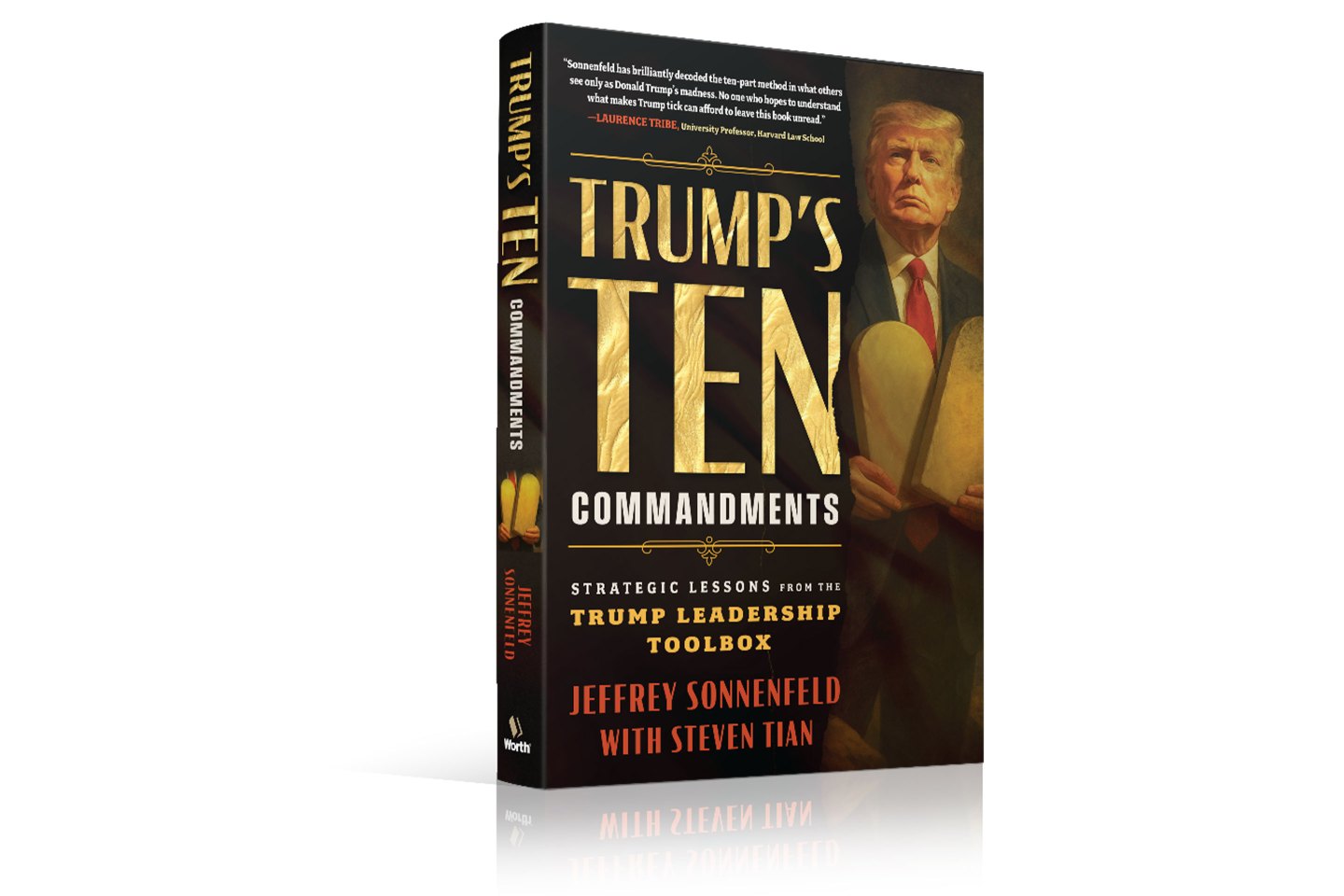
This is an exclusive teaser excerpt, adapted from Jeffrey Sonnenfeld and Steven Tian’s new book, Trump’s Ten Commandments (Worth/Simon& Schuster), out March 31st. The book is now available for pre-order at Amazon and trumptencommandments.com
I have been a scholar and professor of leadership for five decades, teaching at Harvard, Emory, and Yale. In my research, I study all kinds of leaders, from iconic heroes to failures and frauds, in sectors as diverse as business, entertainment, and politics. I have advised thousands of leaders along the way, including five US presidents from both political parties, countless bipartisan cabinet secretaries, elected officials at every level from mayors to the US Senate, and thousands of Fortune 500 CEOs. I continue to convene gatherings of top leaders frequently at events as varied as my Yale CEO Summits, Yale Mayors Colleges, and Yale Higher Education Leadership Summits.
I have also known and worked closely with Donald Trump for a quarter-century, as an advisor, friend, critic, adversary, and everything in between. In fact, I encouraged and helped enable Trump’s evolution from businessman to media personality and then politician; and I have served as a catalyst for and motivator of significant opposition to Trump’s excesses.
Having studied social psychology, sociology, economics, history, political science, and anthropology, I have come to realize that these academic disciplines tend to minimize the importance of individual personality traits and differences, instead focusing on economic, national, regional, interest group, and demographic drivers of behavior.
These vantage points, along with my shared history with Trump, have given me unique insights into how he leads, his strategic playbook, and his bag of tricks. To those who argue that the words “Trump” and “strategic leadership” should never go in the same sentence, I say, quite simply, you are mistaken. I hear your arguments and know you will say that Trump is so unpredictable, uninformed, impressionable, and impulsive that clearly he has no strategy. You’re not entirely wrong. Trump is not a strategist in the classic sense of the word. The second coming of Niccolo Machiavelli or Sun Tzu he is certainly not. But to underestimate Trump’s strategic acumen and intentionality is a big mistake.
Dumb as a fox
If Trump is dumb, he is dumb as a fox. While he rarely reads and might not pass some college exams were he to take them today,5 that is all irrelevant, because an indisputable canniness, a shrewd instinct for survival, and a chameleon-like adaptability guide his every move.
He is impulsively, even explosively, open with his opinions but keeps his strategic game plans close to his vest. And make no mistake about it: There is a method to the madness, and he knows what he is doing. Where others see chaos and unpredictability, I see Trump getting exactly what he wants by intentional design. And therein lies his secret sauce. Through decades of sheer repetition and fine-tuning he has developed a set of stratagems and tricks that allow him to get what he wants when he wants it, no matter how crazy it might seem to the uninitiated.
By deploying the same tried-and-true stratagems over and over again—some of them crossing the lines of conventionally acceptable behavior—Trump manages to regularly and consistently bluster, bully, cajole, flatter, and slither his way out of jams, and into positions of maximum advantage and leverage for achieving his goals. The leadership stratagems that Trump has deployed to overcome successive challenges are visible in plain sight to those who have followed his career closely.
Donald Trump’s career path is not that of a conventional politician, businessman, or media titan, nor that of a scholar, historian, psychologist, global diplomat, military leader, or economist. Yet he disrupted each of these fields, revealing enormous gaps in what the experts presumed to be the realities of their respective domains. His leadership instincts frequently match the research of decades of scholarship and academic theory, which he never needed to read to deftly intuit and deploy. He has challenged and shattered conventional orthodoxies, regardless of whether that was in pursuit of patriotic, unifying, peace-making, deregulatory outcomes as his supporters argue, or for personally enriching, self-aggrandizing, bullying, repressive, divisive, vindictive purposes as his critics argue.
That has always been the case with Trump across his entire life, but now it is especially true—and especially consequential—in his role as president.
Trump proves presidential historians mostly wrong
Having personally advised five US presidents across parties, I can confidently claim that Donald Trump has no peer in his portfolio of success or setbacks, nor in his modus operandi.
First, in his tenure as president, Donald Trump has violated all the rules and norms of the presidency as laid out by pretty much anyone and everyone imaginable: historians, psychologists, policy experts, journalists, media commentators, political scientists, you name it. In the 1970s, I was a student of the renowned Harvard political scientist Richard Neustadt. His hugely influential 1960 book, Presidential Power: The Politics of Leadership, insisted that the essence of presidential strength is the power to persuade rather than to issue decrees. He described the US presidency as a legally weak position. His core thesis was that the president’s formal constitutional powers are constrained, with their effectiveness reliant on their ability to bargain and persuade other key political players. This is because the American system is one of “separated institutions sharing power,” not concentrated power in the hands of any single individual.
He warned that a president cannot accomplish much by merely barking orders, channeling President Truman’s derisive prediction when General Eisenhower was elected president: “Poor Ike, it won’t be a bit like the army. He’ll sit here, and he’ll say, ‘Do this! Do that!’ And nothing will happen.” To Neustadt, a president had to coax others to join him through prestige and reputation rather than issue commands—in other words, the antithesis of Trump’s approach. Clearly, Trump did not get this memo, nor would he have cared much for Neustadt’s theories. Since taking office, he has continued to steadily concentrate power in his own hands, legislative and judicial guardrails be darned.
Both Princeton’s revered political scholar and psychologist Fred Greenstein and presidential historian Stephen Ambrose challenged Neustadt’s view of Eisenhower as inept, instead portraying a crafty leader who masqueraded behind a genial external demeanor to accomplish careful strategic ends. After decades of research on the effectiveness of thirty US presidents, Greenstein developed a checklist of six qualities by which to evaluate success or failure in the Oval Office: public communication, organizational capacity, political skill, vision, cognitive style, and emotional intelligence.
In his book The Presidential Difference: Leadership Style from FDR to Clinton, Greenstein argued that emotional intelligence was the most important quality. He suggested that emotional intelligence could be measured by “the president’s ability to manage his emotions and turn them to constructive purposes, rather than being dominated by them and allowing them to diminish his leadership.” Trump’s heated rhetoric, seemingly impulsive actions, vindictiveness, and hair-trigger attacks when feeling insulted would not rate well on these scales; yet before his death in 2018, at age 88, Greenstein reportedly declared Trump’s presidency “fascinating to a scholar of leadership because it’s so different from anything else”— an expert acknowledging an aberration to all previously held norms, and acknowledging that his own expert theories were obliterated.
What Trump told me in 2015
In his office back in 2015, before he was taken seriously as a presidential candidate, he told me that he hoped to tap into populist anger, and mused about going to the left of Senator Bernie Sanders, while simultaneously realizing that tapping into populist anger on the right might be a more realistic and potent route. Indeed, ideology has never been the correct prism through which to understand the notoriously flexible and unideological Trump, with Trump scrambling the conventional dividing lines of left, right, and center.
I first became close with Trump when, paradoxically, I was an original critic of his hit TV show The Apprentice in the early 2000s, writing scathing critiques of his reality TV stardom. At the time, NBC had asked me to review each episode for the first season to analyze the leadership lessons. Not having tracked Trump as closely as Spy magazine—which trailed him religiously and satirically, anointing him “The Donald”—I agreed, figuring it would help me catch up. What I saw horrified me. I thought that it was the exact wrong model of American business leadership for young, ambitious, rising generations of proteges to seek to emulate, or for our global trading partners seeking to understand how to do business in the US. It was the antithesis of all the ideal values of the truly great business leaders I had studied.
In one early critique in the pages of The Wall Street Journal, I ridiculed, “[The Apprentice] neglects the core functions of leadership, integrity, inspiration, and invention. No business innovation surfaces, no societal problems are solved. Instead, we see people hawking sex, booze, bags of dirt, and more sex, and celebrity access.” I likened the elimination game format of the show and the salacious intrigue as “akin to a musical chairs game in a Hooters restaurant.” My vocal, high-profile criticism resulted in Trump and myself being constantly juxtaposed in media narratives about The Apprentice, which predictably drove Trump crazy.
To my horror and amazement, my support system collapsed upon meeting Trump, and they gravitated to his aura. Yes, the once deep animosity of both of my friends immediately melted as soon as we arrived as Trump laid on the charm. My wife went out and played golf with him; they arrived back shortly thereafter, having played only three holes because she beat him. But he flattered her nevertheless, saying that she reminded him of his then-fiancée, Melania, and giving her clubs and shoes. She had not been a fan of Trump previously; she had joined me in viewing The Apprentice outtakes NBC had sent to us a day in advance for The Wall Street Journal series I was writing, and she did not find the salacious and unsavory things she saw amusing. But she was plainly charmed by Trump after she met him in person, even claiming to all who would hear her out that his hair was real and that he was a delightful person.
Meanwhile, my brilliant economist colleague was similarly converted, selling Trump on endorsing a litany of entrepreneurial products and businesses he was developing. After a while, Trump turned to me and said, “Look, your friends love me, what does it take to win you over?” I replied that I couldn’t be bought and that I saw the premise of the show as the problem, taking engaging, starry-eyed young people and turning them against each other in a vicious, musical chairs, zero-sum game. Trump said don’t blame him, blame Jack Welch—the then-head of GE, which owned NBC, which produced The Apprentice. According to Trump’s retelling, after Welch saw how well CBS’s Survivor was doing, he told Jeff Zucker, the then-head of NBC Universal, to try to secure Survivor for NBC, because reality TV was getting great reviews and was so cheap to produce. Then, according to Trump, when Zucker couldn’t get Survivor from CBS, he had Mark Burnett create the same show with the same premise, but instead of throwing contestants off an island, they would fire them from a job, and that became the premise of The Apprentice.
After Trump explained his perspective, I replied that while I didn’t know about Jack Welch’s take on all this, I thought Trump ought to change the show to past-their-prime celebrity “apprentices,” like Don Rickles, Joan Rivers, Jackie Mason, and other offensive comedians such as Andrew Dice Clay—all public figures so acerbic toward others that they deserved each other—and let them go at it with each other instead of corrupting starry-eyed young people. As an added bonus, these washed-up comedians would surely be happy to do it for free, for the free publicity. Trump defended the elimination game formula of the show as critical for drama but was intrigued by my counterproposal and asked me to give him a year to figure it out and transition the show toward that model. I trusted him and withheld continued public criticism until he could morph The Apprentice into The Celebrity Apprentice, and indeed, he delivered on his word.
To his credit, I found him genuinely disarming in his candor, charm, and willingness to understand my criticisms, as he clearly wanted to see what he could do to stop me from criticizing him so vocally.
We became friends at that point, and I continued to visit Trump Tower through the years at his invitation, even bringing the CEOs of the largest Chinese state-owned enterprises along to visit with him when they came to Yale for an executive program I was teaching in. That mutually amicable relationship continued up through Trump’s pivot into politics and the 2016 presidential election. In fact, in the earliest days of Trump’s bid in 2015, when virtually the entire political establishment refused to take him seriously, I was one of the first media commentators to grasp the serious potential of a Trump candidacy, writing some of the first objective profiles on him in a set of Fortune magazine columns.
Although I was a Hillary Clinton friend and supporter, at one salon-style dinner for wealthy GOP donors hosted by Larry Kudlow in August 2015 at his Redding, Connecticut, home, I ruffled some feathers when I cited Trump as the front-runner and expressed my belief that he could really win. The 50 attendees had all spoken in favor of their own favorite GOP primary contenders, from Jeb Bush to Marco Rubio to Ted Cruz to Carly Fiorina; they all offered strong endorsements of virtually anyone but Trump—except Roger Stone, who refused to endorse anyone, having just left the Trump campaign abruptly. I questioned whether the group might be overlooking the credibility of Trump’s candidacy as the elephant in the room, thinking that the GOP elephant mascot would be a popular symbol. The group, however, burst into laughter.
Trump repeatedly called me to Trump Tower to offer advice during his early candidacy, and I often brought along a diverse set of voices whose insights I thought might benefit him. For example, I brought one liberal political scientist from Yale who was originally highly skeptical of Trump but, to his own amazement, became cautiously intrigued by Trump’s curious mind after a spirited discussion on varied topics ranging from health-care reform to gerrymandering. As another example, after hearing Trump’s hardline perspective on China, I brought to his attention a book written by my old Harvard friend, the controversial, virulently anti-China economist Peter Navarro.
Before I knew it, Peter had landed on the Trump campaign, writing economic and trade policy memos. To my surprise, Trump often cited me by name in his early campaign speeches in 2015 and even in a GOP presidential debate, accurately capturing my perspectives but botching my title, promoting me several rungs up the ladder to the dean of all of Yale! After he was elected in 2016, he suggested to me a senior position in his government that I declined, as I had his offer of the presidency of Trump University so many years earlier.
Trump continued calling for advice throughout his first term, and I became friendly with many of his most trusted lieutenants, including his son-in-law Jared Kushner and a dozen or so of his cabinet members such as Elaine Chao, Wilbur Ross, and Linda McMahon as well as advisors and officials such as Peter Navarro, Larry Kudlow, Robert Lighthizer, Tom Bossert, and Anthony Scaramucci. In fact, I even introduced several of these officials to Trump. Candidly, knowing he generally supported Democratic candidates throughout his career and that he was not driven by ideology, I thought he had the potential to surprise many by drawing disparate parts of the nation together.
Okay, I admit I got that wrong. So now I will share what I have learned about Trump since. Before closing, however, I must admit that despite having written dozens of high-profile critiques of the Trump administration, and despite catalyzing CEOs to walk off his Presidential Business Advisory Councils in 2017 following his failure to forcefully condemn white supremacists in Charlottesville, and despite my role catalyzing one hundred major company CEOs to instantly certify the Biden victory in the 2020 elections, he never has attacked me. In fact, I was still invited to join the administration in the earliest days of Jared Kushner’s brilliant, historic Abraham Accords, and Trump has never rebuked me or threatened me for voicing prominent criticism of some of his actions.