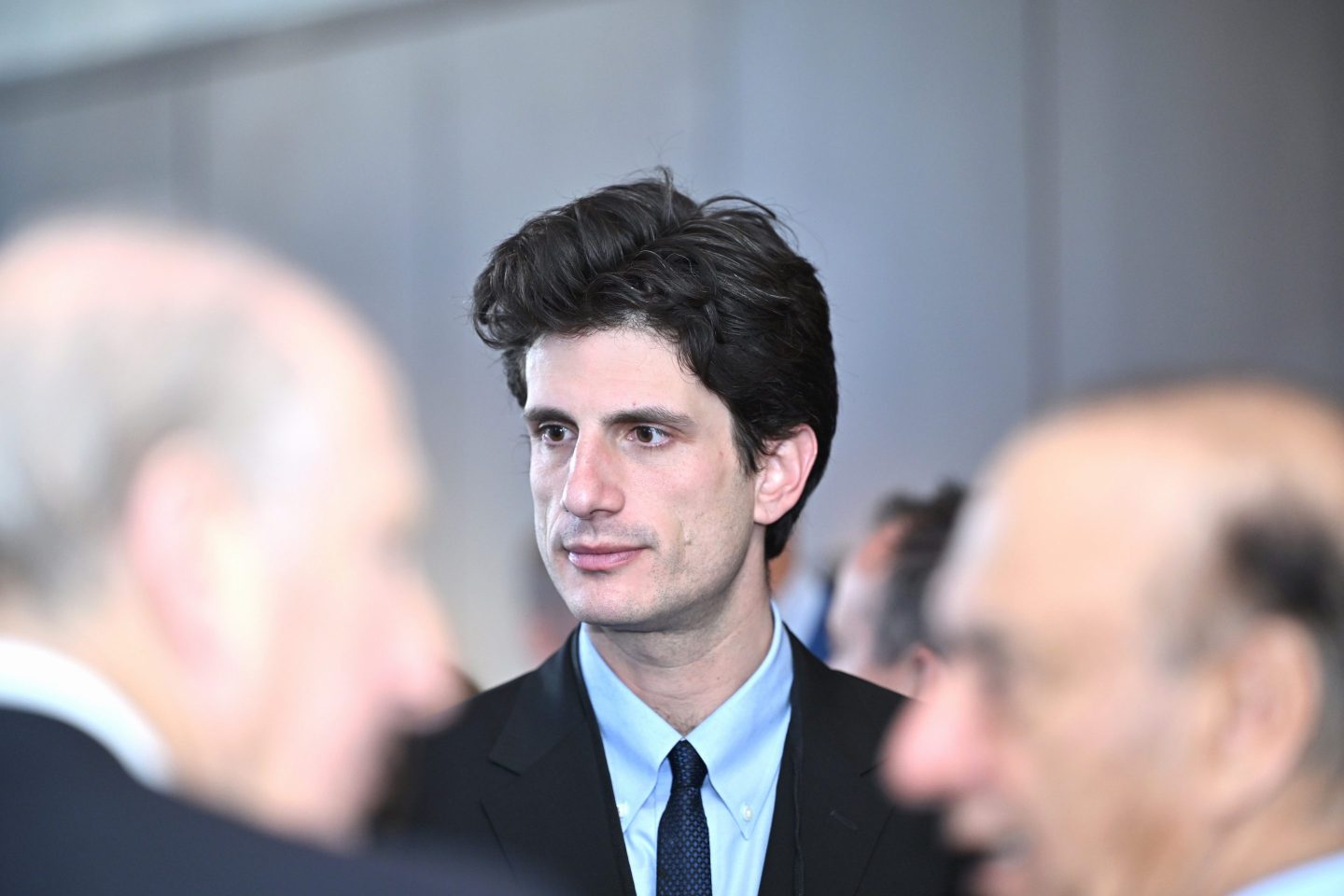
Jack Schlossberg has a confession: He thinks Donald Trump did something right.
At Fortune‘s CEO Initiative dinner in New York, the grandson of President John F. Kennedy — and now a Democratic congressional candidate running in Manhattan’s 12th District — sat down with Fortune editor Diane Brady for a candid, wide-ranging conversation that was as much diagnosis as campaign pitch. The verdict from the 33-year-old: Democrats have a serious problem with young men, and they brought it on themselves.
Schlossberg’s first question was to find an issue on which he and President Trump agreed. “I disagree with President Trump a lot,” he immediately offered, before saying he gives Trump credit for “getting people fired up about politics.” Trump “poached” many of the young men away from the Democratic Party, Schlossberg continued, urging his own party to look closely at how and why this happened.
“I think that they’re not stupid, those young men, and I give President Trump a lot of credit for being able to influence new meeting environments and make politics accessible.”
It’s a striking admission from a man who spent 2024 making viral social media videos for the Biden campaign — until he quit, that is. “I went down to Wilmington,” he explained, only to hear “no” over and over again. “Anyway, long story short, I quit the campaign because I thought if I don’t do this my way, I’m not going to be able to live with myself. A month later, I got a call from the campaign being like, ‘Hey, can you come back and make videos for us?'”
Schlossberg, who holds degrees from Yale Law and Harvard Business School, has built an unlikely second identity as a progressive content creator, deploying deadpan humor to reach an audience the Democratic Party has consistently fumbled. He told Brady that he thinks his use of humor and sense of the unexpected has been an effective vehicle for conveying information, and he argued that viral social media posts actually contain a lot of information. It’s misguided to think viral content is shallow or light.
With the Democratic Party at an all-time low in popularity, Schlossberg said it can’t be down to losing their way on policy, but rather no longer reaching young voters. “People aren’t looking for a superhero … They just want someone who knows how to speak their language, meet them where they are, and give them something of value.”
And he has a clear theory: “The Republican Party has embraced modernity in a way that the Democratic Party used to own,” he told the room of CEOs. “Whether it’s space, whether it’s the AI race, crypto, investing in new technologies — the Democratic Party has been way anti-everything, and anti-business in particular. Anti-modernity. Trump has flipped the script.”
That framing — Democrats as the party of “no” — is the sharpest arrow in Schlossberg’s quiver. He doesn’t believe the party lost its way on policy so much as it lost the plot on storytelling and cultural relevance. “I don’t think that’s because we all of a sudden lost our way on policy,” he said. “I think we’ve mainly been out in terms of reaching young people and telling them a story about what we’re for, not just being a reactionary party.”
The Democratic Party’s shift since JFK
What would his grandfather make of all this? Schlossberg described a sense of disappointment in the current landscape and a desire to, well, make the Democratic Party great again.
“I feel really proud of being a Democrat,” he said, “and that’s because I associate Democrat not with what it is today, but what it was in the past.” He explained that Democrats used to embrace maternity, science, and new media channels, a party that was pro-affordable healthcare, pro-immigration, pro-education. He also talked about “responsibility” and “courage” from political leaders to tell voters what they need to hear, not something false and harmful. This is the danger of Trumpism, he argued.
“Whether you support the president or not, I think he succeeds when people can’t really believe in anything the government is saying. We can’t even necessarily believe what he says on a given basis.” Schlossberg added that he doesn’t think Trump is wrong about everything, “that’s too simplistic a view.” But he said Trump is failing to give Americans confidence in the government. “He’s not giving us confidence in our ability to solve the problems of the future, and I think we really have too many problems that we’re not paying attention to right now that we need to solve.”
His campaign slogan — “Believe in Something Again” — is a deliberate callback to that lost Kennedy-era confidence. He acknowledged it’s “a little cheesy,” but insisted it captures exactly what this political moment demands: not a superhero, but a leader who meets people where they are and gives them something of genuine value. “Young people are not a monolith,” he said. “And young people are really smart. They can probably really tell authenticity from someone who’s not telling the truth.”
Schlossberg is running in one of the bluest, most compressed districts in the country — Manhattan’s 12th, stretching from 96th Street down to 14th — so his path to Congress runs through a Democratic primary, not a general election battle against Trump voters. But his argument, delivered over dinner to a room full of corporate executives, is clearly aimed at a broader audience: the Democratic Party, which, unless it rediscovers its appetite for modernity and courage, risks losing an entire generation of young men for good.
[This report has been corrected with regard to Schlossberg’s age. He was 33 at the time of the interview, not 32.]