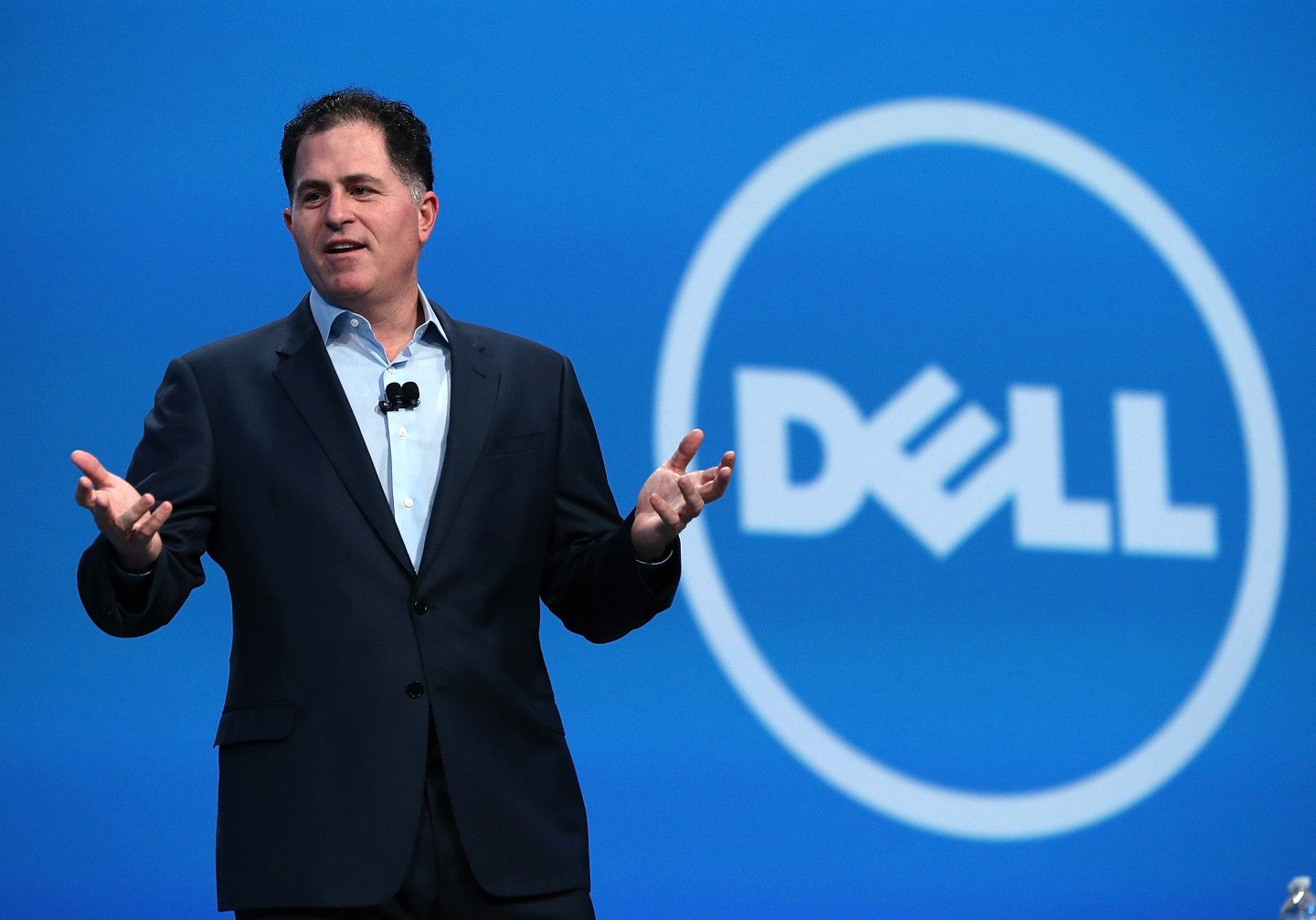
“Time will tell.” The vacuous cliché is a common if pointlessly used idiom of journalists and business executives, traced back to the Greek playwright Euripides, who is usually translated as having said, “Time will explain it all.” However, Michael Dell could have confidentially chanted Mick Jagger’s Rolling Stones anthem “Time is On My Side!”
Indeed, it has now been well over a decade ago, in the summer of 2013, when the battle lines were drawn in a boardroom showdown which, in retrospect, pitted true entrepreneurial vision against the quintessential activist hustle. On one side stood Dell, fighting to take his eponymous company private and rebuild it away from the merciless glare of quarterly earnings calls. On the other stood famed activist raider Carl Icahn, who aggressively peddled a proposal amounting to purely destructive financial engineering at the cost of the company — a scheme involving stock buybacks, warrants for future shares, and ruthless plans to carve up Dell’s creation for quick, extractive cash.
That saga was documented extensively in Dell’s book, Play Nice But Win: A CEO’s Journal From Founder to Leader. Much of the book mapped out the longer-term arc of reinvention, transforming the business from a PC manufacturer into a diversified technology leader, including the massive acquisition of EMC. The attack from Icahn, however, provided some of the book’s most compelling short-term drama. Dell detailed Icahn’s aggressive media campaigns and lawsuits, labeled the board a “dictatorship” and was yet amazed in a face-to-face meeting with Icahn, that he had no actual operational plan for the company.
There is no need to relitigate the blow-by-blow of that titanic fight, but with the passage of time, it has become clear that it was not only a seminal episode in business history; it marked the beginning of the end for old-fashioned activist investors and corporate raiders like Icahn, who had struck fear into the hearts of CEOs everywhere until Dell revealed the emperor had no clothes.
The divergent paths of the two since that epic struggle could not be more striking. Michael Dell has orchestrated one of the most staggering corporate triumphs of our time, creating value that soared from $24 billion to over $100 billion in broad impact, driving technological breakthroughs for his shareholders and the nation. Meanwhile, Icahn appears to be circling the drain.
To understand the sheer magnitude of Dell’s victory, one must look at the sophisticated capital allocation that followed the 2013 take-private. While Icahn wanted to strip the company for parts, Dell and his private equity partners went on the offensive. In 2016, Dell executed the $67 billion acquisition of EMC, the largest technology buyout in history. Rather than fatally fracturing his balance sheet to fund the mega-deal, Dell utilized a masterful piece of financial structuring, issuing a tracking stock (DVMT) tied to EMC’s economic interest in VMware.
This allowed Dell to retain operational control of the crown jewel of virtualization and cloud infrastructure without immediately absorbing the massive cash cost of buying VMware outright. By late 2018, Dell absorbed the tracking stock in a $21.7 billion cash-and-stock swap to simplify its capital structure and return to the public markets. He followed this with the brilliant 2021 tax-free spin-off of VMware, generating an $11.5 billion special dividend to aggressively deleverage Dell’s balance sheet. This wasn’t just corporate survival; it was a textbook lesson in creative, savvy capital allocation in building, practically from scratch, an integrated behemoth, squarely defeating the short-term arbitrage playbook favored by activists like Icahn.
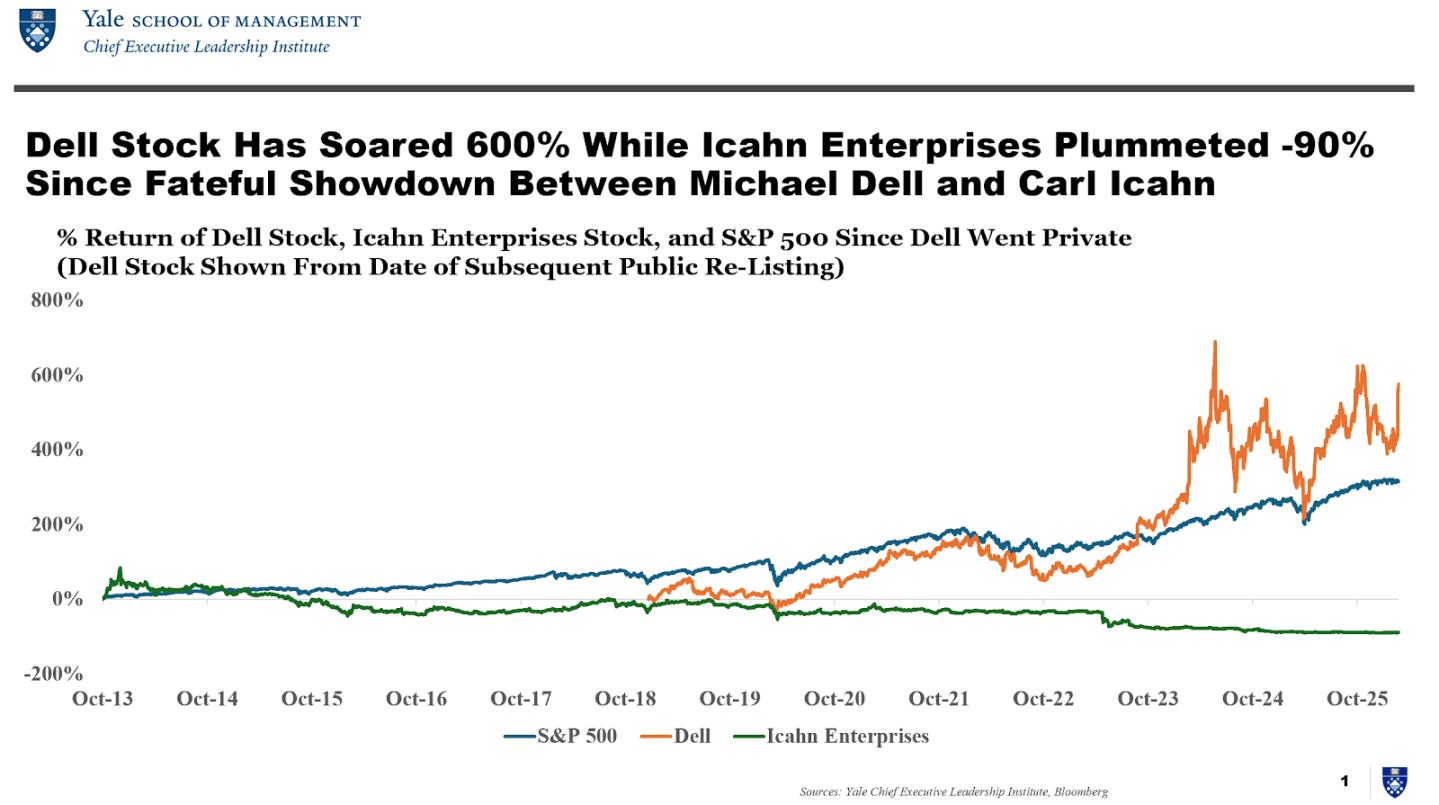
The quantitative divergence in total return between the two men’s equity vehicles since that 2018 relisting is staggering.
Dell returned to the public markets in late December 2018, debuting at $46 per share. Fast forward to today, trading at $153.55, Dell has delivered a compound annual growth rate (CAGR) of 18.1% on a pure price-return basis over the past 7.25 years—a figure that surges even higher when accounting for the total return of the monumental VMware spin-off and regular cash dividends, which puts the CAGR closer to 30%.
Conversely, Icahn Enterprises (IEP) has been the picture of catastrophic shareholder value destruction since slinking away from the Dell episode in defeat. From trading near $68 a share in October 2018, IEP has suffered a brutal, unrelenting collapse down to a dismal $8.11. That represents a value-evaporating negative CAGR of -25.6%. Meanwhile, Icahn Enterprises’ annual reports, where earnings are broken down by segment, reveal that the investment division has generated significant losses almost every year over the last decade plus.
We thought Icahn had hit the bottom years ago, but we had no idea how much further he had to fall. Carl Icahn is known to do some good things in his personal life, like saving dogs. But looking at his cratering metrics, one has to wonder if his investment portfolio is simply filled with dogs nowadays. He seems to have a warm spot for them.
Dell’s fundamental momentum continues to compound. Following a breathtaking recent quarter, Dell reported a soaring $33.38 billion in revenue, handily topping its $31.73 billion forecast. It delivered a massive earnings beat of $3.89 per share, crushing the $3.53-per-share expectations. Anchored by these achievements, including the doubling of AI server revenues to an expected $50 billion, Dell’s company market value surged by an astonishing 22%. This momentum was even punctuated by a warm shoutout to Michael and his wife Susan at the State of the Union regarding the “Trump Accounts lift off”.
This divergence is the ultimate referendum on the activist versus the builder, and Icahn has noticeably lowered his public profile as his track record has unraveled. But that divergence marked something even bigger than Icahn himself: it made it clear that swashbuckling corporate raiders and high-flying activist investors, simply put, are no longer the force they used to be, with a country of builders and doers triumphing over short-term, value destructive profiteering.
Contrary to Icahn’s short-term activism, Michael Dell’s triumphs make the ultimate statement for investing in the long term. Dell is constantly on the frontier of technology, perpetually reinventing his enterprise. Yet, he is famously not a self-promoter. His watchword has always been that a company is not a religion; it has to change and must never be worshipped merely for its past. He is the perfect model of “substance over sizzle.” We live in an era of vaporware and breathless cheerleading, where technology hucksters often have no idea what they are talking about. Dell stands in stark contrast—a quiet, relentless executioner who believes the underlying substance of the technology should sell itself.
This philosophy has allowed Dell to build the most integrated information technology firm in the U.S. and the world. Look at the other great legacy companies we once admired, such as the fractured Hewlett-Packard, with HPE and HP creating something like 15 different spin-outs and fragmented entities. Dell, however, kept it all integrated—devices, software, systems, networks, and cloud infrastructure seamlessly working together.
To truly appreciate Michael Dell’s survival and dominance, one must walk through the graveyard of early computer and device makers that were once considered his peers. Where are they now? Compaq is gone. Gateway is a relic. Packard Bell, Control Data, Data General, Prime Computer, and Sun Microsystems have all been swallowed up or vanished entirely. The pioneers like the Altair 880, Micro Instrumentation and Telemetry Systems (MITS), and Tandy Radio Shack’s TRS-80 (affectionately derided as the “Trash-80”), belong in museums.
Dell didn’t just survive this brutal culling; he thrived, and he didn’t do it by carving up his company to appease the fleeting demands of corporate raiders. He did it by focusing on building for the future, with an immutable focus on building long-term value, ignoring the gaseous distractions of the moment, and steadfastly refusing to treat his own past as a religion with no sacred cows. No wonder fellow entrepreneurial builders regularly point to Dell as their role model, including fellow tech superstar Marc Benioff, founder and CEO of Salesforce, who credited Dell as an inspiration during a Yale Legend in Leadership Award ceremony that we hosted several years ago.
As Helen Keller famously reminded us, “The only thing worse than being blind is having sight but no vision.” As Icahn’s empire shrinks and his stock plummets, Dell’s integrated empire is powering the next generation of artificial intelligence and global infrastructure. The contrast between a founder with long-term vision, on the one hand, and short-term activist value destruction, on the other, could not be clearer, and serves as a defining saga in business history for what really matters — and the turning point where the battle lines were drawn. In his own understated, non-self-promotional humble style, Michael Dell has proven Jonathan Swift’s advice that “vision is the art of seeing what is invisible to others.” Dell matches that vision with equally quiet but simply flawless execution.
The opinions expressed in Fortune.com commentary pieces are solely the views of their authors and do not necessarily reflect the opinions and beliefs of Fortune.