
• Home
  • Latest
  • Fortune 500
  • Finance
  • Tech
  • Leadership
  • Lifestyle
  • Rankings
  • Multimedia
Workplace CultureGender Issues

Why women’s earnings plateau in their 30s while men’s just keep growing through their 40s: It’s not just motherhood

Nick Lichtenberg
By
Nick Lichtenberg
Nick Lichtenberg
Business Editor
Down Arrow Button Icon
Nick Lichtenberg
By
Nick Lichtenberg
Nick Lichtenberg
Business Editor
Down Arrow Button Icon
March 5, 2026, 9:52 AM ET
women in workforce
Juggling it all comes at a cost.Getty Images

A new analysis of millions of Glassdoor salary reviews, published this week in the platform’s Beyond the Gap: Women’s 2026 Compensation Report, reveals a labor market truth that is both well-documented and still somehow underreported or taken for granted: women’s wages stop growing roughly a decade before men’s.

Recommended Video

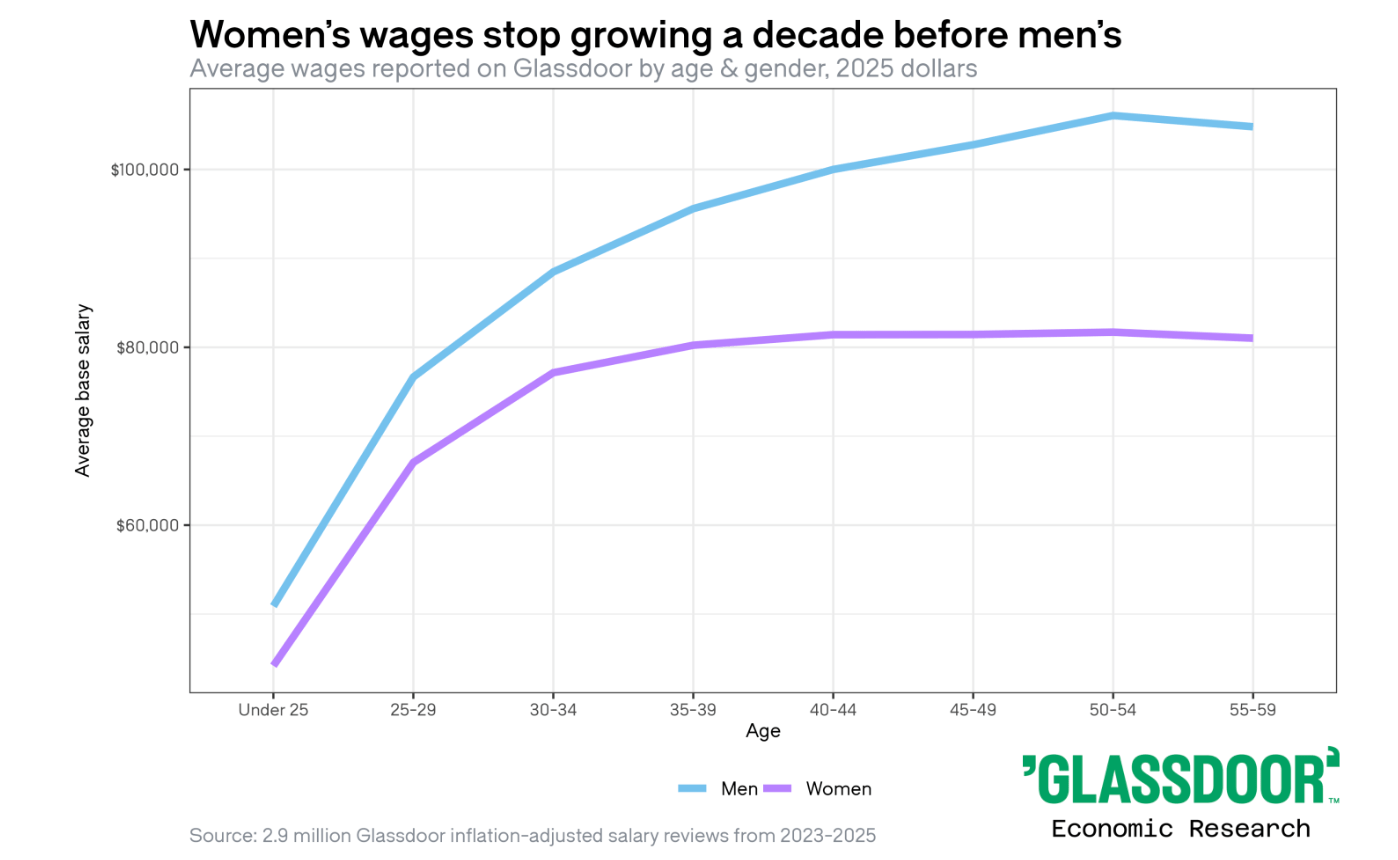
While male earnings climb steadily throughout their 40s, women’s earnings essentially plateau in their late 30s — a divergence that compounds year after year into a 25% gender pay gap by the time workers reach 30 years of experience.​

But why?

The gap starts small — then doubles

At career entry, men out-earn women by 12% — a disparity that Glassdoor’s economic research team says is entirely explained by structural factors: the industries workers enter, the roles they’re hired into, and the credentials they hold. There is no within-role pay difference at the starting line. Zero.​

A decade in, that changes. At 10 years of experience, the gap has grown to 19%, and for the first time, a within-role pay penalty appears — women in similar jobs with similar titles now earn roughly 4% less than their male peers, all else controlled. By the 30-year mark, the total gap hits 25%, though within-role differences account for only five percentage points of that figure. The remaining 20 percentage points reflect something harder to legislate away: men are simply advancing into higher-paying roles at a rate women are not.​

McKinsey Global Institute commentary previously published in Fortune found the same pattern: women consistently make trade-offs, choosing roles with more flexibility and less competition — but also lower pay. Over a 30-year career, MGI estimated that the gap adds up to roughly $500,000 per woman.

The age-35 cliff

The most striking visualization in the Glassdoor report is a wage-by-age chart comparing men’s and women’s average base salaries in 2025 dollars. Men’s earnings rise in a clean, steady arc into their 50s. The women’s line bends flat in the late 30s — and stays there.​

In 2025, as Fortune has reported, men joined the U.S. labor force at three times the rate of women — with the men’s workforce size growing by 572,000 and women’s by only 184,000 — suggesting that the structural headwinds women face are not easing. They are intensifying.

“This gap is driven by trends in the broader market, in the office, and in the home,” said Chris Martin, lead researcher at Glassdoor. “Jobs that tend to employ more women are typically lower-paying, bias can drive pay and promotion gaps, and women still shoulder more caregiving work.”​

Researchers have long linked this plateau to the life stage when many women become mothers, working fewer hours, stepping back from demanding roles, or temporarily exiting the workforce. But Glassdoor’s analysis adds a troubling coda: even women who never had children and remained fully active in the workforce still tend to earn significantly less than men by their 50s. The motherhood penalty is real, but it can’t be the only explanation.​

Fortune‘s previous examinations of the motherhood penalty have highlighted one study of more than 800,000 earnings reports that found women experience a 51% pay cut after giving birth, regardless of company size, industry, education level, or whether the mother was the household breadwinner. A separate study published in the Journal of Applied Psychology found that over a 30-year period, women who delayed motherhood earned between $495,000 and $556,000 more than those who became mothers early.​

But Fortune has also reported on a newer, arguably more troubling phenomenon layered on top of the motherhood penalty: the “menopause penalty.” A 2025 study found women experience a 4.3% average reduction in earnings in the four years following a menopause diagnosis, with losses rising to 10% by the fourth year. That finding matters because it suggests women’s earnings aren’t just penalized for caregiving choices — they’re penalized for biology itself, at a life stage that has nothing to do with workforce withdrawal.

The promotion problem

A Glassdoor Community poll offers a window into the mechanics: women are nearly 10 percentage points less likely than men to feel comfortable aiming for roles above their current level. Fewer attempts at promotion mean fewer promotions — and since the within-role pay gap holds relatively flat after the first decade, the divergence between men’s and women’s earnings is driven almost entirely by the difference in who is moving up the ladder.​

That reluctance — whether internalized or a rational response to observed workplace bias — has a direct dollar value. The longer a worker stays in a role while peers advance, the wider the gap becomes, and the harder it is to close.

Fortune has previously cited Glassdoor’s finding that only 36% of women feel comfortable asking for a raise, compared to 44% of men. But organizational psychologist Adam Grant pushes back hard on what follows from that data. The burden of closing the pay gap, Grant argued, should not fall on women to become better negotiators — it should fall on employers to fix the systems that make negotiating necessary and punish women who attempt it

Women may also be less likely to pursue promotion because they have accurately observed that promotion systems are stacked against them, making their reticence not a confidence deficit but a rational calculation. Calling this a confidence gap pathologizes a reasonable response to a biased environment, placing the burden of correction on women rather than on the organizations doing the selecting.

A sorting problem

There is a key distinction that both complicates and, in some ways, worsens the picture. The within-role pay gap — the controlled difference between a man and a woman doing the same job in the same industry in the same city — barely changes over two decades, rising to 4% at 10 years of experience and only 5% at 30 years. That’s a far cry from the 25% earnings gap across all jobs held by men and women, but it arguably makes it more concerning.

Critics have a point that the gender pay gap is comparing apples to oranges, but the uncomfortable implication is that a large share of the gender earnings gap is a labor sorting problem, not a pay discrimination problem. This is a genuine empirical debate that economists have wrestled with for decades: how much of this sorting reflects constrained choices — the result of inadequate childcare, unequal domestic burdens, and workplace inflexibility — versus preferences that, however socially shaped, are still preferences?​

If a woman earns less at 40 because she negotiated a four-day workweek to manage caregiving, and that tradeoff reflects her genuine ordering of priorities given real options, is that a market failure?

Getting the diagnosis right matters for getting the remedy right. If the gap is primarily a sorting problem, the solution is to change which industries and roles are valued and compensated. If it’s primarily a promotion problem, the solution is to audit advancement processes. If it’s primarily a caregiving infrastructure problem, the solution is paid leave, subsidized childcare, and shared domestic norms. These data points to all three, which means “the gender pay gap” is not one problem. It is at least three.

Join us at the Fortune Workplace Innovation Summit May 19–20, 2026, in Atlanta. The next era of workplace innovation is here—and the old playbook is being rewritten. At this exclusive, high-energy event, the world’s most innovative leaders will convene to explore how AI, humanity, and strategy converge to redefine, again, the future of work. Register now.
About the Author
Nick Lichtenberg
By Nick LichtenbergBusiness Editor
LinkedIn icon

Nick Lichtenberg is business editor and was formerly Fortune's executive editor of global news.

See full bioRight Arrow Button Icon

Latest in Workplace Culture

Finance
Lorem ipsum dolor sit amet, consectetur adipiscing elit, sed do eiusmod tempor incididunt ut labore et dolore magna aliqua. Ut enim ad minim veniam
By Fortune Editors
October 20, 2025
Finance
Lorem ipsum dolor sit amet, consectetur adipiscing elit, sed do eiusmod tempor incididunt ut labore et dolore magna aliqua. Ut enim ad minim veniam
By Fortune Editors
October 20, 2025
Finance
Lorem ipsum dolor sit amet, consectetur adipiscing elit, sed do eiusmod tempor incididunt ut labore et dolore magna aliqua. Ut enim ad minim veniam
By Fortune Editors
October 20, 2025
Finance
Lorem ipsum dolor sit amet, consectetur adipiscing elit, sed do eiusmod tempor incididunt ut labore et dolore magna aliqua. Ut enim ad minim veniam
By Fortune Editors
October 20, 2025
Finance
Lorem ipsum dolor sit amet, consectetur adipiscing elit, sed do eiusmod tempor incididunt ut labore et dolore magna aliqua. Ut enim ad minim veniam
By Fortune Editors
October 20, 2025
Finance
Lorem ipsum dolor sit amet, consectetur adipiscing elit, sed do eiusmod tempor incididunt ut labore et dolore magna aliqua. Ut enim ad minim veniam
By Fortune Editors
October 20, 2025

Most Popular

Finance
Lorem ipsum dolor sit amet, consectetur adipiscing elit, sed do eiusmod tempor incididunt ut labore et dolore magna aliqua. Ut enim ad minim veniam
By Fortune Editors
October 20, 2025
Finance
Lorem ipsum dolor sit amet, consectetur adipiscing elit, sed do eiusmod tempor incididunt ut labore et dolore magna aliqua. Ut enim ad minim veniam
By Fortune Editors
October 20, 2025
Finance
Lorem ipsum dolor sit amet, consectetur adipiscing elit, sed do eiusmod tempor incididunt ut labore et dolore magna aliqua. Ut enim ad minim veniam
By Fortune Editors
October 20, 2025
Finance
Lorem ipsum dolor sit amet, consectetur adipiscing elit, sed do eiusmod tempor incididunt ut labore et dolore magna aliqua. Ut enim ad minim veniam
By Fortune Editors
October 20, 2025
Finance
Lorem ipsum dolor sit amet, consectetur adipiscing elit, sed do eiusmod tempor incididunt ut labore et dolore magna aliqua. Ut enim ad minim veniam
By Fortune Editors
October 20, 2025
Finance
Lorem ipsum dolor sit amet, consectetur adipiscing elit, sed do eiusmod tempor incididunt ut labore et dolore magna aliqua. Ut enim ad minim veniam
By Fortune Editors
October 20, 2025
Fortune Secondary Logo
Rankings
  • 100 Best Companies
  • Fortune 500
  • Global 500
  • Fortune 500 Europe
  • Most Powerful Women
  • Future 50
  • World’s Most Admired Companies
  • See All Rankings
Sections
  • Finance
  • Fortune Crypto
  • Features
  • Leadership
  • Health
  • Commentary
  • Success
  • Retail
  • Mpw
  • Tech
  • Lifestyle
  • CEO Initiative
  • Asia
  • Politics
  • Conferences
  • Europe
  • Newsletters
  • Personal Finance
  • Environment
  • Magazine
  • Education
Customer Support
  • Frequently Asked Questions
  • Customer Service Portal
  • Privacy Policy
  • Terms Of Use
  • Single Issues For Purchase
  • International Print
Commercial Services
  • Advertising
  • Fortune Brand Studio
  • Fortune Analytics
  • Fortune Conferences
  • Business Development
  • Group Subscriptions
About Us
  • About Us
  • Editorial Calendar
  • Press Center
  • Work At Fortune
  • Diversity And Inclusion
  • Terms And Conditions
  • Site Map
Fortune Secondary Logo
  • About Us
  • Editorial Calendar
  • Press Center
  • Work At Fortune
  • Diversity And Inclusion
  • Terms And Conditions
  • Site Map
  • Facebook icon
  • Twitter icon
  • LinkedIn icon
  • Instagram icon
  • Pinterest icon

Latest in Workplace Culture

trump
HealthFDA
‘Usually everybody loves money’: Trump’s FDA chief to start giving bonuses for faster drug reviews
By Catherina GioinoMarch 5, 2026
4 minutes ago
women in workforce
Workplace CultureGender Issues
Why women’s earnings plateau in their 30s while men’s just keep growing through their 40s: It’s not just motherhood
By Nick LichtenbergMarch 5, 2026
55 minutes ago
kids on phones
Arts & EntertainmentSocial Media
Meet the social media CEO who won’t let his own kids on social media: ‘Parents are oblivious to the world’
By Jake AngeloMarch 4, 2026
22 hours ago
Dara Khosrowshahi, chief executive officer of Uber Technologies
Successwork-life balance
Uber CEO says his ‘really demanding’ work culture includes expecting employees to answer his emails over the weekend: ‘Don’t come here if you want to coast’
By Emma BurleighMarch 4, 2026
23 hours ago
Future of Workwork culture
Kickstarter’s CEO stands by a 4-day workweek with a fully remote team, but admits it sometimes backfires
By Sydney LakeMarch 3, 2026
2 days ago
Photo of Bill Gurley
SuccessCareers
Tech investor Bill Gurley says workers who went through the ‘college conveyor belt’ and chased safe jobs are at high risk of AI automation
By Emma BurleighMarch 3, 2026
2 days ago

Most Popular

placeholder alt text
Health
Palantir and other tech companies are stocking offices with tobacco products to increase worker productivity
By Catherina GioinoMarch 4, 2026
1 day ago
placeholder alt text
Success
Uber CEO says his ‘really demanding’ work culture includes expecting employees to answer his emails over the weekend: ‘Don’t come here if you want to coast’
By Emma BurleighMarch 4, 2026
23 hours ago
placeholder alt text
Real Estate
Meet a burned out 28-year-old who pays $168 a month in China's faux Venice to retire early from her Shanghai finance gig
By Albee Zhang and The Associated PressMarch 2, 2026
3 days ago
placeholder alt text
Cybersecurity
Cities join Amazon in cutting ties with license-plate reader Flock following Ring's Super Bowl ad—that Flock 'didn't have anything to do with'
By Catherina GioinoMarch 3, 2026
2 days ago
placeholder alt text
Personal Finance
Current price of gold as of March 3, 2026
By Danny BakstMarch 3, 2026
2 days ago
placeholder alt text
Success
Tech investor Bill Gurley says workers who went through the ‘college conveyor belt’ and chased safe jobs are at high risk of AI automation
By Emma BurleighMarch 3, 2026
2 days ago

© 2026 Fortune Media IP Limited. All Rights Reserved. Use of this site constitutes acceptance of our Terms of Use and Privacy Policy | CA Notice at Collection and Privacy Notice | Do Not Sell/Share My Personal Information
FORTUNE is a trademark of Fortune Media IP Limited, registered in the U.S. and other countries. FORTUNE may receive compensation for some links to products and services on this website. Offers may be subject to change without notice.