
• Home
  • Latest
  • Fortune 500
  • Finance
  • Tech
  • Leadership
  • Lifestyle
  • Rankings
  • Multimedia
AIData centers

Moody’s flags $662 billion risk at the heart of the data center build-out by just 5 companies

Nick Lichtenberg
By
Nick Lichtenberg
Nick Lichtenberg
Business Editor
Down Arrow Button Icon
Nick Lichtenberg
By
Nick Lichtenberg
Nick Lichtenberg
Business Editor
Down Arrow Button Icon
February 25, 2026, 3:10 AM ET
data center
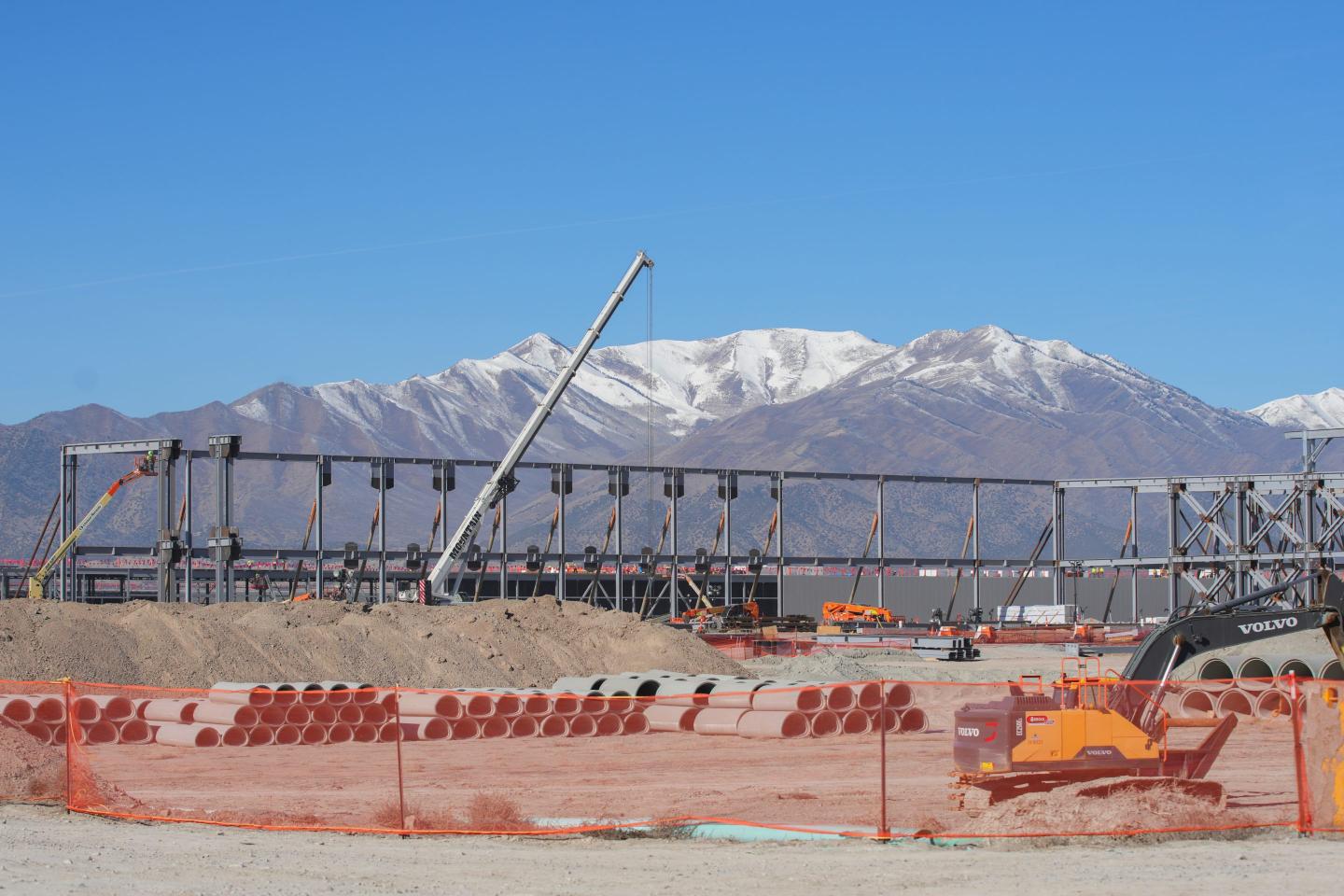
A building under construction at the new QTS Eagle Mountain data center in Utah, Jan. 27, 2026. George Frey—Bloomberg/Getty Images

The technology sector’s frantic race to build artificial intelligence infrastructure has created a massive, financial overhang. According to a recent in-depth report by Moody’s Ratings, the top five U.S. hyperscalers have accumulated $662 billion in future data center lease commitments not yet begun that are not current liabilities and therefore sit entirely off their balance sheets. As those leases begin over the next several years, and as landlords’ obligations are fulfilled, that more than half a trillion dollars’ worth of data center activity will be recorded on balance sheets.

Recommended Video

The report, which analyzed the financial disclosures of Amazon, Meta, Alphabet, Microsoft, and Oracle, highlights how the unprecedented build-out of AI data centers is straining traditional accounting metrics. As of the end of 2025, these five tech giants had amassed a staggering $969 billion in total undiscounted future lease commitments, or data centers that have yet to be built. However, more than two-thirds of this total, that $662 billion figure, is for leases that have yet to commence, meaning that under generally accepted accounting principles, or GAAP, these companies are not required to recognize these massive obligations on their current balance sheets.
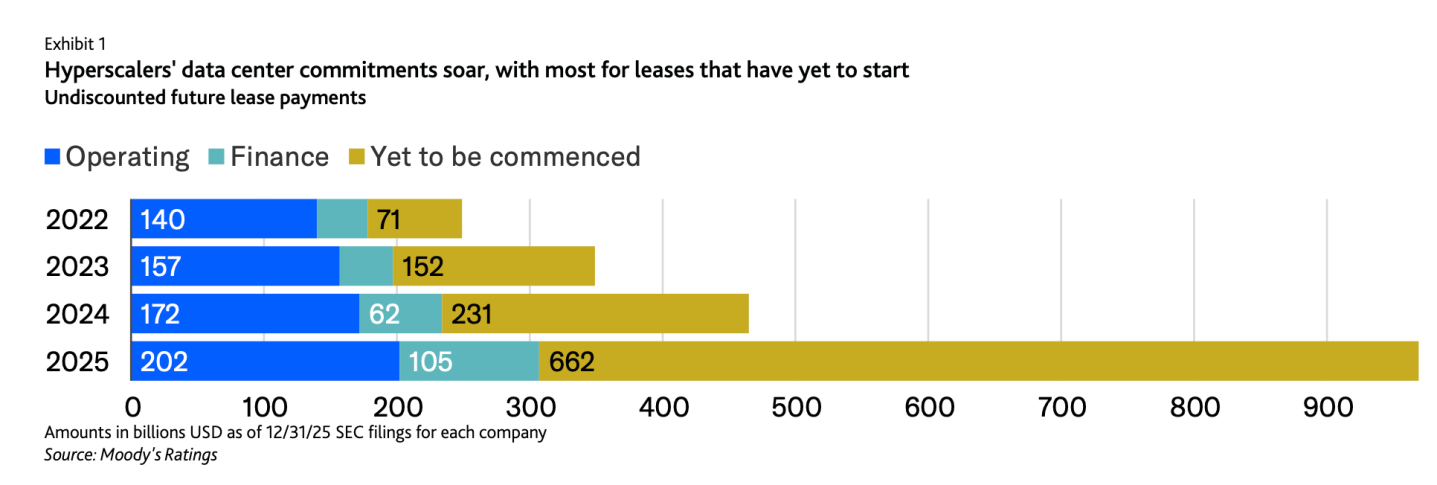
To put the scale of this hidden obligation into perspective, Moody’s accounting analysts David Gonzales and Alastair Drake calculated that the unrecorded $662 billion is equivalent to 113% of these five hyperscalers’ most recent adjusted debt.

Gonzales told Fortune in a statement that it’s “not as if [these hyperscalers] have have avoided a liability through structuring,” characterizing the $662 billion at issue as “yet to be on the balance sheet,” rather than missing. “More accurately,” he added, “they have not yet received the services to trigger this liability as of this time, but they will.”

For instance, Alphabet disclosed in a footnote in the third quarter of 2025 that it had “entered into leases primarily related to data centers that have not yet commenced with future lease payments of $42.6 billion, including a purchase option considered reasonably certain to be exercised, that are not yet recorded on our Consolidated Balance Sheet. These leases will commence between 2025 and 2031 with noncancelable lease terms between one and 25 years.”

That came after a Q2 disclosure stating Alphabet had “entered into leases primarily related to data centers that have not yet commenced with future lease payments of $23.9 billion, that are not yet recorded on our Consolidated Balance Sheets. These leases will commence between 2025 and 2031 with noncancelable lease terms between one and 25 years.”

From the second to the third quarter, future lease payments, an unrecorded future obligation, jumped from $23.9 billion to $42.6 billion.

Meta, Amazon, and Microsoft declined to comment. Alphabet and Oracle did not respond to requests for comment.

What is going on with these leases?

The root of this accounting phenomenon lies in the unique nature of AI hardware and the rules governing corporate leases. Historically, U.S. data center leases spanned 10 to 15 years. But because the cutting-edge semiconductor and technology equipment required for AI typically has a useful life of just four to six years, hyperscalers are demanding shorter initial lease terms with options to renew. And “to make the investment case for landlords,” the note explains, “these structures are often backstopped by a significant off-balance-sheet guarantee from the lessee.”

Under GAAP, a lease renewal period is only included in a company’s lease liability if the renewal is deemed “reasonably certain”—a high threshold requiring greater than 70% certainty. (GAAP emerged in the 1930s as a response to the 1929 stock market crash that coincided with, even caused, the onset of the Great Depression.) Because future AI strategies and technology upgrades are highly unpredictable, tech giants can justifiably argue that they are not reasonably certain to renew, thereby keeping the potential renewal costs off their books.

But landlords still require financial security to construct these specialized, multibillion-dollar facilities. To bridge this gap, hyperscalers are utilizing significant off-balance-sheet guarantees, most notably “residual value guarantees” (RVGs). An RVG acts as a backstop; if a tech company cancels or does not renew a lease, it must pay the landlord the difference if the data center’s market value falls below a pre-agreed threshold.

Crucially, U.S. GAAP allow companies to defer reporting these expected RVG obligations. Unless it is deemed “probable” that the lease will end without renewal, the contingent liability of the RVG does not need to be recorded on the balance sheet. Moody’s notes that “if a company concludes a lease renewal is likely to be exercised, but not reasonably certain, it can avoid classifying both the lease renewal periods and the residual value guarantee as liabilities.”

Meta Platforms provides a striking example of this practice. In its recent SEC filings, Meta disclosed entering into data center leases commencing in 2029 with an initial commitment of approximately $12.3 billion. Alongside this, Meta provided an RVG with a massive aggregate threshold of $28 billion. Because Meta deemed the RVG payouts “not probable,” no liability was recorded for this $28 billion guarantee.

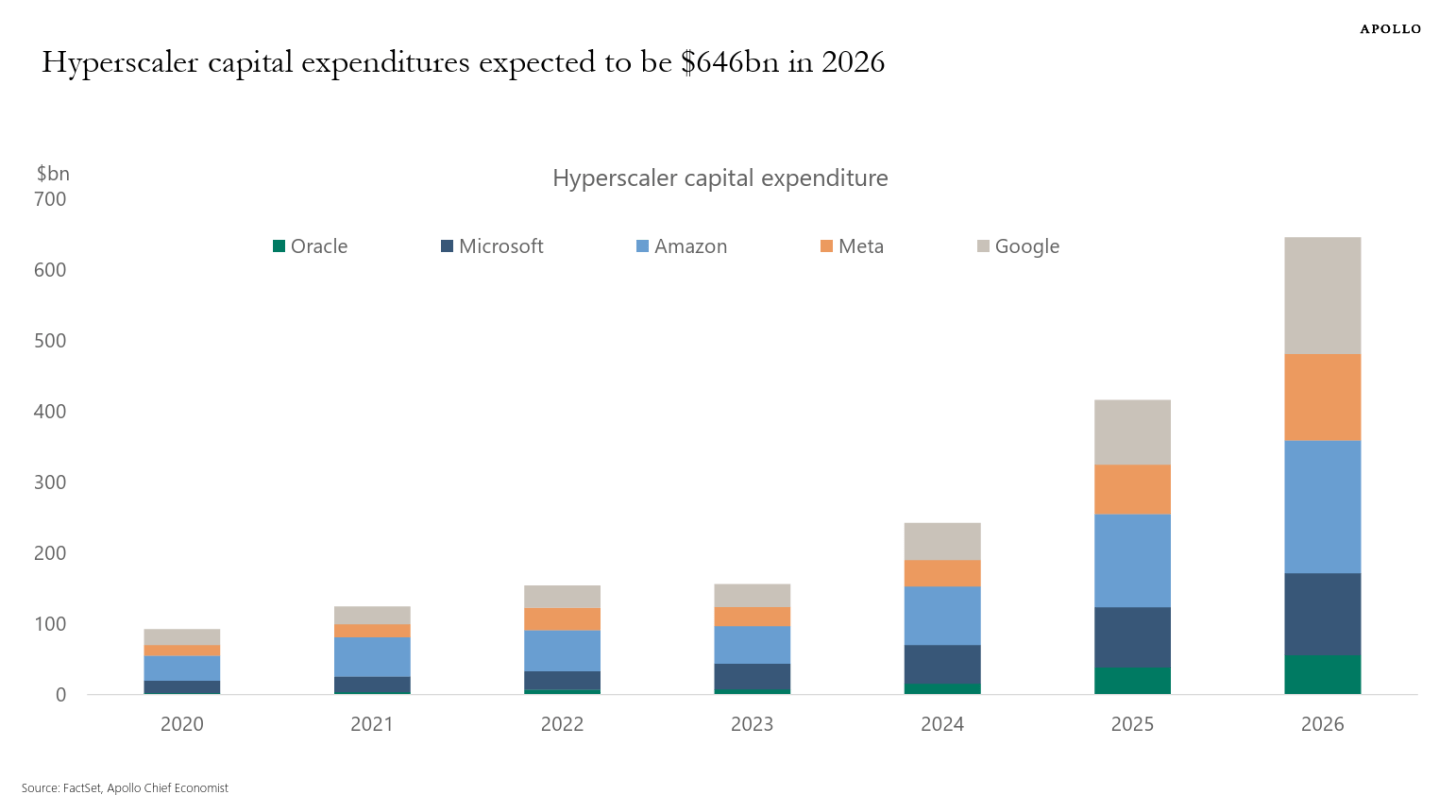
In a chart book published nearly simultaneously with Moody’s report, Apollo Global Management chief economist Torsten Slok worked to put the enormity of data center spending into perspective. With total capital expenditure on data centers estimated at roughly $646 billion, or about 2% of U.S. GDP, Slok noted that is roughly equivalent to the GDP for Singapore, Sweden, and Argentina. Defense spending in 2025, meanwhile, was around $917 billion.
Moody’s warned that these opaque accounting practices mask the true economic risk facing the tech industry. While leasing reduces upfront capital investments, carrying such massive future commitments severely limits a company’s financial and operating flexibility, especially if AI industry conditions change rapidly. Because these liabilities are hidden, Moody’s concluded, in its own jargony way, that it is considering new ways to look at this issue.

“The accounting liability is unlikely to reflect certain plausible future scenarios … With this in mind, we will continue to assess cash exposures and debt-like adjustments as time progresses and the dates of new leases draw nearer. We may make a nonstandard adjustment to Moody’s adjusted debt based on our expectation of likely cash outflows.”

In 2001, Fortune first convened “The Smartest People We Know,” bringing together CEOs and founders, builders and investors, thinkers and doers. Since then, Fortune Brainstorm Tech has been the place where bold ideas collide. From June 8–10, we will return to Aspen—where it all began—to mark 25 years of Brainstorm. Register now.
About the Author
Nick Lichtenberg
By Nick LichtenbergBusiness Editor
LinkedIn icon

Nick Lichtenberg is business editor and was formerly Fortune's executive editor of global news.

See full bioRight Arrow Button Icon

Latest in AI

Finance
Lorem ipsum dolor sit amet, consectetur adipiscing elit, sed do eiusmod tempor incididunt ut labore et dolore magna aliqua. Ut enim ad minim veniam
By Fortune Editors
October 20, 2025
Finance
Lorem ipsum dolor sit amet, consectetur adipiscing elit, sed do eiusmod tempor incididunt ut labore et dolore magna aliqua. Ut enim ad minim veniam
By Fortune Editors
October 20, 2025
Finance
Lorem ipsum dolor sit amet, consectetur adipiscing elit, sed do eiusmod tempor incididunt ut labore et dolore magna aliqua. Ut enim ad minim veniam
By Fortune Editors
October 20, 2025
Finance
Lorem ipsum dolor sit amet, consectetur adipiscing elit, sed do eiusmod tempor incididunt ut labore et dolore magna aliqua. Ut enim ad minim veniam
By Fortune Editors
October 20, 2025
Finance
Lorem ipsum dolor sit amet, consectetur adipiscing elit, sed do eiusmod tempor incididunt ut labore et dolore magna aliqua. Ut enim ad minim veniam
By Fortune Editors
October 20, 2025
Finance
Lorem ipsum dolor sit amet, consectetur adipiscing elit, sed do eiusmod tempor incididunt ut labore et dolore magna aliqua. Ut enim ad minim veniam
By Fortune Editors
October 20, 2025

Most Popular

Finance
Lorem ipsum dolor sit amet, consectetur adipiscing elit, sed do eiusmod tempor incididunt ut labore et dolore magna aliqua. Ut enim ad minim veniam
By Fortune Editors
October 20, 2025
Finance
Lorem ipsum dolor sit amet, consectetur adipiscing elit, sed do eiusmod tempor incididunt ut labore et dolore magna aliqua. Ut enim ad minim veniam
By Fortune Editors
October 20, 2025
Finance
Lorem ipsum dolor sit amet, consectetur adipiscing elit, sed do eiusmod tempor incididunt ut labore et dolore magna aliqua. Ut enim ad minim veniam
By Fortune Editors
October 20, 2025
Finance
Lorem ipsum dolor sit amet, consectetur adipiscing elit, sed do eiusmod tempor incididunt ut labore et dolore magna aliqua. Ut enim ad minim veniam
By Fortune Editors
October 20, 2025
Finance
Lorem ipsum dolor sit amet, consectetur adipiscing elit, sed do eiusmod tempor incididunt ut labore et dolore magna aliqua. Ut enim ad minim veniam
By Fortune Editors
October 20, 2025
Finance
Lorem ipsum dolor sit amet, consectetur adipiscing elit, sed do eiusmod tempor incididunt ut labore et dolore magna aliqua. Ut enim ad minim veniam
By Fortune Editors
October 20, 2025
Fortune Secondary Logo
Rankings
  • 100 Best Companies
  • Fortune 500
  • Global 500
  • Fortune 500 Europe
  • Most Powerful Women
  • Future 50
  • World’s Most Admired Companies
  • See All Rankings
Sections
  • Finance
  • Fortune Crypto
  • Features
  • Leadership
  • Health
  • Commentary
  • Success
  • Retail
  • Mpw
  • Tech
  • Lifestyle
  • CEO Initiative
  • Asia
  • Politics
  • Conferences
  • Europe
  • Newsletters
  • Personal Finance
  • Environment
  • Magazine
  • Education
Customer Support
  • Frequently Asked Questions
  • Customer Service Portal
  • Privacy Policy
  • Terms Of Use
  • Single Issues For Purchase
  • International Print
Commercial Services
  • Advertising
  • Fortune Brand Studio
  • Fortune Analytics
  • Fortune Conferences
  • Business Development
  • Group Subscriptions
About Us
  • About Us
  • Editorial Calendar
  • Press Center
  • Work At Fortune
  • Diversity And Inclusion
  • Terms And Conditions
  • Site Map
Fortune Secondary Logo
  • About Us
  • Editorial Calendar
  • Press Center
  • Work At Fortune
  • Diversity And Inclusion
  • Terms And Conditions
  • Site Map
  • Facebook icon
  • Twitter icon
  • LinkedIn icon
  • Instagram icon
  • Pinterest icon

Latest in AI

ruba
CommentaryAmazon Web Services
Most AI investments fail—here’s what the winners get right 
By Ruba BornoMarch 12, 2026
15 minutes ago
EuropeLetter from London
AI is capable of remarkable feats. And has the power to kill. Meet one woman warning about the dangers ahead
By Kamal AhmedMarch 12, 2026
2 hours ago
Oro cofounders from left: Sudhir Bhojwani, Lalitha Rajagopalan, and Yuan Tung.
Startups & VentureVenture Capital
Exclusive: Oro Labs, which uses AI to streamline corporate procurement, raises $100 million
By Jeremy KahnMarch 12, 2026
6 hours ago
Elon Musk looks down with one hand pressed to his mouth.
AIAmazon
‘Proceed with caution’: Elon Musk offers warning after Amazon reportedly held mandatory meeting to address ‘high blast radius’ AI-related incident
By Sasha RogelbergMarch 11, 2026
17 hours ago
AIBig Data
This startup is helping tech giants and real estate developers find land for data centers—and using its own GPU cluster to do it
By Jessica MathewsMarch 11, 2026
20 hours ago
NewslettersCIO Intelligence
Why Levi’s turned a hackathon idea into an AI tool for store employees to make denim shopping easier
By John KellMarch 11, 2026
21 hours ago

Most Popular

placeholder alt text
Economy
'This cannot be sustainable': The U.S. borrowed $50 billion a week for the past five months, the CBO says
By Eleanor PringleMarch 10, 2026
2 days ago
placeholder alt text
AI
'Proceed with caution': Elon Musk offers warning after Amazon reportedly held mandatory meeting to address 'high blast radius' AI-related incident
By Sasha RogelbergMarch 11, 2026
17 hours ago
placeholder alt text
Big Tech
Big tech has defeated everything for 30 years, but for the first time faces something it can't control: a jury
By Carolina Rossini and The ConversationMarch 10, 2026
2 days ago
placeholder alt text
Future of Work
Shark Tank's Kevin O'Leary doesn't care if you work from your basement. He just wants to know if you can ‘execute’
By Marco Quiroz-GutierrezMarch 10, 2026
2 days ago
placeholder alt text
Commentary
How the ultrawealthy use smartphone apps to avoid millions in taxes
By Jose AtilesMarch 11, 2026
1 day ago
placeholder alt text
Personal Finance
Retirees wait for the day they can sell their homes and cash in—but there's a secret Medicare 'trap' that could stop them in their tracks
By Sydney LakeMarch 11, 2026
1 day ago

© 2026 Fortune Media IP Limited. All Rights Reserved. Use of this site constitutes acceptance of our Terms of Use and Privacy Policy | CA Notice at Collection and Privacy Notice | Do Not Sell/Share My Personal Information
FORTUNE is a trademark of Fortune Media IP Limited, registered in the U.S. and other countries. FORTUNE may receive compensation for some links to products and services on this website. Offers may be subject to change without notice.