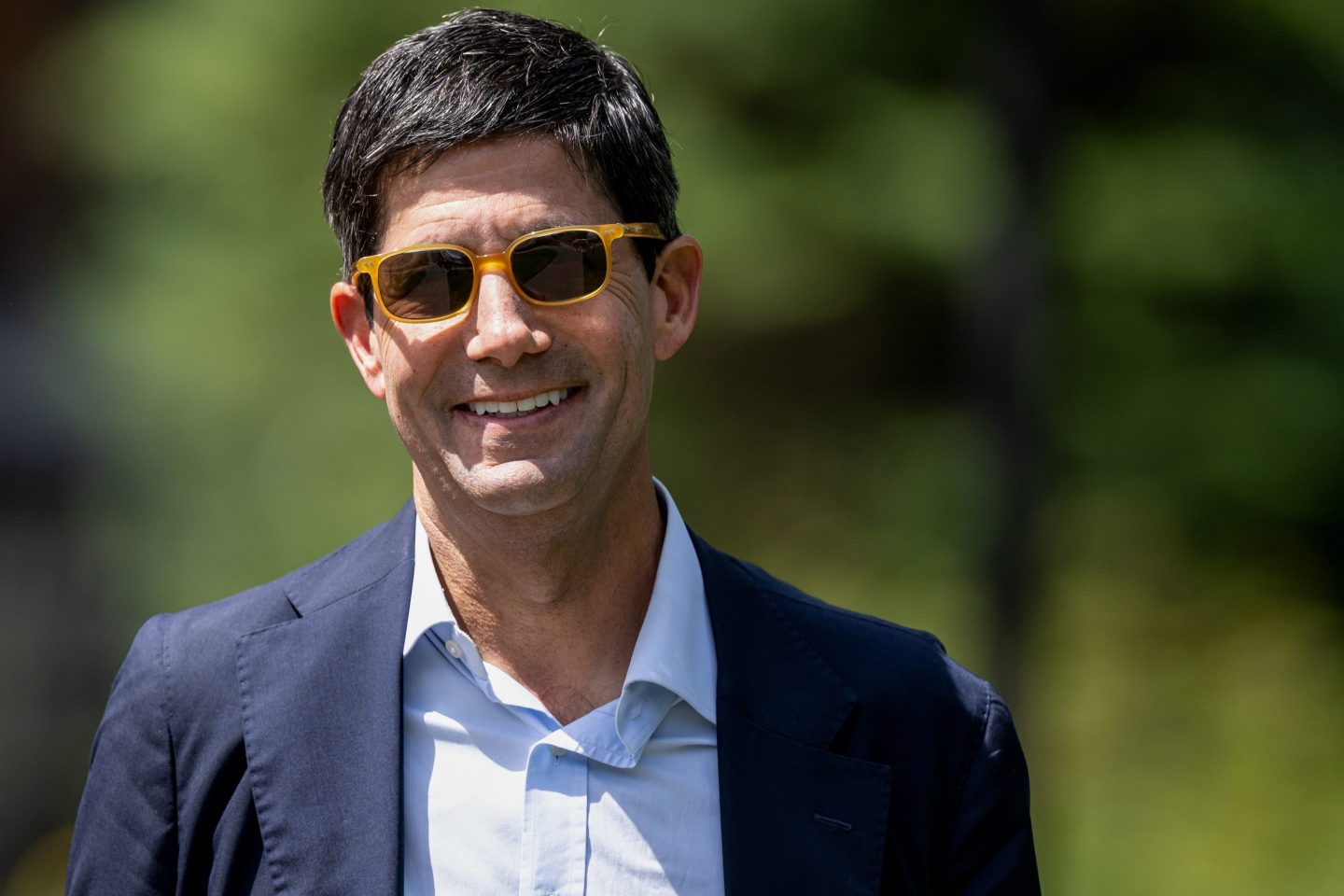
Jerome Powell has been a friendly neighbourhood Fed Chairman to the White House, despite the criticism and insults President Trump has levelled against him. That’s because while Powell may not have yielded to pressure from the White House to lower the base rate, the Fed, under his direction, has dutifully continued to buy Treasury debt.
The central bank, as a lender to the federal government, gives Powell visibility over the nation’s fiscal trajectory, as well as the fact that government borrowing impacts the Fed’s mandate. The U.S. has accumulated $38.5 trillion in national debt under both Democratic and Republican administrations—a matter he says is “past time to get back to an adult conversation among elected officials about.”
That said, Powell has never stood in the way of government spending: The Fed’s balance sheet, since the Great Financial Crisis of 2008, has ballooned. Currently, it is running at 24.6% of GDP. Historically, it has sat between 10% and 20%.
Fed nominee Kevin Warsh wants to change that: He believes the Fed should run a smaller balance sheet, reducing the distortions it causes in markets as a result. Therein lies the snag: A reduced balance sheet means fewer assets, and the Fed’s largest holding is government debt. In theory, if the Fed wants to hold fewer bonds it must sell them to someone else and thus increase their supply in the market. That would push up yields, and making it more expensive for the Treasury to borrow—not something the White House wants from its shiny new Fed chairman.
Indeed, economists suggest Warsh, a former Fed governor, will continue to allow the central bank to still be seen as a safety net for the U.S. government’s fiscal strategy. Warsh has previously called the U.S. a “banana republic” because the Fed continually buys government debt, but speculators are now expecting Warsh to distance himself from the topic of federal deficits more broadly.
The central bank’s new boss has a delicate needle to thread: How to right-size one of the world’s most closely scrutinized balance sheets, without upsetting either watchful bond market investors or the Treasury.
A palatable package
Warsh’s problem isn’t going to be how to achieve his aims at Fed. It’s going to be how he sells it.
Investors and analysts already know Warsh is going to be dovish on the base rate. The president said any nominee would have to be open to cutting further. A tighter balance sheet might be a neat way for Warsh to deliver rate cuts without raising alarm bells over questions of Fed independence. As Professor Yiming Ma, of Columbia University’s Business School explained in a conversation with Fortune: “People often think: ‘Oh, economic conditions, inflation expectations, and unemployment are determining interest rates,’ and the size of the balance sheet is like whatever.”
“But in practice, hiking interest rates is [economic] tightening, and reducing the size of the central bank’s balance sheet is also a form of tightening [because it also raises rates]. And it’s hard to estimate the extent of that interaction, but you can think broadly that if the size of the Fed’s balance sheet is smaller, there is less liquidity in the system, and that is going to reduce inflationary pressure. So in a way, one can afford a lower interest rate with a smaller balance sheet.”
So, Warsh has an argument (a long-term one) to pitch to other members of the Federal Open Market Committee (FOMC). The next step is how to communicate that to markets without causing volatility that might impact the Fed’s mandates of stable inflation, maximum employment, and steady long-term rates.
“I’ll be watching most closely in his confirmation hearings whether he gets asked not, ‘Do you want to shrink the size of the balance sheet?’ but ‘How are you going to shrink the size of the balance sheet?'” Alliance Bernstein’s chief economist, Eric Winograd, told Fortune. “That’s where he has the smallest needle to thread … the communication can be tricky, and it is a source of potential volatility.”
Winograd, who spent five years at the New York Fed, said he agrees with Warsh that quantitative easing (injecting money into the economy by buying government debt) had been harmful, and that the Fed is distorting market signals by holding such a large volume of securities in a key market.
“I’ve got a lot of sympathy for that view,” Winograd added. “But the transition from here to where he wants to get, could be problematic.”
Warsh has already hinted at his strategy, making it clear that alignment with the Treasury is in mind. He told “Kudlow” host Larry Kudlow in July: “You could take down that balance sheet a couple trillion dollars over time, in concert with the Treasury secretary. That’s a big rate cut could come, and what you would do then is turbo-charge the real economy, where things are somewhat tougher, and ultimately the financial markets would be fine.”
Financial markets may not like the sound of “ultimately”—they’ll be concerned the plan trickles through gently, and with investors in mind. As Winograd put it: “Some sort of idea that he isn’t sensitive to the function of markets would be concerning as well.”
Does the central bank need to concern itself with national debt?
Powell’s comments on debt could be brushed off as expected due diligence regarding the Fed’s mandate, as opposed to anything more significant. But Warsh has been clear in his criticism of governments prior to Trump 2.0, saying their budgets got “out of control.”
Speaking on a Hoover Institution podcast in 2022, Warsh said: “The United States government is a third bigger than it was the day before COVID … the government isn’t going to be shrinking then. In fact, it’ll be figuring out a way to try to offset that pain.”
He added: ‘When I joined the Fed in 2006, it was an important organization with … quite a narrow remit … it’s expanded its authority. When crises hit, like in the ’08 crisis and in the 2020 pandemic crisis, it is the Fed’s job to do some extraordinary things. But when those shocks disappear, it’s this faithful institution’s job to go back to ordinary-course stuff.”
And despite the fact the Fed has legally mandated autonomy from politics, Professor Ma said that the “economic tie” between the two is Treasuries: “That is perhaps the motivation behind the discussion.”
Indeed, a line could be drawn from a Fed chairman hawkish on the balance sheet, to higher bond yields, which would incentivize the Treasury toward fiscal responsibility. But will Warsh take it that far? After all, it’s “entirely contrary to the objectives of the administration,” Winograd reasons.
As such, “I don’t expect him to weigh in heavily on fiscal policy. It’s not in his purview; it’s nothing that the Fed can do anything about.”
What if the market doesn’t like it?
The bond market (even with the current weight of Fed intervention) isn’t yet showing any signs of discomfort over public debt levels in the U.S. Yields for 30-Year Treasuries are still comfortably below the 5% mark, while 10-year notes sit at around 4%—signs investors aren’t demanding higher returns to hold what they view as riskier debt.
And if Warsh handles the communication right, Professor Ma adds, there should be no reason for that to change.
But, there are downside risks. The markets might conclude that a bond sale at the Fed will push up the price of government debt and inflate that $38.5 trillion even further. At that point, bond buyers would flee to safer places and the U.S. might end up in a place worse than where it started.
“This is more the discussion in emerging markets in developing countries, where the government usually has some fiscal trouble, then government debt markets can be in trouble.”
“And this is where the central bank has to consider those conditions. The U.S. is not there yet, but we want to make sure that it doesn’t go there. So, there is a lot of debt outstanding, and it has been growing very quickly. There’s a separate discussion on whether that’s sustainable or not, and for what reasons, but I think that the fear is that we enter into a very different regime where investors are thinking about the creditworthiness of the U.S. Treasury, [which] would be bad for everybody.”
“I don’t think there are any winners in that regime, maybe for Europe. But otherwise, if you’re in the U.S., that’s a lose-lose situation. Some of this discussion is to make sure we’re not entering that [state] of the world.”