• Home
  • Latest
  • Fortune 500
  • Finance
  • Tech
  • Leadership
  • Lifestyle
  • Rankings
  • Multimedia
EconomyU.S. economy

New CBO report shows national debt spiraling into uncharted territory by 2035—and Trump’s tariff defeat will make the picture even worse

Shawn Tully
By
Shawn Tully
Shawn Tully
Senior Editor-at-Large
Down Arrow Button Icon
Shawn Tully
By
Shawn Tully
Shawn Tully
Senior Editor-at-Large
Down Arrow Button Icon
February 21, 2026, 5:00 AM ET
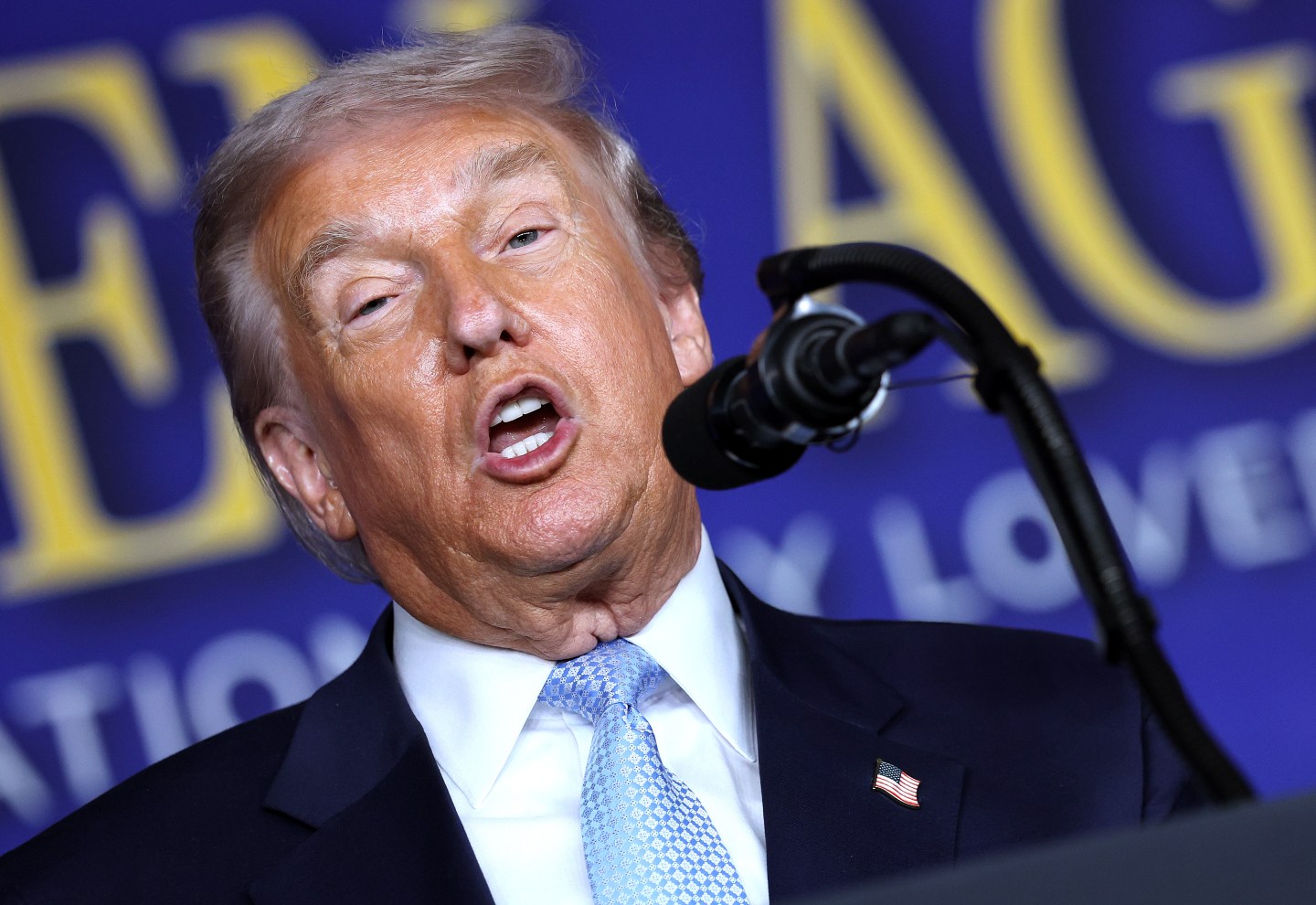
Trump's One Big Beautiful Bill has worsened an already bleak economic picture.
Trump's One Big Beautiful Bill has worsened an already bleak economic picture. Win McNamee/Getty Images

Plenty of observers already had doubts that, as Donald Trump put it on President’s Day, the U.S. has entered a “new golden age of prosperity.” Now, with the Supreme Court ruling negating a wide swath of the Trump tariffs, an already gloomy outlook has suddenly become much darker.

Recommended Video

The new 10-year budget forecasts from the Congressional Budget Office, issued in mid-February, presents an outlook that’s considerably worse than the already dire scenario the agency issued a year earlier. The CBO’s bottom line: On balance, the tax reductions and spending hikes in the One Big Beautiful will increase the persistent shortfalls between revenues and outlays by amounts that swamp the extra take from tariffs, and the fleeting jump in GDP we’re witnessing right now.

The hobgoblin: Exploding interest expense on the national debt. The additional deficits make the future borrowing costs that are already leaving fewer and fewer resources for covering such essentials as Medicare and Defense much bigger. In less than a decade, that burden will reach half the size of the biggest monthly expense for U.S. households, their monthly mortgage payment.

The CBO issues its “The Budget and Economic Outlook” once a year. It presents detailed projections for all federal spending and revenue categories, the impact of new legislation, GDP, interest rates and sundry other economic metrics, and of course deficits and debt, over the current fiscal year and following decade. What’s so concerning about this update covering 2026 to 2036 is that it displays “primary deficits” that are even larger those posited in last year’s report. The “primary deficit” is the gap between what we collect in taxes and spend on everything from Medicare to national defense before interest costs.

Those big and widening chasms are so dangerous because they’re where the debt comes from. The U.S. must borrow 100% of the cash to cover spending-revenue gulf. That cycle keeps ramping interest expense and driving the total deficit ever higher.

The One Big Beautiful Bill will expand the primary deficit

In 2025, the federal government spent just over $6 billion before interest expense, and collected $5.2 trillion, forcing the Treasury to borrow the difference of $805 billion. That number gets tacked onto the debt, and so does the almost $30 billion in all new interest the one-year shortfall generates. The added “principal” plus interest spawns more interest in an ever-quickening spiral.

According to the CBO, the Trump 2025 Reconciliation Act, dubbed the One Big Beautiful Bill (OBBB), will make the spiral spin even faster. The bill contains sundry tax breaks, including no duties for overtime and tips, a $6000 deduction for folks at 65 and older, an increase in the Child Tax Credit, and of course the make-permanent of rate reductions enacted in Trump’s first term that were scheduled to expire. The measure also encompasses a number of significant spending increases, notably for defense and homeland security. All told, the CBO reckons that the OBBB on its own raises deficits through 2035 (it’s using a 9-year time frame) by a total of $3.4 trillion, and additional hits from the crackdown on immigration that curbs growth by shrinking the workforce, and the extra interest, hike the total to $4.1 trillion.

At the time of the report, the CBO reckoned that the Trump tariffs provide an offset, amassing $2.7 trillion over that span. The president’s policies overall were expected trigger a net increase in deficits of $1.4 trillion, or 9% over the 9 year interval. Of course, that number would now be far higher, though we’ll have to wait for a new estimate from the agency. Keep in mind that we’re starting with already high levels of primary deficits that are causing all the problems. So the Trump increases are adding extra weight that makes the climb to fiscal balance all the harder, and the possible downshift in tariff revenue would put the structural shortfalls, and resulting extra interest expense, on a faster track.

Deficits and debt will rise even beyond last year’s predictions, and so will interest expense

By 2035, the CBO expects the deficit to reach $2.96 trillion or 6.2% of GDP versus 5.8% today, and almost double the multi-decade, pre-pandemic average. Debt held by the public mushrooms from $30.2 trillion in 2026 to $53.1 trillion reaching 116% of GDP versus 100% today. Just 12 months ago, the call was for a 2035 deficit 10% lower than the current prediction at $2.7, and about 4% less in federal borrowings.

It’s important to note that the CBO doesn’t foresee a durable surge in economic growth. It did increase its estimate for FY 2026 significantly from last year’s 1.8% to 2.2%. But the agency then expects a downshift to 1.8% annual gains for each of the next nine years. It’s take: A slow-growing labor force due to both our rapidly aging population and tight immigration enforcement, and tariff policies that reduce purchasing power, will counter such positive forces as lower tax rates that enable higher consumer spending, and potential productivity gains from AI.

The speediest spending category by far: interest expense. Here, I’ll make an adjustment to the CBO’s baseline numbers. The agency can only make forecasts based on current law. Hence, it’s stuck positing that discretionary spending that includes defense, education and transportation doesn’t rise at all over the next decade. But the CBO also provides “alternative” numbers incorporating the budgetary effects if those outlays wax in line with GDP. So it’s realistic to include that extra spending and interest expense in a “revised” outlook, leaving all other numbers the same.

In this adjusted scenario, interest expense from 2026 to 2035 would jump from $970 billon to $2.2 trillion. That’s 115% or 8% a year. By then, carrying costs would nearly equal all discretionary spending, tower at two-times outlays for defense, and virtually tie Medicare as the second largest spending category after Social Security. The rise in interest costs would account for the entire increase in the deficit, and over half the increase in the debt.

At $2.2 trillion, interest expense by 2036 would amount to $15,700 for every household in America. That’s $1300 a month, as much as half the average of $2500 to $3100 families typically pay for the mortgage on a $500,000 house. Indeed, the U.S. government’s mortgaging its citizens’ future big time. Washington, in fact, should take its cue from America’s home owners who realize they can’t spend more than they earn, at least for long. Our thrifty citizens pay their mortgages every month. The U.S. just keeps effectively “refinancing” or taking out home equity lines to pay the interest, causing more interest and more debt. The folks are a lot more responsible than the leaders. Unfortunately, it’s the folks who will eventually need to pay.


Join us at the Fortune Workplace Innovation Summit May 19–20, 2026, in Atlanta. The next era of workplace innovation is here—and the old playbook is being rewritten. At this exclusive, high-energy event, the world’s most innovative leaders will convene to explore how AI, humanity, and strategy converge to redefine, again, the future of work. Register now.
About the Author
Shawn Tully
By Shawn TullySenior Editor-at-Large

Shawn Tully is a senior editor-at-large at Fortune, covering the biggest trends in business, aviation, politics, and leadership.

See full bioRight Arrow Button Icon

Latest in Economy

Finance
Lorem ipsum dolor sit amet, consectetur adipiscing elit, sed do eiusmod tempor incididunt ut labore et dolore magna aliqua. Ut enim ad minim veniam
By Fortune Editors
October 20, 2025
Finance
Lorem ipsum dolor sit amet, consectetur adipiscing elit, sed do eiusmod tempor incididunt ut labore et dolore magna aliqua. Ut enim ad minim veniam
By Fortune Editors
October 20, 2025
Finance
Lorem ipsum dolor sit amet, consectetur adipiscing elit, sed do eiusmod tempor incididunt ut labore et dolore magna aliqua. Ut enim ad minim veniam
By Fortune Editors
October 20, 2025
Finance
Lorem ipsum dolor sit amet, consectetur adipiscing elit, sed do eiusmod tempor incididunt ut labore et dolore magna aliqua. Ut enim ad minim veniam
By Fortune Editors
October 20, 2025
Finance
Lorem ipsum dolor sit amet, consectetur adipiscing elit, sed do eiusmod tempor incididunt ut labore et dolore magna aliqua. Ut enim ad minim veniam
By Fortune Editors
October 20, 2025
Finance
Lorem ipsum dolor sit amet, consectetur adipiscing elit, sed do eiusmod tempor incididunt ut labore et dolore magna aliqua. Ut enim ad minim veniam
By Fortune Editors
October 20, 2025

Most Popular

Finance
Lorem ipsum dolor sit amet, consectetur adipiscing elit, sed do eiusmod tempor incididunt ut labore et dolore magna aliqua. Ut enim ad minim veniam
By Fortune Editors
October 20, 2025
Finance
Lorem ipsum dolor sit amet, consectetur adipiscing elit, sed do eiusmod tempor incididunt ut labore et dolore magna aliqua. Ut enim ad minim veniam
By Fortune Editors
October 20, 2025
Finance
Lorem ipsum dolor sit amet, consectetur adipiscing elit, sed do eiusmod tempor incididunt ut labore et dolore magna aliqua. Ut enim ad minim veniam
By Fortune Editors
October 20, 2025
Finance
Lorem ipsum dolor sit amet, consectetur adipiscing elit, sed do eiusmod tempor incididunt ut labore et dolore magna aliqua. Ut enim ad minim veniam
By Fortune Editors
October 20, 2025
Finance
Lorem ipsum dolor sit amet, consectetur adipiscing elit, sed do eiusmod tempor incididunt ut labore et dolore magna aliqua. Ut enim ad minim veniam
By Fortune Editors
October 20, 2025
Finance
Lorem ipsum dolor sit amet, consectetur adipiscing elit, sed do eiusmod tempor incididunt ut labore et dolore magna aliqua. Ut enim ad minim veniam
By Fortune Editors
October 20, 2025
Fortune Secondary Logo
Rankings
  • 100 Best Companies
  • Fortune 500
  • Global 500
  • Fortune 500 Europe
  • Most Powerful Women
  • Future 50
  • World’s Most Admired Companies
  • See All Rankings
Sections
  • Finance
  • Fortune Crypto
  • Features
  • Leadership
  • Health
  • Commentary
  • Success
  • Retail
  • Mpw
  • Tech
  • Lifestyle
  • CEO Initiative
  • Asia
  • Politics
  • Conferences
  • Europe
  • Newsletters
  • Personal Finance
  • Environment
  • Magazine
  • Education
Customer Support
  • Frequently Asked Questions
  • Customer Service Portal
  • Privacy Policy
  • Terms Of Use
  • Single Issues For Purchase
  • International Print
Commercial Services
  • Advertising
  • Fortune Brand Studio
  • Fortune Analytics
  • Fortune Conferences
  • Business Development
About Us
  • About Us
  • Editorial Calendar
  • Press Center
  • Work At Fortune
  • Diversity And Inclusion
  • Terms And Conditions
  • Site Map
Fortune Secondary Logo
  • About Us
  • Editorial Calendar
  • Press Center
  • Work At Fortune
  • Diversity And Inclusion
  • Terms And Conditions
  • Site Map
  • Facebook icon
  • Twitter icon
  • LinkedIn icon
  • Instagram icon
  • Pinterest icon

Latest in Economy

A girl with a computer on the desk in front of her looks up.
InnovationEducation
The U.S. spent $30 billion to ditch textbooks for laptops and tablets: The result is the first generation less cognitively capable than their parents
By Sasha RogelbergFebruary 21, 2026
2 hours ago
EconomyU.S. economy
New CBO report shows national debt spiraling into uncharted territory by 2035—and Trump’s tariff defeat will make the picture even worse
By Shawn TullyFebruary 21, 2026
4 hours ago
Kevin Warsh, former governor of the US Federal Reserve
EconomyFed
Jerome Powell knows the Fed’s balance sheet got too big—Kevin Warsh has a plan, he just has to sell it without freaking out the markets
By Eleanor PringleFebruary 21, 2026
5 hours ago
Missiles produced by Iran's armed forces are displayed near a row of Iranian flags during commemorations to mark the anniversary of the 1979 Iranian Revolution on February 11, 2026 in Tehran, Iran. In that year, Ruhollah Khomeini led an overthrow of the Pahlavi dynasty in 1979 and established himself as Supreme Leader of the Islamic Republic of Iran.
EnergyIran
Trump loves cheap gas—but a military conflict in Iran could nearly double your price at the pump
By Jordan BlumFebruary 21, 2026
7 hours ago
EconomyTariffs and trade
Detroit automakers ask White House to be spared from new tariffs
By Gabrielle Coppola and BloombergFebruary 20, 2026
13 hours ago
LawTariffs and trade
Trump imposes 10% global tariff in bid to salvage trade plans
By Courtney Subramanian, Kate Sullivan and BloombergFebruary 20, 2026
13 hours ago

Most Popular

placeholder alt text
Economy
Fed confirms it obeyed U.S. Treasury request for an unusual ‘rate check,’ weakening the dollar against foreign currencies
By Jim EdwardsFebruary 19, 2026
2 days ago
placeholder alt text
Success
'I had to take 60 meetings': Jeff Bezos says 'the hardest thing I've ever done' was raising the first million dollars of seed capital for Amazon
By Dave Smith and Fortune EditorsFebruary 19, 2026
2 days ago
placeholder alt text
AI
‘I’m deeply uncomfortable’: Anthropic CEO warns that a cadre of AI leaders, including himself, should not be in charge of the technology’s future
By Sasha RogelbergFebruary 19, 2026
2 days ago
placeholder alt text
AI
Sam Altman says the quiet part out loud, confirming some companies are ‘AI washing’ by blaming unrelated layoffs on the technology
By Sasha RogelbergFebruary 19, 2026
2 days ago
placeholder alt text
AI
Deutsche Bank asked AI how it was planning to destroy jobs. And the robot answered
By Nick LichtenbergFebruary 18, 2026
3 days ago
placeholder alt text
Arts & Entertainment
Gen Zers and millennials flock to so-called analog islands 'because so little of their life feels tangible'
By Michael Liedtke and The Associated PressFebruary 20, 2026
20 hours ago

© 2026 Fortune Media IP Limited. All Rights Reserved. Use of this site constitutes acceptance of our Terms of Use and Privacy Policy | CA Notice at Collection and Privacy Notice | Do Not Sell/Share My Personal Information
FORTUNE is a trademark of Fortune Media IP Limited, registered in the U.S. and other countries. FORTUNE may receive compensation for some links to products and services on this website. Offers may be subject to change without notice.