
• Home
  • Latest
  • Fortune 500
  • Finance
  • Tech
  • Leadership
  • Lifestyle
  • Rankings
  • Multimedia
Economy

Trump’s justification for the tariffs was rebalancing the trade deficit—it’s not going the way he wanted

Eleanor Pringle
By
Eleanor Pringle
Eleanor Pringle
Senior Reporter, Economics and Markets
Down Arrow Button Icon
Eleanor Pringle
By
Eleanor Pringle
Eleanor Pringle
Senior Reporter, Economics and Markets
Down Arrow Button Icon
February 20, 2026, 7:09 AM ET
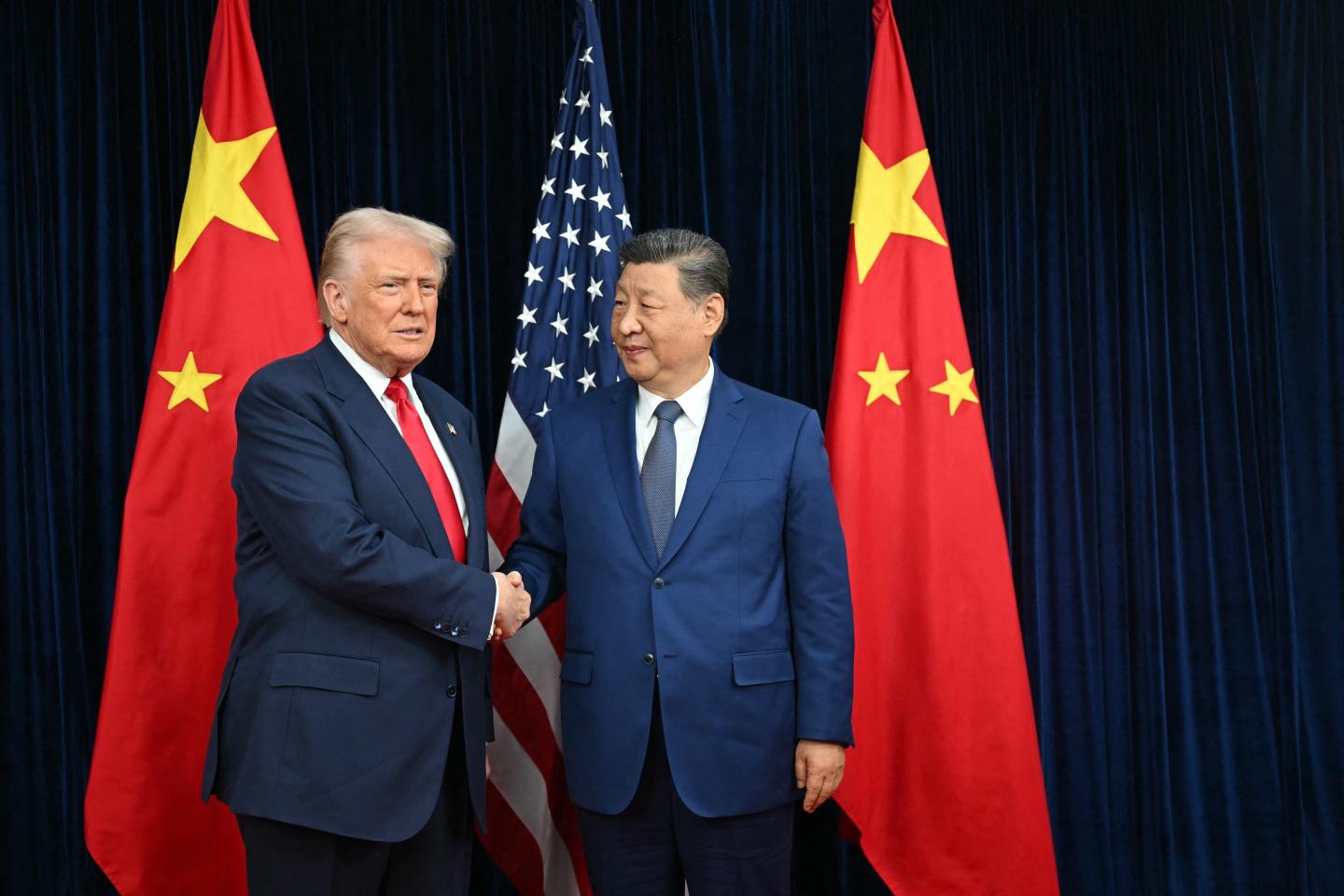
US President Donald Trump (L) and China's President Xi Jinping shake hands as they arrive for talks at the Gimhae Air Base, located next to the Gimhae International Airport in Busan on October 30, 2025.
U.S. President Donald Trump and Chinese President Xi Jinping arrive for talks at the Gimhae Air Base, in Busan, South Korea, Oct. 30, 2025. ANDREW CABALLERO-REYNOLDS—AFP/Getty Images

President Trump hates the United States’ trade deficit. Indeed, he is so concerned about the “economic and national security risks” the deficit creates that he imposed a tariff regime that raised geopolitical tensions across the globe.

The only problem is that his tariffs don’t appear to be rebalancing the huge volume of goods and services the U.S. imports, versus its declining exports.

The goods and services deficit for the U.S. was $70.3 billion in December, up $17.3 billion from $53 billion in November, according to the latest data from the Bureau of Economic Analysis (BEA), released yesterday.

Recommended Video

This imbalance came on account of a 3.6% increase in imports, up to $357.6 billion—$12.3 billion more than in November.

The gap was widened because exports also fell: In December, they sat at $287.3 billion—$5 billion less than in November. The U.S. is also losing traction in the areas in which it previously held a surplus over its trading partners, with the services sector reducing its trade surplus in the month of December by $1.6 billion, to $29 billion.

In terms of the specific industries where the U.S. is seeing the greatest shift in its trading balances, it saw an $8.7 billion decrease in industrial supplies and materials. Meanwhile, its imports in the same category rose by $7 billion.

However, while the U.S. is still operating a monthly trade deficit of some $70 billion, the deficit on a year-to-year scale is improving, albeit slowly. For 2025, the goods and services deficit decreased $2.1 billion, or 0.2% compared with 2024.

The data prompts the question of how successful Trump 2.0 will ultimately be in addressing the nation’s trade deficit with partners. Between July and October 2025, the U.S. trade deficit had been trending downward on a monthly basis, bringing down the three-month average as well.

However, toward the end of 2025 that figure began to rise again, up from a monthly deficit of circa $30 billion to more than $70 billion in December. The December trade shortfall is roughly on par with the monthly deficit reported in December 2024, before President Trump won the election.

The bigger picture

Trump set his agenda on trade deficits early, in an executive order on Liberation Day in April 2025: “Large and persistent annual U.S. goods trade deficits have led to the hollowing out of our manufacturing base; inhibited our ability to scale advanced domestic manufacturing capacity; undermined critical supply chains; and rendered our defense-industrial base dependent on foreign adversaries.”

Here, the president is echoing the concerns of many: that America is drifting from self-sufficiency, particularly in its own defense. JPMorgan CEO Jamie Dimon advocated for greater U.S. independence from China in his 2023 letter to shareholders, writing: “The United States cannot rely on any potential adversaries for materials essential to our national security … We also cannot be sharing vital technologies that can enhance an adversary’s military capabilities. The United States should properly and narrowly define these issues and then act unilaterally, if necessary, to fix them.”

This is where the BEA report indicates some positive news for Trump 2.0. Perhaps unsurprisingly, given the escalating tensions between Washington and Beijing, in 2025 the deficit with China decreased by $93.4 billion to $202.1 billion. Exports decreased $36.9 billion to $106.3 billion, and imports decreased $130.4 billion to $308.4 billion.

As Deutsche Bank’s Jim Reid told clients this morning: “While the aggregate trade position of the U.S. has not changed much, we’ve seen some big redirection of trade. Notably, the latest data highlights the extent that U.S.-China decoupling, with China now accounting for only 7% of U.S. imports, down from 13% in 2024 and above 20% prior to President Trump’s first China tariffs in 2018.”

The Fortune 500 Innovation Forum will convene Fortune 500 executives, U.S. policy officials, top founders, and thought leaders to help define what’s next for the American economy, Nov. 16-17 in Detroit. Apply here.
About the Author
Eleanor Pringle
By Eleanor PringleSenior Reporter, Economics and Markets
LinkedIn icon

Eleanor Pringle is an award-winning senior reporter at Fortune covering news, the economy, and personal finance. Eleanor previously worked as a business correspondent and news editor in regional news in the U.K. She completed her journalism training with the Press Association after earning a degree from the University of East Anglia.

See full bioRight Arrow Button Icon

Latest in Economy

Finance
Lorem ipsum dolor sit amet, consectetur adipiscing elit, sed do eiusmod tempor incididunt ut labore et dolore magna aliqua. Ut enim ad minim veniam
By Fortune Editors
October 20, 2025
Finance
Lorem ipsum dolor sit amet, consectetur adipiscing elit, sed do eiusmod tempor incididunt ut labore et dolore magna aliqua. Ut enim ad minim veniam
By Fortune Editors
October 20, 2025
Finance
Lorem ipsum dolor sit amet, consectetur adipiscing elit, sed do eiusmod tempor incididunt ut labore et dolore magna aliqua. Ut enim ad minim veniam
By Fortune Editors
October 20, 2025
Finance
Lorem ipsum dolor sit amet, consectetur adipiscing elit, sed do eiusmod tempor incididunt ut labore et dolore magna aliqua. Ut enim ad minim veniam
By Fortune Editors
October 20, 2025
Finance
Lorem ipsum dolor sit amet, consectetur adipiscing elit, sed do eiusmod tempor incididunt ut labore et dolore magna aliqua. Ut enim ad minim veniam
By Fortune Editors
October 20, 2025
Finance
Lorem ipsum dolor sit amet, consectetur adipiscing elit, sed do eiusmod tempor incididunt ut labore et dolore magna aliqua. Ut enim ad minim veniam
By Fortune Editors
October 20, 2025

Most Popular

Finance
Lorem ipsum dolor sit amet, consectetur adipiscing elit, sed do eiusmod tempor incididunt ut labore et dolore magna aliqua. Ut enim ad minim veniam
By Fortune Editors
October 20, 2025
Finance
Lorem ipsum dolor sit amet, consectetur adipiscing elit, sed do eiusmod tempor incididunt ut labore et dolore magna aliqua. Ut enim ad minim veniam
By Fortune Editors
October 20, 2025
Finance
Lorem ipsum dolor sit amet, consectetur adipiscing elit, sed do eiusmod tempor incididunt ut labore et dolore magna aliqua. Ut enim ad minim veniam
By Fortune Editors
October 20, 2025
Finance
Lorem ipsum dolor sit amet, consectetur adipiscing elit, sed do eiusmod tempor incididunt ut labore et dolore magna aliqua. Ut enim ad minim veniam
By Fortune Editors
October 20, 2025
Finance
Lorem ipsum dolor sit amet, consectetur adipiscing elit, sed do eiusmod tempor incididunt ut labore et dolore magna aliqua. Ut enim ad minim veniam
By Fortune Editors
October 20, 2025
Finance
Lorem ipsum dolor sit amet, consectetur adipiscing elit, sed do eiusmod tempor incididunt ut labore et dolore magna aliqua. Ut enim ad minim veniam
By Fortune Editors
October 20, 2025
Fortune Secondary Logo
Rankings
  • 100 Best Companies
  • Fortune 500
  • Global 500
  • Fortune 500 Europe
  • Most Powerful Women
  • Future 50
  • World’s Most Admired Companies
  • See All Rankings
Sections
  • Finance
  • Fortune Crypto
  • Features
  • Leadership
  • Health
  • Commentary
  • Success
  • Retail
  • Mpw
  • Tech
  • Lifestyle
  • CEO Initiative
  • Asia
  • Politics
  • Conferences
  • Europe
  • Newsletters
  • Personal Finance
  • Environment
  • Magazine
  • Education
Customer Support
  • Frequently Asked Questions
  • Customer Service Portal
  • Privacy Policy
  • Terms Of Use
  • Single Issues For Purchase
  • International Print
Commercial Services
  • Advertising
  • Fortune Brand Studio
  • Fortune Analytics
  • Fortune Conferences
  • Business Development
  • Group Subscriptions
About Us
  • About Us
  • Editorial Calendar
  • Press Center
  • Work At Fortune
  • Diversity And Inclusion
  • Terms And Conditions
  • Site Map
Fortune Secondary Logo
  • About Us
  • Editorial Calendar
  • Press Center
  • Work At Fortune
  • Diversity And Inclusion
  • Terms And Conditions
  • Site Map
  • Facebook icon
  • Twitter icon
  • LinkedIn icon
  • Instagram icon
  • Pinterest icon

Latest in Economy

Four people onstage before a screen that reads "America's Workforce."
Future of WorkBipartisan
‘I don’t know if we’re ready’: Governors from each party appalled at 100-year-old federal workforce strategy
By Catherina GioinoMarch 12, 2026
14 minutes ago
altman
AIOpenAI
Sam Altman admits AI is killing the labor-capital balance—and says nobody knows what to do about it
By Nick LichtenbergMarch 12, 2026
29 minutes ago
Current price of Bitcoin for March 12, 2026
Personal FinanceCryptocurrency
Current price of Bitcoin for March 12, 2026
By Joseph HostetlerMarch 12, 2026
1 hour ago
U.S. President Donald Trump speaks to the press after landing on Air Force One on March 11, 2026 at Joint Base Andrews, Maryland.
EconomyIran
Stagflation risks are rising due to Iran conflict, as economist warns it’s ‘getting harder to argue disruption will be temporary’
By Eleanor PringleMarch 12, 2026
2 hours ago
Current price of oil as of March 12, 2026
Personal FinanceOil
Current price of oil as of March 12, 2026
By Joseph HostetlerMarch 12, 2026
2 hours ago
Photo: Infographic with map showing the Strait of Hormuz, locating floating objects (generally boats) captured by the Sentinel-1 radar satellite, before and after the announcement of the blockade of the strait by the Iranian Revolutionary Guard, according to an AFP analysis (Graphic by Valentin RAKOVSKY and Julie PEREIRA / AFP)
EnergyIran
Oil went over $100 again after the U.S. admitted it cannot control the Strait of Hormuz
By Jim EdwardsMarch 12, 2026
4 hours ago

Most Popular

placeholder alt text
Economy
'This cannot be sustainable': The U.S. borrowed $50 billion a week for the past five months, the CBO says
By Eleanor PringleMarch 10, 2026
2 days ago
placeholder alt text
AI
'Proceed with caution': Elon Musk offers warning after Amazon reportedly held mandatory meeting to address 'high blast radius' AI-related incident
By Sasha RogelbergMarch 11, 2026
19 hours ago
placeholder alt text
Commentary
How the ultrawealthy use smartphone apps to avoid millions in taxes
By Jose AtilesMarch 11, 2026
1 day ago
placeholder alt text
Big Tech
Big tech has defeated everything for 30 years, but for the first time faces something it can't control: a jury
By Carolina Rossini and The ConversationMarch 10, 2026
2 days ago
placeholder alt text
Future of Work
Shark Tank's Kevin O'Leary doesn't care if you work from your basement. He just wants to know if you can ‘execute’
By Marco Quiroz-GutierrezMarch 10, 2026
2 days ago
placeholder alt text
Personal Finance
Retirees wait for the day they can sell their homes and cash in—but there's a secret Medicare 'trap' that could stop them in their tracks
By Sydney LakeMarch 11, 2026
1 day ago

© 2026 Fortune Media IP Limited. All Rights Reserved. Use of this site constitutes acceptance of our Terms of Use and Privacy Policy | CA Notice at Collection and Privacy Notice | Do Not Sell/Share My Personal Information
FORTUNE is a trademark of Fortune Media IP Limited, registered in the U.S. and other countries. FORTUNE may receive compensation for some links to products and services on this website. Offers may be subject to change without notice.