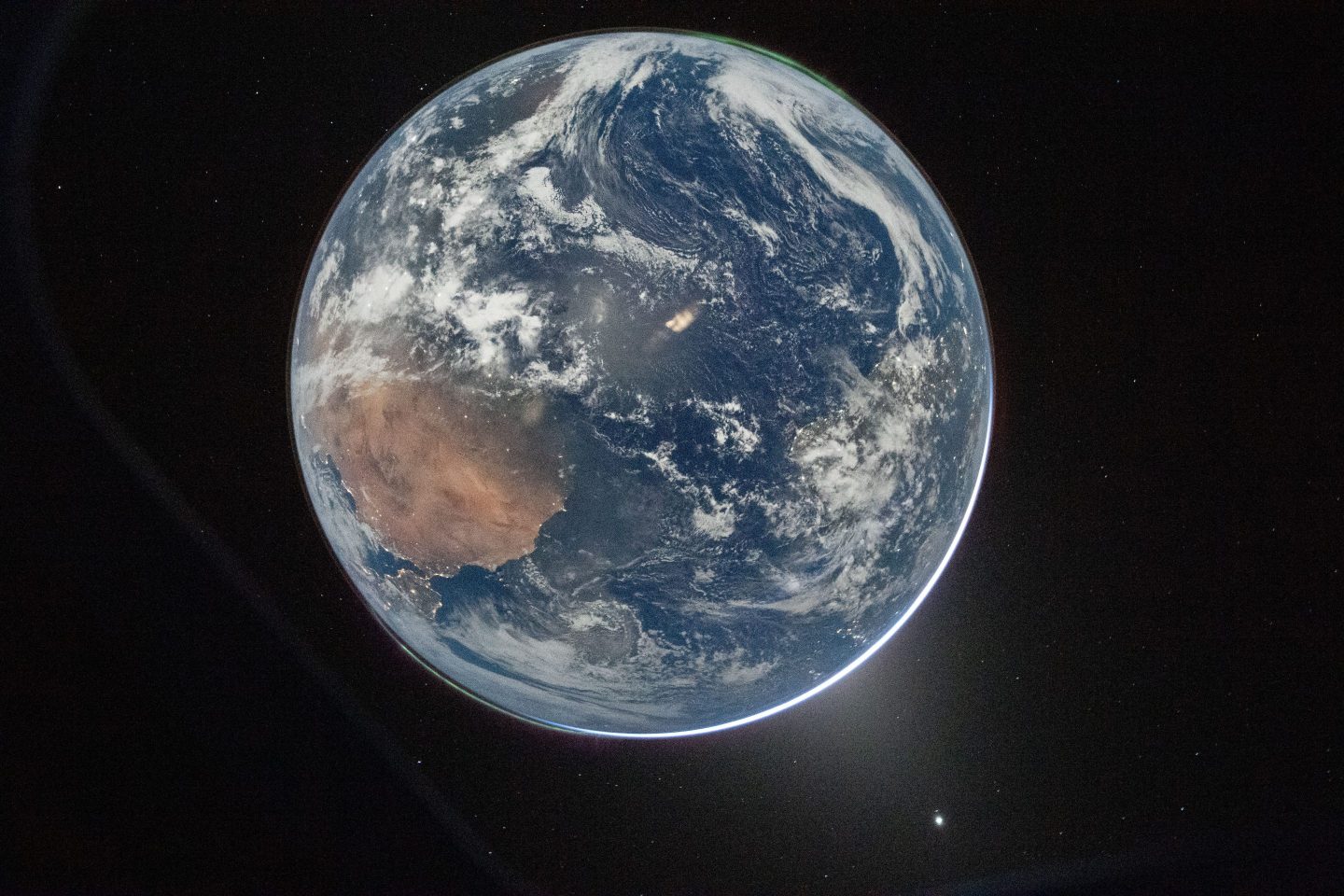
Even as technology companies are projected to spend more than $5 trillion globally on earth-based data centers by the end of the decade, Elon Musk is arguing the future of AI computing power lies in space—powered by solar energy—and that the economics and engineering to make it work could align within a few years.
Over the past three weeks, SpaceX has filed plans with the Federal Communications Commission for what amounts to a million-satellite data-center network. Musk has also said he plans to merge his AI startup, xAI, with SpaceX to pursue orbital data centers. And at an all-hands meeting last week, he told xAI employees the company would ultimately need a factory on the moon to build AI satellites—along with a massive catapult to launch them into space.
“The lowest-cost place to put AI will be in space, and that will be true within two years, maybe three at the latest,” Musk said at the World Economic Forum meeting in Davos this January.
Musk is not alone in floating the idea. Alphabet CEO Sundar Pichai has said Google is exploring “moonshot” concepts for data centers in space later this decade. Former Google CEO Eric Schmidt has warned that the industry is “running out of electricity” and has discussed space-based infrastructure as a potential long-term solution. And Amazon and Blue Origin founder Jeff Bezos has said orbital data centers could become the next step in space ventures designed to benefit earth.
Still, while Musk and some other bulls argue that space-based AI could become cost-effective within a few years, many experts say anything approaching meaningful scale remains decades away—especially as the bulk of AI investment continues to flow into terrestrial infrastructure. That includes Musk’s own Colossus supercomputer in Memphis, which analysts estimate will cost tens of billions of dollars.
They emphasize that while limited orbital computing is feasible, constraints around power generation, heat dissipation, launch logistics, and cost make space a poor substitute for earth-based data centers anytime soon.
Mounting pressure to provide power for AI
The renewed interest reflects mounting pressure on the industry to find ways around the physical limits of earth-based infrastructure, including strained power grids, rising electricity costs, and environmental concerns. Talk of orbital data centers has circulated for years, largely as a speculative or long-term concept; but now, experts say, there is additional urgency as the AI boom is increasingly dependent on ever more power to support the training and running of energy-hungry AI models.
“A lot of smart people really believe that it won’t be too many years before we can’t generate enough power to satisfy what we’re trying to develop with AI,” said Jeff Thornburg, CEO of Portal Space Systems and a SpaceX veteran who led development of SpaceX’s Raptor engine. “If that is indeed true, we have to find alternate sources of energy. That’s why this has become so attractive to Elon and others.”
However, while the concept of data centers in space has moved beyond science fiction, it is unlikely to displace the massive AI facilities now being built on earth anytime soon.
“This is something people are cynical about because it’s just technologically not feasible at the moment,” said Kathleen Curlee, a research analyst at Georgetown University’s Center for Security and Emerging Technology who studies the U.S. space economy. “We’re being told the timeline for this is 2030, 2035—and I really don’t think that’s possible.”
Thornburg agreed that the hurdles are formidable, even if the underlying physics are sound. “We know how to launch rockets; we know how to put spacecraft into orbit; and we know how to build solar arrays to generate power,” he said. “And companies like SpaceX are showing we can mass-produce space vehicles at lower cost. With vehicles like Starship, you can carry a lot of equipment to orbit.” As far as it being the right thing to try to move data centers off the ground to take advantage of the solar energy in orbit, he added, “it’s a no-brainer.”
But feasibility, Thornburg cautioned, does not mean being able to build at speed or scale. “I think it’s always a question of how long it will take,” he said.
The biggest challenges
The first—and most fundamental—challenge is power. Running AI data centers in orbit would require “ginormous” solar arrays that do not yet exist, Thornburg said. Today’s AI chips, including Nvidia’s most powerful GPUs, demand far more electricity than current solar-powered satellites can reliably provide.
Boon Ooi, a professor at Rensselaer Polytechnic Institute who studies long-term semiconductor challenges, put the scale into stark perspective: Generating just one gigawatt of power in space would require roughly one square kilometer of solar panels. “That’s extremely heavy and very expensive to launch,” he said. While the cost of transporting materials to orbit has come down in recent years, it still costs thousands of dollars per kilogram, raising the question of how to lower costs so space-based data centers could compete economically with those on earth.
Even in orbit, solar power is not constant. Satellites regularly pass through earth’s shadow, and solar panels cannot always remain optimally aligned with the sun. At the same time, AI chips require steady, uninterrupted power, even as their demand spikes during intensive computation.
As a result, orbital data centers would also need large onboard batteries to smooth out power fluctuations, said Josep Miquel Jornet, a professor of electrical and computer engineering at Northeastern University. So far, he noted, only one startup—Lumen—has successfully flown even a single Nvidia H100 GPU on a satellite.
Cooling presents another unresolved challenge. While space itself is cold, the methods used to cool data centers on earth—airflow, liquid cooling, and fans—do not work in a vacuum. “There’s nothing that can take heat away,” Jornet said. “Researchers are still exploring ways to dissipate that heat.”
Other obstacles include space traffic jams and communication delays. With growing amounts of space debris in low earth orbit, managing and maneuvering large numbers of satellites would require autonomous collision-avoidance systems, Curlee said. And for many AI workloads, communicating with data centers via satellites would be slower and less energy-efficient than using fiber-connected facilities on the ground.
“If you have data centers on earth, fiber connections will always be faster and more efficient than sending every prompt to orbit,” Jornet said.
Early trials, not earth’s replacements
The consensus among experts is that small pilot projects may emerge by the end of the decade—but not anything approaching the scale of today’s terrestrial data centers.
“What you’ll see between now and 2030 is design iteration,” Thornburg said, pointing to work on solar arrays, heat rejection systems, and orbital positioning. “Will it be on schedule? No. Will it cost what we think it will? Probably not.”
Even SpaceX, he added, is still several years away from routinely flying its Starship launch vehicle at the cadence required to support such infrastructure. “They’re in the lead, but they still have development to finish,” he said. “I think it’s a minimum of three to five years before you see something that’s actually working properly, and you’re beyond 2030 for mass production.”
Jornet echoed that view. “Two to three years is not realistic at the scale being promised,” he said. “You might see three or four or five satellites that together look like a tiny data center. But that would be orders of magnitude smaller than what we build on earth.”
Still, Thornburg cautioned against dismissing the idea of orbital data centers outright. “You shouldn’t bet against Elon,” he said, pointing to SpaceX’s long history of defying skepticism. In the long run, he added, the energy pressures driving interest in orbital data centers are unlikely to disappear. “Engineers will find ways to make this work,” he said. “Long term, it’s just a matter of how long is it going to take us.”
This article is part of the Feb. 19, 2026, Special Digital Issue of Fortune.
Read more on leadership, AI, and venture capital in the Feb. 19, 2026, Special Digital Issue of Fortune.