• Home
  • Latest
  • Fortune 500
  • Finance
  • Tech
  • Leadership
  • Lifestyle
  • Rankings
  • Multimedia
Big Techquantum computer

D-Wave CEO shrugs off short attacks with ‘revolutionary’ $550 million quantum computing acquisition

Jim Edwards
By
Jim Edwards
Jim Edwards
Executive Editor, Global News
Down Arrow Button Icon
Jim Edwards
By
Jim Edwards
Jim Edwards
Executive Editor, Global News
Down Arrow Button Icon
February 17, 2026, 8:37 AM ET
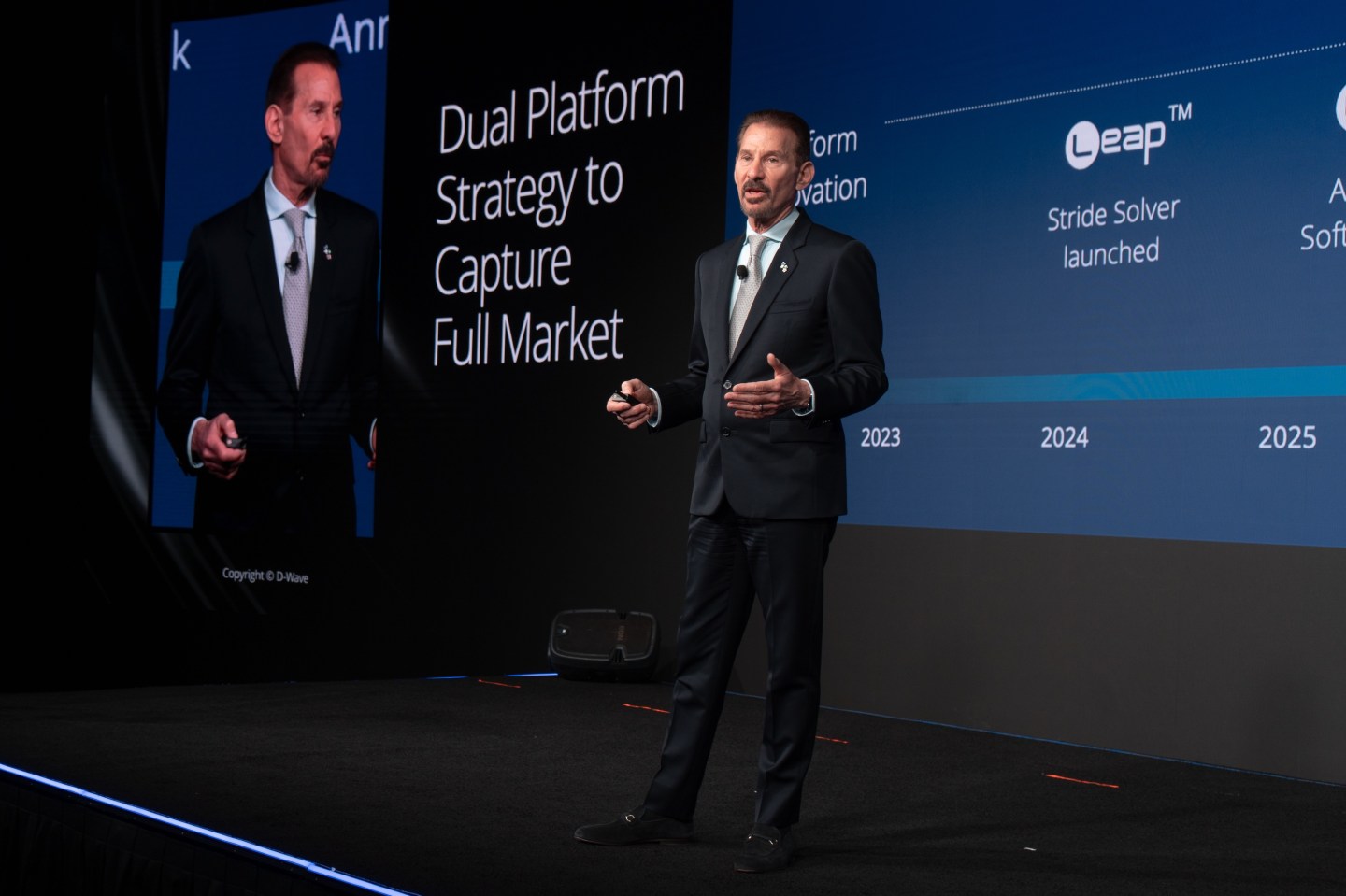
Photo: D-Wave CEO Alan Baratz at Qubits 2026, the company's annual conference.
Photo: D-Wave CEO Alan Baratz at Qubits 2026, the company's annual conference.Photo via D-Wave Quantum

There are four main publicly-traded quantum computing companies, and they all have one thing in common: In the last 14 months, all of them have been the target of activist investors shorting their stock.

This isn’t totally surprising. All four companies—D-Wave Quantum, IonQ, Rigetti Computing, and Quantum Computing Inc.—have market caps in the billions of dollars, which in no way reflect the modest revenues generated by their day-to-day businesses.

Alan Baratz, CEO of the 27-year-old Palo Alto, California-based company, says that short attacks are a hazard of the job. His company was the target of Kerrisdale Capital in April of last year, which argued “there is no proof” that D-Wave’s quantum systems solve complex problems faster than ordinary “classical” computers. 

Recommended Video

Nearly a year on from Kerrisdale’s broadside, D-Wave’s stock price has tripled, and a defiant Baratz is touting figures that counter Kerrisdale’s accusations: a three-fold increase in revenue, more than 100 paying customers (including a new $10 million licensing deal), and a half-billion-dollar acquisition that will help D-Wave solve one of quantum computing’s thorniest problems.

Fighting off ‘untrue statements and characterizations’

Short-seller campaigns are “really all about somebody who’s shorting the stock trying to make money. So, I think you need to take everything with a grain of salt,” Baratz told Fortune recently. “There were a lot of misstatements and untrue statements and characterizations in the Kerrisdale report, so we just dismissed it.”

Kerrisdale’s attack hinged on a head-turning accusation: “A wide range of D-Wave customers we interviewed in key verticals like logistics, manufacturing, and pharmaceuticals reported seeing zero benefit from the technology,” the report alleged at the time. The stock wobbled for a few days immediately after the report but then rose sharply, from about $6 per share to $15 per share by the end of May 2025.

Baratz says such reports sometimes include “nuggets of truth” but are also often riddled with “mistruth and overstatement.” Kerrisdale’s report, for instance, “quoted somebody who worked for a customer of ours. Turns out they were not even a customer of ours—so it’s that kind of thing that goes on,” he says.

D-Wave’s stock has rebounded since the report, as has its underlying business. It most recently reported $22 million in revenues for the most recent nine-month period, up three times from $6.5 million the year before.

The problem—from the short-seller point of view—is that D-Wave’s market cap is $7.4 billion, far higher than the value of its business. About 16% of its stock is currently held short—far above the average.

Photo via D-Wave Quantum

Baratz admits that there’s a lot of speculation driving up the value of quantum computing shares: “The total addressable market for quantum is, depending on who you talk to, anywhere in the $200 billion to $1 trillion range. And the companies who actually get to the point where they can capture that are going to be very highly valued, and I think investors are making bets on them.”

From R&D to revenue

One struggle the quantum sector has is emerging from the research phase into the scalable, commercially viable, real-world stage.

The technology is notoriously difficult to make. In “classical” computer chips, the processing “gates,” or “bits,” are conceptually simple: they function like light switches—they are on or off, signaling only a 1 or 0 at any given moment. By contrast, quantum computers use subatomic particles that give off information while in a state of quantum uncertainty, meaning that their gates, or “qubits,” can signal 1 or 0, or both, or neither, all at the same time. 

Because qubits can signal information from a “superposition” that gives off both or all states of information at once, they can potentially be more powerful as computers than classical chips. But with all that extra information comes errors, and error-correcting a quantum qubit—weeding out the noise to find the signal—is a challenge in itself.

D-Wave admits as much in its most recent annual report: “Building quantum computers requires advances in both science and engineering, and we may not have the ability to deliver those advances,” it says. Future generations of its equipment “may be delayed or may never be delivered … our technical roadmap may be delayed or may never be achieved,” it said.

D-Wave is moving to reduce that risk. Last month it acquired for $550 million Quantum Circuits (QC), a maker of superconducting quantum gate computers spun out of Yale University. Baratz believes the company’s founder, Robert Schoelkopf, has developed a method of creating qubits that can work at superior speed with a lower error rate. 

To create one qubit that performs “logically” (i.e. free of errors and noise), a larger number of “physical” qubits are needed to correct and eliminate errors. Some companies still need 1,000 physical qubits to correct errors and eliminate the noise generated by one underlying logical qubit.

Baratz believes that with its latest acquistion D-Wave can get that ratio down to 25 to 100 physical qubits per logical qubit.

QC’s chips “can be error-corrected with a small number of physical qubits. They are revolutionary,” he said.

A $10 million all-you-can-eat buffet

The new tech from QC will supplement D-Wave’s core business, which is based around a quantum method called “annealing,” in which quantum computing is used to calculate the optimal solution from a many variables by detecting the solution indicated by the lowest energy state within the quantum mechanism. (Yes, it’s complicated.) 

That service is starting to show signs of commercial pickup. D-Wave just signed a $10 million, two-year licensing deal with an unnamed Fortune 100 company in which the client will get an “all you can eat” buffet of D-Wave’s services. 

The company also claims more than 100 revenue-paying customers, including Ford, BASF, Shionogi (Japan), and Pattison Food Group.

Importantly, less than 10% of D-Wave’s clients are government research contracts, Baratz said.

“That’s another thing that makes us different,” Baratz said. “If you look at the revenue for pretty much all the independent quantum computing companies it’s 90% government work, because what they’re doing is taking government grants to fund their R&D and calling it ‘revenue.’ That’s mostly what’s going on.” 

Join us at the Fortune Workplace Innovation Summit May 19–20, 2026, in Atlanta. The next era of workplace innovation is here—and the old playbook is being rewritten. At this exclusive, high-energy event, the world’s most innovative leaders will convene to explore how AI, humanity, and strategy converge to redefine, again, the future of work. Register now.
About the Author
Jim Edwards
By Jim EdwardsExecutive Editor, Global News
LinkedIn iconTwitter icon

Jim Edwards is the executive editor for global news at Fortune. He was previously the editor-in-chief of Business Insider's news division and the founding editor of Business Insider UK. His investigative journalism has changed the law in two U.S. federal districts and two states. The U.S. Supreme Court cited his work on the death penalty in the concurrence to Baze v. Rees, the ruling on whether lethal injection is cruel or unusual. He also won the Neal award for an investigation of bribes and kickbacks on Madison Avenue.

See full bioRight Arrow Button Icon

Latest in Big Tech

Finance
Lorem ipsum dolor sit amet, consectetur adipiscing elit, sed do eiusmod tempor incididunt ut labore et dolore magna aliqua. Ut enim ad minim veniam
By Fortune Editors
October 20, 2025
Finance
Lorem ipsum dolor sit amet, consectetur adipiscing elit, sed do eiusmod tempor incididunt ut labore et dolore magna aliqua. Ut enim ad minim veniam
By Fortune Editors
October 20, 2025
Finance
Lorem ipsum dolor sit amet, consectetur adipiscing elit, sed do eiusmod tempor incididunt ut labore et dolore magna aliqua. Ut enim ad minim veniam
By Fortune Editors
October 20, 2025
Finance
Lorem ipsum dolor sit amet, consectetur adipiscing elit, sed do eiusmod tempor incididunt ut labore et dolore magna aliqua. Ut enim ad minim veniam
By Fortune Editors
October 20, 2025
Finance
Lorem ipsum dolor sit amet, consectetur adipiscing elit, sed do eiusmod tempor incididunt ut labore et dolore magna aliqua. Ut enim ad minim veniam
By Fortune Editors
October 20, 2025
Finance
Lorem ipsum dolor sit amet, consectetur adipiscing elit, sed do eiusmod tempor incididunt ut labore et dolore magna aliqua. Ut enim ad minim veniam
By Fortune Editors
October 20, 2025

Most Popular

Finance
Lorem ipsum dolor sit amet, consectetur adipiscing elit, sed do eiusmod tempor incididunt ut labore et dolore magna aliqua. Ut enim ad minim veniam
By Fortune Editors
October 20, 2025
Finance
Lorem ipsum dolor sit amet, consectetur adipiscing elit, sed do eiusmod tempor incididunt ut labore et dolore magna aliqua. Ut enim ad minim veniam
By Fortune Editors
October 20, 2025
Finance
Lorem ipsum dolor sit amet, consectetur adipiscing elit, sed do eiusmod tempor incididunt ut labore et dolore magna aliqua. Ut enim ad minim veniam
By Fortune Editors
October 20, 2025
Finance
Lorem ipsum dolor sit amet, consectetur adipiscing elit, sed do eiusmod tempor incididunt ut labore et dolore magna aliqua. Ut enim ad minim veniam
By Fortune Editors
October 20, 2025
Finance
Lorem ipsum dolor sit amet, consectetur adipiscing elit, sed do eiusmod tempor incididunt ut labore et dolore magna aliqua. Ut enim ad minim veniam
By Fortune Editors
October 20, 2025
Finance
Lorem ipsum dolor sit amet, consectetur adipiscing elit, sed do eiusmod tempor incididunt ut labore et dolore magna aliqua. Ut enim ad minim veniam
By Fortune Editors
October 20, 2025
Rankings
  • 100 Best Companies
  • Fortune 500
  • Global 500
  • Fortune 500 Europe
  • Most Powerful Women
  • Future 50
  • World’s Most Admired Companies
  • See All Rankings
Sections
  • Finance
  • Leadership
  • Success
  • Tech
  • Asia
  • Europe
  • Environment
  • Fortune Crypto
  • Health
  • Retail
  • Lifestyle
  • Politics
  • Newsletters
  • Magazine
  • Features
  • Commentary
  • Mpw
  • CEO Initiative
  • Conferences
  • Personal Finance
  • Education
Customer Support
  • Frequently Asked Questions
  • Customer Service Portal
  • Privacy Policy
  • Terms Of Use
  • Single Issues For Purchase
  • International Print
Commercial Services
  • Advertising
  • Fortune Brand Studio
  • Fortune Analytics
  • Fortune Conferences
  • Business Development
About Us
  • About Us
  • Editorial Calendar
  • Press Center
  • Work At Fortune
  • Diversity And Inclusion
  • Terms And Conditions
  • Site Map
  • Facebook icon
  • Twitter icon
  • LinkedIn icon
  • Instagram icon
  • Pinterest icon

Latest in Big Tech

india
AIIndia
India cobbles together $200 billion-plus for data-center investment
By Rajesh Roy and The Associated PressFebruary 17, 2026
10 minutes ago
cook
AIApple
While big tech burns cash on AI, Apple waits
By Ioannis IoannouFebruary 17, 2026
2 hours ago
Photo: D-Wave CEO Alan Baratz at Qubits 2026, the company's annual conference.
Big Techquantum computer
D-Wave CEO shrugs off short attacks with ‘revolutionary’ $550 million quantum computing acquisition
By Jim EdwardsFebruary 17, 2026
2 hours ago
ring
LawAmazon
Amazon’s Ring decides maybe partnering with a police surveillance firm is a bad idea after wide revulsion at Super Bowl ad
By The Associated PressFebruary 16, 2026
23 hours ago
Traders work on the floor of the New York Stock Exchange (NYSE) on February 13, 2026 in New York City.
InvestingMarkets
Trillion-dollar AI market wipeout happened because investors banked that ‘almost every tech company would come out a winner’
By Eleanor PringleFebruary 16, 2026
1 day ago
Big TechChips
Rampant AI demand for memory is fueling a growing chip crisis
By Debby Wu, Takashi Mochizuki, Yoolim Lee and BloombergFebruary 15, 2026
2 days ago

Most Popular

placeholder alt text
Economy
Social Security's trust fund is nearing insolvency, and the borrowing binge that may follow will rip through debt markets, economist warns
By Jason MaFebruary 15, 2026
2 days ago
placeholder alt text
Future of Work
Malcolm Gladwell tells young people if they want a STEM degree, 'don’t go to Harvard.' You may end up at the bottom of your class and drop out
By Sasha RogelbergFebruary 14, 2026
3 days ago
placeholder alt text
Real Estate
A billionaire and an A-list actor found refuge in a 37-home Florida neighborhood with armed guards—proof that privacy is now the ultimate luxury
By Marco Quiroz-GutierrezFebruary 15, 2026
2 days ago
placeholder alt text
C-Suite
Blackstone mogul warned of 'urgent need' for AI preparedness—Now he’s turning his $48 billion fortune into a top philanthropic foundation
By Sydney LakeFebruary 16, 2026
1 day ago
placeholder alt text
Investing
Trillion-dollar AI market wipeout happened because investors banked that 'almost every tech company would come out a winner'
By Eleanor PringleFebruary 16, 2026
1 day ago
placeholder alt text
Commentary
Something big is happening in AI — and most people will be blindsided
By Matt ShumerFebruary 11, 2026
6 days ago

© 2026 Fortune Media IP Limited. All Rights Reserved. Use of this site constitutes acceptance of our Terms of Use and Privacy Policy | CA Notice at Collection and Privacy Notice | Do Not Sell/Share My Personal Information
FORTUNE is a trademark of Fortune Media IP Limited, registered in the U.S. and other countries. FORTUNE may receive compensation for some links to products and services on this website. Offers may be subject to change without notice.