The Trump administration is framing its decision to repeal the landmark legal finding that’s used for the regulation of greenhouse gas emissions—for everything from automobiles to power plants—as the “largest deregulatory action in American history.” And it is indeed a sizable policy shift—but the practical implications won’t change much for the shorter-term operations of the energy and auto sectors, legal experts and industry analysts from across the ideological spectrum said.
While rescinding the Environmental Protection Agency’s 2009 endangerment finding about climate change may help extend the lives of existing coal plants and of internal combustion engine vehicles, existing regulations largely remain intact as industries continue to move toward safer and cleaner technologies overall, they said. And nobody is building new coal-fired plants.
“We don’t have a bunch of fedora-wearing fat cats sitting around going, ‘I can’t wait until the endangerment finding gets repealed, so I can crank the CO₂ all the way up,’” said Eric Groten, senior partner for environmental and natural resources law at Vinson & Elkins, which represents energy clients. “The idea that suddenly we’re going to have unregulated power is a false fear. We’ll be unwinding very little that has already been put in place.” Groten also said that the repeal would prevent “irrational overregulation” under Democrats.
The EPA is issuing the rescission Feb. 12 to repeal its own scientific finding from the Obama administration that key greenhouse gas emissions—including carbon dioxide and methane—contribute to climate change and negative public health and welfare outcomes. The finding, which came after a narrow Supreme Court ruling that greenhouse gas emissions from fossil fuels are air pollutants under the Clean Air Act, has been used as the basis for most air and tailpipe emissions regulations ever since.
The repeal will impact proposed rules already tied up in litigation and make it harder for future Democratic administrations to implement new rules, legal experts agreed. The expectation is the repeal will immediately be challenged in court on a crash course to the Supreme Court—likely not until 2028—after going through federal district and appellate courts.
“I can’t imagine a more reckless and shortsighted move out of the EPA,” said Basil Seggos, a partner at Foley Hoag and former commissioner of the New York State Department of Environmental Conservation. But despite the significance of the move, Seggos said, the legal challenges and technological progression of the industries will have some “blunting effect on the outcome.”
“Given how aggressively the world is moving towards electrification and more choice on automobiles and emissions from power plant sources, there will be some resiliency within the market to help get us to the next point of sanity,” Seggos said.
And the repeal has little impact on the EPA decision last year under Trump to dramatically reduce enforcement of industry emissions. “In the meantime, the EPA is doing nothing on greenhouse gases, and this is the signal that they intend to shatter the bedrock underneath the entire edifice,” Seggos said.
Dan Romito, managing director overseeing sustainability consulting and advocacy at Pickering Energy Partners, largely agreed with that assessment on enforcement—or the complete lack thereof.
“The running joke is, ‘What is the EPA going to do?’ The answer is, ‘Nothing,’” Romito said.
Political swings
The oil and gas sector wants to avoid the regulatory whipsaw that can come every four years, and companies likely won’t change their steady course toward reducing emissions—while still focusing on fossil fuel extraction and combustion, Romito said. The industry also has made sizable gains in limiting the methane flaring and venting that was a larger problem a decade ago.
“I don’t think this is too big of a deal at all,” Romito said. “The companies want to remain as immune as possible from any swings in that political pendulum. Companies aren’t doing cartwheels about this. They’re going to maintain their paths regardless of the political whims.”
The industries are taking a wait-and-see approach because they know it will be battled out in court, he added. The companies that are the most diligent with emissions tracking and reductions will continue to do so, and the ones that do as little as possible will probably remain on that path.
For oil and gas exporters, they still must follow stricter regulatory guidelines to meet the reporting requirements of importing nations in Europe and Asia, Romito said. And the shareholders will always have the final say on the directions of companies. “Nothing speaks louder and carries a bigger stick than the capital markets. If your investor wants you to do something, you probably have to do it.”
States’ rights and power trends
The Trump administration’s approach may have an unintended effect, Seggos said, pointing out that the federal-level rollbacks are indirectly “going to put the focus squarely back on states. I think the EPA is completely shortsighted on this.”
California and other left-leaning states are expected to step in and help fill the regulatory void, with air emissions and automotive standards. Much of the nation’s auto industry already follows vehicle emissions standards set by California, although the Trump administration is pushing back.
“It’s a lot less of what the feds are doing, and it’s a lot more of where the puck is headed at a state level,” Romito said.
The oil and gas industry and Republicans contend the Obama administration took a Supreme Court ruling and an allegedly vague climate change finding to stiffen tailpipe emissions standards and then expand the finding to all greenhouse gas emissions—“for very deliberate purposes to unleash the whirlwind of Clean Air Act regulation,” as Groten put it.
During his administration, Obama was often criticized as “picking winners and losers” to benefit wind and solar energy and punish coal, the dirtiest of the widely used fossil fuels.
Now, the rescission of the endangerment finding is expected to benefit the economically struggling coal sector. Coal represented more than 50% of U.S. electricity generation in 2000, and it’s down to just under 17% today. Natural gas-fired power leads the way, with just over 40% of U.S. generation.
Trump is now openly pushing winners and losers himself, fighting the permitting and expansion of wind and solar power while pushing more subsidies toward the coal industry.
On Feb. 11, Trump ordered the Defense Department to sign power contracts with coal plants, while authorizing more than $525 million in federal funds for the expansion and upgrades of coal plants.
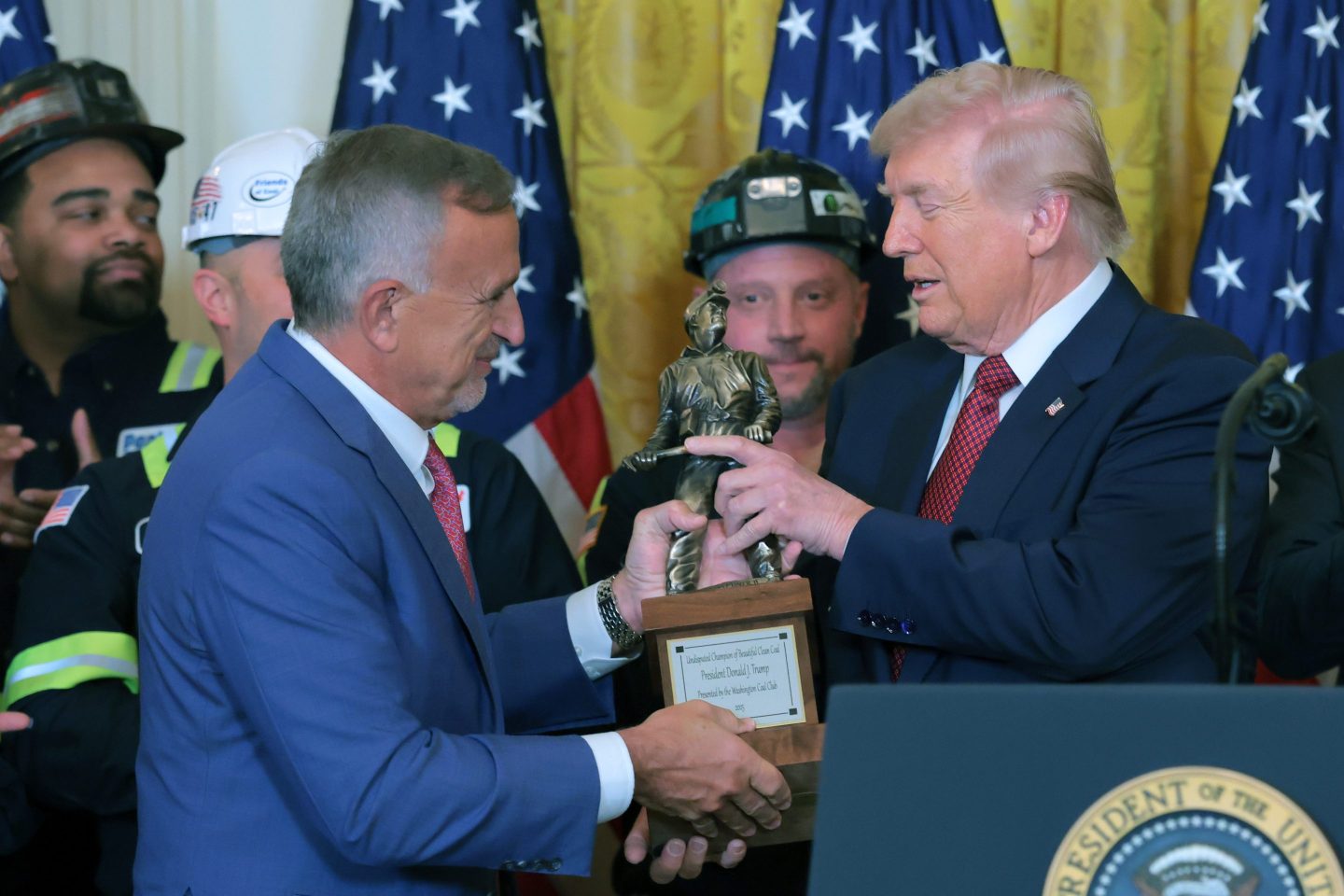
The coal industry awarded Trump with the inaugural “Undisputed Champion of Coal Award,” another example of new awards or gifts invented to honor the sitting president.
Regardless of such awards, the EPA rescission sets a dangerous precedent, the Environmental Defense Fund said.
“This action will only lead to more of this pollution, and that will lead to higher costs and real harms for American families,” said EDF president Fred Krupp. “The evidence—and the lived experiences of so many Americans—tell us that our health will suffer.”