

• Home
  • Latest
  • Fortune 500
  • Finance
  • Tech
  • Leadership
  • Lifestyle
  • Rankings
  • Multimedia
Future of Workskills

Welcome to the ‘skills mismatch economy’: the shift from roles to skills making your resume—and your job title—meaningless

Nick Lichtenberg
By
Nick Lichtenberg
Nick Lichtenberg
Business Editor
Down Arrow Button Icon
Nick Lichtenberg
By
Nick Lichtenberg
Nick Lichtenberg
Business Editor
Down Arrow Button Icon
January 22, 2026, 10:20 AM ET
mismatch
The job description and the CV don't line up with the job.Getty Images

The modern labor market is currently reorganizing at a pace that outstrips employers, workers, and educators’ ability to adapt. Traditional job titles, which once served as reliable proxies for professional capability, no longer accurately describe how work is actually performed. Instead, we have entered a “skills mismatch economy,” where a profound disconnect has emerged between the signals workers send and the capabilities their bosses are willing to reward.

Recommended Video

That’s the somewhat obvious—and yet still somewhat remarkable—takeaway from the newly released Wharton–Accenture Skills Index (WAsX), an empirical benchmark that tracks more than 150 million unique U.S. profiles and 100 million job postings. The research team, comprising Wharton professor Eric Bradlow and Accenture’s James Crowley, Ken Munie, and Selen Karaca-Griffin, found the labor market is operating in a state of structural imbalance. The signaling gap in a nutshell: workers are overwhelmingly promoting generalist traits such as communication, leadership, and problem-solving, while employers are increasingly desperate for specialized, execution-oriented skills that remain in short supply.

“I think just that there is this massive skills gap,” Bradlow told Fortune in an interview. “The skills that people, that companies are saying they want in job postings are just not the way people are representing themselves.” The professor, who serves as the vice dean of AI and analytics at the vaunted business school, said he sees employers drowning in “table stakes” skills like leadership, teamwork, and communication—capabilities that everybody’s putting down on their resumes, which means they no longer differentiate candidates in the market. Bradlow, a statistician and computer scientist by training who has been at Wharton for 30 years, has led a data-science program for 20 years, and has drilled down on AI for the last decade, added that he was certain about one thing: this situation can’t last.

The signaling trap

The research highlights an oversupply of “generalists,” with workers competing on “safe” signals that are socially reinforced, but have become so common that they no longer differentiate talent. In the WAsX “surplus-deficit map,” these broad traits appear as the most oversupplied. Conversely, the market rewards technical depth, scientific methods, and analytical precision—capabilities that workers consistently under-signal.

This means your job title and your resume won’t protect you anymore. Once a reliable proxy for what workers do, job titles “no longer describe how work actually gets done,” the report says. While the CV, which remains the “dominant signaling tool” in the workforce, tends to emphasize broad traits such as communication, leadership and problem solving without really communicating what value a particular worker adds.

According to Bradlow, employers increasingly say, “Don’t tell me your title. Tell me what skills you have, and tell me what you actually do.” Yet the CV, which remains the “dominant signaling tool,” still tends to emphasize broad traits such as communication, leadership, and problem solving “without really communicating what value a particular worker adds.”​

Artificial intelligence (AI) is acting as a massive catalyst for this shift. Rather than simply automating work away, AI is redistributing economic value across the skills spectrum. Demand is falling sharply for routine content creation and structured cognitive work, such as basic writing and routine analysis. Meanwhile, demand is rising for skills that AI cannot easily replicate, such as expert judgment, coordination, and regulatory compliance.

The authors describe a “striking and persistent disconnect between what workers choose to signal and what employers truly need to get work done.” The less valuable generalist traits include leadership, communication, teamwork, and problem-solving. On the other hand, workers tend to “under-signal” the hard, specific, valuable skills that employers want—and in many cases, they “lack them altogether.”

According to Bradlow, the rise of large language models is making deep expertise more—not less—valuable, because “who’s going to train it? A person with deep skills. Who’s going to assess whether it’s correct? Someone with deep skills.”​

The $18,000 swing

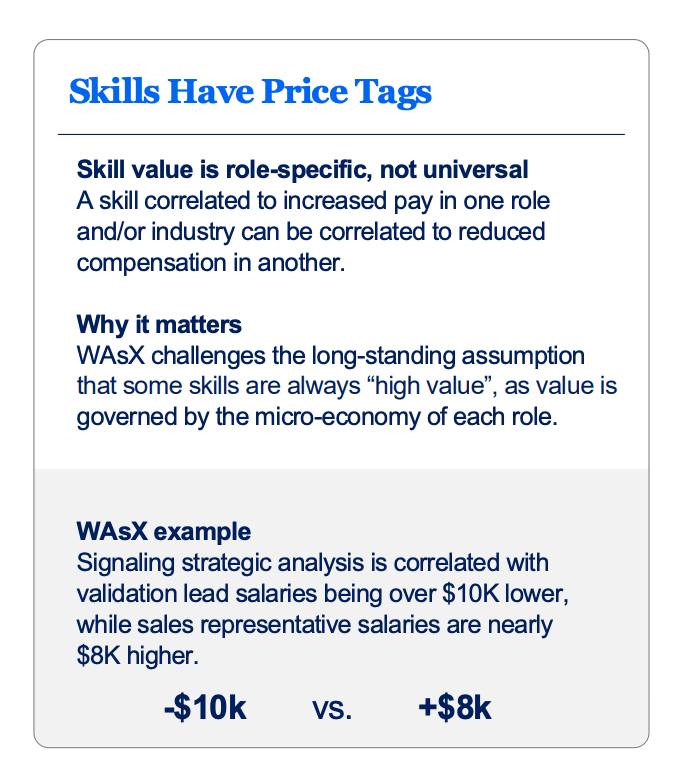
One of the most revealing findings of the WAsX is that skill value is role-specific, not universal, with a capability that boosts pay in one industry, for instance, actually lowering it in another. For example, the index found that signaling “strategic analysis” skills is correlated with an $8,000 salary increase for sales representatives but a $10,000 salary decrease for technical validation leads. In highly technical roles, the market prioritizes domain depth—such as liposome technologies or catalytic reactor techniques—over general management strategy.
New currency for work

The implication for the future of work is clear: skills are replacing job titles as the primary currency of the labor market. To navigate this transition, the authors suggest a radical shift in perspective for all stakeholders:

• Employers must move away from “job architecture” and toward “skill architecture,” breaking roles into underlying tasks and aligning compensation with the specific skills that drive value. As Bradlow put it, firms need to understand “the workflow of your job” and then decide “what’s the best role for a human in that workflow.

• Employees are encouraged to view their careers as a portfolio of high-value skills rather than a list of titles, using AI to rapidly acquire technical depth.

• Educators need to rebalance curricula, shifting away from generalist preparation toward specialized, job-ready capabilities that ensure graduates can contribute from day one.

Bradlow had some advice for people anxious that they don’t have the right skills in the age of AI: don’t worry about what you lack, and find hard problems to solve. “What you want people to be able to do is to take potentially hard, amorphous problems, structure them, and solve them to the best of their ability.” Whether you’re an English or a Physics major or a computer scientist, Bradlow said it doesn’t matter. Your skills come down to the sharpness of your critical thinking.

Bradlow said he gets asked all the time whether he regrets taking so much computer science, since LLMs can do the work now. “It taught me structured thinking. It taught me algorithmic thinking.” The only thing he’s worried about, he added, is the person that doesn’t know how to take hard problems and break them down and solve them. Furthermore, he added, LLMs have democratized skills by allowing people of different backgrounds to ramp up their expertise a lot faster than before. “So it’s not obvious to me that the losers are the humanities people and the winners are the quant techie people.”

“I would say the same to everybody,” Bradlow advocated. “Learn how to take hard problems, break them into small structured problems, state what your assumptions are, understand uncertainty, and you’ll be fine. There are jobs for those people all the time. Those are called thinking and structuring skills.”


Join us at the Fortune Workplace Innovation Summit May 19–20, 2026, in Atlanta. The next era of workplace innovation is here—and the old playbook is being rewritten. At this exclusive, high-energy event, the world’s most innovative leaders will convene to explore how AI, humanity, and strategy converge to redefine, again, the future of work. Register now.
About the Author
Nick Lichtenberg
By Nick LichtenbergBusiness Editor
LinkedIn icon

Nick Lichtenberg is business editor and was formerly Fortune's executive editor of global news.

See full bioRight Arrow Button Icon

Latest in Future of Work

Finance
Lorem ipsum dolor sit amet, consectetur adipiscing elit, sed do eiusmod tempor incididunt ut labore et dolore magna aliqua. Ut enim ad minim veniam
By Fortune Editors
October 20, 2025
Finance
Lorem ipsum dolor sit amet, consectetur adipiscing elit, sed do eiusmod tempor incididunt ut labore et dolore magna aliqua. Ut enim ad minim veniam
By Fortune Editors
October 20, 2025
Finance
Lorem ipsum dolor sit amet, consectetur adipiscing elit, sed do eiusmod tempor incididunt ut labore et dolore magna aliqua. Ut enim ad minim veniam
By Fortune Editors
October 20, 2025
Finance
Lorem ipsum dolor sit amet, consectetur adipiscing elit, sed do eiusmod tempor incididunt ut labore et dolore magna aliqua. Ut enim ad minim veniam
By Fortune Editors
October 20, 2025
Finance
Lorem ipsum dolor sit amet, consectetur adipiscing elit, sed do eiusmod tempor incididunt ut labore et dolore magna aliqua. Ut enim ad minim veniam
By Fortune Editors
October 20, 2025
Finance
Lorem ipsum dolor sit amet, consectetur adipiscing elit, sed do eiusmod tempor incididunt ut labore et dolore magna aliqua. Ut enim ad minim veniam
By Fortune Editors
October 20, 2025

Most Popular

Finance
Lorem ipsum dolor sit amet, consectetur adipiscing elit, sed do eiusmod tempor incididunt ut labore et dolore magna aliqua. Ut enim ad minim veniam
By Fortune Editors
October 20, 2025
Finance
Lorem ipsum dolor sit amet, consectetur adipiscing elit, sed do eiusmod tempor incididunt ut labore et dolore magna aliqua. Ut enim ad minim veniam
By Fortune Editors
October 20, 2025
Finance
Lorem ipsum dolor sit amet, consectetur adipiscing elit, sed do eiusmod tempor incididunt ut labore et dolore magna aliqua. Ut enim ad minim veniam
By Fortune Editors
October 20, 2025
Finance
Lorem ipsum dolor sit amet, consectetur adipiscing elit, sed do eiusmod tempor incididunt ut labore et dolore magna aliqua. Ut enim ad minim veniam
By Fortune Editors
October 20, 2025
Finance
Lorem ipsum dolor sit amet, consectetur adipiscing elit, sed do eiusmod tempor incididunt ut labore et dolore magna aliqua. Ut enim ad minim veniam
By Fortune Editors
October 20, 2025
Finance
Lorem ipsum dolor sit amet, consectetur adipiscing elit, sed do eiusmod tempor incididunt ut labore et dolore magna aliqua. Ut enim ad minim veniam
By Fortune Editors
October 20, 2025
Rankings
  • 100 Best Companies
  • Fortune 500
  • Global 500
  • Fortune 500 Europe
  • Most Powerful Women
  • Future 50
  • World’s Most Admired Companies
  • See All Rankings
Sections
  • Finance
  • Leadership
  • Success
  • Tech
  • Asia
  • Europe
  • Environment
  • Fortune Crypto
  • Health
  • Retail
  • Lifestyle
  • Politics
  • Newsletters
  • Magazine
  • Features
  • Commentary
  • Mpw
  • CEO Initiative
  • Conferences
  • Personal Finance
  • Education
Customer Support
  • Frequently Asked Questions
  • Customer Service Portal
  • Privacy Policy
  • Terms Of Use
  • Single Issues For Purchase
  • International Print
Commercial Services
  • Advertising
  • Fortune Brand Studio
  • Fortune Analytics
  • Fortune Conferences
  • Business Development
About Us
  • About Us
  • Editorial Calendar
  • Press Center
  • Work At Fortune
  • Diversity And Inclusion
  • Terms And Conditions
  • Site Map
  • Facebook icon
  • Twitter icon
  • LinkedIn icon
  • Instagram icon
  • Pinterest icon

Latest in Future of Work

Future of Workskills
‘AI adoption is accelerating, but confidence is collapsing’: The more workers use AI, the less they trust it. Baby boomers show a 35% drop
By Jake AngeloJanuary 21, 2026
1 day ago
Jensen Huang
SuccessCareers
Six-figure plumbing and construction jobs are coming, Nvidia CEO Jensen Huang says—as AI data centers need to be built
By Preston ForeJanuary 21, 2026
1 day ago
Yasmeen
CommentaryCloud
Google Cloud exec on software’s great reset and the end of certainty: we’re shifting from predictability to probability
By Yasmeen AhmadJanuary 21, 2026
1 day ago
karp
Future of WorkDavos
Palantir CEO says AI ‘will destroy’ humanities jobs but there will be ‘more than enough jobs’ for people with vocational training
By Jacqueline MunisJanuary 20, 2026
2 days ago
Image of various nation's flags over the World Economic Forum sign in Davos.
NewslettersEye on AI
At Davos, AI hype gives way to focus on ROI
By Jeremy KahnJanuary 20, 2026
2 days ago
Woman driving truck
SuccessCareers
Truck driving is among the best jobs to have right now, Indeed says—it pays $160,000, with no degree required
By Emma BurleighJanuary 20, 2026
2 days ago

Most Popular

placeholder alt text
AI
Elon Musk says that in 10 to 20 years, work will be optional and money will be irrelevant thanks to AI and robotics
By Sasha RogelbergJanuary 19, 2026
3 days ago
placeholder alt text
Economy
Jamie Dimon says he’d have no issue paying higher taxes if it actually went to people who need it. Right now it just goes to the Washington ‘swamp’
By Eleanor PringleJanuary 21, 2026
1 day ago
placeholder alt text
Politics
Jamie Dimon tells Davos: ‘You didn’t do a particularly good job making the world a better place’
By Eleanor PringleJanuary 21, 2026
1 day ago
placeholder alt text
Success
Nvidia CEO Jensen Huang says ‘a lot’ of six-figure jobs in plumbing and construction are about to be unlocked because someone needs to build all these new AI centers
By Preston ForeJanuary 21, 2026
1 day ago
placeholder alt text
Economy
Scott Bessent insists he’s ‘not concerned at all’ about investors selling America—despite the fact it’s unraveled tariffs before
By Eleanor PringleJanuary 21, 2026
1 day ago
placeholder alt text
Personal Finance
Current price of silver as of Tuesday, January 20, 2026
By Joseph HostetlerJanuary 20, 2026
2 days ago

© 2026 Fortune Media IP Limited. All Rights Reserved. Use of this site constitutes acceptance of our Terms of Use and Privacy Policy | CA Notice at Collection and Privacy Notice | Do Not Sell/Share My Personal Information
FORTUNE is a trademark of Fortune Media IP Limited, registered in the U.S. and other countries. FORTUNE may receive compensation for some links to products and services on this website. Offers may be subject to change without notice.