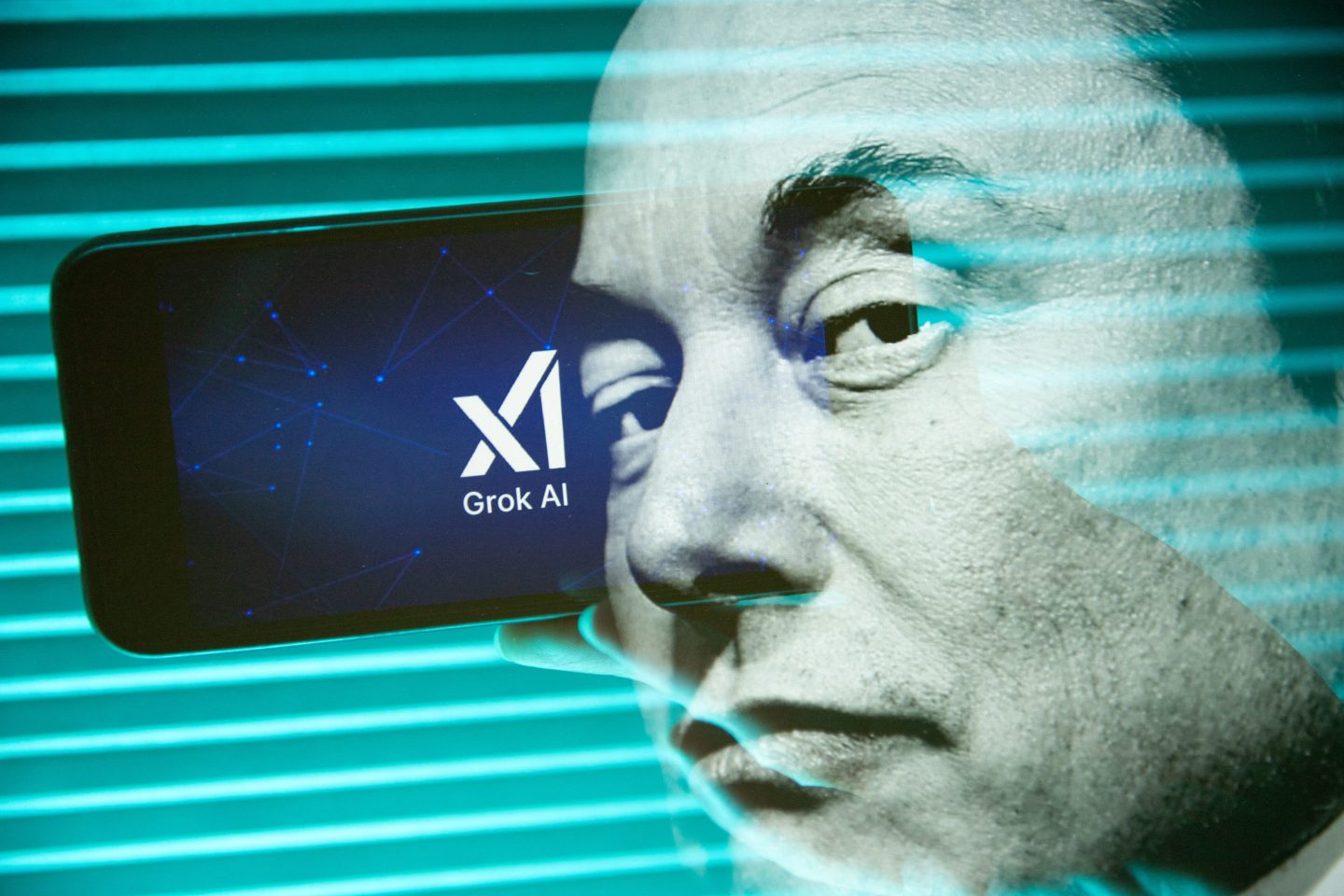
The U.K.’s investigation into Elon Musk’s X platform over allegedly illegal deepfakes risks igniting a simmering battle over online regulation and free speech between the U.S. and Europe.
On Monday, the U.K.’s online safety regulator Ofcom announced it had opened a formal investigation into the platform over the rise of sexualized deepfakes of women and children being created and shared on X. The investigation will examine whether the social media platform has failed to comply with its legal obligations under the U.K. Online Safety Act, which came into force in March last year. The UK government is also bringing into force a law that will make it illegal for companies to supply the tools that create deepfake images, the country’s UK technology secretary, Liz Kendall, said on Monday.
xAI’s Grok still appears to be churning out thousands of sexualized deepfakes of women and children, despite restrictions that the company imposed late last week that it said would make it much less likely for users to create these kinds of images.
“Reports of Grok being used to create and share illegal non-consensual intimate images and child sexual abuse material on X have been deeply concerning,” Ofcom said in a statement, adding that “platforms must protect people in the U.K. from content that’s illegal in the U.K., and we won’t hesitate to investigate where we suspect companies are failing in their duties, especially where there’s a risk of harm to children.”
If found in violation, X could face fines of up to £18 million or 10% of its global revenue, whichever is greater, and in severe cases of non-compliance, courts could order British internet providers to block access to the platform entirely.
But while the probe is centered on illegal content—particularly child sexual abuse material—experts warn the enforcement action risks being reframed as a geopolitical battle over censorship and free speech.
X has already been temporarily blocked in Malaysia and Indonesia over the images. But, in response to the threats of a U.K. ban, Musk has accused the British government of being “fascist” and claimed ministers just “want any excuse for censorship.”
X did not immediately respond to a request for comment from Fortune. xAI responded with the automated message: “Legacy Media Lies.”
If Ofcom does decide to ban the platform, Nick Anstead, an associate professor specializing in political communication at the London School of Economics, told Fortune he expected there would be “an attempt to co-opt it rhetorically into this wider conversation about free speech.”
“We’ve already seen that this discourse is playing out and the actual substance of why it’s happened and the trigger will get lost in the debate,” he said.
A free speech battle
British politicians have indicated that they are willing to support Ofcom if it chooses to block the platform, but they have also made an effort to distance themselves from whatever decision the independent regulator makes.
The U.K.’s technology minister Liz Kendall said last week that the Online Safety Act “includes the power to block services from being accessed in the U.K., if they refuse to comply with U.K. law” and if Ofcom decided to use those powers it would have the government’s full support.
“It’s very notable that you have had government ministers on the television in the past couple days saying, this is a matter for Ofcom,” Anstead said. “It’s already been slightly removed from the political arena by giving it to this regulator.”
British Foreign Secretary David Lammy has also said that U.S. Vice President JD Vance agrees that sexualized AI deepfakes, particularly those of children, are “entirely unacceptable.” Lammy said he raised concerns about Grok being used to create explicit images of women and children with Vance during a meeting in Washington last week and that Vance agreed with the U.K.’s position.
However, the U.K.’s Online Safety Act, which outlaws content such as non-consensual intimate images and child sexual abuse material, has been a particular point of contention between the U.S. and the U.K. Vance has repeatedly criticized European online safety regulations, warning at the Munich Security Conference in February last year that they suppress political speech.
The Trump administration has taken multiple actions against what it views as European censorship, including barring five Europeans from entering the U.S. in December for allegedly pressuring tech firms to censor American viewpoints. Members of Congress have also introduced resolutions opposing what they describe as foreign efforts to censor constitutionally protected speech by Americans under laws such as the EU’s Digital Services Act (DSA), and the State Department has instructed some U.S. embassies in Europe to lobby against aspects of the DSA.
Grok is still producing sexualized deepfakes
Women have been particularly targeted by AI-manipulated images showing them nude or in sexual scenarios without consent, with many victims reporting that X ignored their complaints and left the content online. Researchers say Grok’s integration into X creates an unprecedented distribution system for such imagery. According to a report from Bloomberg, one analysis found Grok was generating approximately 6,700 sexually explicit or “undressing” images per hour and that sexualized content comprised 85% of Grok’s total output.
In response, Musk has argued that other AI chatbots and digital tools can edit images in the same way as Grok, and accused the U.K. of singling out his platform.
On Monday, when questioned if the threats to block Elon Musk’s social media platform amounted to an attack on free speech, the British prime minister’s spokesperson said in comments reported by Sky News: “I don’t accept that at all. Our position on free speech is clear. You had the PM discuss this directly with the president in the Oval Office in February.”
“We’re fully committed to the right to free speech,” the spokesperson added.