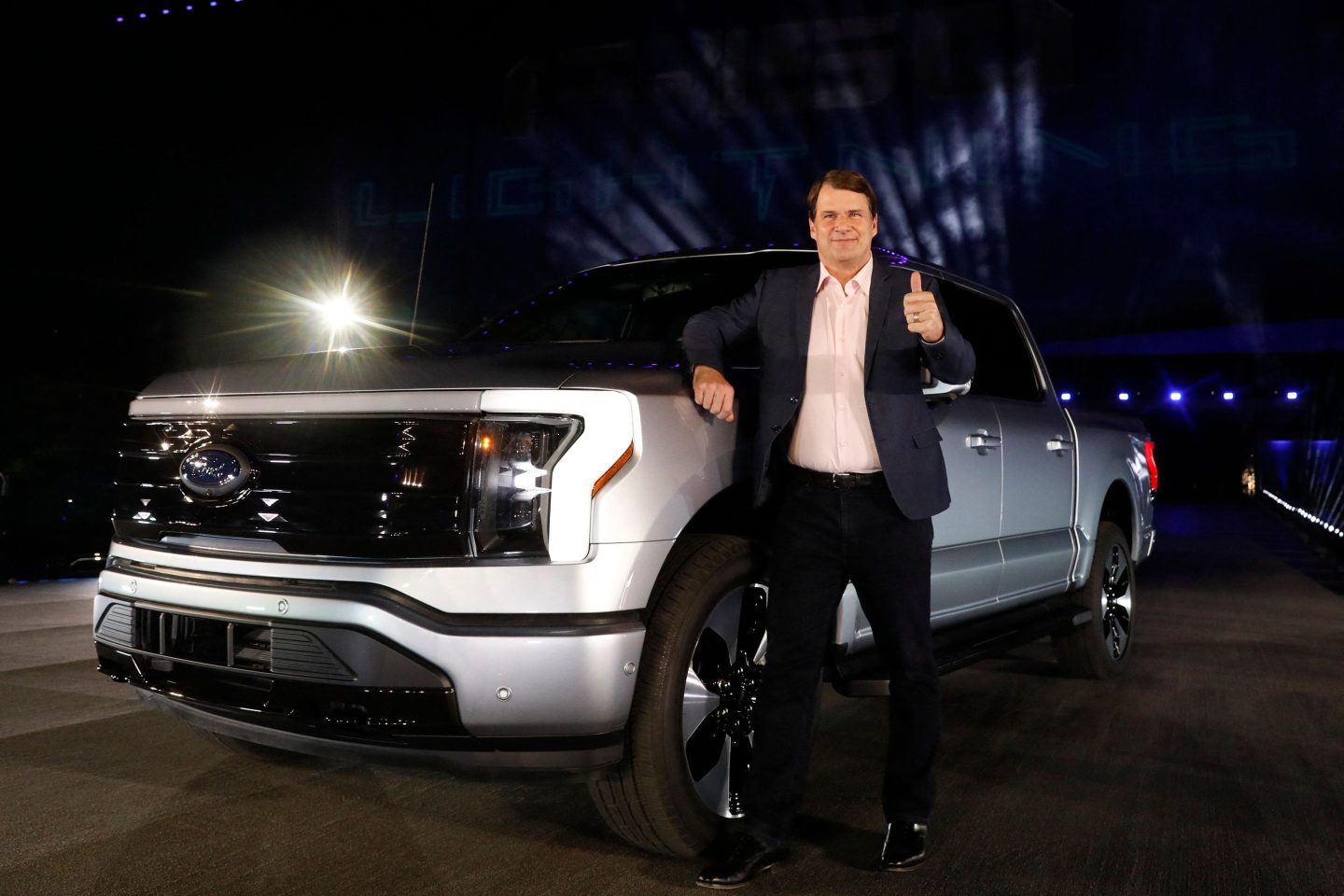
Several months ago, Ford CEO Jim Farley said ending the nearly two-decade-long EV tax credit would halve America’s electric-vehicle market. Now his company is facing its own reality check.
Ford said this week it would cease production for the original electric F-150 Lightning, which was once touted as a breakthrough for the industry, and shift some of its existing workforce to producing a hybrid version of the pickup with a gas-powered generator called an EREV‚ or an extended range electric vehicle. The automaker said it would be taking a $19.5 billion charge in 2026 as a result of this “customer-driven shift.”
With that in mind, it’s worth reviewing what Farley said at the Ford Pro Accelerate summit in Detroit in September. EVs will remain a “vibrant industry” going forward, he said, but also “smaller, way smaller than we thought.” The end of the $7,500 consumer incentive would be a game-changer, Farley added, before predicting that EV sales in the U.S. could plummet from to 5% from a previous 10% to 12%.
Speaking to CNBC on Monday about Ford’s electric pivot, Farley claimed the EV market had, in fact, already shrunk to around 5% of the U.S. vehicle market. The automaker’s EV lineup was simply out of sync with consumer demand, he said.
“More importantly, the very high-end EVs, the 50, 60, 70, $80,000 vehicles, they just weren’t selling,” Farley told CNBC.
Farley had established Ford’s Model E division in 2022 to innovate on electric vehicles and operate as a startup within the more-than-100-year-old automaker. At the same time, Farley told CNBC that he knew when he established Model E, it would be “brutal business-wise.” That may have been an understatement. In under three years, the Model E division has lost $13 billion, more than double Ford’s net income for 2024.
As part of its pivot, Farley said the company is listening to consumers.
“We’re following customers to where the market is, not where people thought it was going to be, but to where it is today,” he said.
This means prioritizing hybrid and semi-gas-powered EREVs over pure-play EVs. These categories are what customers are still interested in, Farley said.
To be sure, the company says its Model E division will still be profitable, but in 2029, three years after the 2026 date it had previously targeted. By 2030, the company is also predicting that hybrids, semi-gas-powered EREVs, and pure-play EVs will make up half of Ford’s global sales, a stark increase from about 17% now. And most of that, Farley told CNBC, will be “hybrid and EREV.”