Roughly 1 in 5 Americans live in rural areas – places the federal government defines based on small populations and low housing density.
Yet many people understand rural America through stereotypes. Media and political conversations often use words or terms such as “fading,” “white,” “farming,” “traditional” and “politically uniform” to describe rural communities.
In reality, rural communities are far more varied. Getting these facts right matters because public debates, policies and resources – including money for programs – often rely on these assumptions, and misunderstandings can leave real needs neglected.
We are rural demographers at Louisiana State University and Syracuse University who study the causes and consequences of well-being in rural America. Here we outline six myths about rural America – a few among many – highlighted in our recent book “Rural and Small-Town America: Context, Composition, and Complexities.”
Myth 1: Rural America is disappearing due to depopulation
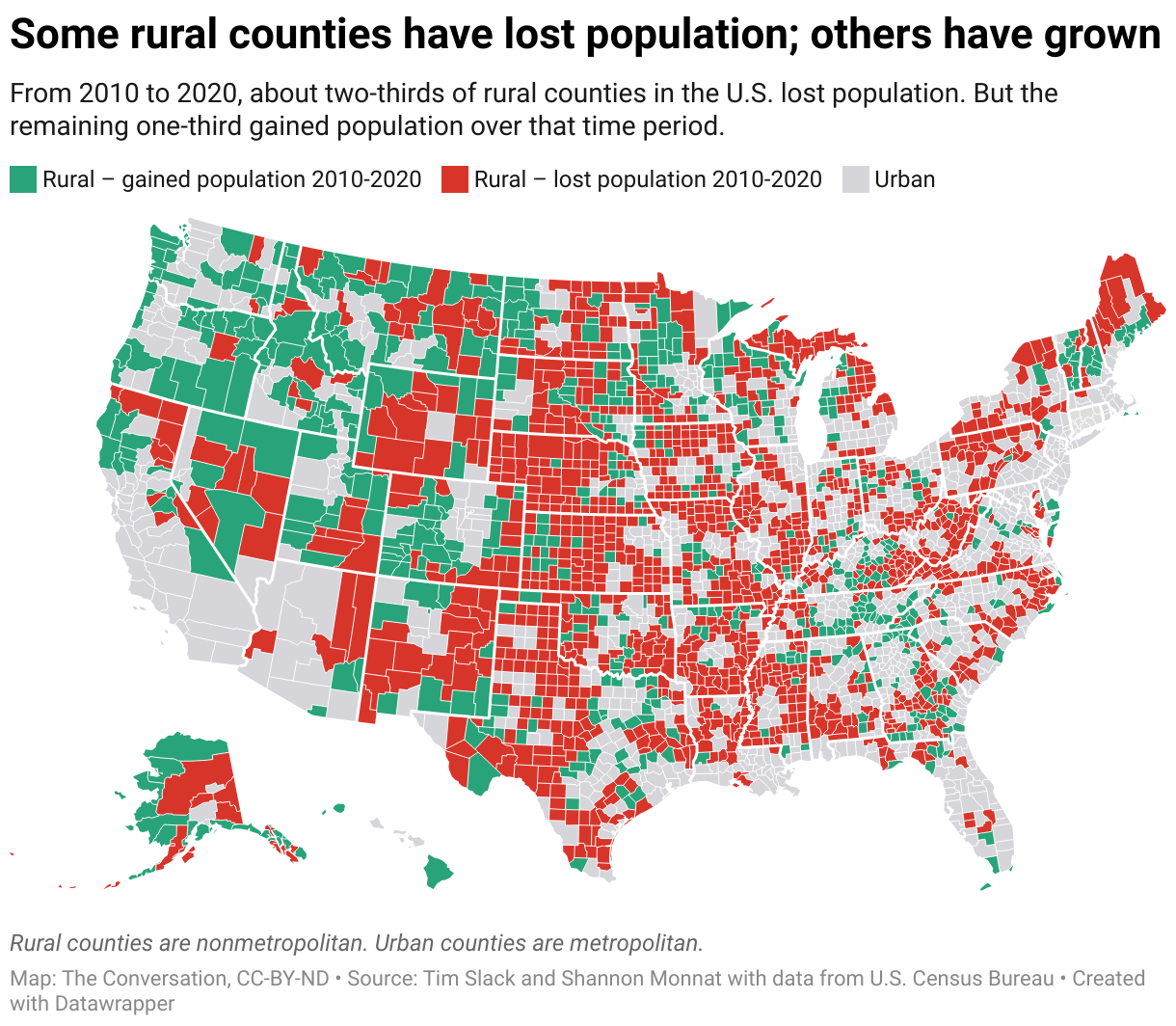
Many people think rural America is emptying out. The story is more complicated. It’s true that from 2010 to 2020 most rural counties lost population. But about one-third grew, especially those near cities or those with lakes, mountains and other natural attractions. And there have been times, like in the 1970s and 1990s, when rural populations grew faster than cities – periods called “rural rebounds.”
An important thing to know about rural population change is that the places defined as “rural” change over time. When a rural town grows enough, the U.S. Office of Management and Budget reclassifies it as “urban.” In other words, rural America isn’t disappearing – it’s changing and sometimes urbanizing.
Myth 2: Most rural Americans live on farms
Farming is still important in many rural places, but it’s no longer the way most rural Americans make a living. Today, roughly 6% of rural jobs are in agriculture. And most farm families also have members who work off-farm jobs, often for access to health insurance and retirement benefits.
A bigger source of employment in rural America is manufacturing. In fact, manufacturing plays a larger role as a share of jobs and earnings in rural areas than in cities. That also means that deindustrialization – steady job losses in manufacturing over the decades – has been especially painful in rural America. Unlike large cities with lots of employers, rural communities rely on just a few. When a rural plant or factory closes, the local impacts are often devastating.
The largest share of rural jobs today is in service-sector work, such as retail, food service, home health care and hospitality. These jobs often pay low wages, offer few benefits and have unstable hours, making it harder for many rural families to stay financially secure.
Myth 3: Only white people live in rural America
People often picture rural America as mostly white, but that’s not the full story. About 1 in 4 rural residents are nonwhite. Hispanic and Black people make up the largest shares, and Indigenous people have a greater portion of their population living in rural areas than any other racial group.
Rural America is also getting more racially and ethnically diverse every year. Young people are leading that change: About 1 in 3 rural children are nonwhite. The future of rural America is racially diverse, even if popular images don’t always show it.
Myth 4: Rural America is healthier than urban America
Many people imagine rural life as healthier than city life. But the opposite is true. People in rural areas die younger and at higher rates than people in cities. Scholars call this the “rural mortality penalty,” and it has been widening for years. The COVID-19 pandemic made the gap even larger due to higher death rates in rural communities.
This isn’t just because rural areas have more older people. Rural working-age people, ages 25 to 64, are dying younger than their urban peers, and the gap is growing. This trend is being driven by nearly all major causes of death. Rural residents have higher rates of early death from cancers, heart disease, COVID-19, motor vehicle crashes, suicide, alcohol misuse, diabetes, stroke and pregnancy-related complications.
Myth 5: Rural families are more traditional than urban families
Images of rural life often evoke households in which married couples are raising children in traditional family structures. Historically, rural children were more likely to live with married parents. But that’s no longer the case.
Today, rural children are less likely than urban children to live with married parents and are more likely to live with cohabiting unmarried parents or in the care of grandparents or other relatives. Partly as a result, rural child poverty rates are higher than urban rates, and many rural families rely on safety-net supports such as the food aid program SNAP. Rural families are diverse, and many are economically vulnerable.
Myth 6: A new ‘rural revolt’ gave Donald Trump his presidential victories
Many rural voters have supported Donald Trump, but this didn’t happen overnight.
For much of the 20th century, Democrats drew major support from rural areas due to the party’s alignment with the working class and 100 years of single-party rule in the South spanning Reconstruction to the civil rights era.
However, social class and regional flips in voting patterns have meant rural voters have been shifting toward Republicans for nearly 50 years. The last time rural and urban residents voted within 1 percentage point of each other was in 1976, when Georgia peanut farmer and former governor Jimmy Carter was elected.
The partisan gap between rural and urban voters averaged 3 percentage points in the 1980s and 1990s, before growing to 10 percentage points in the 2000s and 20 percentage points in recent cycles. So, Trump’s support in rural America was not a new “revolt” but part of a long-term trend.
And in 2024, the key geographic story wasn’t rural voters at all – it was the sharp drop in turnout in big cities. Both candidates got fewer urban votes than in 2020, with Kamala Harris capturing over 10 million fewer votes in major and medium-sized cities than Joe Biden had four years earlier.
Tim Slack, Professor of Sociology, Louisiana State University and Shannon M. Monnat, Professor of Sociology, Syracuse University
This article is republished from The Conversation under a Creative Commons license. Read the original article.