

Only 6% of companies fully trust AI agents to autonomously run their core business processes, highlighting a stark gap between enthusiasm for artificial intelligence and confidence in turning it loose on the most critical workflows.
That’s just one of the headline findings from a new Harvard Business Review Analytic Services research report, sponsored by automation platform provider Workato and Amazon Web Services, which surveyed 603 business and technology leaders worldwide in July 2025.
The report finds that while agentic AI—systems that can make decisions and take actions with minimal human supervision—is spreading quickly, trust remains tightly constrained to lower-risk work.
For example, 43% of respondents said they trust AI agents with only limited or routine operational tasks, and 39% restrict them to supervised use cases or noncore processes. The pattern underscores a cautious posture: Most enterprises are willing to experiment, but not yet ready to let AI agents make unsupervised decisions that affect finances, customers, or the workforce at scale.
Adoption outpaces readiness
Despite this caution, deployment is moving fast. Nine percent of organizations say they have already fully deployed agentic AI, and half report piloting or exploring use cases, with only 10% deciding not to move forward after initial consideration. Eighty‑six percent of respondents expect investment in agentic AI to increase over the next two years, signaling that experimentation will deepen even as skepticism persists.
Yet the study shows that underlying capabilities are lagging. Only 20% say their technology infrastructure is fully ready to support agentic AI for core processes; 15% say the same about their data and systems; and just 12% feel risk and governance controls are fully in place.
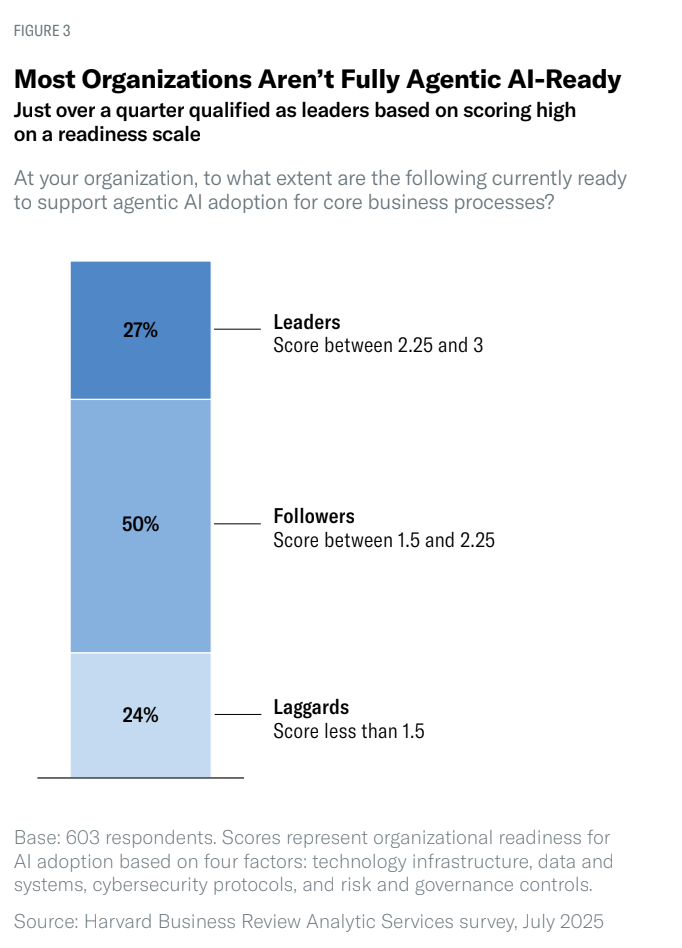
Using a composite readiness index spanning infrastructure, data, cybersecurity, and governance, the report classifies 27% of organizations as “leaders,” 50% as “followers,” and 24% as “laggards.”
Benefits real, but below expectations
Companies adopting agentic AI are already seeing measurable gains, but most have not yet achieved the full benefits they anticipate. Among organizations that have deployed or are piloting agentic AI and report any benefits, realized gains in these areas are lower than expected, though improved productivity, cost reduction, and customer experience still top the list. The data suggests that without robust foundations in data quality, governance, and architecture, organizations risk falling into “garbage in, garbage out” scenarios that erode trust in AI rather than build it.
Security and privacy worries loom largest as barriers to wider adoption. Thirty‑one percent of respondents cite cybersecurity and privacy concerns as a main challenge, followed by anxiety over data output quality (23%), unready business processes (22%), and technology infrastructure limitations (22%). Executives are also grappling with governance, regulatory uncertainty, and potential workforce impacts, reinforcing a tendency to keep AI agents away from customer‑facing or mission‑critical workflows.
In response, many organizations are turning to “enterprise orchestration,” connecting systems, data, and applications into a governed layer that can safely power AI agents at scale. Eight percent say they have already implemented enterprise orchestration in preparation for agentic AI, and 74% are either working on it or planning to do so, with leaders far ahead of laggards. More than 80% view providing connectivity to applications and contextual information from data as very or moderately important outcomes of these orchestration efforts.
Human factor and the road ahead
Beyond technology, the report highlights people and change management as decisive factors in whether AI agents ever move from the edge of the enterprise to its core.
“The change management and reskilling that is going to be required across every company is something I feel has been underestimated,” said Kim Huffman, chief information officer at Workiva.
Forty‑four percent of organizations are prioritizing training or upskilling employees in agentic AI oversight, and 39% are focused on building responsible AI guardrails and governance frameworks. Some companies are designating AI ambassadors and champions in every function to identify use cases and shepherd teams through early pilots.
Even with only 6% of companies expressing full trust in AI agents for core processes today, 72% of respondents say the benefits of agentic AI outweigh the risks, with leaders most confident about that tradeoff.
The study suggests that as enterprises invest in orchestration, governance, and workforce readiness, the trust gap at the center of the business may narrow—and AI agents could move from experimental helpers to trusted stewards of the workflows that define corporate performance.
For this story, Fortune journalists used generative AI as a research tool. An editor verified the accuracy of the information before publishing.