Welcome to Eye on AI, with AI reporter Sharon Goldman. In this edition, a new startup is tackling AI impersonation…legal AI startup Harvey raised $160 million at an $8 billion valuation…VC ‘kingmaking’ is happening earlier than ever with AI startups…Why AI writes like that…Microsoft lowers sales staff’s growth targets for newer AI software.
A year ago, I spoke to several cybersecurity leaders at companies like SoftBank and Mastercard who were already sounding alarms about AI-powered impersonation threats, including deepfakes and voice clones. They warned that fraud would evolve quickly: The first wave of scams were about scammers using deepfakes to pretended to be someone you know. But attackers would soon begin using AI-generated video and audio to impersonate strangers from trusted sources, such as a help-desk rep from your bank or an IT administrator at work.
A year later, this is exactly what’s happening: The Identity Theft Resource Center reported a 148% surge in impersonation scams between April 2024 and March 2025, driven by scammers spinning up fake business websites, deploying lifelike AI chatbots, and generating voice agents that sound indistinguishable from real company representatives. In 2024 alone, the Federal Trade Commission recorded $2.95 billion in losses tied to impersonation scams.
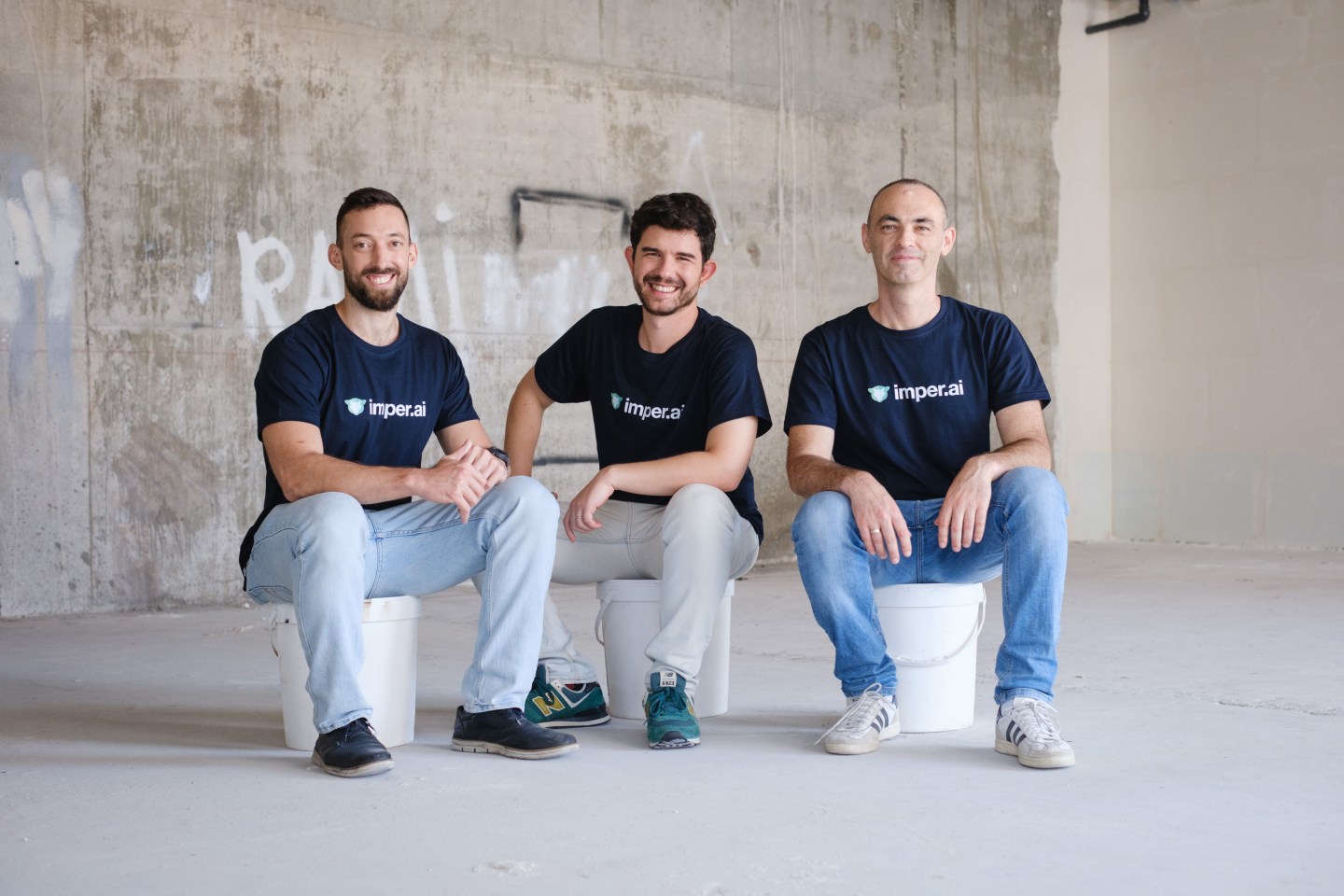
Now, a new startup is stepping directly into the breach. imper.ai aims to stop AI impersonation attacks in real time, and today announced its public launch and $28 million in new funding. Redpoint Ventures and Battery Ventures led the investment round, with participation from Maple VC, Vessy VC, and Cerca Partners.
Instead of trying to spot visual or audio anomalies—an approach that is rapidly becoming almost impossible—imper.ai says it analyzes the digital breadcrumbs attackers can’t fake. These include device telemetry (the background data your device gives off, like location, operating system, hardware details, and network behavior), network diagnostics, and environmental signals. Its platform runs silently across systems including Zoom, Teams, Slack, WhatsApp, Google Workspace, and IT help-desk environments, flagging risky sessions before a human ever gets deceived.
CEO Noam Awadish, a veteran of autonomous-driving pioneer Mobileye and a longtime member of Israel’s 8200 cyberwarfare unit, said AI has supercharged classic social-engineering tactics—the kind of attacks that manipulate people into giving up sensitive information or approving actions that compromise security. Whether through impersonation, fake urgency, or psychological pressure, attackers are increasingly using AI to trick victims into revealing passwords, financial details, or remote access.
A recent example is Jaguar Land Rover. Last month hackers used fake credentials to carry out coordinated phishing and “vishing” (voice-phishing) campaigns impersonating JLR’s IT support staff to harvest credentials and gain access. The attack forced the automaker to shut down critical IT systems and ultimately its production lines, resulting in estimated losses of $1.5 billion so far.
Imper.ai’s founding team of Awadish, along with other 8200 veterans Anatoly Blighovsky and Rom Dudkiewicz, believes their background as both cyber attackers and defenders gives them an edge. “I think that people don’t understand that most of the major breaches start with social engineering,” Awadish told me, adding that AI is a game changer because emails, videos, and voice clones have become almost perfect.
In addition, he pointed out that collaboration tools have multiplied far beyond email and phone calls. Now attackers have dozens of communication tools, and AI lets them generate “spear-phishing” messages (personalized phishing emails) at scale, as well as cloned voices, and deepfake videos at massive speed.
That’s why imper.ai avoids trying to out-detect AI impersonation directly from the AI-generated content itself. “We don’t want to get into an AI arms race,” Awadish said. Instead, the startup focuses on what attackers cannot fake—mostly metadata.
As the company’s traction has accelerated, so has investor interest. “We want to build a platform that safeguards the entire communication space,” Awadish said. “ It’s not something small, it’s not like a plugin that one of the giants is going to build.” With the new funding, he said that the company can double its R&D headcount and triple its go-to-market organization in the US.
“At the moment, there is really high traction, so we need to keep up with the pace, so we need to grow,” he said.
Note: I am super-excited to be headed to San Francisco for Fortune Brainstorm AI on Monday and Tuesday! I’ll be interviewing Prakhar Mehrotra, SVP and global head of AI at PayPal, and Marc Hamilton, VP of solutions architecture and engineering at Nvidia, on the main stage. I’ll also be moderating a spicy roundtable session all about AI data centers. Plus, I’m looking forward to seeing some of the other speakers, including actor Joseph Gordon-Levitt, OpenAI COO Brad Lightcap, and Ali Ghodsi, CEO of Databricks.
And with that, here’s more AI news.
Sharon Goldman
sharon.goldman@fortune.com
@sharongoldman
FORTUNE ON AI
Microsoft AI wants all its employees to be AI-native by the end of the fiscal year, says VP of design Liz Danzico–by Angelica Ang
China’s ByteDance could be forced to sell TikTok U.S., but its quiet lead in AI will help it survive—and maybe even thrive–by Nicholas Gordon
Anthropic considers IPO despite warnings that excess liquidity is blowing a bubble in the markets–by Jim Edwards
Sam Altman declares ‘Code Red’ as Google’s Gemini surges—three years after ChatGPT caused Google CEO Sundar Pichai to do the same–by Sharon Goldman
AI IN THE NEWS
OpenAI to acquire experiment-tracking startup. In blog post today, OpenAI announced is acquiring experiment-tracking startup neptune.ai in a bid to deepen its training infrastructure and speed up frontier model development. Neptune’s tools give researchers real-time visibility into how models learn—letting them monitor runs, compare thousands of experiments, analyze metrics across layers, and spot issues faster. OpenAI Chief Scientist Jakub Pachocki said the system will be integrated directly into the company’s training stack to expand insight into complex training workflows. The move underscores OpenAI’s push to tighten its internal tooling as it races to iterate on increasingly large and sophisticated models.
Legal AI startup Harvey raises $160 million at an $8 billion valuation. Harvey, one of the fastest-rising startups in the AI legal-tech boom, just raised $160 million at an $8 billion valuation, according to the New York Times. This more than doubles its valuation since February and brings its total funding this year to roughly $760 million. The four-year-old company, already used by about half of the Am Law 100, builds AI assistants that help lawyers draft and review documents, answer case-law questions, and automate routine workflows. The round was led by Andreessen Horowitz with participation from T. Rowe Price, WndrCo, Sequoia, Kleiner Perkins, and others, and signals that investor enthusiasm for AI tools built for white-collar professionals remains intense even as broader tech markets wobble.
VC 'kingmaking' is happening earlier than ever with AI startups. AI ERP startup DualEntry raised a $90 million Series A at a $415 million valuation—despite being just a year old—as Lightspeed and Khosla Ventures bet that a next-generation replacement for legacy systems like Oracle NetSuite can scale fast. But according to TechCrunch, the size of the round has revived questions about “kingmaking,” the increasingly common VC tactic of pouring huge sums into a single early-stage company to manufacture category dominance. While one investor told TechCrunch that DualEntry had only around $400,000 in ARR last summer—a figure the company disputes—the aggressive funding mirrors a broader shift: venture firms are picking winners earlier than ever.
Why does AI write like that? I definitely wanted to shout out this (long) essay in the New York Times that is well worth a read. It argues that AI-generated writing has quietly become the dominant voice of the internet—shaping everything from student essays to political statements—with its now-familiar mix of em dashes, ghostly metaphors, triplets, and overpolished sincerity. What’s unsettling, the author writes, isn’t just that AI prose is everywhere, but that humans are starting to unconsciously imitate it, creating a feedback loop where machine-bred language becomes the default cultural tone. Personally, I had heard about how AI chatbots love the word "delve," but not that they love ghostly words and all things "quiet": "Everything is a shadow, or a memory, or a whisper. They also love quietness. For no obvious reason, and often against the logic of a narrative, they will describe things as being quiet, or softly humming."
Microsoft lowers sales staff’s growth targets for newer AI software. Like every other Big Tech company, Microsoft spent much of 2025 loudly touting AI agents as the next big leap in enterprise automation, but as the year ends the company is quietly dialing back expectations, according to new reporting from The Information. After multiple sales teams missed aggressive growth targets, Microsoft has relaxed quotas for certain AI products—an unusually public acknowledgment that traditional enterprises are still hesitant to pay for advanced automation. Customers say the ROI remains hard to measure and the tech too error-prone for high-stakes workflows like finance and cybersecurity. While AI has been a major boon to Microsoft’s cloud business—thanks largely to massive spending from OpenAI and strong demand for tools like Microsoft 365 Copilot and GitHub Copilot—getting mainstream companies to significantly increase their AI budgets is proving far tougher than selling to AI labs.
AI CALENDAR
Dec. 2-7: NeurIPS, San Diego.
Dec. 8-9: Fortune Brainstorm AI San Francisco. Apply to attend here.
Jan. 7-10: Consumer Electronics Show, Las Vegas.
March 12-18: SWSW, Austin.
March 16-19: Nvidia GTC, San Jose.
April 6-9: HumanX, San Francisco.
EYE ON AI NUMBERS
221 Million
That's how many YouTube users subscribe to so-called "AI slop" channels, or those posting mostly AI-generated content, according to a new report from cloud-based video editing platform Kapwing.
- The U.S.-based "AI slop" channel Cuentos Facinates has the most subscribers globally (5.95M).
- Spain has eight such channels in their top 100 trending channels with a combined 20.22M subscribers, the most of any country.
- These channels get the most views in South Korea (8.45B views across 11 trending channels).
- India is home to the most-viewed "AI slop" channel, Bandar Apna Dost, with 2.07B views and an estimated $4.25M in annual earnings.