
• Home
  • Latest
  • Fortune 500
  • Finance
  • Tech
  • Leadership
  • Lifestyle
  • Rankings
  • Multimedia
RetailRetail

‘There’s only so much you can absorb from the tariffs, because they’re just very high’: Levi’s CEO states the plain truth

Nick Lichtenberg
By
Nick Lichtenberg
Nick Lichtenberg
Business Editor
Down Arrow Button Icon
Nick Lichtenberg
By
Nick Lichtenberg
Nick Lichtenberg
Business Editor
Down Arrow Button Icon
November 24, 2025, 2:41 PM ET
Michelle Gass
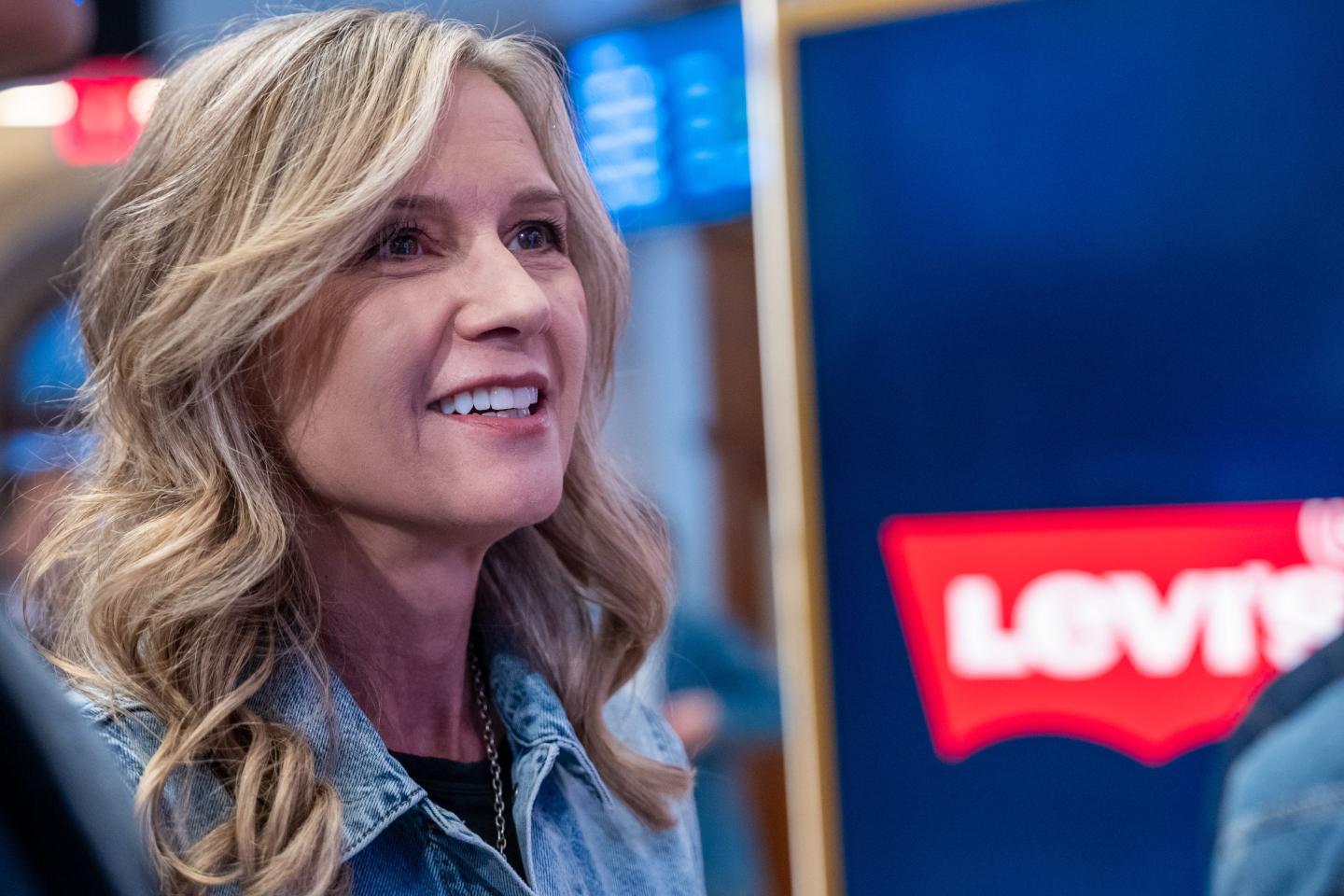
Levi Strauss CEO Michelle Gass on the floor of the New York Stock Exchange during a Levi’s listing event on April 5, 2024, in New York City. Spencer Platt/Getty Images

The global fashion industry is bracing for 2026, navigating a market defined by geopolitical instability, macroeconomic uncertainty, and, above all, unprecedented U.S. tariffs. As leaders pivot from focusing on “uncertainty” to acknowledging the environment is simply “challenging,” tariffs have emerged as the number one hurdle facing executives.

Recommended Video

The severity of the trade landscape cannot be overstated, executives told McKinsey and the Business of Fashion for the 2026 edition of The State of Fashion report. U.S. tariffs on apparel and footwear imports, which had been around 13% earlier in 2025, dramatically spiked to 54% following initial government announcements in April. Although rates later eased, the weighted average tariff rate for apparel and footwear from the top 10 importers stood at 36% as of mid-October, well above historical norms. This sudden surge places the apparel and footwear industry among those most exposed to the tariffs’ profound impacts. Reflecting this critical situation, 76% of fashion executives surveyed believe responses to trade disruptions and tariffs will be the single most important factor shaping the industry in 2026.

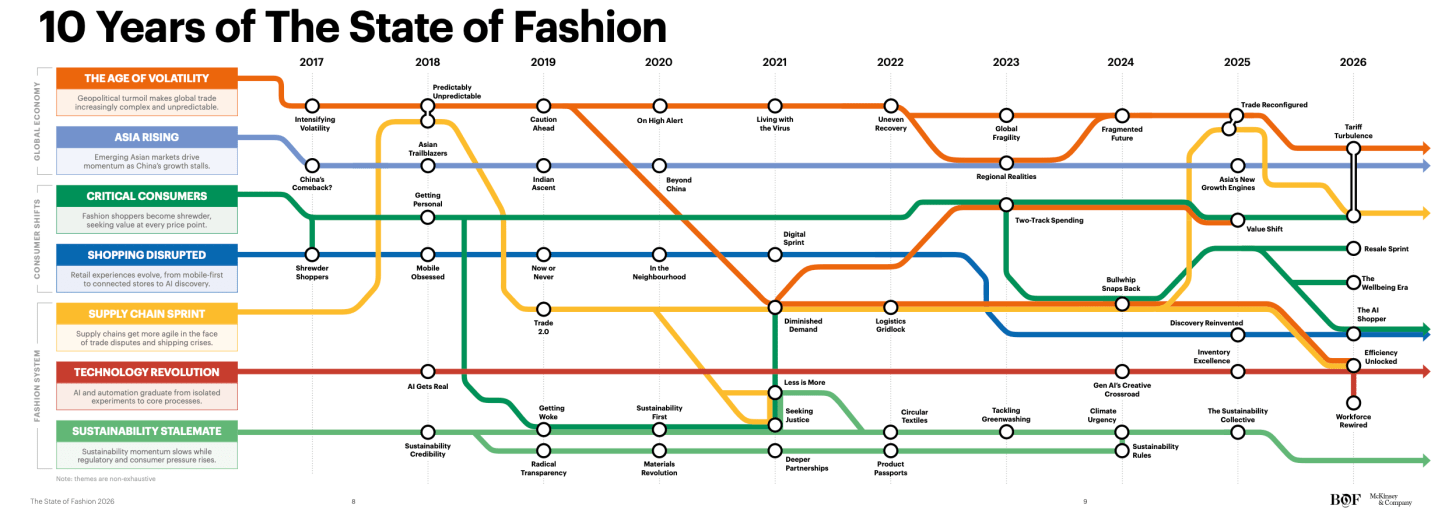
For the 10th anniversary of the report, which began in 2016, McKinsey and Business of Fashion charted the many changes for the industry since 2016, from a generalized “age of volatility” to Asia’s undeniable rise to disruptions in how shoppers shop. For 2026, they chart major issues, including “tariff turbulence” and three emergent shopper appetites: a focus on resale, a sense of “well-being” in their purchases, and a future marked by artificial intelligence (AI).
The report finds brands making price changes, shifting sourcing, and improving efficiency in a bid to counteract the impact of tariffs. Larger suppliers are responding by optimizing their footprints while chasing digitization and automation, and smaller players, meanwhile, are under mounting pressure. “Agility will be the defining factor enabling brands and suppliers to maintain their competitive edge.” Amid this economic disruption, Levi Strauss CEO Michelle Gass spoke to Joan Kennedy of Business of Fashion about how she’s adopted an aggressive and methodical tariff playbook, positioning the 170-year-old denim giant as a standout in managing the chaos.

Levi’s advantage, and painful truth

Crucially, Levi’s entered this period with a structural advantage: Approximately 60% of its business is international, reducing the tariff burden compared to many domestic competitors who are more heavily penetrated in the U.S. Yet, even with this advantage, the tariff increases demanded strategic action. Gass described the overall environment as “very complex,” encompassing macroeconomic forces, geopolitical issues, and massive disruption in technology and AI, and she articulated the necessary, unavoidable reality of passing some costs on to the consumer, stating plainly: “There’s only so much you can absorb from the tariffs, because they’re just very high.”

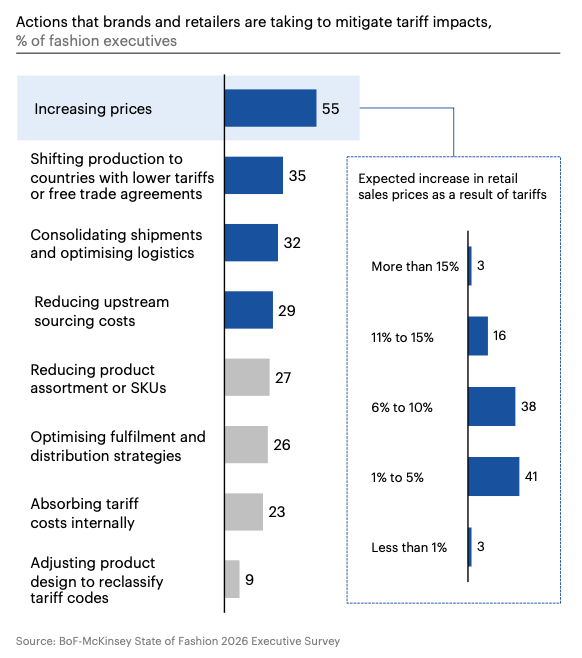
Levi’s approach to pricing is multifaceted: First, targeted and surgical pricing increases are being implemented, a measure also being taken by most apparel retailers (55% of executives expect further price increases in 2026 in response to tariffs). Second, the company is utilizing promotional levers, specifically pulling back on discounts such as “20% off” events, which helps elevate the brand and mitigate tariff impact by improving margins. Third, the company is pricing for innovation, leveraging new products where consumers are “likely willing to pay more.”

Levi’s did not respond to Fortune’s request for comment on more specifics about pricing increases to come.
Beyond pricing, Levi’s has prioritized internal operational prowess. Gass, who took over as CEO in 2024, has been driving a course correction focused on transformation, streamlining the business and reducing unwieldy inventory. Tactical moves included cutting slower-selling SKUs. More significantly, the company is undergoing a fundamental “rewiring” to reduce complexity across its network of 120 countries. By increasing the commonality of product across all global stores from less than 10% to about 40%, Levi’s is generating efficiencies across design, sourcing, and merchandising. As Gass summarizes this strategy: “We’re operating in a complex environment, but we ourselves are becoming less complex.”

This disciplined approach has delivered results. Levi’s reported a 7% year-on-year increase in quarterly sales in October 2025, posting its fourth consecutive quarter of high-single-digit growth. The company also raised its full-year revenue outlook, even as it cautioned that tariffs would impact margins in the fourth quarter.

The industry overall is adapting to the new trade map, with 35% of executives planning to shift sourcing to markets with more favorable trade agreements. However, Levi’s emphasizes that in a volatile trade environment, agility depends heavily on strategic supplier partnerships built on collaboration. Gass noted that Levi’s teams talk to vendors 24/7, treating it as a “relationship business” where sourcing from multiple countries offers crucial flexibility against tariffs and supply-chain disruptions.

The Fortune 500 Innovation Forum will convene Fortune 500 executives, U.S. policy officials, top founders, and thought leaders to help define what’s next for the American economy, Nov. 16-17 in Detroit. Apply here.
About the Author
Nick Lichtenberg
By Nick LichtenbergBusiness Editor
LinkedIn icon

Nick Lichtenberg is business editor and was formerly Fortune's executive editor of global news.

See full bioRight Arrow Button Icon

Latest in Retail

Finance
Lorem ipsum dolor sit amet, consectetur adipiscing elit, sed do eiusmod tempor incididunt ut labore et dolore magna aliqua. Ut enim ad minim veniam
By Fortune Editors
October 20, 2025
Finance
Lorem ipsum dolor sit amet, consectetur adipiscing elit, sed do eiusmod tempor incididunt ut labore et dolore magna aliqua. Ut enim ad minim veniam
By Fortune Editors
October 20, 2025
Finance
Lorem ipsum dolor sit amet, consectetur adipiscing elit, sed do eiusmod tempor incididunt ut labore et dolore magna aliqua. Ut enim ad minim veniam
By Fortune Editors
October 20, 2025
Finance
Lorem ipsum dolor sit amet, consectetur adipiscing elit, sed do eiusmod tempor incididunt ut labore et dolore magna aliqua. Ut enim ad minim veniam
By Fortune Editors
October 20, 2025
Finance
Lorem ipsum dolor sit amet, consectetur adipiscing elit, sed do eiusmod tempor incididunt ut labore et dolore magna aliqua. Ut enim ad minim veniam
By Fortune Editors
October 20, 2025
Finance
Lorem ipsum dolor sit amet, consectetur adipiscing elit, sed do eiusmod tempor incididunt ut labore et dolore magna aliqua. Ut enim ad minim veniam
By Fortune Editors
October 20, 2025

Most Popular

Finance
Lorem ipsum dolor sit amet, consectetur adipiscing elit, sed do eiusmod tempor incididunt ut labore et dolore magna aliqua. Ut enim ad minim veniam
By Fortune Editors
October 20, 2025
Finance
Lorem ipsum dolor sit amet, consectetur adipiscing elit, sed do eiusmod tempor incididunt ut labore et dolore magna aliqua. Ut enim ad minim veniam
By Fortune Editors
October 20, 2025
Finance
Lorem ipsum dolor sit amet, consectetur adipiscing elit, sed do eiusmod tempor incididunt ut labore et dolore magna aliqua. Ut enim ad minim veniam
By Fortune Editors
October 20, 2025
Finance
Lorem ipsum dolor sit amet, consectetur adipiscing elit, sed do eiusmod tempor incididunt ut labore et dolore magna aliqua. Ut enim ad minim veniam
By Fortune Editors
October 20, 2025
Finance
Lorem ipsum dolor sit amet, consectetur adipiscing elit, sed do eiusmod tempor incididunt ut labore et dolore magna aliqua. Ut enim ad minim veniam
By Fortune Editors
October 20, 2025
Finance
Lorem ipsum dolor sit amet, consectetur adipiscing elit, sed do eiusmod tempor incididunt ut labore et dolore magna aliqua. Ut enim ad minim veniam
By Fortune Editors
October 20, 2025
Fortune Secondary Logo
Rankings
  • 100 Best Companies
  • Fortune 500
  • Global 500
  • Fortune 500 Europe
  • Most Powerful Women
  • World's Most Admired Companies
  • See All Rankings
  • Lists Calendar
Sections
  • Finance
  • Fortune Crypto
  • Features
  • Leadership
  • Health
  • Commentary
  • Success
  • Retail
  • Mpw
  • Tech
  • Lifestyle
  • CEO Initiative
  • Asia
  • Politics
  • Conferences
  • Europe
  • Newsletters
  • Personal Finance
  • Environment
  • Magazine
  • Education
Customer Support
  • Frequently Asked Questions
  • Customer Service Portal
  • Privacy Policy
  • Terms Of Use
  • Single Issues For Purchase
  • International Print
Commercial Services
  • Advertising
  • Fortune Brand Studio
  • Fortune Analytics
  • Fortune Conferences
  • Business Development
  • Group Subscriptions
About Us
  • About Us
  • Press Center
  • Work At Fortune
  • Terms And Conditions
  • Site Map
  • About Us
  • Press Center
  • Work At Fortune
  • Terms And Conditions
  • Site Map
  • Facebook icon
  • Twitter icon
  • LinkedIn icon
  • Instagram icon
  • Pinterest icon

Latest in Retail

Vincent Clerc speaks in front of a picture of a port.
EnergyShipping
The CEO of Maersk, which ships 14% of everything you buy, said the Iran war is adding $500 million in monthly costs it’s trying not to pass down
By Sasha RogelbergMay 8, 2026
2 hours ago
Tapestry thinks it’s cracked the code of ‘expressive luxury’ for Gen Z: a ‘Goldilocks’ combo of aspirational and approachable
Investingearnings
Tapestry thinks it’s cracked the code of ‘expressive luxury’ for Gen Z: a ‘Goldilocks’ combo of aspirational and approachable
By Nick LichtenbergMay 7, 2026
22 hours ago
eBay bans GameStop CEO’s account after he started listing store signs and old carpets to fund his $56 billion offer to buy the marketplace
C-SuiteGameStop
eBay bans GameStop CEO’s account after he started listing store signs and old carpets to fund his $56 billion offer to buy the marketplace
By Marco Quiroz-GutierrezMay 7, 2026
1 day ago
‘Blue dot fever’ plagues musicians like Post Malone, Meghan Trainor, and Zayn as a growing list of artists cancel tours due to lagging ticket sales
Arts & EntertainmentMusic
‘Blue dot fever’ plagues musicians like Post Malone, Meghan Trainor, and Zayn as a growing list of artists cancel tours due to lagging ticket sales
By Dave Lozo and Morning BrewMay 7, 2026
1 day ago
Two Americas, one drive-thru: Welcome to fast food’s contradictory, split-screen economy
EconomyMcDonald's
Two Americas, one drive-thru: Welcome to fast food’s contradictory, split-screen economy
By Nick LichtenbergMay 7, 2026
1 day ago
people watching tv
Arts & EntertainmentGen Z
Gen Z just broke the streaming model: A majority subscribe, binge, and cancel over and over, study finds
By Jake AngeloMay 7, 2026
1 day ago

Most Popular

California farmers must destroy 420,000 peach trees after Del Monte closes its canneries and cancels more than $550 million in long-term contracts
North America
California farmers must destroy 420,000 peach trees after Del Monte closes its canneries and cancels more than $550 million in long-term contracts
By Sasha RogelbergMay 7, 2026
23 hours ago
'Blue dot fever' plagues musicians like Post Malone, Meghan Trainor, and Zayn as a growing list of artists cancel tours due to lagging ticket sales
Arts & Entertainment
'Blue dot fever' plagues musicians like Post Malone, Meghan Trainor, and Zayn as a growing list of artists cancel tours due to lagging ticket sales
By Dave Lozo and Morning BrewMay 7, 2026
1 day ago
U.S. Treasury will have to borrow $2 trillion this year just to continue functioning—more than $166 billion every month
Economy
U.S. Treasury will have to borrow $2 trillion this year just to continue functioning—more than $166 billion every month
By Eleanor PringleMay 7, 2026
1 day ago
A Michigan farm town voted down plans for a giant OpenAI-Oracle data center. Weeks later, construction began
Magazine
A Michigan farm town voted down plans for a giant OpenAI-Oracle data center. Weeks later, construction began
By Sharon GoldmanMay 6, 2026
3 days ago
Airbnb CEO Brian Chesky warns two types of people won’t survive the AI era: ‘pure people managers’ and workers who resist change
Success
Airbnb CEO Brian Chesky warns two types of people won’t survive the AI era: ‘pure people managers’ and workers who resist change
By Emma BurleighMay 7, 2026
1 day ago
Current price of oil as of May 7, 2026
Personal Finance
Current price of oil as of May 7, 2026
By Joseph HostetlerMay 7, 2026
1 day ago

© 2026 Fortune Media IP Limited. All Rights Reserved. Use of this site constitutes acceptance of our Terms of Use and Privacy Policy | CA Notice at Collection and Privacy Notice | Do Not Sell/Share My Personal Information
FORTUNE is a trademark of Fortune Media IP Limited, registered in the U.S. and other countries. FORTUNE may receive compensation for some links to products and services on this website. Offers may be subject to change without notice.