The reporting this week that the Trump administration is moving to craft an executive order potentially limiting the power of proxy advisory firms such as ISS and Glass Lewis, along with the reported FTC investigation into whether these firms have violated antitrust laws, should be celebrated across the political spectrum. As longtime corporate governance scholars, we believe these moves are not only correct but long overdue.
For decades, far before it became popular to do so, the first author has been vocally questioning the credibility of proxy advisory firms. And he’s not alone. As Jamie Dimon incisively warned in his recent shareholder letter, “it is increasingly clear that proxy advisers have undue influence….many companies would argue that their information is frequently not balanced, not representative of the full view, and not accurate.”
Similarly, Elon Musk blasted ISS and Glass Lewis as “corporate terrorists” after the proxy advisers attempted to usurp voting power rightfully belonging to the shareholders. Regardless of how you feel about the $1 trillion pay package that was up for shareholder approval at that time, it was noteworthy that shareholders overwhelmingly joined Musk in repudiating the proxy advisers, showing how ineffectual and problematic the proxy advisers can be. We would not use the term “terrorist,” nor would we call them “extortionist,” but we would go so far as to say that “some might say it resembles an extortion scheme!”
Here are some of the primary reasons I’ve identified and trumpeted over decades for why the proxy advisory firms are problematic:
- Rampant conflicts of interest: as the first author wrote in the Wall Street Journal in 2003, “some of the governance ratings agencies look dodgier than the companies they watchdog,” pointing out that these same ratings firms are trying to hawk consulting services to companies whose proposals they also rate, creating at least some appearance of pay to play. “This starts to resemble the protection schemes of bullies or the conflicts of auditors/consultants which governance gurus decry,” the first author wrote. “ISS directly sells advice to the institutional investors on voting their proxies while at the same time it sells advice to management on how to protect itself from these investors’ proxies.”
- Outdated checklist approach reflecting superstition not fact: the proxy advisory firms are staffed by inexperienced staffers lacking governance experience or expertise, who work off unthinking checklists of highly stringent standards, even though many criteria reflect superstition rather than fact. Such key scoring dimensions as limiting CEO/director tenure; implementing a formal retirement age, or mandating the separation of the chair/CEO have little basis in empirical fact. If anything, some of the most prominent corporate scandals over the past few decades, from Enron to Worldcom to Tyco, scored highly on these spurious checklists – reflecting just how useless they really are in capturing good vs. bad governance. Ironically, sometimes it is the proxy advisers themselves who are guilty of misconduct; for example, the influential ISS analyst who recommended HP’s disastrous merger with Compaq was later found to have falsified their own credentials.
- Rampant factual errors: I have been vocal in repeatedly calling out instances where the work of proxy advisory firms is so sloppy that they contain basic factual errors – which can be sadly, hugely consequential. For example, at the peak of Disney’s heated proxy fight with Nelson Peltz, I called out how one major proxy advisory firm egregiously miscalculated CEO Bob Iger’s stock performance, accidentally attributing successor Bob Chapek’s underperformance to Iger. Similarly, ISS blamed Disney for not bringing a specific individual (Mason Morfit of ValueAct) onto the board — even though that individual has repeatedly disclaimed, publicly and privately, any interest in serving on the board.
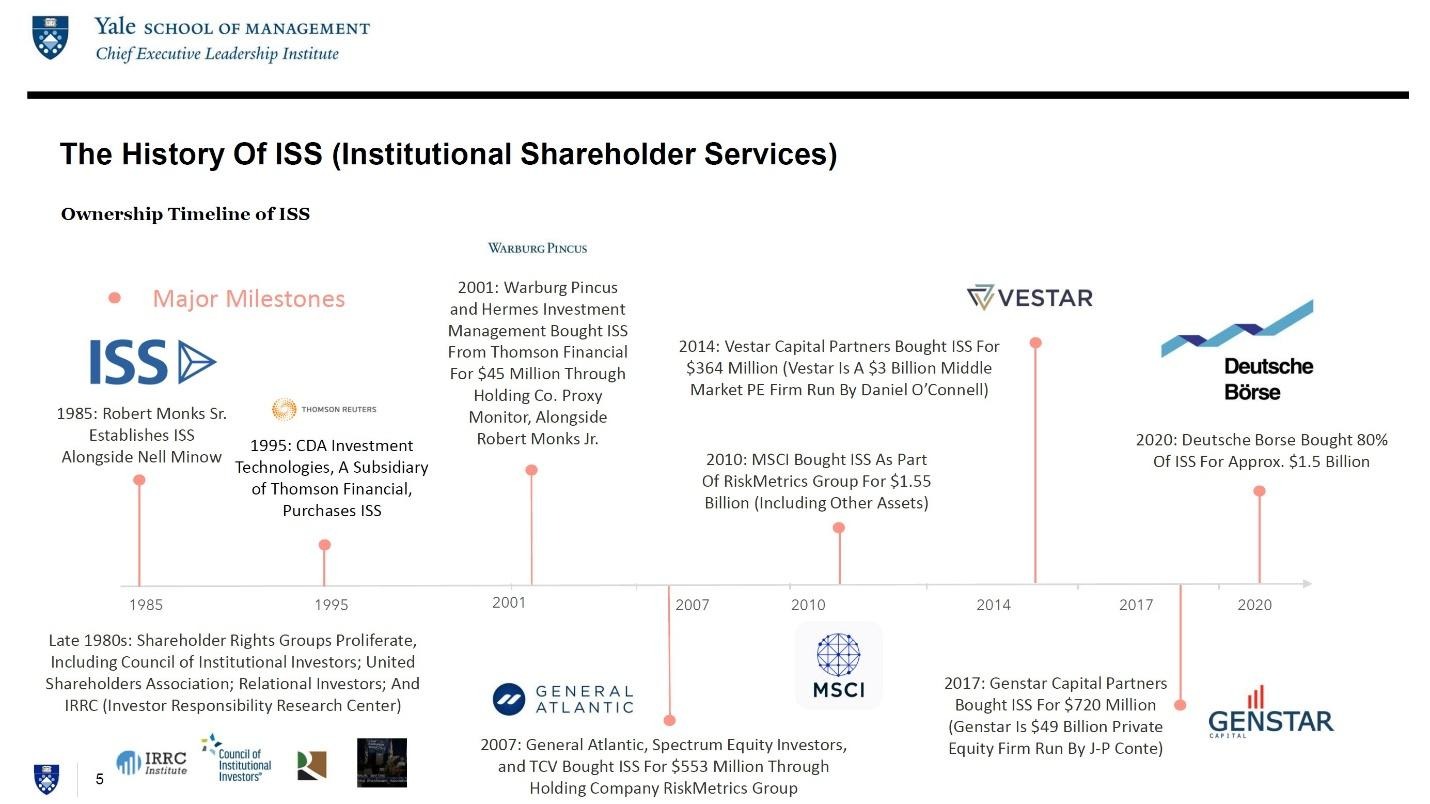
The proxy advisory firms haven’t always been all bad. The genuine, original proxy advisors, such as Nell Minow and Bob Monks, who co-founded ISS, and Ralph Whitworth of Relational Investors, pioneered the proxy advisory concept in the 1980s alongside peer shareholder rights groups such as The Council of Institutional Investors, United Shareholders Association, and the Investor Responsibility Research Center. They were at the forefront of a virtuous and necessary movement in corporate governance, bringing accountability, transparency, and shareholder value to the forefront while exposing and ending rampant corporate misconduct, cronyism and excess.
But over time, they themselves have been overtaken by misconduct, cronyism, and excess, especially after the leading proxy advisory firms continually traded hands between a rotating cast of conflicted foreign buyers and private equity firms. ISS alone traded hands no less than eight times in the last three decades; one wonders how these proxy advisory firms are supposed to be evaluating long-term value for shareholders when their own governance seems to be a bad cross between musical chairs and hot potato.
For too long, these proxy advisors have been a scourge in the corporate governance landscape, and the Trump administration deserves credit from across the political spectrum for acting on this critical challenge.
The opinions expressed in Fortune.com commentary pieces are solely the views of their authors and do not necessarily reflect the opinions and beliefs of Fortune.