• Home
  • Latest
  • Fortune 500
  • Finance
  • Tech
  • Leadership
  • Lifestyle
  • Rankings
  • Multimedia
Commentary

AI’s hidden recession: How fewer jobs and cultural backlash create a governance crisis

By
Jane Sadowsky
Jane Sadowsky
Down Arrow Button Icon
By
Jane Sadowsky
Jane Sadowsky
Down Arrow Button Icon
November 8, 2025, 9:15 AM ET
Altman
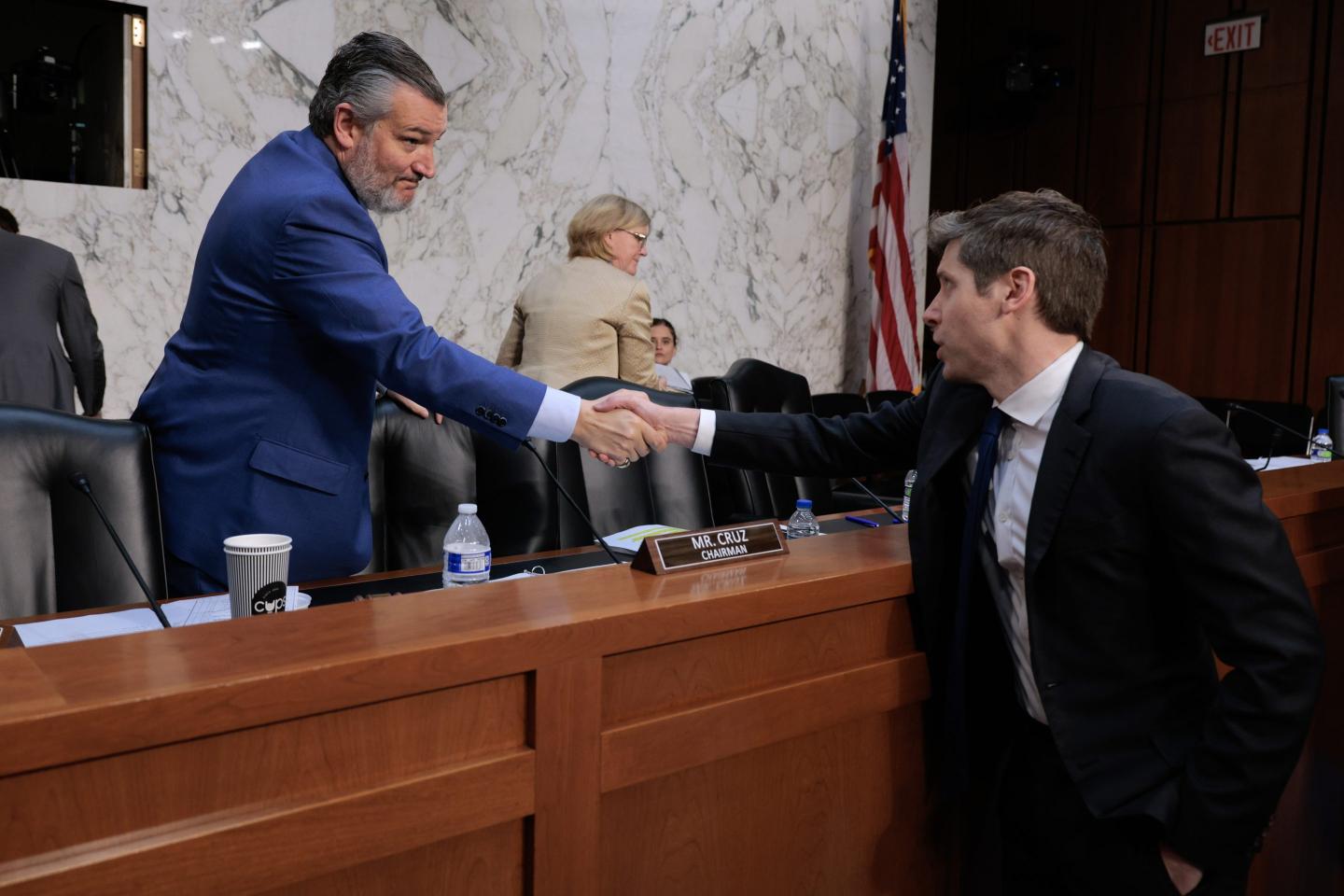
Senate Committee on Commerce, Science, and Transportation Chair Ted Cruz (R-TX) shakes hands with OpenAI CEO Sam Altman following a hearing in the Hart Senate Office Building on Capitol Hill on May 08, 2025 in Washington, DC. Chip Somodevilla/Getty Images

Artificial intelligence is reshaping work faster than policy or leadership can adapt. U.S.  companies report record productivity, yet payrolls barely rise. Goldman Sachs estimates  that AI automation could affect the equivalent of 300 million full-time jobs worldwide.  Investors are cheering the efficiency. But history suggests that when work becomes scarce,  societies ration opportunity, and women often pay the price. 

Recommended Video

The pattern is familiar. During the Great Depression, dozens of U.S. states and school districts enacted “marriage bars,” policies that barred married women from employment or  forced them to resign upon marriage, claiming to “protect” male breadwinners. After World War II, governments closed wartime child-care centers and urged women out of factories  so returning soldiers could reclaim work. In post-war Japan and Australia, the “male breadwinner compact” guaranteed men lifetime jobs while women were steered into part time work or unpaid care. Each policy was framed as moral restoration; each was  economic triage. 

AI may now drive a similar re-ordering. “Headcount-light” companies can scale output  without adding workers. Knowledge-based roles once thought immune to automation:  legal research, accounting, customer service and the like, are being rewritten by software.  For many displaced workers, especially mid-career professionals, retraining programs  rarely keep pace with technology’s curve. 

As the labor market polarizes, some voices are recasting gender equity itself as a problem. A recent essay by commentator Helen Andrews titled “Overcoming the Feminization of  Culture,” has drawn unusual attention. Andrews argues that the growing presence of  women in professional and public life has made society “empathic rather than rational”  and “risk-averse rather than competitive,” and that this “feminization” represents a potential threat to civilization itself. According to The New York Times, as of October 23, her speech had been viewed more than 175,000 times. Her argument resonates precisely because economic anxiety seeks moral explanation. History shows that when structural change threatens status, nostalgia for hierarchy often masquerades as rational analysis.

An economic paradox

The economic paradox is clear. In the short term, investors may reward companies that grow without hiring. But long-term prosperity depends on broad participation in income and consumption. According to the International Monetary Fund, raising women’s labor force participation to men’s levels could expand GDP by up to 35% in some  economies. Conversely, excluding women, or any large group of workers, shrinks markets, innovation, and resilience. 

Governments under fiscal strain are simultaneously cutting social supports such as child care subsidies and workforce training. If job losses accelerate, the temptation to frame  gender regression as cultural renewal will rise. But excluding women from paid work  doesn’t just shrink the labor force, it also makes it older. 

In most advanced economies, women now supply the bulk of new labor-force entrants in  the 25-to-54 age group, the very cohort that offsets aging among men. When women step  back or are pushed out, the pipeline of prime-age talent contracts even as older men delay  retirement. The result is a workforce that is smaller, less dynamic, and aging faster,  precisely when adaptation to technological change requires the opposite. 

For boards and investors, this is not a social-policy sidebar; it is a core governance issue.  Directors should press management to quantify how AI will change headcount, skill mix,  and pay equity over the next five years. They should examine whether algorithmic HR tools  introduce hidden bias or legal exposure and ensure that human-capital disclosures explain  how automation affects opportunity by gender and age. Insurers and lenders are already  incorporating these factors into risk models. 

The larger question is one of social license. Companies cannot thrive indefinitely in  economies that cannot sustain full employment. A short-term efficiency story can quickly  become a long-term demand problem, and, if gender backlash gains political traction, a  reputational one. 

When societies fear obsolescence, they often seek order through exclusion. The impulse is  as old as industrialization itself: when technology or globalization threatens the familiar,  institutions reassert hierarchy to restore a sense of stability. Schools once pushed girls out  of science when jobs were scarce; factories barred women from higher-paying trades to  protect male employment; companies in the 1980s celebrated “decisive” and “tough”  leadership as automation hollowed out middle management. Each response framed  exclusion as virtue: efficiency, morality, or merit, but all served the same purpose: to make  uncertainty feel orderly. 

Thus we have seen it before, in classrooms, factories, and corporate hierarchies. The  technology has changed; the instinct has not.

AI will redefine how humans create value. Whether it also redefines who is allowed to create value will depend on the choices leaders make now. 

Efficiency can make a company stronger and a society brittle at the same time. What we  choose to optimize will tell us what kind of future we deserve.

The opinions expressed in Fortune.com commentary pieces are solely the views of their authors and do not necessarily reflect the opinions and beliefs of Fortune.

Join us at the Fortune Workplace Innovation Summit May 19–20, 2026, in Atlanta. The next era of workplace innovation is here—and the old playbook is being rewritten. At this exclusive, high-energy event, the world’s most innovative leaders will convene to explore how AI, humanity, and strategy converge to redefine, again, the future of work. Register now.
About the Author
By Jane Sadowsky
See full bioRight Arrow Button Icon

Latest in Commentary

Finance
Lorem ipsum dolor sit amet, consectetur adipiscing elit, sed do eiusmod tempor incididunt ut labore et dolore magna aliqua. Ut enim ad minim veniam
By Fortune Editors
October 20, 2025
Finance
Lorem ipsum dolor sit amet, consectetur adipiscing elit, sed do eiusmod tempor incididunt ut labore et dolore magna aliqua. Ut enim ad minim veniam
By Fortune Editors
October 20, 2025
Finance
Lorem ipsum dolor sit amet, consectetur adipiscing elit, sed do eiusmod tempor incididunt ut labore et dolore magna aliqua. Ut enim ad minim veniam
By Fortune Editors
October 20, 2025
Finance
Lorem ipsum dolor sit amet, consectetur adipiscing elit, sed do eiusmod tempor incididunt ut labore et dolore magna aliqua. Ut enim ad minim veniam
By Fortune Editors
October 20, 2025
Finance
Lorem ipsum dolor sit amet, consectetur adipiscing elit, sed do eiusmod tempor incididunt ut labore et dolore magna aliqua. Ut enim ad minim veniam
By Fortune Editors
October 20, 2025
Finance
Lorem ipsum dolor sit amet, consectetur adipiscing elit, sed do eiusmod tempor incididunt ut labore et dolore magna aliqua. Ut enim ad minim veniam
By Fortune Editors
October 20, 2025

Most Popular

Finance
Lorem ipsum dolor sit amet, consectetur adipiscing elit, sed do eiusmod tempor incididunt ut labore et dolore magna aliqua. Ut enim ad minim veniam
By Fortune Editors
October 20, 2025
Finance
Lorem ipsum dolor sit amet, consectetur adipiscing elit, sed do eiusmod tempor incididunt ut labore et dolore magna aliqua. Ut enim ad minim veniam
By Fortune Editors
October 20, 2025
Finance
Lorem ipsum dolor sit amet, consectetur adipiscing elit, sed do eiusmod tempor incididunt ut labore et dolore magna aliqua. Ut enim ad minim veniam
By Fortune Editors
October 20, 2025
Finance
Lorem ipsum dolor sit amet, consectetur adipiscing elit, sed do eiusmod tempor incididunt ut labore et dolore magna aliqua. Ut enim ad minim veniam
By Fortune Editors
October 20, 2025
Finance
Lorem ipsum dolor sit amet, consectetur adipiscing elit, sed do eiusmod tempor incididunt ut labore et dolore magna aliqua. Ut enim ad minim veniam
By Fortune Editors
October 20, 2025
Finance
Lorem ipsum dolor sit amet, consectetur adipiscing elit, sed do eiusmod tempor incididunt ut labore et dolore magna aliqua. Ut enim ad minim veniam
By Fortune Editors
October 20, 2025
Fortune Secondary Logo
Rankings
  • 100 Best Companies
  • Fortune 500
  • Global 500
  • Fortune 500 Europe
  • Most Powerful Women
  • World's Most Admired Companies
  • See All Rankings
  • Lists Calendar
Sections
  • Finance
  • Fortune Crypto
  • Features
  • Leadership
  • Health
  • Commentary
  • Success
  • Retail
  • Mpw
  • Tech
  • Lifestyle
  • CEO Initiative
  • Asia
  • Politics
  • Conferences
  • Europe
  • Newsletters
  • Personal Finance
  • Environment
  • Magazine
  • Education
Customer Support
  • Frequently Asked Questions
  • Customer Service Portal
  • Privacy Policy
  • Terms Of Use
  • Single Issues For Purchase
  • International Print
Commercial Services
  • Advertising
  • Fortune Brand Studio
  • Fortune Analytics
  • Fortune Conferences
  • Business Development
  • Group Subscriptions
About Us
  • About Us
  • Press Center
  • Work At Fortune
  • Terms And Conditions
  • Site Map
  • About Us
  • Press Center
  • Work At Fortune
  • Terms And Conditions
  • Site Map
  • Facebook icon
  • Twitter icon
  • LinkedIn icon
  • Instagram icon
  • Pinterest icon

Jane Sadowsky has served as an independent director on corporate and non-profit boards for more than a decade and currently serves on three global boards: two NYSE-listed mining companies, Allied Gold (AAUC) and Nexa Resources (NEXA) and one PE-backed gaming technology company, Scientific Games,  as well as two non-profit boards: NACD NY Chapter and Art Omi. She retired from a career in investment banking as a Senior Managing Director and head of the Power & Utility Group for Evercore Partners and is currently a Senior Advisor at Moelis & Co. Jane also coaches executives both inside Moelis and externally and started a furniture business during the pandemic. She earned her BA from UPenn, her MBA from Wharton and her coaching credentials from Columbia. 


Latest in Commentary

hollywood
CommentaryMarketing
I spent 20 years learning to navigate an industry. Then I built a campaign for the man who’s dismantling it
By Matti YahavApril 29, 2026
18 hours ago
aging
HealthLongevity
We’re the CEOs of Peloton and the Hospital for Special Surgery. Living longer isn’t enough, we need to live better, too
By Bryan T. Kelly and Peter SternApril 29, 2026
19 hours ago
gen z
Commentarydisruption
AI won’t kill your job — it will kill the path to your first one
By Jeffrey Sonnenfeld, Stephen Henriques, Johan Griesel, Andrew Alam-Nist and Peter YuApril 29, 2026
20 hours ago
greer
CommentaryTariffs
No, tariffs are not strengthening the economy
By Alex DuranteApril 29, 2026
21 hours ago
AI is changing who gets to be an expert. Are your colleagues ready to become ‘directors of intelligence’?
AIProductivity
AI is changing who gets to be an expert. Are your colleagues ready to become ‘directors of intelligence’?
By Bruce BroussardApril 29, 2026
22 hours ago
gen z
CommentaryEducation
Gen Z has the wrong idea about college. Your career doesn’t start after you graduate 
By Ashley BigdaApril 29, 2026
23 hours ago

Most Popular

Apple cofounder Ronald Wayne—whose stake would be worth up to $400 billion had he not sold it in 1976—says that at 91, he has no regrets
Success
Apple cofounder Ronald Wayne—whose stake would be worth up to $400 billion had he not sold it in 1976—says that at 91, he has no regrets
By Preston ForeApril 27, 2026
3 days ago
‘Take the money and run’: Johns Hopkins economist Steve Hanke on why the UAE quit OPEC
Energy
‘Take the money and run’: Johns Hopkins economist Steve Hanke on why the UAE quit OPEC
By Shawn TullyApril 29, 2026
1 day ago
‘The cost of compute is far beyond the costs of the employees’: Nvidia executive says right now AI is more expensive than paying human workers
AI
‘The cost of compute is far beyond the costs of the employees’: Nvidia executive says right now AI is more expensive than paying human workers
By Sasha RogelbergApril 28, 2026
2 days ago
Jamie Dimon gets candid about national debt: ‘There will be a bond crisis, and then we’ll have to deal with it’
Economy
Jamie Dimon gets candid about national debt: ‘There will be a bond crisis, and then we’ll have to deal with it’
By Eleanor PringleApril 29, 2026
21 hours ago
‘They left me no choice’: Powell isn’t going anywhere—blocking Trump from another Fed appointee
Banking
‘They left me no choice’: Powell isn’t going anywhere—blocking Trump from another Fed appointee
By Eva RoytburgApril 29, 2026
13 hours ago
More than two-thirds of U.S. schools say they’re unable to afford the cost of student free lunch—and MAHA’s dietary guidelines may make it worse
Economy
More than two-thirds of U.S. schools say they’re unable to afford the cost of student free lunch—and MAHA’s dietary guidelines may make it worse
By Sasha RogelbergApril 29, 2026
23 hours ago

© 2026 Fortune Media IP Limited. All Rights Reserved. Use of this site constitutes acceptance of our Terms of Use and Privacy Policy | CA Notice at Collection and Privacy Notice | Do Not Sell/Share My Personal Information
FORTUNE is a trademark of Fortune Media IP Limited, registered in the U.S. and other countries. FORTUNE may receive compensation for some links to products and services on this website. Offers may be subject to change without notice.