
• Home
  • Latest
  • Fortune 500
  • Finance
  • Tech
  • Leadership
  • Lifestyle
  • Rankings
  • Multimedia

Trendingnow

1

Jensen Huang made his $172 billion fortune on AI chips. His family's $75 million gift to Vanderbilt argues art decides what technology is for

2

'The demographic dividend of the last 40 years is ending': J.P. Morgan says the world is running out of the two things that kept interest rates down

3

The $39 trillion U.S. national debt isn’t as high as Japan’s and Singapore’s relative to economy size—and yet it's still worse somehow

1

Jensen Huang made his $172 billion fortune on AI chips. His family's $75 million gift to Vanderbilt argues art decides what technology is for

2

'The demographic dividend of the last 40 years is ending': J.P. Morgan says the world is running out of the two things that kept interest rates down

3

The $39 trillion U.S. national debt isn’t as high as Japan’s and Singapore’s relative to economy size—and yet it's still worse somehow
EconomyGold

Ray Dalio says investors should take heed of the 1970s and increase their gold holdings

Eleanor Pringle
By
Eleanor Pringle
Eleanor Pringle
Senior Reporter, Economics and Markets
Down Arrow Button Icon
Eleanor Pringle
By
Eleanor Pringle
Eleanor Pringle
Senior Reporter, Economics and Markets
Down Arrow Button Icon
October 8, 2025, 11:04 AM ET
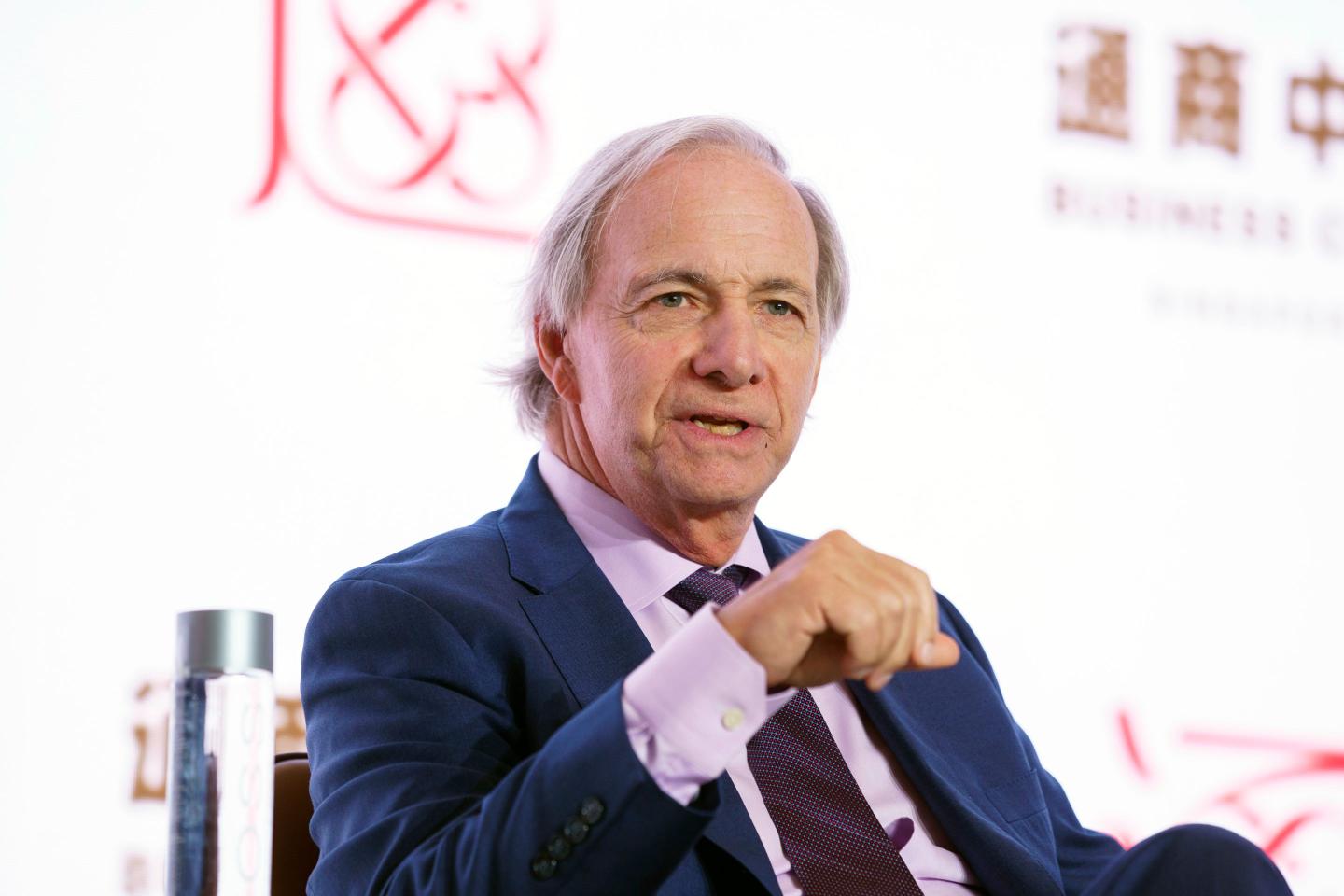
Ray Dalio, founder of Bridgewater Associates
Ray Dalio, founder of Bridgewater AssociatesOre Huiying—Bloomberg/Getty Images
Add Fortune on Google for similar content.
  • Ray Dalio urged investors to allocate around 15% of their portfolios to gold, calling it a strong hedge against credit-dependent assets and a key protector of real returns. Speaking at the Greenwich Economic Forum, the Bridgewater Associates founder said the metal’s surge reflects a global shift away from debt assets and fiat currencies, reminiscent of the 1970s. It comes after Citadel CEO Ken Griffin warned gold’s rally signals investor unease with U.S. sovereign risk and growing efforts to “de-dollarize.” Dalio linked the trend to rising global debt levels—especially America’s $37.8 trillion burden—arguing that central banks’ increasing gold reserves highlight an ongoing “change in the monetary order.”

Usually investors look to buy the dip—and when it comes to gold, even the most minor of drops are few and far between. Yet as the asset spun to new record highs this week, Ray Dalio’s advice to speculators was to invest a substantial portion of their portfolio to the precious metal.

Recommended Video

Gold is traditionally seen as something of a safe harbor for investors: It is not tied to any one currency or nation, and has steadily increased in price over time. While it may not provide the mammoth returns of the equity markets or currency alternatives, its lower-risk status has earned it a corner in many investment portfolios.

As its price has rocketed this year—surging past $4,000 per troy ounce overnight—financial institutions have encouraged clients to consider their holdings. UBS chief investment officer, Mark Haefele, wrote last month that the bank maintained an “attractive view on gold” and recommended a mid-single-digit percentage allocation.

Dalio puts the weighting far higher than that, telling the Greenwich Economic Forum that allocations should be 15% of a portfolio.

“When you’re … doing your asset allocation, what is going to protect your real after-tax returns? So you do create that optimal mix—gold is a very excellent diversifier of the portfolio,” Dalio told his audience. “So if you were to look just from the strategic asset allocation mix perspective, you would probably have something like—as the optimal mix—something like 15% of your portfolio in gold because … it is the one asset that does very well when the typical parts of your portfolio go down, because the typical parts of your portfolio are so credit dependent.”

Dalio’s stance is precisely the notion which Citadel CEO Ken Griffin described as “concerning” this week. Speaking during a Citadel Securities conference, the hedge fund titan warned the spike in gold prices was a clear signal that investors are moving risk out of the U.S.

He explained: “So we’re seeing substantial asset inflation away from the dollar as people are looking for ways to effectively de-dollarize or de-risk their portfolios vis-à-vis U.S. sovereign risk,” Griffin explained. “That’s what’s really concerning to me.”

Additionally, foreign investors are hedging the returns from their U.S. equities in their own currency, added Griffin, a “bifurcation of: ‘I’m going to bet on American business, but I wanna immunize some of my sovereign exposure to the United States.’”

This is precisely Dalio’s argument for investors, he said, arguing he would favor a tilt toward gold “more than what would be a normal allocation risk” because he doesn’t like debt assets: government debt but also credit or private credit.

A return to the 1970s

Dalio said this flight to gold—not only by individual investors but also by central banks—is reminiscent of the 1970s when the economy experienced “changes in the monetary order.”

This reshuffling of currency power boils down to an issue Dalio has raised the alarm on many times: national debt.

Economists around the world are concerned about the various debt levels of advanced nations. While France and the U.K. are raising eyebrows, America’s fiscal trajectory is garnering the most attention given the potential global fallout if investors begin to back out of buying U.S. debt, a.k.a. bonds.

At present, U.S. debt stands at $37.8 trillion, with a debt-to-GDP ratio of 125%. It is this latter figure that has economists concerned; they worry that the ratio will one day fall so far out of balance that the buyers of debt either demand even higher interest, or refuse to buy the debt entirely. Either way, the U.S. would be left with paying out even higher rates to service their debt, or will have to radically cut back spending to balance its books.

With this context in mind, Dalio said gold is looking all the more attractive on a global scale: “You’re seeing a dynamic of why countries are letting their reserves or their assets in bonds and so on go down, and they’re acquiring—and have been acquiring—gold, for example. Gold is a currency. We think of currencies of being fiat currency, the major fiat currency, but gold is a currency.

“It’s the second-largest reserve currency, and so you’re seeing changes in the monetary order that are reflecting those things, somewhat like what happened in the early ’70s.”

Subscribe to Fortune Gulf Brief. Every Tuesday, this new newsletter delivers clear-eyed, authoritative intelligence on the deals, decisions, policies, and power shifts shaping one of the world’s most consequential regions, written for the people who need to act on it. Sign up here.
About the Author
Eleanor Pringle
By Eleanor PringleSenior Reporter, Economics and Markets
LinkedIn icon

Eleanor Pringle is an award-winning senior reporter at Fortune covering news, the economy, and personal finance. Eleanor previously worked as a business correspondent and news editor in regional news in the U.K. She completed her journalism training with the Press Association after earning a degree from the University of East Anglia.

See full bioRight Arrow Button Icon
Add Fortune on Google for similar content.

Latest in Economy

Finance
Lorem ipsum dolor sit amet, consectetur adipiscing elit, sed do eiusmod tempor incididunt ut labore et dolore magna aliqua. Ut enim ad minim veniam
By Fortune Editors
October 20, 2025
Finance
Lorem ipsum dolor sit amet, consectetur adipiscing elit, sed do eiusmod tempor incididunt ut labore et dolore magna aliqua. Ut enim ad minim veniam
By Fortune Editors
October 20, 2025
Finance
Lorem ipsum dolor sit amet, consectetur adipiscing elit, sed do eiusmod tempor incididunt ut labore et dolore magna aliqua. Ut enim ad minim veniam
By Fortune Editors
October 20, 2025
Finance
Lorem ipsum dolor sit amet, consectetur adipiscing elit, sed do eiusmod tempor incididunt ut labore et dolore magna aliqua. Ut enim ad minim veniam
By Fortune Editors
October 20, 2025
Finance
Lorem ipsum dolor sit amet, consectetur adipiscing elit, sed do eiusmod tempor incididunt ut labore et dolore magna aliqua. Ut enim ad minim veniam
By Fortune Editors
October 20, 2025
Finance
Lorem ipsum dolor sit amet, consectetur adipiscing elit, sed do eiusmod tempor incididunt ut labore et dolore magna aliqua. Ut enim ad minim veniam
By Fortune Editors
October 20, 2025

Most Popular

Finance
Lorem ipsum dolor sit amet, consectetur adipiscing elit, sed do eiusmod tempor incididunt ut labore et dolore magna aliqua. Ut enim ad minim veniam
By Fortune Editors
October 20, 2025
Finance
Lorem ipsum dolor sit amet, consectetur adipiscing elit, sed do eiusmod tempor incididunt ut labore et dolore magna aliqua. Ut enim ad minim veniam
By Fortune Editors
October 20, 2025
Finance
Lorem ipsum dolor sit amet, consectetur adipiscing elit, sed do eiusmod tempor incididunt ut labore et dolore magna aliqua. Ut enim ad minim veniam
By Fortune Editors
October 20, 2025
Finance
Lorem ipsum dolor sit amet, consectetur adipiscing elit, sed do eiusmod tempor incididunt ut labore et dolore magna aliqua. Ut enim ad minim veniam
By Fortune Editors
October 20, 2025
Finance
Lorem ipsum dolor sit amet, consectetur adipiscing elit, sed do eiusmod tempor incididunt ut labore et dolore magna aliqua. Ut enim ad minim veniam
By Fortune Editors
October 20, 2025
Finance
Lorem ipsum dolor sit amet, consectetur adipiscing elit, sed do eiusmod tempor incididunt ut labore et dolore magna aliqua. Ut enim ad minim veniam
By Fortune Editors
October 20, 2025
Fortune Secondary Logo
Rankings
  • 100 Best Companies
  • Fortune 500
  • Global 500
  • Fortune 500 Europe
  • Most Powerful Women
  • World's Most Admired Companies
  • See All Rankings
  • Lists Calendar
Sections
  • Finance
  • Fortune Crypto
  • Features
  • Leadership
  • Health
  • Commentary
  • Success
  • Retail
  • Mpw
  • Tech
  • Lifestyle
  • CEO Initiative
  • Asia
  • Politics
  • Conferences
  • Europe
  • Newsletters
  • Personal Finance
  • Environment
  • Magazine
  • Education
Customer Support
  • Frequently Asked Questions
  • Customer Service Portal
  • Privacy Policy
  • Terms Of Use
  • Single Issues For Purchase
  • International Print
Commercial Services
  • Advertising
  • Fortune Brand Studio
  • Fortune Analytics
  • Fortune Conferences
  • Business Development
  • Group Subscriptions
About Us
  • About Us
  • Press Center
  • Work At Fortune
  • Terms And Conditions
  • Site Map
  • About Us
  • Press Center
  • Work At Fortune
  • Terms And Conditions
  • Site Map
  • Facebook icon
  • Twitter icon
  • LinkedIn icon
  • Instagram icon
  • TikTok icon
  • YouTube icon

Latest in Economy

j
AINvidia
Nvidia, Microsoft lead call for open-weight AI models after Kimi
By Michael Shepard and BloombergJuly 24, 2026
2 hours ago
Trump’s latest import taxes could set a precedent for a ‘broad tariff generator’ on anything a president wants to target, expert warns
LawTariffs
Trump’s latest import taxes could set a precedent for a ‘broad tariff generator’ on anything a president wants to target, expert warns
By Jason MaJuly 24, 2026
2 hours ago
Wealthy man in car
SuccessMillionaires
120 millionaires have signed a letter begging the British government to tax them more: ‘We can afford it’
By Emma BurleighJuly 24, 2026
4 hours ago
shop
EnergyInflation
Oil at $100 is pushing up costs from gas pumps to grocery aisles
By Cathy Bussewitz, Mae Anderson, Anne D'Innocenzio and The Associated PressJuly 24, 2026
7 hours ago
Inside Larry Culp’s playbook for fixing GE
NewslettersCFO Daily
Inside Larry Culp’s playbook for fixing GE
By Sheryl EstradaJuly 24, 2026
8 hours ago
tim
Commentarysmartphones and mobile devices
NYU Stern pricing expert: There’s a hidden ‘AI tax’ hitting Apple, Dell — and your next phone
By Srikanth JagabathulaJuly 24, 2026
8 hours ago

Most Popular

Jensen Huang made his $172 billion fortune on AI chips. His family's $75 million gift to Vanderbilt argues art decides what technology is for
Big Tech
Jensen Huang made his $172 billion fortune on AI chips. His family's $75 million gift to Vanderbilt argues art decides what technology is for
By Sydney LakeJuly 23, 2026
2 days ago
'The demographic dividend of the last 40 years is ending': J.P. Morgan says the world is running out of the two things that kept interest rates down
Economy
'The demographic dividend of the last 40 years is ending': J.P. Morgan says the world is running out of the two things that kept interest rates down
By Eleanor PringleJuly 24, 2026
12 hours ago
The $39 trillion U.S. national debt isn’t as high as Japan’s and Singapore’s relative to economy size—and yet it's still worse somehow
Economy
The $39 trillion U.S. national debt isn’t as high as Japan’s and Singapore’s relative to economy size—and yet it's still worse somehow
By Sasha RogelbergJuly 23, 2026
1 day ago
The millennial generation has split, new Fed research shows: Those over 35 are edging toward boomer-style wealth, while everyone else falls behind
Real Estate
The millennial generation has split, new Fed research shows: Those over 35 are edging toward boomer-style wealth, while everyone else falls behind
By Nick LichtenbergJuly 22, 2026
2 days ago
Spain lifted the World Cup, but the IRS still gets a cut of its $50 million pay day as players, coaches and refs all face complex U.S. “jock taxes”
Personal Finance
Spain lifted the World Cup, but the IRS still gets a cut of its $50 million pay day as players, coaches and refs all face complex U.S. “jock taxes”
By Joshua HongJuly 23, 2026
2 days ago
Current price of oil as of July 23, 2026
Personal Finance
Current price of oil as of July 23, 2026
By Joseph HostetlerJuly 23, 2026
1 day ago

© 2026 Fortune Media IP Limited. All Rights Reserved. Use of this site constitutes acceptance of our Terms of Use and Privacy Policy | CA Notice at Collection and Privacy Notice | Do Not Sell/Share My Personal Information
FORTUNE is a trademark of Fortune Media IP Limited, registered in the U.S. and other countries. FORTUNE may receive compensation for some links to products and services on this website. Offers may be subject to change without notice.