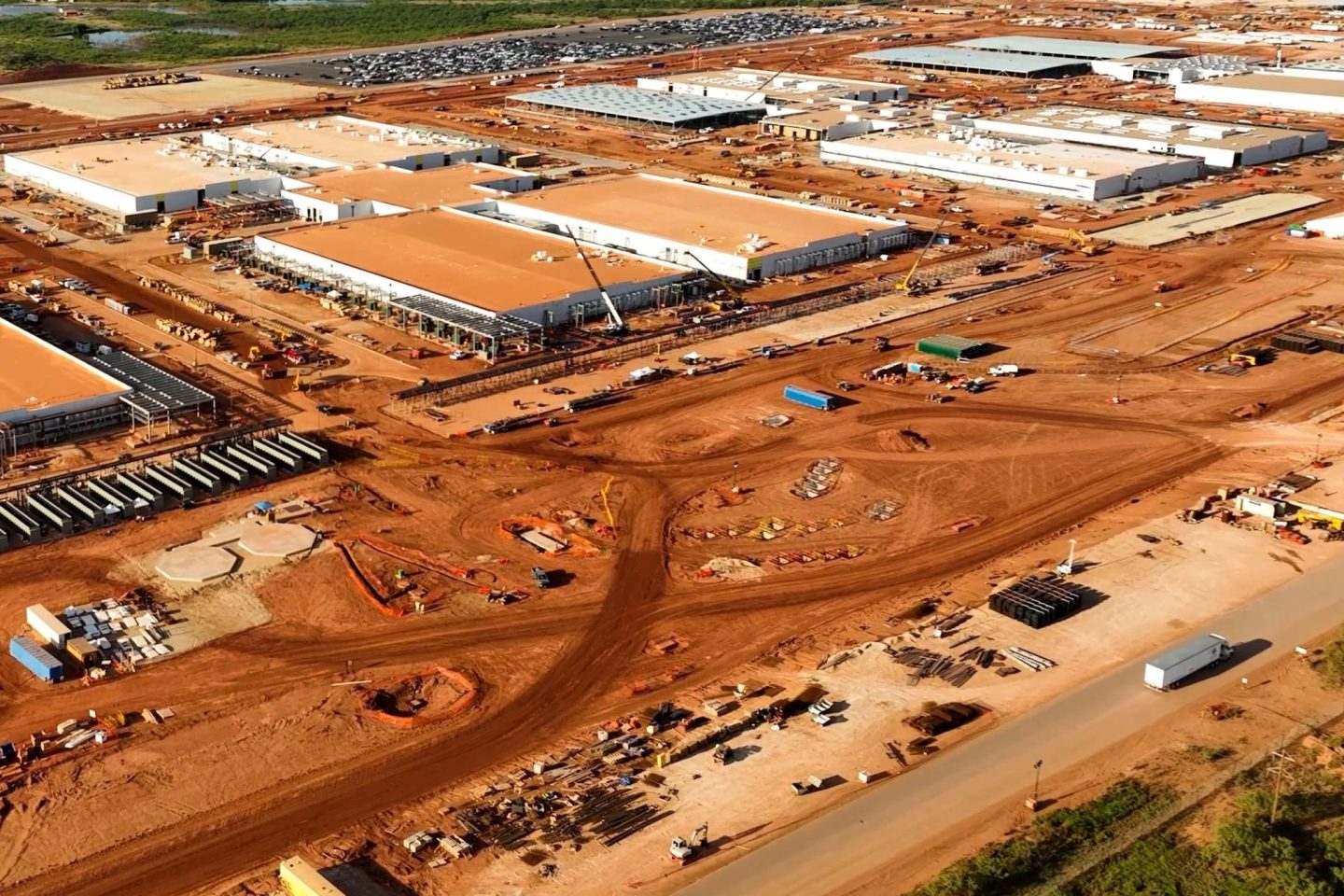
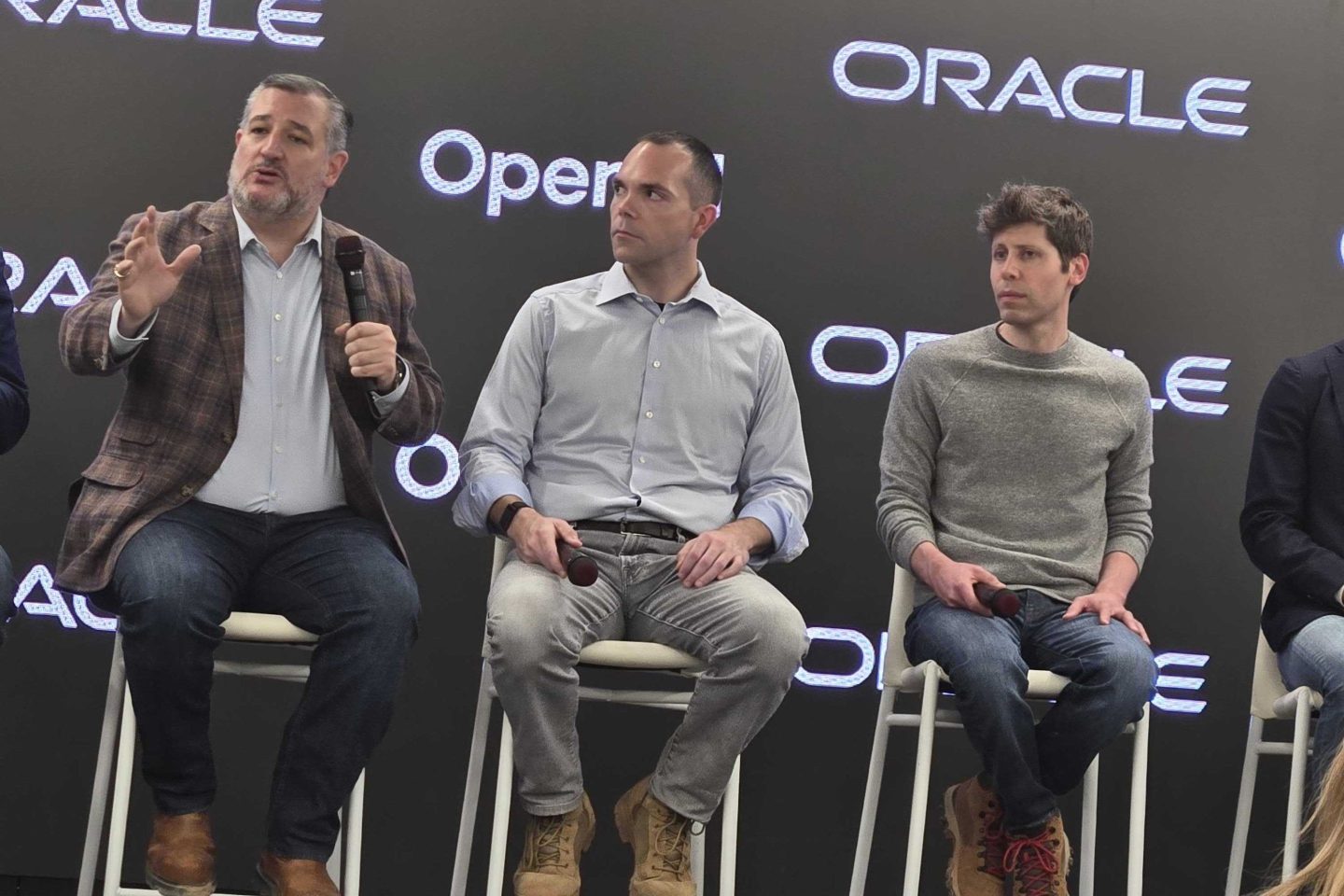
In Abilene, Texas—in the heart of what locals call the Big Country, long defined by ranching, farming, shale oil exploration, and now dotted with wind turbines—OpenAI and Oracle staged a carefully crafted media showcase on Tuesday to talk about the latest boom underway. Throngs of journalists from across the country were escorted by police to a half-completed 800-acre data center complex, guided through halls packed with tens of thousands of state-of-the-art Nvidia GPUs, and greeted by the company CEOs and by policymakers including Texas Senator Ted Cruz.
The event was a victory lap of sorts, as OpenAI CEO Sam Altman and Oracle’s new co-CEO Clay Magouryk pushed back against critics who have questioned the progress of their high-profile and ambitious “Stargate” AI infrastructure project.
At Tuesday’s event, the two companies, joined by Japan’s SoftBank, announced a big step forward for Stargate, touting an expansion of the Abilene site, as well as plans to build five massive, new data center complexes across the U.S. over the next several years. Altogether, the initiative calls for hundreds of billions of dollars of investment in a project of a mind-boggling scale. In Abilene alone, a crew of 6,400 workers have already moved massive amounts of soil to flatten the hills, and laid down enough fiber optic cable to wrap the Earth 16 times.
“We cannot fall behind in the need to put the infrastructure together to make this revolution happen,” OpenAI’s Altman said during a Q&A with reporters. “What you saw today is just like a small fraction of what this site will eventually be, and this site is just a small fraction or building, and all of that will still not be enough to serve even the demand of ChatGPT,” he said, referring to OpenAI’s flagship AI product.
The buildout attests to the towering expectations surrounding AI, as tech companies like OpenAI, Alphabet, Microsoft, and Meta race to put in place the infrastructure necessary to power their latest large language models. In July, Meta CEO Mark Zuckerberg said the company would spend hundreds of billions of dollars building a network of data centers with names like Prometheus and Hyperion to create “superintelligence.”
Abilene, as well as the newly-announced data centers, are all part of the Stargate project, a half-trillion-dollar joint initiative that OpenAI unveiled in January that aims to create a nationwide backbone for training its ever-larger AI models. Stargate has been touted as a public–private partnership with the Trump administration—part of a bid to keep AI compute infrastructure in the U.S. and push projects past regulatory hurdles.
“Message number one: America will beat China in the race for AI,” Texas Senator Ted Cruz proclaimed at the event.
Other guests and speakers included Congressman Jodey Arrington, and local dignitaries including the mayor of Abilene and even a county judge. Each emphasized Texas’ appeal as a hub for AI infrastructure. “Sam, Clay, welcome to Silicon Prairie,” Arrington said on stage, referring to the CEOs of OpenAI and Oracle.
The five new Stargate projects—in Texas, New Mexico, Ohio, and in an undisclosed Midwest location—will bring Stargate’s current pipeline to nearly 7 gigawatts and more than $400 billion in investment over the next three years. In the data center world, “gigawatts” are shorthand for how much electricity a facility can draw—and therefore how much AI compute it can deliver. A 1-gigawatt facility, for instance, requires enough substations, cooling, and transmission to sustain the power demand of nearly a million homes.
Until recently, the data center facilities owned and operated by the largest cloud computing companies—the so-called hyperscalers—topped out at a few hundred megawatts. But Microsoft and Meta have recently unveiled multi-gigawatt projects in Wisconsin and Louisiana.
And in a sign of the ever-increasing stakes in AI arms race, OpenAI and its partners promised Tuesday to reach a 10-gigawatt, $500 billion target by the end of 2025—ahead of schedule. Oracle pointed out that the campus in Abilene, Texas is already up and running on Oracle Cloud Infrastructure (OCI), continues to progress rapidly, and is on track to provide OpenAI with the “world’s largest supercluster” when fully built.
A network of gigawatt data centers
Tuesday’s announcement included an expansion in Abilene on another site which will draw 600 megawatts—enough to power roughly 450,000–600,000 homes’ worth of electricity demand, which is about four times the actual population of Abilene. The new projects—in Texas, New Mexico, Ohio, and in an undisclosed Midwest location—will bring Stargate’s current pipeline to nearly 7 gigawatts and more than $400 billion in investment over the next three years.
Three of the new sites will be built with Oracle, expanding a July deal to develop up to 4.5 gigawatts of capacity worth more than $300 billion over five years. Two others — in Lordstown, Ohio, and Milam County, Texas — will be developed with SoftBank, which has promised “fast-build” facilities that can scale quickly to multiple gigawatts. The five sites emerged from a January site-selection contest that drew more than 300 proposals from 30 states, underscoring how aggressively local governments courted the Stargate project.
But Stargate’s expansion is certain to draw criticism on multiple fronts. In Abilene and other communities hosting mega AI data centers, residents and activists worry about the trade-offs: billions in tax abatements, the risk of gas-fired generation worsening local air quality, and the likelihood that permanent jobs will number far fewer than the headlines suggest. National energy analysts, meanwhile, warn that multi-gigawatt campuses could strain fragile power grids and lock in huge new demands for water and fossil fuels at a time when utilities are already struggling to keep up with AI’s growth.
For example, the planned Stargate site in Dona Ana County, New Mexico has garnered mixed reactions, with opponents raising concerns about water usage and pollution, arguing these issues outweigh the economic benefits. According to a county presentation, the project will bring 800 permanent jobs and 2,500 construction jobs over three years.
The Stargate plans were unveiled amid ongoing debate about whether overheated expectations about AI were creating an industry bubble that will eventually burst. Asked about the risk, Altman said that he fully expects there will be “booms and busts” related to AI. But, he said, “over the arc that we have to plan over, we are confident that this technology will drive a new way of unprecedented economic growth, and not just economic growth, but people’s lives much better.”
The day before the event, Nvidia, the leading AI chipmaker, pledged to invest up to $100 billion into OpenAI’s infrastructure. Under the terms of letter of intent announced on Monday, Nvidia will contribute GPU-powered systems capable of drawing up to 10 gigawatts of electricity — the equivalent demand of 7 to 10 million homes.
Citing the Nvidia deal at Tuesday’s event, Altman said the most significant piece of the announcement wasn’t just the new sites but the financing model behind them. Rather than paying billions for chips up front, OpenAI will be able to spread those costs over time as revenue scales.
“We can kind of like pay as we go, like what’s on cloud services,” he said. “The chips are a humongous percentage of the capex, and it’s harder for us to pay for that all up front, because our revenue comes in over the many months that customers run service among those chips. So that really helps projects like this.”
But when it came to OpenAI’s energy demands, Senator Ted Cruz cast the stakes in both geopolitical and local terms. “Texas is ground zero for AI,” he added. “What do you want when you’re building AI data centers? Number one, you want abundant, low-cost energy. Welcome to the great state of Texas.”